CSEIT172595| Received:15Sep 2017 | Accepted:05 Oct2017 | September-October-2017[(2)5: 553-558]
International Journal of Scientific Research in Computer Science, Engineering and Information Technology © 2017 IJSRCSEIT | Volume 2 | Issue 5 | ISSN : 2456-3307
553
Reduction of Inter-Symbol Interference using Artificial Neural
Network System in Multicarrier OFDM System
Jyoti Makkar1, *Dr. Himanshu Monga2, Silki Baglha3
1 M.Tech Scholar, ECE Department, J.C.D.M College of Engineering, Sirsa, Haryana, India
2 Professor, ECE Department, J.C.D.M College of Engineering, Sirsa Haryana, India
3
Assistant Professor,ECE Department, J.C.D.M College of Engineering, Sirsa Haryana, India
*Corresponding Author – Dr. Himanshu Monga
ABSTRACT
The work proposes Inter-Symbol Interference (ISI) reduction scheme, ISI is a major problem in Optical systems, which produces various types of non-linear distortions. So the implementation of OFDM system using Artificial Neural Network (ANN) scheme with M-QAM modulation technique is proposed and compared with the conventional OFDM system without using ANN. This proposed scheme is an implementation of Back-propagation (BP) algorithm over AWGN channels to achieve an effective ISI reduction in orthogonal frequency division multiplexing (OFDM) systems. Simulation results prove that ANN equalizer can further reduce ISI effectively and provide acceptable BER and better MSE plotcompared to the conventional OFDM system.
Keywords:OFDM, Artificial Neural Network (ANN), FFT, QAM, BER, ISI, MMSE
I.
INTRODUCTION
OFDM facilitates the possible growth of wireless communication for high quality multimedia services, high speed internet access, as well as data, video and voice transmission at higher rates. This multi-carrier modulation technique is limited to 4G mobile communication; it will also be implemented in the 5G communication system [1]. It also provides a possible solution to multipath frequency selective fading effect. However, the problem of ISI occurs due to causes of multipath propagation, dispersive, noisy and fading channels present in the original signal in OFDM system. If the ISI is not mitigated properly, then decision device may interpret the logic wrongly [2].
In this paper, ANN is proposed and implement after decoder of an OFDM system and this approach minimizes the error. Further, this proposed technique compares to conventional ISI reduction techniques.
The paper constitutes: Section II, which deals with relevant literature; Section III, proposed OFDM system description; ISI system model; Section IV, explains
about proposed methodology; Section V, gives simulation setup and results; Section VI, highlights conclusions and future scopes and Section VII, presents references.
II.
RELATED WORK
better performance under Rayleigh fading channel as compared to AWGN. In [10] presented a two-dimensional 9/12 modulation code to combat 2D ISI and achieve ~2Db gain as compared to without encoding modulation code. In [11] proposed unique word (UW) sequence which improved bandwidth efficiency, 15% throughput, and spectral efficiency 17% as compared to CP but CP-OFDM give better BER than UW-OFDM system. In [12] proposed two channel estimator in which MMSE estimator gives more complexity than the LS estimator but MMSE need low SNR and LS need high for better performance.
III.
BASIC OFDM SYSTEM MODEL
Any OFDM system consists of N subcarriers, suppose that the complex symbol ( ) is the signal point from the modulation signal constellation, which is modulated on the nth subcarriers and transmitted signal ( )
defined in [5] as follows:
( ) ∑ ( ) ( ) ( )
Where ⁄ , , is the interval of OFDM symbol, Is the symbol data period. To synthesize the above OFDM signal in equation (1) use Inverse Fast Fourier transforms (IFFT) which samples the ( ) signal with sample rate After IFFT the original time domain symbolic signal ( )given as below: ( ) * ( )+
( ) ∑ ( ) ( ⁄ )
( )
Where and ( )is the FFT length, baseband data sequence. To reduce, the ISI [6] inserted cyclic prefix, which extends the duration of symbols, which given below as:
( ) { ( ) ( ) ( )
Then fading channel with white Gaussian noise transmitted ( ) Signal and calculated the received signal ( )in the form below:
( ) ( ) ( ) ( ) ( )
Where, ( )is the response of impulse for selective fading channel and ( )is the AWGN. After, that signal ( ) transmits without using CP given as:
( ) * ( )+
( ) ∑ ( )
( )
( )
IV.
INTER-SYMBOL INTERFERENCE (ISI)
In band limited region, when the number of pulses is transmitted in succession, then these pulses will interfere with each other and hence receiver will not be interpreted the transmitted logic. Therefore, the BER in the receiver will increase. We can visualize inter-symbol interference (ISI) effect in “Fig. 1”.
Transmit signal delay by
ISI
Receive signal delay by
Figure1. Inter-Symbol Interference (ISI) effect
When then different symbol creates interference with each other as shown in above figure where T is the symbol time, Is the transmitted signal delay and Is the received signal delay. . If then this lead to inter-symbol interference (ISI) where is the delay spread. ISI is undesirable since it leads to distortion of the original transmitted signal, but if we can make this implies no ISI. The ISI channel described as:
( ) ( ) ( ) ( ) ( ) ( ) ( )
Where ( ) received symbol at time k, ( )
transmitted symbol at time k, ( ) is the previous transmitted symbol at k-1, ( ) is the noise signal. The past symbol ( )Interference with the present symbol ( ) and introduce ISI.
V.
PROPOSED METHODOLOGY
In this work, we have proposed an artificial neural network combined technique, which provides an ISI reduction in OFDM systems.
A. Proposed OFDM with ANN:
specified poly2trellis (171,133] matrix and provide
coded data. Matrix interleaving, block is employed to further restrict the burst error developed during transmission. The output of the interleaver is
coded output data is obtained. Further, a data converter is available, which converting the binary interleaving coded data into decimal format.
After that, M-QAM modulation scheme, the symbol values are generated. The proposed method provides better BER performance by (16, 64, and 256) QAM modulation schemes. This modulation value determines the number of bits (4, 6, and 8) per sub-carriers. Further, the pilot insertion concept introduced which adds data subcarrier values, 4 pilot symbols, and one DC subcarrier. Again, we take 64 points IFFT lengths that is equal to a number of carriers. The IFFT length, data subcarriers, pilot value and DC subcarrier also determine the guard band values. The 16 cyclic prefix lengths are inserted before the AWNG channel. CP means prefixing of symbols from the last part to front part. Here, the AWGN channel transmits original information data from transmitter to receiver. It adds some noise, which destroys the signal. This can only be rectified by the use of the ANN technique at the receiver side as shown in “Fig. 2”.
Figure2. Block diagram of proposed (OFDM-ANN) technique
B. Proposed Artificial Neural Network (ANN) Algorithm:
The artificial neural network implements after Viterbi decoder block of an OFDM system; it takes input from
an OFDM system and output set as a target value. ANN is an artificial intelligence method used to enhance the capacity of computer by sending human like intelligence. This proposed work depends on back-propagation (BP) algorithm, which sends signals in a forward direction, and propagate error in backward direction. The multilayer BP network shown in “Fig.3” and the Log-Sigmoid function in [8] given as below:
( )
( )
Hidden Layer Input Layer
Forward-Propagation
Output Layer
Backward-Propagation (BP) Figure3. Multilayer back-propagation network
Fig. 4 shows, the flowchart of ANN, which give Error, ( ) as the difference between the target (actual) value and expected value in [10] [14] as below:
( ) ( ) ( ) ( )
Start
Initialize Input Value Vector
, Output Value
Vector, Weight ... and
Bias Values
Set Number of Neuron in the Hidden Layer
Set Number of Iterations & Goal Error
Initialize Weight & Bias
Apply No. Of Iterations & Goal-Error Loop
Figure4. Flow chart of ANN algorithm MSE performances of an OFDM system.
Table -1 Parameters of OFDM system
Parameter Value
FFT size 64
Number of carriers 64 Single frame size 96bits Total number of frames 100
Cyclic-prefix 16
Modulation 16,64,256QAM
Table -2 Parameters of artificial neural networks
Parameter Value Number of inputs 2 Number of hidden layers 1 Number of neurons 90,1 results compare with the conventional OFDM system as shown in Table 3 & Table 4.
(1). BER performances of conventional OFDM systems with varying QAM Modulation schemes:
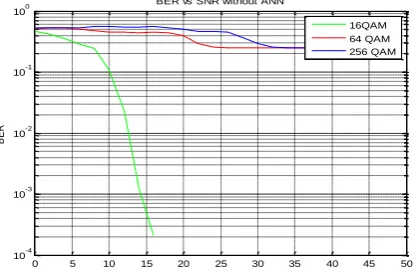
In “Fig.5”, the BER performance of conventional OFDM systems with varying 16, 64, 256 QAM modulation scheme was studied. It shows the highest BER at the lowest signal to noise ratio (SNR) of 0dB for 64 and 256QAM modulation scheme. After that,
with increasing the SNR at 9.9dB the BER will be decreased at 10^-1 sharply in the system by using the 16QAM modulation, but the other 64, 256 QAM modulation at 9.9dB gives highest 10^0 BER and does not tend to decrease. After SNR=15dB the BER in the system by using 16QAM modulation has little BER but the system with 64 and 256 QAM Modulation have high BER.
Figure5. Comparison between M-QAM BER of the conventional OFDM system
(2). BER performances of Proposed OFDM Systems with varying M-QAM Modulation schemes:
In “Fig.6”, the BER of proposed OFDM systems with different 16, 64, and 256 QAM modulation scheme is to be considered. After that, with increasing the SNR the BER tends to be decreased more in the system by using 16QAM modulation scheme. After SNR=20dB all of the three M-QAM modulation scheme provide little BER.
Figure6. Comparison between M-QAM BER of the proposed OFDM system
Table-3 shows the BER performance by varying signal to noise ratio. It shows that the proposed system provides lesser BER approximate (10^-9) in all M-QAM (16, 64, and 256) modulation scheme, but the conventional OFDM system provide highest BER (10^-4) in 16 QAM and (10^0) in 64 and 256 QAM modulation scheme.
(3). MSE performances of the Proposed OFDM Systems with varying QAM Modulation schemes:
Figure7. Comparison between M-QAM MSE of the proposed OFDM system
Table-4 MSE for Conventional and Proposed OFDM systems varying one thousand times the number of iterations. It shows that the Proposed OFDM with ANN under M-QAM modulation require minimum MSE as compare to conventional OFDM without ANN.
VII.
CONCLUSION AND FUTURE SCOPE
This paper proposed, Back-propagation (BP) based ANN channel estimator, which is further combine with OFDM system. This proposed combined technique provides better ISI reduction performance than an OFDM system without adding ANN. In this work, ISI is directly proportional to BER and inversely proportional to the SNR. The future scope of this paper is to apply ANN with MIMO-OFDM system or use of all other modulation technique.
VIII.
REFERENCES
[1]. R.van Nee, R. Prasad; "OFDM for Wireless Multimedia Communications" Artech House Publishers; Boston, 2000.
[2]. Z. Wang and G. B. Giannakis, Wireless multicarrier communications, IEEE Signal Processing Mag., pp. 29–48, May 2000.
[3]. D.M. Bappy, Ajoy Kumar Dey, Susmita Saha; "OFDM System Analysis for reduction of Inter symbol Interference Using the AWGN Channel Platform"; IJACS; Vol. 1, No. 5, November 2010.
[4]. Yang-Yang Chen, Zi-Wei Zheng; "Research on the Inter Symbol Interference Mitigation for the MIMO-OFDM Systems"; IEEE 2011.
[5]. Aida zaier1 and Ridha bouallègue; "a full performance analysis of channel estimation methods for time varying ofdm systems" ijmnct ;Vol. 1, no. 2, December 2011.
[6]. Usama S. Mohammed, Ahmed Tohamy; "A Low Complexity OFDM System with Minimum Inter-symbol Interference"; IEEE 2012.
[7]. Pragya Sharma;"Performance Analysis of Zero-Forcing Equalizer for ISI Reduction in Wireless Channels"; International Journal of Engineering Research & Technology; Vol. 1 Issue 8, October – 2012.
[8]. Amit goyal1, gurleen kaur walia2 and simranjeet kaur; "implementation of back propagation algorithm using MATLAB"; international journal of information technology and knowledge management; July-Dec 2012, volume 5, no. 2, pp. 429-431.
[9]. Prafulla. D. Gawande and Sirddharth. A. Ladhake; "BER Performance of OFDM system with cyclic prefix & zero padding";International Journal of Advances in Engineering & Technology; Mar. 2013.
[10]. Nirmalkumar S. Reshamwala1, Pooja S. Suratia, Satish K. Shah; "Artificial Neural Network trained by Genetic Algorithm for Smart MIMO Channel Estimation for Downlink LTE-Advance System"; I.J. Computer Network and modulation code"; IET Communication., 2016, Vol. 10, Issue 14, pp. 1730–1735.
[12]. Amevi Acakpovi, Abdul-Shakud Iddrisu, Nana Yaw Asabere and John Kwofie; "Performance Comparison of Cyclic Prefix OFDM and Unique Word OFDM in the LTE Downlink"; International Journal of Computer Science and Telecommunications; Volume 7, Issue 2, February 2016.
[13]. R Srinivasa Aditya Varma, Marthy Siva Sai Krishna; " Estimation of channel in an OFDM wireless channel using LS and MMSE techniques"; IJECET; Volume 7, Issue 3, May– June 2016, pp. 68–74.
[14]. Arne Bråten;"Data editing with Artificial Neural Networks"; December 1997.
AUTHORS PROFILE
Jyoti Makkar received B. Tech in
Electronics and Communication
Engineering from Eternal University, Baru Sahib, Himachal Pardesh in 2014. She is Currently pursuingM.Tech. in ECE department From Jan Nayak Chaudhary Devi Lal Lal Vidyapeeth, Sirsa, Haryana; India.Her research area is wirelesscommunication and OFDM technology.
Dr. Himanshu Monga Obtained PhD from Thapar Institute of Engineering and Technology, (TU) Department Of ECE, Patiala, Punjab, INDIA, in the field of Optical networks / coding and Wireless networks. He obtained his bachelor’s degree in Electronics & Communication Engineering from
Govt. Engineering College, Amravati University,
Maharashtra, India and Master’s degree in Electronics and Telecommunication Engineering & Masters degree in management in Human resource management. Presently he is presently working as Director/Principal in Jan Nayak Chaudhary Devi Lal Lal Vidyapeeth, Sirsa. Before this he served as Professor and Dean Research in Lovely Professional University, Phagwara, India. He has more than 95 Research papers in international/national conferences. Have more than 22 Thomson Reuter SCI publications to his credit. He has authored 04 Books/ chapters in renowned books. He successfully completed 06 projects worth Rs 70 Lacks and successfully completed many consultancy projects.
Silki Baghlais Assistant Professor in JCDM College of Engineering, Sirsa (Haryana, India). She has done his
Masters in Electronics and
Communication from IKG Punjab
![Fig. 4 shows, the flowchart of ANN, which give Error, ( ) as the difference between the target (actual) value and expected value in [10] [14] as below:](https://thumb-us.123doks.com/thumbv2/123dok_us/1021051.1126757/3.595.48.278.416.667/shows-flowchart-error-difference-target-actual-value-expected.webp)