Paragraph Acquisition and Selection for List Question Using Amazon’s
Mechanical Turk
Fang Xu and Dietrich Klakow
Spoken Language Systems Saarland University D-66123 Saarbr¨ucken, Germany {fang.xu, dietrich.klakow}@lsv.uni-saarland.de
Abstract
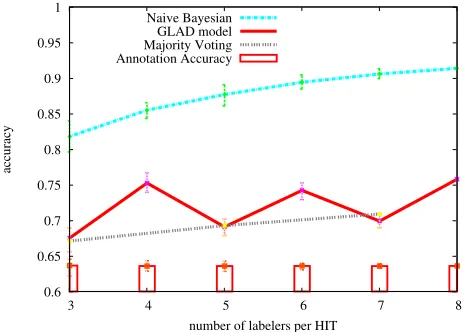
Creating more fine-grained annotated data than previously relevent document sets is important for evaluating individual components in automatic question answering systems. In this paper, we describe using the Amazon’s Mechanical Turk (AMT) to judge whether paragraphs in relevant documents answer corresponding list questions in TREC QA track 2004. Based on AMT results, we build a collection of 1300 gold-standard supporting paragraphs for list questions. Our online experiments suggested that recruiting more people per task assures better annotation quality. In order to learning true labels from AMT annotations, we investigated the influence of annotation accuracy and number of labels per HIT on the performance of those approaches. Experimental studies show that the Naive Bayesian model and EM-based GLAD model can generate results highly agreeing with gold-standard annotations, and dominate significantly over the majority voting method for true label learning. We also suggested setting higher HIT approval rate to assure better online annotation quality, which leads to better performance of learning methods.
1.
Introduction
The question answering (QA) is an important common task for the information retrieval (IR), information extraction (IE) and natural language processing (NLP) communities. TREC QA evaluation1 cover a broad range of techniques in those communities. Most QA systems’ architecture in TREC includes IR techniques to locate supporting para-graphs from relevant documents, and IE techniques involv-ing with syntactic or semantic processinvolv-ing to target exact an-swers from paragraphs. Comparing with documents, para-graphs reduce search granularity and provide compact con-text for pinpointing answers, and therefore serve as an im-portant intermediary between whole documents and exact answers. TREC QA only provided answer patterns and re-lated documents for yearly question sets, which are useful for evaluating the overall performance of QA systems, but for the evaluation of individual component in QA systems more compact and precise paragraphs are required. Cur-rently there is no such dataset of question-supporting texts for TREC list question task. The purpose of our work is to contribute to the development of QA systems by providing a new corpus, which include questions, answers and para-graphs which support their containing answer to the ques-tion. The application of IR, IE and NLP techniques in QA will all benefit from the fine-grained annotated dataset.
Question Answers
What countries have Albania, Argentina, IFC financed projects in? Bosnia, etc. 42 answers Where did Johnny Ohio, Indiana,
Appliseed plant trees? Pennsylvania. 3 answers
Table 1: Example of list questions1
1http://trec.nist.gov/data/qa.html
TREC QA proposed two fact-based short-answered tasks – factoid question and list question tasks. Factoid task re-quire one answer, while list task rere-quire to provide a list of distinct instances. As it shown in Table 1, the main challenge for the list task is to determine the number of instances to return. Kaisser et al. (2008) collected the cor-pus of supporting sentences for factoid questions via Ama-zon Mechanical Turk (AMT) 3. In contrast to expensive and time-consuming relevance judgement by very few as-sessors (Voorhees and Harman, 2005), AMT offers a web-based solution to quickly and cheaply annotate supporting compact excerpt in the question-relevant documents. Our work is not only to construct the corpus of supporting para-graphs for list task, but also to investigate and compare various methods to select true annotations and improve the quality of data from AMT results.
We conduct the data collection in following steps: data generation, online annotation and automatic selection of true annotations. In the following sections, we first in-troduce the usage of AMT and the control of data qual-ity by build-in functionalities from AMT. We then describe three methods to learn the true annotations from AMT data. Finally we summarize the related work and pro-posed future works. The ListQA corpus can be downloaded
fromwww.lsv.uni-saarland.de.
2.
Experiment Design
2.1. Mechanical Turk
AMT is a web-based marketplace where requesters design and publish their work as micro HITs (Human Intelligence Tasks) to be done by multiple workers concurrently. With a large group of people working on HITs, requesters can get results very fast with very low cost. Major categories of
1TREC 2004 answer sets are in http://trec.nist.
HITs include “catalogue and data management, search op-timization, database creation and content management”4. AMT provides the web interface, command line tools and developer API, so that requesters can choose their favourite way of creating, publishing and managing their HITs. One HIT consists of one or more assignments. The requester can set desired number of assignments and download results of all HITs in different formats. AMT-registered online work-ers can preview and work on HITs, and then get paid by requesters.
2.2. Data and Experiment Setup
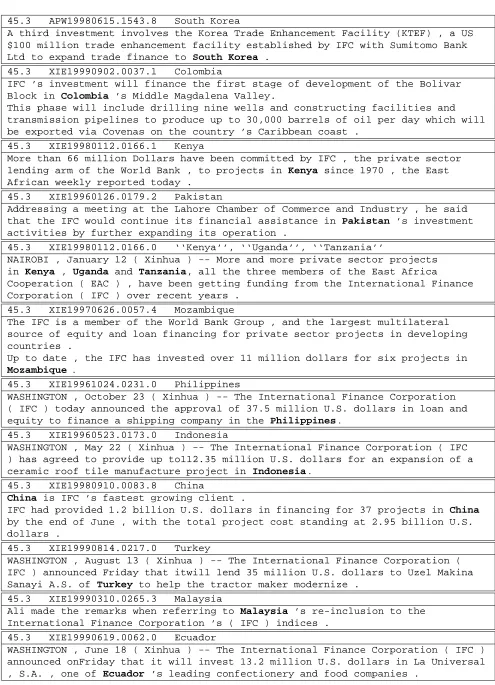
Table 2 shows an example of answer patterns (regular ex-pressions) and linked document IDs for questions provided by TREC. To construct supporting paragraph candidates, first we use built-in paragraph boundary tags to split each documents into successive paragraphs. Then those pas-sages matching given patterns are selected as paragraph candidates. Given that the result of pattern matching is very noisy and coarse, we created HITs to recruit people to make binary decisions on whether each paragraph sup-ports its containing answer(s) to the corresponding ques-tion or not. We generate 2856 quesques-tion-paragraph pairs for TREC 2004. To reduce the number of HITs and control the budget, every HIT contains 2 question-paragraph pairs and costs $0.02.
Question What countries have IFC financed projects in? Pattern Sri LankankSri Lanka
Doc. IDs XIE19981108.0129, XIE19990506.0269, XIE19981101.0083
Table 2: Example of answer pattern and linked documents
2.3. Data Quality Control
Requesters can use HIT approval rate5to control the qual-ity of work. At the initial run, we set the rate more than 95 (frequent threshold) and recruited 3 workers per HIT. We found the result (Dataset A) very noisy, with the annotation accuracy 6 of 49.37%. To minimize the negative effects from the diverse workers’ expertise and spam workers, we therefore increase the approval rate to more than 98 and re-cruited 5 workers per HIT, and the final AMT results are exported as Dataset B.
Based on AMT results, we manually created the gold-standard annotations to evaluate the quality of work. Among the gold-standard 2856 paragraphs, 1300 para-graphs completely support their containing answer(s) to the given question, while rest 1556 paragraphs are irrelevant or partially relevant to the questions.
Table 3 shows the annotation accuracy of Dataset B, compared with A, increases by 24.40%, from 49.37% to
4https://requester.mturk.com/mturk/
resources
5
The proportion of a worker’s submitted HITs that have been approved.
6
The proportion of assignments that are correctly judged by workers according to gold-standard annotations.
Dataset A B
Approval Rate 95 98
Workers per HIT 3 5
Duration (hrs) 9.55 47.63
Annotation Accuracy 49.37% 73.77%
Table 3: Comparison of Datasets exported from AMT
# of Agreed Workers # of HITs Dataset A
Two 1748 (61.20%)
Three 1108 (38.80%)
Dataset B
Three 1068(37.39%)
Four 1030 (36.06%)
Five 758 (26.54%)
Table 4: Inter Annotation Agreement
0 0.1 0.2 0.3 0.4 0.5 0.6 0.7 0.8 0.9 1
0 500 1000 1500 2000
Accuracy
Number of Completed Paragraphs Dataset A
0 0.1 0.2 0.3 0.4 0.5 0.6 0.7 0.8 0.9 1
0 500 1000 1500 2000
Accuracy
Number of Completed Paragraphs Dataset B
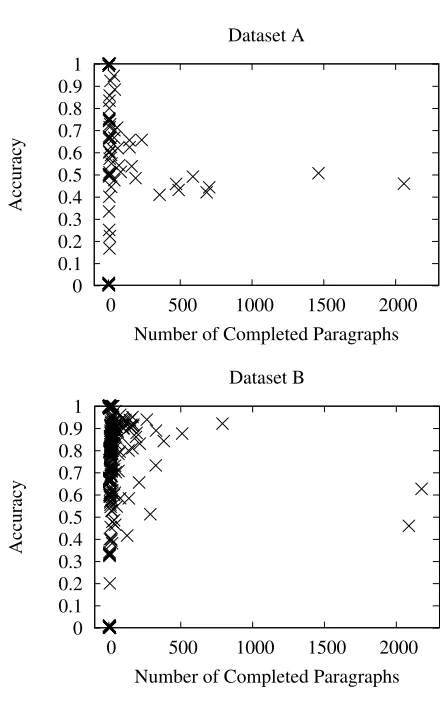
Figure 1: Individual workers’ accuracy vs. # Paragraphs they completed.
NAACL9and Coling10aim at promoting wide and creative use of AMT in various domains. Several works have ex-plored the effectiveness of using AMT for resources anno-tation and performance evaluation.
Snow et al.(2008) thoroughly reviewed works of annota-tion collecting via AMT, empirically examined 5 natural language processing tasks and proposed a technique for im-proving annotation quality. Callison-Burch (2009) showed that AMT can be for complex tasks suh as creating multi-ple reference translations and reading comprehension tests. Both papers domonstrated that although AMT labelers are often individually less reliable and stable, non-expert la-belers in aggregation can produce judgements highly agree with gold-standard experts.
For the search evaluation, Kaisser et al. (2008) launched a survey via AMT on customizing the summary length of search results. Studies on AMT results suggest that search results best presented different lengths of summary snippets for different types of queries. Alonso et al. (2009) evalu-ated the quality of search results produced by their time-based clustering algorithm combined with temporal snip-pets.
Previous efforts at QA corpus construction focus on anno-tating more precise annotated data. Kaisser et al. (2008) constructed a corpus of question-sentence pairs for the TREC factoid question and employed experts to further cleaned the corpus and tagged how sufficiently a sentence supports its question. To create a Why QA corpus, Morzin-ski et al. (2008) first asked workers to write a why question based on part of a Wikipedia article, then presented HITs to select answer sentences from the original articles, and in the final task workers paraphrased each question to provide variation of questions. In this paper, we collected corpus for the TREC list questions and further explored three methods to automatically boost the quality of corpus..
5.
Conclusion and Future Work
We constructed a new corpus of supporting paragraphs col-lections for list question in TREC QA 2004. We also in-vestigated how to control annotation quality through the functionality provided by AMT and suggested that recruit-ing more people per task along with settrecruit-ing higher HIT ap-proval rate assures better annotation quality. We compared three approaches of selecting accurate annotations in AMT results, and investigated the influence of mislabeling data and number of labelers per HIT on their performance. Ex-periments show that, with careful design of tasks and ap-propriate approaches to select true labels, high-quality la-bels can be automatically learned from AMT non-expert annotations. We also suggested that better online annota-tion quality leads to better performance of learning meth-ods.Furthermore, we will continue collecting supporting para-graphs for TREC 2005-2007 list questions. With a large collection of data, obvious areas for future work are para-graph retrieval and answer extraction for list questions.
9http://sites.google.com/site/
amtworkshop2010
10http://www.ukp.tu-darmstadt.de/
scientific-community/coling-2010-workshop
The question-paragraph corpus and AMT results is avail-able viawww.lsv.uni-saarland.de.
Acknowledgements
Thanks to Matt Lease, Omar Alonso, and Grzegorz Chrupała for enlightening discussions and comments. Fang Xu was funded by the German research council DFG through the Partnership for Re-search and Education “PIRE” on the International ReRe-search Train-ing Group “IRTG” grant.
6.
References
Omar Alonso, Michael Gertz, and Ricardo Baeza-Yates. 2009. Clustering and Exploring Search Results Using Timeline Constructions. In Proceedings of CIKM, Hong Kong, China.
Chris Callison-burch. 2009. Fast, Cheap, and Creative: Evaluating Translation Quality Using Amazons Mechan-ical Turk. In Proceedings of EMNLP, Singapore. Michael Kaisser and John B. Lowe. 2008. Creating a
Re-search Collection of Question Answer Sentence Pairs with Amazon’s Mechanical Turk. In Proceedings of International Conference on Language Resources and Evaluation, LREC, Marrakech, Morocco.
Michael Kaisser, Marti A. Hearst, and John B. Lowe. 2008. Improving search results quality by customizing sum-mary lengths. In Proceedings of ACL-08: HLT, pages 701–709, Columbus, Ohio, June. Association for Com-putational Linguistics.
Joanna Mrozinski, Edward Whittaker, and Sadaoki Furui. 2008. Collecting a Why-Question Corpus for Develop-ment and Evaluation of an Automatic QA-system. In Proceedings of ACL-08: HLT, pages 443–451, Colum-bus, Ohio, USA.
Rion Snow, Brendan O Connor, Daniel Jurafsky, and An-drew Y Ng. 2008. Cheap and Fast – But is it Good? Evaluating Non-Expert Annotations for Natural Lan-guage Tasks. In Proceedings of ACL-08:HIT, Columbus, Ohio, USA.
E. Voorhees and D. Harman. 2005. Trec experiment and evaluation in information retrieval. MIT Press, MA, USA.
45.3 APW19980615.1543.8 South Korea
A third investment involves the Korea Trade Enhancement Facility (KTEF) , a US $100 million trade enhancement facility established by IFC with Sumitomo Bank Ltd to expand trade finance to South Korea .
45.3 XIE19990902.0037.1 Colombia
IFC ’s investment will finance the first stage of development of the Bolivar Block in Colombia ’s Middle Magdalena Valley.
This phase will include drilling nine wells and constructing facilities and transmission pipelines to produce up to 30,000 barrels of oil per day which will be exported via Covenas on the country ’s Caribbean coast .
45.3 XIE19980112.0166.1 Kenya
More than 66 million Dollars have been committed by IFC , the private sector lending arm of the World Bank , to projects in Kenya since 1970 , the East African weekly reported today .
45.3 XIE19960126.0179.2 Pakistan
Addressing a meeting at the Lahore Chamber of Commerce and Industry , he said that the IFC would continue its financial assistance in Pakistan ’s investment activities by further expanding its operation .
45.3 XIE19980112.0166.0 ‘‘Kenya’’, ‘‘Uganda’’, ‘‘Tanzania’’
NAIROBI , January 12 ( Xinhua ) -- More and more private sector projects in Kenya , Uganda and Tanzania, all the three members of the East Africa
Cooperation ( EAC ) , have been getting funding from the International Finance Corporation ( IFC ) over recent years .
45.3 XIE19970626.0057.4 Mozambique
The IFC is a member of the World Bank Group , and the largest multilateral source of equity and loan financing for private sector projects in developing countries .
Up to date , the IFC has invested over 11 million dollars for six projects in
Mozambique .
45.3 XIE19961024.0231.0 Philippines
WASHINGTON , October 23 ( Xinhua ) -- The International Finance Corporation ( IFC ) today announced the approval of 37.5 million U.S. dollars in loan and
equity to finance a shipping company in the Philippines.
45.3 XIE19960523.0173.0 Indonesia
WASHINGTON , May 22 ( Xinhua ) -- The International Finance Corporation ( IFC ) has agreed to provide up to112.35 million U.S. dollars for an expansion of a
ceramic roof tile manufacture project in Indonesia.
45.3 XIE19980910.0083.8 China
China is IFC ’s fastest growing client .
IFC had provided 1.2 billion U.S. dollars in financing for 37 projects in China by the end of June , with the total project cost standing at 2.95 billion U.S. dollars .
45.3 XIE19990814.0217.0 Turkey
WASHINGTON , August 13 ( Xinhua ) -- The International Finance Corporation ( IFC ) announced Friday that itwill lend 35 million U.S. dollars to Uzel Makina Sanayi A.S. of Turkey to help the tractor maker modernize .
45.3 XIE19990310.0265.3 Malaysia
Ali made the remarks when referring to Malaysia ’s re-inclusion to the International Finance Corporation ’s ( IFC ) indices .
45.3 XIE19990619.0062.0 Ecuador
WASHINGTON , June 18 ( Xinhua ) -- The International Finance Corporation ( IFC ) announced onFriday that it will invest 13.2 million U.S. dollars in La Universal , S.A. , one of Ecuador ’s leading confectionery and food companies .