Reclassifying subcategorization frames for experimental analysis and stimulus
generation
Paula Buttery
1, Andrew Caines
21University of Cambridge, 9 West Road, Cambridge CB3 9DP, U.K.
2European Bioinformatics Institute, Wellcome Trust Genome Campus, Hinxton CB10 1SD, U.K. [email protected], [email protected]
Abstract
Researchers in the fields of psycholinguistics and neurolinguistics increasingly test their experimental hypotheses against probabilistic models of language. VALEX (Korhonen, Krymolowski & Briscoe, 2006) is a large-scale verb lexicon that specifies verb usage as probability distributions over a set of 163 verbSUBCATEGORIZATION FRAMES(SCFs). VALEX has proved to be a popular computational linguistic resource and may also be used by psycho- and neurolinguists for experimental analysis and stimulus generation. However, a probabilistic model based upon a set of 163 SCFs often proves too fine grained for experimenters in these fields. Our goal is to simplify the classification by grouping the frames into genera---explainable clusters that may be used as experimental parameters. We adopted two methods for re-classification. One was a manual, linguistic approach derived from verb argumentation and clause features; the other was an automatic, computational approach driven from the graphical representation of SCFs for use in Natural Language Processing technology. The premise was not only to compare the results of two quite different methods for our own interest, but also to enable other researchers to choose whichever re-classification better suited their purpose (one being grounded purely in theoretical linguistics and the other in practical language engineering). The various classifications are available as a free online resource to researchers.
Keywords:Verb classification, Experiment design, Cognitive modelling
1.
Introduction
1.1. Overview
We describe a dual-approach re-classification of the widely-used verb SUBCATEGORIZATION FRAME (SCF) types which were defined by Briscoe and Carroll (Briscoe & Car-roll, 1997; Briscoe, 2000). This is a set of 163 frames which describe verbs and their argument structures, ranging from the straightforward subject-verb intransitive (Frame 22, ‘she reads’) to more complex clauses involving extraposition, clausal complements, etc.
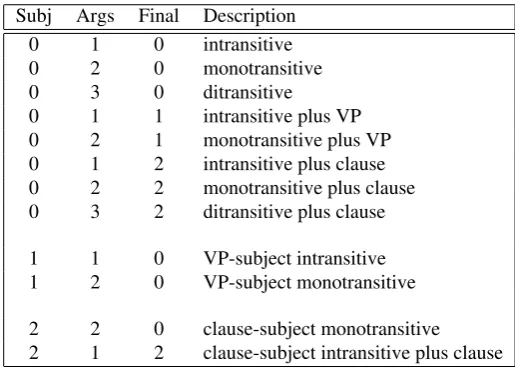
A linguistic method for re-classification reduces the 163 SCFs into 12 clusters based on simple linguistic properties. These clusters are each considered a SCF genus and are pre-sented in Table 1. A second, graphical method derives from Briscoe and Carroll’s description of the SCFs as directed graphs of grammatical relations between words. Several tax-onomies are produced over varying degrees of specificity of these graphs.
1.2. Motivation
Our input set of SCFs comes from Briscoe and Carroll’s amalgamation of the frames which feature in the Alvey NL Tools (ANLT; Boguraev et al, 1987) and COMLEX Syntax dictionaries (Grisham, Macleod & Meyers, 1994). Briscoe and Carroll originally listed 160 SCFs (1997: 357). Briscoe later extended the list to 163 in an unpublished manuscript (2000).
In the field of computational linguistics this set of SCFs has been employed in the development of several natural lan-guage processing algorithms; for instance in the automatic identification of diathesis alternations (McCarthy, 2001). The SCFs have also been used to extend VerbNet with novel verb classes (Kipper et al., 2006) and to supplement Levin’s
verb class taxonomy (cf. Levin, 1993; Korhonen & Briscoe 2004). The lexical resource VALEX (a popular, automati-cally derived, large-scale verb lexicon) specifies verb usage as probability distributions over this set of 163 SCFs (Ko-rhonen, Krymolowski & Briscoe, 2006).
Recently these SCFs have been integrated into cognitive models. For instance, in order to build more accurate mod-els of first language acquisition, distributions of these SCFs have been to used describe changes in child language (But-tery, 2006). The SCFs have also been used to explain ex-perimental findings within psycholinguistics (e.g. Devereux, Korhonen & Tyler, 2011) and neurolinguistics (e.g. Bozic et al., 2011).
The SCFs are extremely fine-grained, reflecting the many complexities and subtleties of verb argumentation. Some frames necessarily differ by as little as the presence or ab-sence of a direct object (cf. Frame 123, ‘it cost ten pounds’, and Frame 124, ‘it cost him ten pounds’), or the use of a particle in the verb phrase: Frame 125, ‘it set him back ten pounds’.1
For researchers in psycholinguistics and neurolinguistics, ex-perimental hypotheses are increasingly being tested against probabilistic models of language. However, a probabilis-tic model based upon a set of 163 SCFs often proves too fine grained for experimenters in these fields. For instance, when studying fMRI neuro-imaging data (where temporal quantisation is crude compared to the functional operation of the brain) researchers would rather use a small number of broader conceptual parameters in their models. Our goal is to simplify the classification by grouping the frames into
1
genera---explainable clusters that may be used as experi-mental parameters.
We adopted two methods for re-classification. One was a manual linguistic approach derived from verb argumenta-tion and clause features; the other was an automatic, com-putational approach derived from the graphical represen-tations of the SCFs.2 The premise was not only to com-pare the results of two quite different methods for our own interest, but also to enable other researchers to choose whichever re-classification better suited their purpose (one being grounded purely in theoretical linguistics and the other in practical language engineering).
2.
Subcategorization frames
2.1. Argument vs. adjunct
Subcategorization frames relate to the demands made by verbs on the number and type of arguments they permit and require, including obligatory and optional arguments but
notadjuncts. Arguments are understood to be selected by the verb and complete its meaning. Adjuncts are optional and serve to extend the meaning of the central predication. The argument-adjunct ‘distinction’ is in fact a continuum with considerable grey area in the middle. Somers (1984), for one, describes a six-point adjunct-argument scale:
i, integral arguments
Jon doesn’t have a hope
ii, obligatory arguments
He beat me
iii, optional arguments
William drank lager
iv, middles
Vic worked in the garden
v, adjuncts
Harvey sat licking his paws
vi, extra-peripherals
Bobby can eat, as you know
Generally speaking, arguments of type i-iv are relevant to this work.
The set of 163 SCFs referred to in this paper are a superset of the SCFs found in the Alvey NL Tools (ANLT; Boguraev et al, 1987) and COMLEX Syntax dictionaries (Grisham, Macleod & Meyers, 1994). The COMLEX lexicographers distinguish adjuncts from arguments using a set of criteria and heuristics (Meyers, Macleod and Grisham 1994). For instance, they state that prepositional phrases headed byto
tend to be arguments, whereas PPs expressing time, manner, or place are mostly adjuncts. They also state that adjuncts occur with a large variety of verbs at a similar frequency whereas arguments occur with a high frequency with spe-cific verbs.
2
These graphs, which represent the grammatical relations be-tween lexical items within a SCF, are more generally utilised by Natural Language Processing technology
2.2. Argument valency
The examples in (1) demonstrate some of the ways that verbs vary in their number of obligatory arguments. In (1a),surf
only selects one argument - the subject noun phrase. Here,
surf is an intransitive verb and we assign it to Frame 22 INTRANS3. In (1b),boughtselects not only a subject but also an object noun phrasea juicerto complete its meaning. Thus we assignbuyto Frame 24NP. In (1c),putrequires a subject as well as an object noun phraseHarveyand prepositional phraseon the floor. We therefore recognizeputas Frame 49, theNP-PPframe, in this context.
1a, Stephen surfs Frame 22:INTRANS 1b, Andrew bought a juicer Frame 24:NP
1c, Lindsay put Harvey on the floor Frame 49:NP-PP
Verbs may be associated with more than one subcategoriza-tion frame, since they may vary in their argument require-ments. For example,surf can also be transitive (2a),buy
can be ditransitive (2b) andputmay co-occur with a particle (2c).
2a, Stephen surfs the internet Frame 24:NP
2b, Andrew bought me a juicer Frame 37:NP-NP
2c, Lindsay put up with his foibles Frame 76:PART-NP/NP-PART
Note that the SCFs abstract over specific lexically governed particles, prepositions and specific predicate selectional pref-erences.
3.
Reclassifying the SCFs
3.1. Linguistic approach
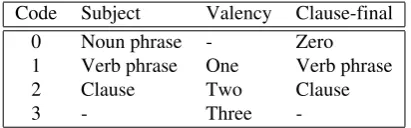
To provide a descriptive but less fine grained classification, the SCFs were annotated for three features: (a) subject type, (b) valency, and (c) presence of clause-final verb phrase or clause. Each feature has three possible values, as set out in Table 2.
Code Subject Valency Clause-final 0 Noun phrase - Zero 1 Verb phrase One Verb phrase 2 Clause Two Clause
3 - Three
-Table 2: Linguistic approach --- three criteria for composi-tion of genera.
Subject type can occur as a noun phrase, verb phrase or clause. The frames are mono-, di- or tri-valent:i.e., they
3The frame numbers are taken from the original Briscoe &
Subj Args Final Description 0 1 0 intransitive 0 2 0 monotransitive 0 3 0 ditransitive
0 1 1 intransitive plus VP 0 2 1 monotransitive plus VP 0 1 2 intransitive plus clause 0 2 2 monotransitive plus clause 0 3 2 ditransitive plus clause
1 1 0 VP-subject intransitive 1 2 0 VP-subject monotransitive
2 2 0 clause-subject monotransitive 2 1 2 clause-subject intransitive plus clause
Table 1: Linguistic approach --- composition of genera required to account for the 163 SCFs.
feature one, two or three arguments of the verb, the subject being at least one of those. After these arguments, the frames can optionally close with a verb phrase or clause (the third value in this case being absence).
Any SCFs clustered with identical values were then grouped into a genus. It would have been feasible to produce twenty-seven genera (33) if all combinations of all values were employed. However, the reorganisation was a data-driven process. As it turned out, the input set of SCFs clustered into just twelve of the available genera, as shown in Table 1. Although only twelve members of the paradigm are required here, twenty-seven genera are maximally available in the current model. This means that the set of SCFs and their genera are readily extendible in future, and moreover that the genera are adaptable to other languages which may re-quire a different set of parameters (or spoken English which will at the very least require a zero value for valency; think of common phrases in speech such asjust coming,only jok-ing, etc). This will in turn increase the number of available genera and enhance their adaptability.
The descriptive labels for each genus draw on the notion of transitivity which in its abstract sense is a binary category indicating the presence (or not) of an object. But there is also an inherently countable aspect to the concept which is more relevant for our purposes. This relates to the traditional dis-tinction which is made between verbs as intransitive (subject only;i.e., mono-valent), mono-transitive (subject and ob-ject;i.e., di-valent), and ditransitive (subject and two objects;
i.e., tri-valent). Thus, for this particular classification, we need only identify and count the arguments, rather than any attempt to distinguish between direct and indirect objects. Grouping direct and indirect objects as one may seem unnec-essarily crude at first, but there is no pressing need to make this distinction within the most general classification. The point of the exercise is in fact to abstract away sufficiently from the SCFs to produce a new and useful taxonomic level, and at the same time maintain necessary distinctions relating to valency, subject type and clause-final structure.
The full set of SCFs do indeed distinguish between direct and indirect objects: incorporating this information to the general classification results (via a fourth ‘object type’
fea-ture) produces a classification with a significantly larger number of genera (where several SCFs exist as single-member genera).
The twelve genera specified here (as well as an extended set of genera that incorporate object type information) are listed with their associated SCFs in full at http://www.wordiose. co.uk/resources.
3.2. Computational approach
The computational re-classification of the SCFs is based on their definitions as expressed in the grammatical rela-tions (GRs) notation used by the RASP system (Briscoe & Carroll, 2002; Briscoe et al., 2006). In a simplified form of this notation a transitive verb (Frame 24), exemplified by
Norman admires Alan, may be defined as:
(SUBJX Y) (OBJX Z)
which expresses that wordY is the subject of wordX and wordZis the object ofX. For our example sentence:
(SUBJadmires N orman) (OBJadmires Alan)
As a graph we could think of this as a directed edge, la-belledSUBJ, indicating a subject relationship from the word at vertexX to the word at vertexY with a second edge, labelledOBJ, indicating an object relationship from vertex X to vertexZ:
X
Z Y
OBJ SUBJ
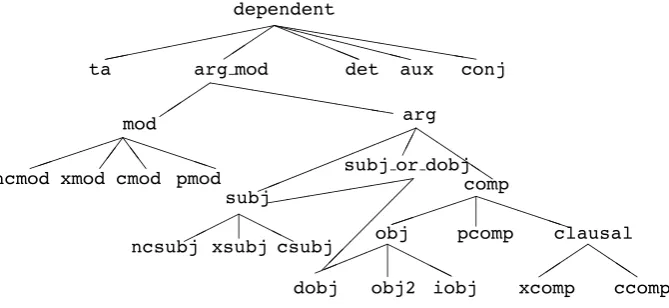
We present several taxonomies based on such graphs, each with a differing level of specificity. The degree of specificity is provided by the amount of information available at a vertex or labelled edge.
of the noun had a stronger tendency to occupy the subject position there would be a preference for adjectival readings (e.g.cooking pastaversuscooking husbands). Frequencies for lexical items in the subject and direct object position were correlated over our taxonomies and used to interpret the results of sentence completion and sentence acceptability tasks. The results supported a lexicalist model of syntactic processing, where experience of verb lexico-syntactic be-haviour (as revealed through corpus statistics) influences parsing preferences for local ambiguities during sentence processing.
Feedback from researchers in the fields of neurolinguistics and psycholinguistics is that they have found the flexible, computationally derived taxonomies (especially when com-bined with frequency distributions derived from corpora) to be a valuable tool for designing their stimuli and for man-ageably analysing results. Additionally, they have found the linguistically derived reclassification has facilitated their understanding of the genera in general and enabled more a more informed analysis.
The authors have made the resources discussed here together with supporting documentation available online at http:// www.wordiose.co.uk/resources.
5.
Acknowledgements
The first author was supported by Engineering and Physical Sciences Research Council (UK) grant number EP/F030061/1. Both authors thank the anonymous reviewers for their constructive criticism which was of much assistance in preparing this paper for submission. Finally, both authors sincerely acknowledge feedback, support and guidance from Mirjana Bozic, Ted Briscoe, Norman Cobley, Barry Dev-ereux, Alan Horne, Jyothi Katuri, Barbara Lawn-Jones, Billi Randall, William Marslen-Wilson, Michael McCarthy, Peter Stoehr, Andrew Thwaites and Lorraine Tyler.
6.
References
B.K. Boguraev, E.J. Briscoe, J.A. Carroll, D. Carter and C. Grover 1987. The derivation of a grammatically-indexed lexicon from the Longman Dictionary of Contemporary English. In:Proceedings of the 25th Annual Meeting of the Association for Computational Linguistics, 193-200. M. Bozic, E. Fonteneau, L.K. Tyler, B. Devereux, P. Buttery and W. Marslen-Wilson 2011. Grammatical categories in the fronto-temporal language network. In:proceedings of 11th International Conference on Cognitive Neuroscience, 120.
E.J. Briscoe 2000. Dictionary and System Subcategorisa-tion Code Mappings. Unpublished manuscript, Univer-sity of Cambridge Computer Laboratory.
E.J. Briscoe and J.A. Carroll 1997. Automatic extraction of subcategorization from corpora. In: Proceedings of the 5th ACL Conference on Applied Natural Language Processing, 356-363.
E.J. Briscoe and J.A. Carroll 2002. Robust accurate statisti-cal annotation of general text. In:Proceedings of the 3rd International Conference on Language Resources and Evaluation, 1499-1504.
E.J. Briscoe, J.A. Carroll and R. Watson 2006. The Second Release of the RASP System. In: Proceedings of the COLING/ACL 2006 Interactive Presentation Sessions. E.J. Briscoe 2006. An introduction to tag sequence
gram-mars and the RASP system parser. University of Cam-bridge, Computer Laboratory. http://www.cl.cam.ac.uk/ techreports/UCAM-CL-TR-662.pdf.
P.J. Buttery 2006. Computational models for first lan-guage acquisition. University of Cambridge, Com-puter Laboratory. http://www.cl.cam.ac.uk/techreports/ UCAM-CL-TR-675.pdf
B. Devereux, A. Korhonen and L.K. Tyler 2011. Parsing Sentences are Unlikely: Corpus-based Analyses of the Neural Processing of Verbs. In:Proceedings of 11th In-ternational Conference on Cognitive Neuroscience, 118. B. Devereux, L.K. Tyler, P. Buttery and A. Korhonen 2011. The role of verb subcategorization frames and selectional preferences in sentence processing: an investigation using corpus-derived measures. Presented at: Multidisciplinary Workshop on the Mental Representation of Verbal Argu-ment Structure.
R. Grishman, C. Macleod and A. Meyers 1994. COMLEX syntax: building a computational lexicon. In: Proceed-ings of COLING, 268-272. Association for Computational Linguistics.
K. Kipper, A.L. Korhonen, N. Ryant and M. Palmer 2006. Extending VerbNet with Novel Verb Classes. In: Pro-ceedings of the Fifth International Conference on Lan-guage Resources and Evaluation.
A.L. Korhonen 2002. Subcategorization acquisition. Uni-versity of Cambridge, Computer Laboratory. http://www. cl.cam.ac.uk/techreports/UCAM-CL-TR-530.pdf A.L. Korhonen and E.J. Briscoe 2004. Extended
Lexical-Semantic Classification of English Verbs. In: Proceed-ings of the HLT/NAACL Workshop on Computational Lexical Semantics.
A.L. Korhonen, Y. Krymolowski and E.J. Briscoe 2006. A Large Subcategorization Lexicon for Natural Language Processing Applications. In:Proceedings of the 5th inter-national conference on Language Resources and Evalua-tion.
B.C. Levin 1993. English Verb Classes and Alternations: A Preliminary Investigation. Chicago: University of Chicago Press.
D. McCarthy 2001. Lexical Acquisition at the Syntax-Semantics Interface: Diathesis Alternations, Subcatego-rization Frames and Selectional Preferences. Ph.D thesis, University of Sussex.
A. Meyers, C. Macleod and R. Grishman 1994. Standard-ization of the complement adjunct distinction. In: Pro-ceedings of Euralex96, 141-150.