Speaker Attribution in Cabinet Protocols
Josef Ruppenhofer, Caroline Sporleder, Fabian Shirokov
Department of Computational Linguistics, Saarland University, Saarbr¨ucken Building C 74, PO Box Postfach 15 11 50
{josefr, csporled, fabians}@coli.uni-saarland.de
Abstract
Historical cabinet protocols are a useful resource which enable historians to identify the opinions expressed by politicians on different subjects and at different points of time. While cabinet protocols are often available in digitized form, so far the only method to access their information content is by keyword-based search, which often returns sub-optimal results. We present a method for enriching German cabinet protocols with information about the originators of statements. This requires automatic speaker attribution. In order to avoid costly manual annotation of training data, we design a rule-based system which exploits morpho-syntactic cues. Unlike many other approaches, our method can also deal with cases in which the speaker is not explicitly identified in the sentence itself. This is an important capability as 45% of all sentences in the data constitute reported speech whose speakers are not explicitly marked. Our system is able to detect implicit speakers by taking into account signals of speaker continuity. We show that such a system obtains good results, especially with respect to recall which is particularly important for information access.
1.
Introduction
A growing number of projects is aimed at making cultural heritage data more accessible by digitizing them and mak-ing them publically searchable. Ultimately one would like to do more than simple keyword-based search. Support for more sophisticated search typically requires enriching the data with additional information such as semantic disam-biguation, explicit structuring, or introducing hyper-links between documents.
In this paper, we address the enrichment task of attributing speech events in cabinet protocols to their speakers. Such information allows historians to search systematically for statements made by a particular politician. This capability is important because statements frequently reflect opinions of their speakers and can also provide information about which facts where known by a particular person at a given time. Such information is often crucial for historical re-search.
Speaker attribution in cabinet protocols is not a trivial task since they typically do not contain direct speech but sum-maries in indirect speech. This means that some kind of deeper analysis is required. Speaker attribution is essen-tially a classification task and can be modelled by super-vised machine learning. However, this requires manually labelled training data, which are typically not available for the cultural heritage domains and too expensive to create from scratch. We investigate an alternative approach which exploits the fact that there are certain linguistic regularities in this text type that can be utilized by a rule-based system. One important linguistic cue is the use of the subjunctive. For instance in (1), the use of subjunctive mood and present tense on the main verb mark sentence (2) as a continuation of the chancellor’s statement in the preceding sentence. (A formulation using indicative mood would be understood as expressing the text writer’s opinion.) In our meeting proto-cols, such morpho-syntactic cues are used with great regu-larity and we show that by relying on such cues it is pos-sible to identify the speakers of sentences without explicit attribution. Such sentences are not rare: in data we anno-tated for agreement testing, 45% of all sentences continued
reported speech begun in a previous sentence.
(1) a. Der Bundeskanzler erkl¨art, daß er dem Kabinett zur Saarfrage alles gesagt habe, was er wisse.
b. The chancellor states that he has told the cab-inet everyting about the Saar question that he knows.
(2) a. Seitdem SEI nichts geschehen und es werde auch nichts geschehen.
b. Since then nothing had happened and nothing would happen.
We present a fairly shallow, rule-based approach to speaker attribution in cabinet protocols. Before describing our ap-proach in detail, we give an overview of related work (Sec-tion 2.) and of the data and annota(Sec-tion scheme we used (Section 3.).
2.
Related Work
An important theoretical work on the issue of speaker attri-bution is Bergler’s thesis (1992). Wiebe’s (1990) disserta-tion has a broader focus of psychological subjects and pro-vides a first implemented system for tracking point of view in narratives.
that by looking for positive cues for speaker continuity, we are also able to identify speakers for sentences where no communicative, evaluative or cognitive predicate is present. By contrast, Bethard et al. (2004), look only for opin-ion holders occurring as arguments of propositopin-ional attitude verbs. Kim and Hovy (2006) rely on the roles by a role la-beler as candidates for the status of opinion topic or holder, and Choi et al. (2005) also require that “the source phrases should be directly related to an opinion expression”. Only Seki et al.’s (2009) system for opinion holder identification uses information from prior sentences, opinionated or not, as evidence for the identification of speakers in the current opinionated sentence. Finally, the work by Krestel et al. (2008) on automatically finding sources of reported speech is also closely related. However, it focuses on English lan-guage news and, like sentiment research, it only targets re-ported speech with an explicit reporting clause, while our system can also deal with so-called ’free indirect speech’.
3.
Data and Annotation
Our data are taken from the minutes of the weekly meet-ings of the German cabinet during the period 1949-1960. The minutes are available to the public on request from the Bundesarchiv (German federal archive).1We automatically
identified sentence boundaries in the documents by apply-ing the OpenNLP2 sentence splitter. From our collection
of 58,310 sentences, we then randomly extracted two data sets: a development set of 687 sentences and a test set of 400 sentences. The first set was annotated by one of the authors according to pre-defined guidelines outlined below, the second set was annotated by the remaining two authors. We had to discard some examples due to sentence splitting mistakes. Our final data sets contained 566 sentences (de-velopment) and 323 sentences (test). To assess the reliabil-ity of the annotation, we computed inter-annotator agree-ment on the test set The average inter-annotator f-score achieved was .87 on a strict measure and .88 on a looser one (see Section 5. for the definitions of the measures). The annotation task consisted of recording for every sen-tence the set of speakers for all actual present or past speech events and private states (Wiebe et al. 2005) expressed in the sentence, as shown in (3).
(3) a. <sentence id=”149” hasSpeaker=”281,5”> <person id=”281”> Der Bundesinnenmin-ister </person>schließt sich der Auffas-sung<person id=”5”> des Bundeskanzlers </person>an, wird den Entwurf noch zur¨uckhalten und verschiebt die von ihm vorgesehenen Besprechungen.</sentence>
b. The Secretary of the Interior concurs with the opinion of the Chancellor, is going to hold back the proposal for a while, and postpones the talks he had planned.
Note that in the annotation process, references to offices are resolved to their holders. Thus, for (3) we record id 281
1http://www.bundesarchiv.de/cocoon/barch/0000/index.html
(in German). 2
http://opennlp.sourceforge.net/
(Robert Lehr) as speaker rather than using an id for the of-fice of Secretary of the Interior. The set of persons available for annotation as speakers was limited to an almost exhaus-tive biographical database from the Bundesarchiv, which contains the most important politicians and officials from the period. In addition, a virtual speaker was created to rep-resent the cabinet as a whole. The total number of potential speakers available for annotation is 1932.
Whereas newspaper texts usually include statements by the writer as well as quoted sources, almost all sentences in the minutes report utterances by the meeting participants. Only a few sentences contain background or meta information given by the minute takers. Since these sentences are not of interest to our application scenario, they were assigned the speaker value “unknown”. This value was also assigned when the annotators could not identify a speaker at all or where the speaker was an identifiable politician or organi-zation which, however, lacked an entry in the database. In line with Wiebe et al.’s practice of marking future or hy-pothetical speech events and private states as insubstantial (Wiebe et al. (2005)), we leave these cases unannotated. For instance, in (4), while we make a record of the consen-sus reached, we do not capture the speech event of publica-tion that the cabinet decides to refrain from.
(4) a. Der Bundesminister f¨ur Angelegenheiten der Vertriebenen tr¨agt das Memorandum der Alliierten Hohen Kommission vor . Es besteht Ubereinstimmung¨ , daß dieses der
¨
Offentlichkeit nicht bekanntzugeben ist .
b. The Secretary for the Affairs of Displace Peo-ple presents the memorandum by the Allied High Commission. There is consensus that it will not be made known to the public.
Not annotating the insubstantial cases, while making the annotation task easier, is somewhat detrimental to our ap-plication scenario since it is often important to know when somebody chooses not to supply or volunteer information that they have.
Note that our annotation guidelines allow for a sentence to be associated with more than one speaker. For instance, in (3), the Secretary of the Interior is reported by the min-utes as concurring with the Chancellor. However, the em-bedding of the two speech events is not represented: both speakers simply appear on the list of speakers associated with the sentence. While one would ideally like to represent the hierarchical embedding of opinions, we consider our coarser results to be acceptable for the kinds of information users that we envision. Historians will want to check the details of who spoke on which topic for themselves rather than relying on summary information provided by an auto-matic system.
hypothet-ical. Finally, 14% (58/405) of the speakers associated with private states and speech events are unknown.
Total Avg. per S private states/speech 493 1.6 insubstantial events 84 0.3
speakers 405 1.4
unknown speakers 58 0.2
Table 1: Basic statistics on the test set
Finally note that the 405 speakers associated with the differ-ent private states and speech evdiffer-ents in our agreemdiffer-ent data set corespond to 75 unique individuals. 5 out of the 75 in-dividuals account for 64% for all identifiable speakers: the Cabinet, Adenauer (Chancellor), Sch¨afer (Secretary of the Treasury), Erhard (Secretrary of Commerce), and Bl¨ucher (Secretary for the Marshal Plan). This skew is to some extent a historical artifact: Adenauer ruled throughout the whole period for which we have data and his Cabinet mem-bers served long tenures.
4.
Linguistic background
The main linguistic cue that we exploit in our work is the highly regular use of the subjunctive mood in formal Ger-man in contexts of reported speech. It is exemplified by the passage in (5-9). New speakers typically appear as the sub-jects of reporting verbs in the indicative mood (5,7, 8). Re-porting verbs appear in bold in the examples. The contents of reported speech are typically presented in the subjuntive mood, which is rendered by underlining. Subjunctive mood is used for reported content whether that content appears with a reporting clause, as in (5) or without one, as in (9). Sentence (9) shows the simple case where the use of the subjunctive mood marks a sentence as continuing reported speech from a previous sentence, in this case sentence (8). Sentence (6) represents the interesting case where the pri-vate state of one source (the Secretary of Transportation) is embedded under the continuing speech event of another (the undersecretary of State) from a prior sentence, in this case (5).
(5) a. Staatssekret¨ar Hartmannbemerkterg¨anzend, daß ¨uber die in dieser Vorlage angeschnitte-nen Fragen soeben eine Chefbesprechung 26 stattgefunden habe, die zu keiner Einigung gef¨uhrt habe.
b. Undersecretary of state Hartmann observes in addition that, concerning the issues broached in this proposal, a principals’ meeting had taken place just now , which had not produced an agreement.
(6) a. Uberdies¨ wolle der Verkehrsminister das Erm¨aßigungsprogramm umarbeiten und auf Kinder bis zu 25 Jahren ausdehnen.
b. On top of that, the secretary of transportation wanted to revise the discount program and ex-tend it to children up to 25 years.
(7) a. Der Bundesminister f¨ur Verkehr erkl¨art hi-erzu, daß er diese Absicht nicht mehr habe.
b. The transportation secretary explains that he no longer has this intention.
(8) a. Der Bundesminister f¨ur Familienfragen be-tont demgegen¨uber, daß man sich in der genannten Chefbesprechung einig geworden sei.
b. The Secretary for Family Affairs stresses, by contrast, that there had been an agreement in the aforementioned principals’ meeting.
(9) a. Man solle vorl¨aufig an der Vorlage festhalten und sie m¨oglicherweise sp¨ater verbessern.
b. One should hold fast to the proposal and im-prove it later , if possible.
The passage above also illustrates another important pat-tern found in the protocols: whenever a potential speaker appears as subject of a sentence, he is typically an actual speaker (at some depth of embedding). This is true for all sentences except (9).
It should be noted that other linguistic cues can also be ex-ploited in analyzing comparable data from languages which may lack the clear morphological cues that German offers. Consider passage (10-13), which is taken from the minutes of a meeting of the British Cabinet on 28 January 1919.3
(10) Sir Eric Geddes said that it was proposed so to throw the net as to get more men than we require.
(11) The A.S.C on the lines of communication con-tained a large proportion of the older men.
(12) In the combatant services there were many older men who werepivotalN.C.O.’s and whomust be retained.
(13) Hethereforedid notseewhy it should be nec-essary to discriminate against the A.S.C.
Sentence (10) clearly introduces reported speech. Sentence (11) might be a statement by the minute taker, based on the words and constructions it contains. However, sentence (12) contains uses of the appraisal pivotal and of (epis-temic)must, which it is very likely the minute taker would not use in a background informational statement. Sentence (13) then confirms the impression that sentences (11) and (12) also represent the views of Geddes by anaphorically referring to them as the reasons for Geddes’ opinion stated in the current sentence.
While the cues used in this analysis of the above passage are not a hundred percent reliable individually, we think that in combination they can be useful in the task of attributing content to speakers.
Finally, we note that while the notion of speaker continu-ity is very useful in analyzing protocols, it may not be as relevant in other genres. An illustration of this is a random
3The minutes are made available by the British National
sample of 10 Associated Press newswire stories totalling 4122 words that we collected from the year 2003. This sample contains 122 expressions of speech events and pri-vate states. We found that the only type of speaker conti-nuity that occurs is of the type exemplified in (14), where direct speech is continued and where that continuation can be readily recognized from the quotation marks.
(14) “The domestic leisure market is growing rapidly and now represents over 60 percent of all passen-gers,” Qantas Chief Executive Officer Geoff Dixon said Monday. “Jetstar will concentrate on growing this market with value fares while opening up new destinations.”
There were, however, no cases where indirect speech is continued past a reported speech-sentence marked by a re-porting verb. This confirms Bergler’s (1995) finding that so-called free indirect speech is virtually absent from North American newspaper writing.
5.
Experiments
We use precision (prec), recall (rec) and f-score (f) as our evaluation metrics. Loose precisioncounts a sentence as correctly labeled if at least one of the recognized speakers is correct.Strict precisionrequires all recognized speakers to be correct. Similarly, forloose recall, we count a sentence as correctly labeled if at least one of the speakers in the sentence was found by our system. For strict recall, we require all of them to have been found.
While we would have liked to use a baseline algorithm used in other work, we decided to construct one of our own be-cause our data contains many instances where (some part of ) the content of a sentence needs to be attributed to a speaker that is not explicitly mentioned in that sentence, as seen in (2, 6, 9). As noted in section 1., in the 300-sentence sample that we annotated as agreement data, there were 135 sentences (45%) that continued the speech of a speaker mentioned explicitly only in a preceding sentence. Tools like Krestel et al.’s (2008) Reported Speech Tagger4
do not look for cases where speakers neeed to be carried over from prior discourse. In addition, Krestel et al.’s tool does not include a grammar for German.
The baseline algorithm we use is centrally based on the in-tuition that whenever the main clause of the current sen-tence siis headed by a subjunctive mood verb, we can
as-sume speaker continuity with the previous sentence si−1.
Otherwise, we need to associate the speaker of siwith some
referent mentioned in si.
Additionally, we look for sentence-initial occurrences of the third person masculine singular pronouner, which typ-ically occurs in cases of same-speaker continuity (of the type “He added that ...”).5If one of these two rules matches
and there exists a prior sentence in the protocol with a known speaker, we carry over that speaker. If there is no
4
See
http://www.semanticsoftware.info/reported-speech-tagger . 5
German politics in the 1940s and 1950s was unfortunately en-tirely male-dominated and female speakers are sadly non-existent in our data set.
prior sentence si−1 or it lacks a known speaker, we set
speaker to the value “unknown”. If the first two rules do not fire, we assign as speaker the first person mentioned in sentence si, with person mentions being supplied by our
Named Entity recognition system. If there are no such men-tions, we assign “unknown”. To obtain named entity and co-reference information we use a custom-built system that was developed as part of a student project at Saarland Uni-versity (Atef et al., September 2009). Using a custom-built system proved necessary as most references to people are made not by name, but by the office they hold. Our system can resolve these mentions to specific individuals by con-necting document metadata to a database with information on the tenure of the various officials. The system was eval-uated on a subset of the data and obtained 79.9% precision, 74.2% recall and 76.9% f-score.
An example where the subjunctive mood rule correctly ap-plies is sentence (9), whose main verb is the subjunctive formsolle. Sentence (9) continues the reported speech be-gun in sentence (8) by the Secretary for Family Affairs. In sentences (5,7,8) neither the subjuntive mood nor the
er-rule fires and therefore the first-encountered potential speaker is assigned speaker status, which is correct in all three cases. Sentence (6) is assigned the speaker from the previous sentence because its main verb is in the subjunc-tive mood. While this is correct, the system fails to also record the Secretary of Transportation as a speaker, whose private state is embedded under the speech of Undersecre-tary Harmann from sentence (5).
The baseline algorithm has a surprisingly good precision (see Tables 2 and3) but error analysis reveals some major problems. One is the assumption that the first-mentioned person would be the subject and, therefore, the speaker. The relatively flexible word order of German as well as passive-voice sentences cause this bet to fail in many in-stances such as (15), where the Secretary for Intra-German relations is the addressee of a request to be made but not himself a speaker.
(15) a. Der Bundesminister f¨ur gesamtdeutsche Fra-gen wird deshalb gebeten, im ¨Altestenrat darauf hinzuweisen, daß die Interpellation zumindest nicht vor der Beendigung der Außenministerkonferenz auf die Tagesord-nung gesetzt wird.
b. The Secretary for Intra-German relations will therefore be asked to suggest to the Council of Elders that the interpellation should at least not be put on the agenda before the end of the foreign ministers’ conference.
a lot of subjunctive forms of the same and other verbs. Fi-nally, sentence-initial third person pronouns do not always signal speaker continuity. In (16), for instance, the referent oferis not a speaker but simply a topical referent that the speaker talks about.
(16) a. ErSEIin der Tat der einzige, der infolge seiner Personen- und Sachkenntnisse in der Lage sei, reformerische Maßnahmen durchzuf¨uhren. b. He was the only one who could carry out
re-form measures based on his knowledge of the people and matters involved.
Prec. Loose Strict
Baseline 77% 77%
Subject-based 81% 79%
Syntactic 86%‡◦ 69%†∗
Recall Loose Strict
Baseline 44% 36%
Subject-based 65%‡ 56%‡
Syntactic 87%‡∗ 79%‡∗
F-score Loose Strict
Baseline 56% 49%
Subject-based 72% 65%
Syntactic 87% 74%
Table 2: Results on development set. †and‡indicate sta-tistical significance compared to the baseline at p < .05 andp < .01level, respectively;∗and◦indicate statistical significance compared to Subject-based method atp < .01 andp < .05level, respectively (Fisher’s Exact Test, two-tailed).
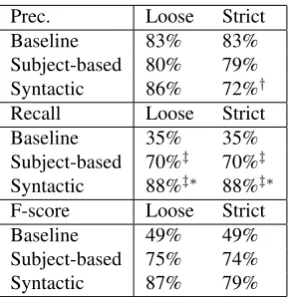
Prec. Loose Strict
Baseline 83% 83%
Subject-based 80% 79%
Syntactic 86% 72%†
Recall Loose Strict
Baseline 35% 35%
Subject-based 70%‡ 70%‡
Syntactic 88%‡∗ 88%‡∗
F-score Loose Strict
Baseline 49% 49%
Subject-based 75% 74%
Syntactic 87% 79%
Table 3: Results on test set.†and‡indicate statistical sig-nificance compared to the baseline atp < .05andp < .01 level, respectively;∗indicates statistical significance com-pared to Subject-based method atp < .01level (Fisher’s Exact Test, two-tailed).
Our first algorithm following on the baseline is subject-basedin that it addresses the problem that the first mention of a person in a sentence is not necessarily the subject by using the output of the Stanford parser (Klein & Manning 2003).6Our new algorithm works as follows:
6
http://nlp.stanford.edu/software/lex-parser.shtml
1 If the current sentence sihas a main clause subject go
to step 2. Otherwise assign the person mentioned first in sias its speaker.
2 If the subject(s) occurring in si refer to persons from
the biographical database, assign them as speakers. Otherwise, go to 3.
3 If si contains references to potential speakers, assign
the first one as the subject. Otherwise, assign as speaker of sithe speaker of si−1
Note that the subject-based algorithm ignores the subjunctive-mood indicators that the baseline uses as they turned out to deteriorate performance. This algorithm sig-nificantly outperforms the baseline on recall while having a comparable precision. The key to this boost is the fact that the current algorithm drastically decreases the num-ber of sentences that are assigned “unknown” as speaker, which can only happen when si has no potential speaker
and si−1does not either or there is no si−1. The baseline
had 26687 cases of unknown speakers, whereas the subject-based algorithm has only 12914 instances. Note that the improvement would probably have been greater if the Stan-ford parser had been able to parse more of the long sen-tences in the protocols.
After another round of optimization, we arrive at a new al-gorithm which again makes use of subjunctive mood in-dicators. But instead of acting based on the presence of subjunctive forms anywhere in the sentence, we check for subjunctive mood only on main clause verbs. The final al-gorithm works as follows:
1 If current sentence si has a subjunctive mood main
verb, assign speaker of si−1. Go on to 2
2 If si has a subject referring to potential speakers, add
them to the set of speakers. If not, add the first-mentioned person in sito the set of speakers. Go on to
3.
3 If no speaker has been assigned so far, assign the speakers of si−1.
4 If the head verb is passive, assign the virtual speaker representing the cabinet as a whole.
The resulting algorithm (syntactic) is capable of cumula-tively assigning multiple (sets of) speakers rather than just assigning one based on the first rule that fires. First, it checks for the presence of a subjunctive main verb as ev-idence for speaker continuity. Additionally, it can assign further speakers based on the evidence of the current sen-tence si, which allows us to correctly deal with embedded
speakers. Specificaly, the algorithm adds the subject refer-ents of si if they are potential speakers according to the
biographical database. If they are not, or if no parse is available, the algorithm adds the first-mentioned potential speaker in sentence sias a speaker, a fallback strategy
rule (4),, which is useful for picking up decisions by the cabinet, which are typically stated in the passive as illus-trated in (17).
(17) a. Der vom Bundesminister der Justiz vor-getragene Entwurf wird antragsgem¨aß beschlossen.
b. The bill presented by the Secretary of Justice is adopted as proposed.
The new algorithm significantly increases recall compared to both the baseline and the subject-based method. On strict precision it performs somewhat worse than the other two methods, while on loose precision it scores higher than both the baseline and the subject-based method, though the difference is not statistically significant on the test set (Ta-bles 2 and 3). With respect to the f-score the syntax-based method outperforms the other method noticeably.
Note that for information retrieval in a cultural heritage context, recall is typically more important than precision. For a historian searching for statements made by a partic-ular politician it is important to be reasonably sure that all relevant information is found. If this cannot be guaranteed, i.e., if there are many false negatives, the search engine is of very limited use. On the other hand, erroneous informa-tion returned by the search engine, i.e., statements which were made by a different politician (false positives), is less harmful as they can be easily recognized and disregarded by the user.
6.
Conclusion
We presented a rule-based system for speaker attribution in cabinet protocols. We experimented with different heuris-tics and showed that it is possible to obtain a relatively high performance by exploiting linguistic cues.
While the performance of the system is fairly high, there are some remaining errors. For example, it is currently not possible to correctly identify embedded speech events, e.g., those evoked by a noun (e.g., “the report by ...”) or preposition (“according to...”). We are currently working on addressing these shortcomings. One extension is to use a semantic role labeller (SRL) to find speakers based on their semantic role. The use of an SRL system also gives us information about speech events introduced by predicates other than verbs. Another extension is to use our rule-based system to label initial training data for a second stage su-pervised classifier, which can then exploit a larger set of linguistic cues to deal with the more difficult cases as well. Finally, we would also like to address topic identification as it is likely that not all speakers are equally likely to speak on any given topic.
Acknowledgements
This work was funded by the German Research Foundation DFG under grant PI 154/9-3 (Josef Ruppenhofer) and as part of the Cluster of Excellence “Multimodal Computing and Interaction” (Caroline Sporleder).
7.
References
G. Atef, T. Barth, D. Quinten, A. Scheidel, and F. Shirokov. September 2009. SCOPE. Ein intelligentes webbasiertes Suchinterface f¨ur die Kabinettsprotokolle des Deutschen Bundestages. Unpublished project report.
S. Bergler. 1992. The Evidential Analysis of Reported Speech. Ph.D. thesis, Brandeis University, Boston, MA. S. Bergler. 1995. Generative Lexicon Principles for
Ma-chine Translation: A Case for Meta-Lexical Structure.
Journal of Machine Translation, 9(3):155–182.
S. Bethard, H. Yu, A. Thornton, V. Hatzivassiloglou, and D. Jurafsky. 2004. Automatic extraction of opinion propositions and their holders. In AAAI Spring Sympo-sium on Exploring Attitude and Affect in Text.
S. Blair-Goldensohn, K. Hannan, R. McDonald, T. Neylon, G. Reis, and J. Reynar. 2008. Building a sentiment sum-marizer for local service reviews. InWWW Workshop on NLP in the Information Explosion Era (NLPIX). Y. Choi, C. Cardie, E. Riloff, and S. Patwardhan. 2005.
Identifying sources of opinions with conditional ran-dom fields and extraction patterns. In Proceedings of EMNLP, pages 355–362.
S.M. Kim and E. Hovy. 2006. Extracting opinions, opin-ion holders, and topics expressed in online news media text. InProceedings of the Workshop on Sentiment and Subjectivity in Text, pages 1–8.
D. Klein and C.D. Manning. 2003. Fast Exact Inference with a Factored Model for Natural Language Parsing. In
Advances in Neural Information Processing Systems 15 (NIPS 2002), pages 3–10.
R. Krestel, S. Bergler, and R. Witte. 2008. Minding the source: Automatic tagging of reported speech in newspaper articles. InProceedings of the Sixth Interna-tional Conference on Language Resources and Evalua-tion (LREC 2008).
Y. Seki, N. Kando, and M. Aono. 2009. Multilingual opinion holder identification using author and authority viewpoints. Information Processing and Management, 45:189–199.
J. Wiebe, T. Wilson, and C. Cardie. 2005. Annotating ex-pressions of opinions and emotions in language. Lan-guage Resources and Evaluation, 39(2-3):165–210. J. Wiebe. 1990. Recognizing Subjective Sentences: A