Corpus-based Semantics of Concession: Where do Expectations Come from?
Livio Robaldo
∗, Eleni Miltsakaki
+, Alessia Bianchini
∗∗Department of Computer Science, University of Turin, Italy.
+Institute for Research in Cognitive Science, University of Pennsylvania, USA.
[email protected], [email protected], [email protected]
Abstract
In this paper, we discuss our analysis and resulting new annotations of Penn Discourse Treebank (PDTB) data tagged as Concession. Concession arises whenever one of the two arguments creates an expectation, and the other ones denies it. In Natural Languages, typical discourse connectives conveying Concession are ‘but’, ‘although’, ‘nevertheless’, etc. Extending previous theoretical accounts, our corpus analysis reveals that concessive interpretations are due to different sources of expectation, each giving rise to critical inferences about the relationship of the involved eventualities. We identify four different sources of expectation: Causality, Implication, Correlation, and Implicature. The reliability of these categories is supported by a high inter-annotator agreement score, computed over a sample of one thousand tokens of explicit connectives annotated as Concession in PDTB. Following earlier work of (Hobbs, 1998) and (Davidson, 1967) notion of reification, we extend the logical account of Concession originally proposed in (Robaldo et al., 2008) to provide refined formal descriptions for the first three mentioned sources of expectations in Concessive relations.
1.
Introduction
Progress in pushing the state of the art in major text pro-cessing areas such as information extraction, summariza-tion, and question-answering is hindered by a lack of prac-tical algorithms for deep semantic processing. Recent re-leases of richly annotated corpora will facilitate advances in the development of more sophisticated NLP technologies ((Carlson et al., 2001), (Gaizauskas et al., 2003), (Palmer et al., 2005), (Wolf et al., 2005), (Hovy et al., 2006), (Poesio and Artstein, 2008) among others). The Penn Discourse Treebank 2.0 (Prasad et al., 2008), is, to date, the largest annotation effort at the discourse level, including approx-imately 40,000 annotations of discourse connectives and their arguments, sense labels, and speaker attribution. Pro-cessing discourse relations in free text and deriving appro-priate inferences remain one of the most challenging areas in natural language understanding. Discourse relations can be explicitly expressed by the use of connectives such as ‘because’ and ‘although’ but often they are implicit and must be inferred. Research efforts to identify discourse re-lations automatically using shallow features are moderately successful and are limited in their ability to infer implicit relations ((Marcu and Echihabi, 2002), (Wellner and Puste-jovsky, 2007)). In order to advance performance of systems processing discourse relations in free text, deeper semantic representations are needed for the interpretation of connec-tives and the semantic contributions of their arguments. In this paper, we focus on the Concessive interpretation of connectives such as ‘ although’, ‘but’ and ‘nevertheless’. Concession is a particular semantic relation between the in-terpretation of one argument that creates an expectation and the second argument which explicitly denies it. Previous theoretical work on formalizing the semantics of Conces-sion recognizes and analyzes two types, direct and indirect, which we will discuss in more detail in Section 2. However, for lack of groundtruth data, so far it has been hard to eval-uate the validity and coverage of the proposed semantics. With the release of the large scale annotated corpora such
as the PDTB, we are, finally, able to a) evaluate empirically previous accounts of Concession and b) develop corpus-based semantic descriptions for connectives and the rela-tions they represent. Building on the work of (Miltsakaki et al., 2008) which gives rough semantic descripions of all the PDTB sense labels, we analyze PDTB data labelled with Concessive sense tags. The paper makes two contributions a) we show that the distinction between direct and indirect Concession is insufficient to account for the substantially richer variety of ‘sources of expectation’, and b) using ba-sic concepts from Hobbs’ logic framework, we offer an em-pirically tested account of Concessive relation triggered by different sources of expectation. This line of work is novel in developing corpus-based and empirically tested semantic descriptions for discourse relations.
The paper is organized as follows. Section 2. gives a brief overview of prior work using logic formalisms to describe the meaning of Concessive relations. Section 3. focuses on Hobbs’ logic framework and describes the concepts that we use in our proposed semantics of Concession. Section 4. re-ports our empirical analysis and classification of sources of expectation, using Concessive data from PDTB 2.0. This analysis motivates our proposed semantics of Concession presented in detail in section 5. and compared with closely related work in 5.1. To evaluate the reliability of the new sources of expectation, we conducted a scale annotation study. We report inter-annotator agreement and statistics on PDTB data in Section 6.
2.
Background and related work
sev-eral viewpoints. Mann&Thompson’s influential Rhetori-cal Structure Theory (Mann and Thompson., 1988), views relations from a functional perspective and the proposed in-terpretations include the speaker’s intention and the effect that the relation is intended to achieve on the hearer. Fol-lowing (Moore and Pollack., 1992), we find it problematic that the RST framework presumes a single relation between two discourse segments, thus conflating the intentional and
informational levels of interpretation. We recognize this
distinction and, here, we aim at developing semantic de-scriptions at the informational level, i.e., we are interested in deriving inferences that would help NLP extract knowl-edge from the text. In this spirit, our work extends prior work in developing formal representations of the semantics of discourse relations.
In prior work, two types of Concession are often discussed which instantiate a direct and an indirect relation between the triggered expectation and the content of the textual span that denies it (Abraham, 1991), (Winter and Rimon, 1994), (Lagerwerf, 1998), (Grote et al., 1997), (Korbayova and Webber, 2007). Let us first look at some direct, (1.a), and
indirect,(1.b), examples to illustrate the distinction. In all
the examples below, the connective is underlined, the ar-gument in boldface is the one that creates the expectation, while the one in italics is the one that denies it. We refer to them asArgcandArgd, respectively.
(1) a. Although Greta Garbo was considered the yardstick of beauty, she never married.
b. Although he does not have a car, he has a bike.
According to (Winter and Rimon, 1994) and other re-searchers, (1.a) presupposes a general rule, paraphrasable as “Beautiful women usually get married”. Because of this rule, the sentence “Great Garbo was considered the yard-stick of beauty” directly triggers the expectation that she is married. This expectation is explicitly denied inArgd. (1.b) is different. In this case, “not having a car” does not imply “not having a bike”. Instead, the general rule is prob-ably “not having a car implies being less mobile”, an ex-pectation that is indirectly denied inArgd, since having a bike implies being mobile. In other words, in (1.b) the con-trast between expectation and denial of expectation is indi-rect, i.e., it involves an intermediate proposition, termed by (Lagerwerf, 1998) as ‘Tertium Comparationis’, implied by one argument while its negation is implied by the other. How can this basic intuitition on the relationship be-tween expectation and denied expectation be formalized? (Francez, 1995) proposes bilogic which uses two semantic structures, the standard and the actual world. The contrast between the two worlds gives rise to what we character-ize here as Concession and models the difference between Concession and contradiction in terms of whether the state-ments are evaluated in different worlds. (Winter and Ri-mon, 1994) agree with (Francez, 1995) on the basic intu-ition but propose to analyze Concession as presupposintu-ition failure. They combine presupposition failure and the pos-sibility and necessity operators of modal logic to define the semantics of ‘restrictive’ (‘although’, ‘even though’, ‘yet’, ‘nevertheless’) and ‘non-restrictive’ connectives (‘but’).1
1Interestingly, for (Winter and Rimon, 1994), ‘although’,
Finally, (Lagerwerf, 1998) discusses cases of Concession when the defeasible rule is accessed abductively rather than deductively and the eventualities creating/denying the ex-pectation are those associated with the Speech Acts ofArgc
andArgd. Two examples are shown in (2):
(2) a. Theo was not exhausted, although he was gasping for
breath. (Denial of Expectation - Epistemic)
b. Mary loves you very much, although you already know
that. (Denial of Expectation - Speech Act)
In (2.a), the defeasible (causal) rule is not “gasping for breath causes being exhausted”. Rather, the directionality of the trigger of expectation is reversed: “being exhausted causes gasping for breath”. the expectation is thus created
abductively: by observing that Theo was gasping for breath,
it may be concluded that he was exhausted.
On the other hand, in (2.b) the expectation is denied by the illocution of Argd, i.e. its Speech Act, rather than by its locutionary meaning. It is the fact that I tell youArgd, and not Argd itself, that is inconsistent with the expectation, created by the defeasible rule “If (I know that) you already know something, I do not tell you it”.
In sum, so far logical accounts of Concession have mainly focused on how the expectation is denied, e.g., directly rather than indirectly. We are interested instead in how the expectation is created, i.e., in the “general defeasible entail-ment” that must hold in the context in order to trigger the expectation. In our view, characterizing such an entailment is crucial to deriving appropriate inferences.
The present paper aims at exploring this line of research with one important methodological strategy. Our goal is to develop semantic representations that are based on empir-ical data. We want to bridge the gap between corpus data and logic, starting from the bottom (the connectives and their semantic contribution) and building up more abstract models for deriving appropriate inferences. Using Hobbs’ logic, we argue that a general semantics of Concession is possible, which can be further refined to account for the at-tested range of sources of expectation. Specifically, four different sources are identified which allow for ‘denied ex-pectation’ without giving rise to contradiction: Causality,
Implication, Correlation, and Implicature.
An important question raised when discussing multiple senses is whether it is advisable to make finer semantic dis-tinctions when even coarser ones are hard to recognize au-tomatically. Indeed, our purpose is not to build a richer tax-onomy of discourse relations (cf. (Hovy, 1990), for a com-prehensive presentation of discourse relations proposed in the literature). On the other hand, if the distinctions are too coarse, it may be, actually, harder to identify features that will help identify and interpret discourse relations.
3.
Hobbs’ logic
(Hobbs, 1998) proposed a wide coverage logical frame-work for natural language based on the notion of reifica-tion (Davidson, 1967) (Bach, 1981). Reificareifica-tion allows a wide variety of complex natural language statements to be expressed in first order logic. Reification is the act of identifying eventualities (events and states), as first order constants and variables. Two parallel sets of predicates are distinguished: primed and unprimed. The unprimed predi-cates are standard first order logic predipredi-cates. For example, (give a b c) asserts thatagivesbtocin the real world. The primed predicate represents the reified eventualities. The expression (give’ e a b c) says thateis a giving event bya ofbtoc. In natural language, eventualities may be possible or actual. In Hobbs’, being actual is one of their properties and is denoted by the notation (Rexist e). To give an exam-ple cited in Hobbs, if I want to fly, my wanting really exists, but my flying does not. This is represented as
(Rexist e)∧(want’ e I e1)∧(fly’ e1I )
Contrary to (p x), (p’ e x) does not say that e actually occurs, only that if it did, it would be a “p” event. The relation between primed and unprimed predicates is formalized by the following axiom:
(forall (x) (iff (p x) (exists(e) (and (p’ e x)(Rexist e)))))
Eventualities can be treated as the objects of human thoughts. Reified eventualities are inserted as parameters of such predicates as believe, think, want, etc. These predicates can be recursively applied. The fact that John
believes that Jack wants to eat an ice cream is represented
as an eventualityes.t.2
(believe’ e John e1)∧(want’ e1Jack e2)∧ (eat’ e2Jack Ic)∧(iceCream’ e3Ic)
Every relation on eventualities, including logical operators, causal and temporal relations, and even tense and aspect, may be reified into another eventuality. For instance, by as-serting (imply’ e e1 e2), we reify the implication frome1 toe2 into an eventualitye andeis, then, thought as ‘the state holding betweene1ande2such that whenevere1 re-ally exists,e2really exists too’. On the other hand, nega-tion is represented as (not’ e1e2): e1is the eventuality of thee2’s not existing. The predicatesimplyandnotallow Hobbs to model the concept of “inconsistency”. In Section 5.1., we show how this concept can be used in defining the semantics of Concession. Two eventualitiese1 ande2are said to be inconsistent iff they respectively imply two other eventualitiese3ande4such thate3is the negation ofe4:
(3) (forall (e1e3)
(iff (inconsistent e1e2)
(and (eventuality e1) (eventuality e2) (exists (e3e4) (and (imply e1e3)
(imply e2e4)(not’ e3e4))))))
2
The formula expresses the de-re reading of the sentence, wheree1,e2,e3,John,Jack,Icare first order constants.
3.1. Typical elements, eventuality types and tokens
Among the things we can think about are both specific eventualities, like Fido is barking, and general or abstract types of eventualities, like Dogs bark. We do not want to treat these as radically different kinds of entities. We would like both, at some level, to be treated simply as eventualities that can be the content of thoughts. To this end, the logi-cal framework includes the notion of typilogi-cal element (from (Hobbs, 1995), (Hobbs, 1998)). The typical element of a set is the reification of the universally quantified variable ranging over the elements of the set (cf. (McCarthy, 1977)). Typical elements are first-order individuals. The introduc-tion of typical elements arises from the need to move from the standard set theoretic notation
(forall (x) (iff (member x s) (p x)))
to a simple statement thatpis true of a “typical element” of sby reifying typical elements. The principal property of typical elements is that all properties of typical elements are inherited by the real members of the set.
It is important not to confuse the concept of typical ele-ment with the standard concept of “prototype”, which al-lows defeasibility, i.e., properties that are not inherited by all of the real members of the set. Asserting a predicate on a typical element of a set is logically equivalent to the multiple assertions of that predicate on all elements of the set. Talking about typical elements of sets of eventualities leads to the distinction between eventuality types and even-tuality tokens. The logic defines the following concepts, for which we omit formal details3: a) Eventualities types (aka
abstract eventualities): eventualities that involve at least
one typical element among their arguments or arguments of their arguments (we can call these “parameters”), b)
Par-tially instantiated eventuality types (aka partial instances):
a particular kind of eventuality type resulting from instan-tiating some of the parameters of the abstract eventuality either with real members of their sets or with typical ele-ments of subsets, and c) Eventuality tokens (aka instances): a particular kind of partially instantiated eventuality type with no parameters. It is a consequence of universal instan-tiation that any property that holds of an eventuality type is true of any partial instance of it.
3.2. Defeasible entailment, causality, and likelihood
The concept of reification used in Hobbs’ logic is partic-ularly suitable to the study of the semantics of discourse connectives, in that it allows focusing on their meaning while leaving underspecified the details about the eventu-alities involved. In other words, we can simply assume the existence of two eventualitiese1 ande2, coming from the two argumentsArgcandArgdrespectively, and defining the semantics of the connectives on them.
In what follows, we will briefly illustrate three basic con-cepts from Hobbs’ logic that we use in the semantics of Concession: Defeasibility, Causality, and Likelihood.
Defeasibility: Most of our everyday knowledge is
non-monotonic, i.e., only approximately correct. It is
defea-3
sible, in that we can draw a conclusion which can be de-feated in the light of new information. For example, know-ing that birds fly allows us to infer that if Tweety is a bird, then Tweety can fly. This conclusion will be defeated later when we learn that Tweety is actually a penguin and there-fore does not fly. Hobbs, following (McCarthy, 1980), models commonsense implication via monotonic implica-tion (meta-operator if ), but allows for defeasibility via the introduction of the underspecified predicateetcin the an-tecedent of the implication.
(4) (forall (x) (if (and (bird x) (etc)) (fly x)))
The achieved interpretation is that the implication holds if the antecedent is evaluated in “normal” situation. The for-mula above says that ifxis a bird andxhas other unspec-ified properties encoded asetc (i.e.,x’s wings are robust enough), thenxcan fly. There are a number of ways the
etcpredicate can enter into the inference process.
The high degree of flexibility of the logic allows us to de-fine a meta-predicate nonMonotonicIf that holds between two eventualitiese1ande2and that is true iffe1defeasibly impliese2. According to the definition in (5), an eventual-itye1defeasibly impliese2iff for each sub-eventuality of
e1there is a sub-eventuality ofe2for which the formula in
(4) holds.P1andP2are the predicates indicating the types of the eventualitiese1ande2respectively.
(5) (forall (e1e2)
(iff (nonMonotonicIf e1e2) (forall (e1)
(if ( partialInstance e1e1) (forall (x)
(if (and (P1e1x) (etc))
(exists (e2)
(and ( partialInstance e2e2) (P2e2x)))))))))
Causality: Besides defeasible implication, Hobbs’ logic
also adopts a defeasible account of causality, originally proposed in (Hobbs, 2005). This distinguishes between the monotonic notion of “causal complex” and the non-monotonic, defeasible notion of “cause”. As (Hobbs, 2005) explains, when we flip a switch to turn on a light, we say that flipping the switch “caused” the light to turn on. But for this to happen, many other factors need to be satisfied: the bulb is good, the switch is connected to the bulb, there is power in the city, etc. The set of all the states and events that are necessary for the event e to take place as a result, are called the “causal complex” of e. In a causal complex, the majority of participating eventualities are normally true and therefore presumed to hold. In the light bulb case, it is normally true that the bulb is not burnt out, the wiring is in good condition and the power is on, so the conditions are presumed to hold. What cannot be presumed to hold is whether the switch is on or off. Eventualities that are not assumed to be true under normal contexts are commonly identified as causes (Kayser and Nouioua, 2009).
Based on these ontological grounds, Hobbs represents causality in terms of two predicates: (cause’ c e1 e2) and (causalComplex s e2). cause’ says thatc is the state
holding between e1 and e2 such that the former is a non-presumable cause of the latter. causalComplex says that s is the set of all presumable or non-presumable eventualities that are involved in causinge2, includinge1. To preserve defeasibility, we need an axiom stating that the consequence really exists just in case all the eventualities in its causal complex really exist:
(forall (s e)
(if (and (causalComplex s e)
(forall (e1) (if (member e1s) (Rexist e1))) (Rexist e)))
Likelihood: In Hobbs’ logic, whether an eventuality exists
in the real world or not is a property of the eventuality. Eventualities that exist in the real world are represented with the predicateRexist. Real existence is one of several modes of existence. The eventuality could be part of someone’s beliefs but not occur in the real world. It could be merely possible or likely but not real. It could, also, be unlikely or impossible. Possibility is one common judgment we make about eventualities in situations of uncertainty. Likelihood is intended as the commonsense notion of the mathematical version of probability. Likeli-hood is a qualitative notion intended to model the vague probability judgements we make in everyday life, as when we say that it’s likely to rain or that the train may be late. Likelihoods are members of a partially ordered scale of likelihoods. For Hobbs, such a scale s satisfies the predicate(likelihoodScale s). Likelihood is with respect to an implicit set of constraints defining the sample space.
(likelihood d e c) asserts that d is the likelihood ofe’s really existing, whenever the set of eventualities in c
really exist. We say that a certain eventualityeis “likely” when a set of eventualities cholds, iff the likelihood ofe givencis a qualitative value within the highest part of the contextually relevant likelihood scale.
(forall (e c) (iff (likely e c)
(exists (s d s1)
(likelihood d e c) (likelihoodScale s) (belong d s1) (high s1s)))))
Likelihood is connected to other modalities via additional axioms. If the likelihood of an eventuality e with con-straints cis the top of the likelihood scale, then eis
nec-essary givenc, i.e., it is implied from the latter. If the like-lihood ofeis the bottom of the likelihood scale, then it is
not possible givenc.
In the next section, we use the above definitions of causal-ity, defeasibiliy and likelihood to define the semantics of Concession and the different sources of expectation that we identified in our analysis of concessive tokens in the PDTB.
4.
Sources of Expectation in PDTB
(non-monotonic) Implication, Correlation, and Implicature. In (6) we show four constructed examples used for expla-nation, while in (7) are four corresponding PDTB tokens.
(6) a. Although John studied hard, he did not pass the exam. (Causality)
b. Penguins are birds. Nevertheless, they do not fly. (Implication)
c. John will finish his report, but he’ll do it at home. (Correlation)
d. Although John ate a lot of pizza, he did not eat it all. (Implicature)
(7) a. This meeting “put in motion” procedural steps that would speed up both of these functions. But no
spe-cific decisions were taken on either matter. (Causality)
b. Although working for U.S. intelligence, Mr. Noriega
was hardly helping the U.S. exclusively. (Implication)
c. The Treasury will raise 10 billion in fresh cash by selling
30 billion of securities [...]. But rather than sell new
30-year bonds, the Treasury will issue 10 billion of 29 year, nine-month bonds. (Correlation)
d. Although it is not the first company to produce the thinner drives, it is the first with an 80-megabyte drive. (Implicature)
In (6.a), “studying hard” (defeasibly) causes “passing ex-ams”. However, that is not true in the case of John, who failed his exam despite studying hard. Similar considera-tions hold in (7.a), where “the procedural steps triggered by the meeting” (defeasibly) causes “taking important de-cisions in both of these functions”.
The examples in (6.b) and (7.b) involve non-monotonic Im-plication rather than Causality. (6.b) is obvious. In (7.b), it is strange to say that working for U.S. intelligence nor-mally “causes” helping U.S. exclusively. Rather, the latter seems to be a property or condition for working for U.S. intelligence. In other words, working for U.S. intelligence implies (among other things) helping U.S. exclusively in the same way that being a bird implies flying.
In (6.c) and (7.c), a third kind of relation seems to be in-volved betweenArgcand the expectation. The latter
usu-ally occurs whenever the eventuality denoted by the former
occurs. For instance, it is likely that John will do the report in the office, on the basis that he usually does his reports when he is in his office. However, on this occasion this ex-pectation does not materialize as John will finish the report at home. Similarly, in (7.b), a possible interpretation is that the Treasury usually raises money by selling new 30-year bonds, whereas on this occasion, it decided to adopt a dif-ferent strategy.
Finally, (6.d) and (7.d) do not appear to fall in neither one of the three categories, nor does it seem that the expectation is identified on semantic grounds only. Rather, it seems that the argument is insufficient/non-relevant with respect to the satisfation of speakers intentions, i.e., communicating the hearer that there is some pizza left. We suspect that (6.d) involves violation of a Gricean Maxim. Similarly, in (7.d),
Argcdoes not really create any expectation that is inconsis-tent withArgd. Rather, the latter explains the property of drivers that is really worth noticing in the context of (7.d).
5.
A better semantics of Concession
Hobbs’ logic allows us to build logical representations for discourse interpretations that are simple to use for deciding what inferences are allowed. For example, in our proposed logical account for Causality, non-monotonic Implication and Correlation shown in (8), (9) and (10) respectively, the reified predicates cause’, nonMonotonicIf ’, and likely’ are a straightforward representation on which we can build the inferences that are licensed in each case. We show un-der the formulae the eventualities identified for (6.a-c). A proper logical account of the Implicature case is considered as the object of future work.
(8) (exist (ca
ccceceeed)
(Rexistca
c)∧(partialInstance cccac)∧
(cause’ ccecee)∧
(Rexist cc)∧(Rexist ec)∧(Rexist ed)∧
(inconsistent eeed) )
ec= “John studied hard”
ca
c= “Studying hard causes passing exams”
ee= “John passed the exam”
ed= “John did not pass the exam”
ca
cis a general causal rule that holds in the context and
in-stantiates in a contingent causal rule holding between ec
andee. The latter is inconsistent withed, which directly
comes fromArgd. The semantics of Implication and Cor-relation shown in (9) and (10) differs only in the general rule, which in these cases indicates a non-monotonic Impli-cation and a likely trend respectively, rather than Causality.
(9) (exist (iaciceceeed)
(Rexistia
c)∧(partialInstance icica)∧
(nonMonotonicIf ’ icecee)∧
(Rexist ic)∧(Rexist ec)∧(Rexist ed)∧
(inconsistent eeed) )
ec= “Penguins are birds”
ia
c= “Birds fly”
ee= “Penguins fly”
ed= “Penguins do not fly”
(10) (exist (laclceceeed)
(Rexistla
c)∧(partialInstance lclac)∧
(likely’ lcecee)∧
(Rexist lc)∧(Rexist ec)∧(Rexist ed)∧
(inconsistent eeed) )
ec= “John will do his report”
la
c= “John does not usually do his reports at home”
ee= “John will not do his report at home”
ed= “John will do his report at home”
Thus, (9) encodes that “birds fly” (ia
c≡ic) is presupposed.
Analogously, in case of formula (10), what creates the ex-pectation is the previous history about similar eventualities. It is then assumed that “when John has a report to do, he does not usually do it at home” (la
c). This partially
instanti-ates in “John will not likely do the present report at home” (ee). But that is inconsistent withed, denoted byArgd.
5.1. Comparison with related work
Our proposal seems to be the proper generalization of the previous approaches to Concession mentioned in the Sec-tion 2. The predicate inconsistent defined in (3) deals with direct as well as indirect Concession in a straightforward, intuitive way. This is in line with the approach of (Winter and Rimon, 1994) who classify connectives as restrictive and non-restrictive, the latter being a particular case of the former, according to their ability to induce direct and indi-rect Concession respectively.
(Winter and Rimon, 1994) formalize their framework in Veltman’s Data Logic (DL) (Veltman, 1986), a particular modal logic where possible worlds are modeled as
infor-mation states. (Winter and Rimon, 1994) introduce two
operators ‘→’ and ‘⇒’ to model commonsense implication and standard logical implication respectively. In practice, ‘→’ subsumes the predicates cause, nonMonotonicIf and
likely of Hobbs’ logic, while ‘⇒’ corresponds to imply. In Winter and Rimon, Concession is modeled by the implica-tions ‘e1→e3’ and ‘e1→(not e3)’, wheree1ande2are the eventualities associated with the two arguments, ande3is the expectation, implied by the former but whose negation is implied by the latter. However, ‘→’ is not defeasible. Therefore, the two implications cannot hold in a state of in-formation where bothe1 ande2hold, or the two opposite consequents would hold. To avoid such an inconsistency, in (Winter and Rimon, 1994) only ‘e1→e3’ holds in the current state of information, while ‘e1→(not e3)’ holds in a previous state of information, but not in the current one. Winter and Rimon, also, acknowledge that some cases are actually problematic for their account, for instance:
(11) John walks slowly. But he walks.
Suppose (11) is uttered in a context where John had a sur-gical operation. e1may be taken as the eventuality ‘John walks slowly’,e2as ‘John walks’, ande3as the expectation ‘the operation was a success’. Note, however, that ‘John walks slowly’ is clearly a particular case of ‘John walks’ (‘e1⇒e2’ holds). From this we infer ‘e1→e3’ in the current state of information, i.e., that ‘John walks slowly’ implies ‘the operation was a success’, which is clearly not the case. In our proposed semantics, this problem does not arise, in that cause, nonMonotonicIf, and likely are defeasible, and so not all properties asserted on an abstract eventuality are inherited by all its partial instances.
More generally, the fact that ‘e1→(not e3)’ is false in the current state of information seems to be in contrast with lin-guistic intuition. For instance, the proposition “the fact that the patient of an operation walks slowly causes/implies/co-occurs with the fact that the operation was unsuccessful” seems to hold even in states of information where an oper-ation is assumed to be a success although the patient walks slowly. Analogously, in (6.a), it seems that “hard studying
causes passing exams” is true even in contexts where some student failed despite having studied hard. In (Winter and Rimon, 1994), the non-defeasibility of ‘→’ does not allow for such default assertions.
Furthermore, in our approach the cases of Concession stud-ied by (Lagerwerf, 1998) are also unproblematic. To be more specific, following (Sweetser, 1990), (Lagerw-erf, 1998)’s cases of ‘Epistemic Denial of Expectation’ in-volve arriving at the defeasible expectation abductively. In ‘Speech Act Denial of Expectation’ the concessive relation holds between the illocution of at least one of the argu-ments. We repeat examples (2) here for convenience.
(12)a. Theo was not exhausted, although he was gasping for
breath. (Denial of Expectation - Epistemic)
b. Mary loves you very much, although you already know
that. (Denial of Expectation - Speech Act)
In (12.a), the expectation is created abductively, i.e., by ob-serving that Theo was gasping for breath, it may be con-cluded that he was exhausted.
(Lagerwerf, 1998) proposes the following formalization in Predicate Logic:
∀x[Gfb(x)>B(i, Exh(x))]
where Gfb and Exh are predicates denoting, respectively, the set of individuals gasping for breath and the exhausted ones. B(y,Φ)is an epistemic operator asserting thaty be-lievesΦ,irefers to the speaker, and>is the defeasible im-plication operator defined in (Asher and Morreau, 1991). Lagerwerf’s intuition is correct, but the proposed formal-ization seems to deviate from the heart of the intuition. Firstly, it is somehow odd to assert that the speaker be-lieves someone to be exhausted given that he is gasping for breath. The defeasible rule is general and therefore does not apply specifically to any particular speaker. Therefore, in the formalization,ishould be most properly substituted by a universal quantification over all possible believers. Secondly, Causality (as well as non-monotonic Implication and Correlation) is a defeasible rule both in cases it is rived at deductively, as in example (8), and in cases it is ar-rived at abductively. If should be asserted that the speaker believes the causes when he or she observes the effects, it should, also, be asserted that he or she believes the effects when he observes the causes. (Lagerwerf, 1998)’s intuition must be formalized exactly as it is stated: the defeasible causal rule is “being exhausted causes gasping for breath”, and it yields the expectation abductively. Thus, the formula associated with (12.a) is the one in (13); the only differ-ence with respect to the formula in (8) is the assertion of the conjunct (cause’ cc eeec) in place of (cause’ cc ec ee).
(13) (exist (ccacceceeed)
(Rexistca
c)∧(partialInstance cccac)∧
(cause’ cceeec)∧
(Rexist cc)∧(Rexist ec)∧(Rexist ed)∧
(inconsistent eeed) )
ec= “Theo was gasping for breath”
ca
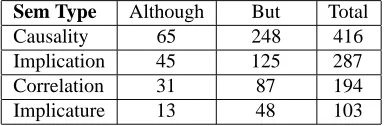
Sem Type Although But Total
Causality 65 248 416
Implication 45 125 287 Correlation 31 87 194 Implicature 13 48 103
Table 2: Distribution of the four sources of Concession.
ee= “Theo was exhausted”
ed= “Theo was not exhausted”
On the other hand, in (12.b) the expectation is denied by the illocution ofArgd, i.e., its Speech Act, rather than by its lo-cutionary meaning. It is the fact that I tell youArgd, and not Argd itself, that is inconsistent with the expectation, created by the defeasible rule “If I know that you already know something, I do not tell you it”.
The formalization of such cases does not raise particular problems in our approach and so we omit it. Consistent with Hobbs’s logic, the Speech Act of an eventuality is sim-ply reified into a new eventuality, and the defeasible rules are asserted on the latter.
6.
Inter-annotator agreement and
PDTB statistics
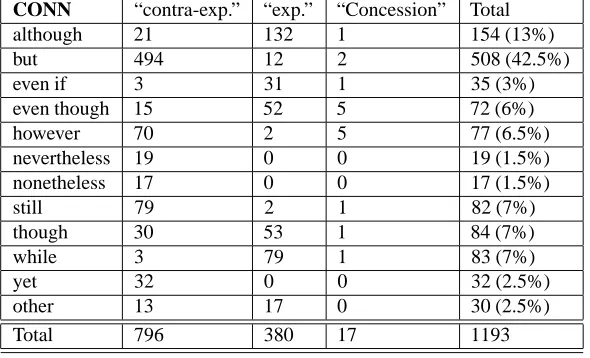
PDTB 2.0 includes 1193 tokens of explicit connectives which are annotated as “Concession” or its subtypes “contra-expectation”, when the argument that syntactically contains the connective denies an expectation, and “expec-tation”, when this argument triggers an expectation4.
Table 1 shows the distribution of Concessive labels for the 1193 tokens. Explicit connectives with a Concessive label assigned to less than 10 tokens are grouped under “other”. The rest of the connectives amount to 98% of all “contra-expectation” and 95% of all ““contra-expectation” tokens. The most common concessive connective is “but” with 508 to-kens (42% of all concessive labels), followed by “although” with 154 tokens (13% of all concessive labels).
We conducted an empirical analysis on 1000 of those to-kens, which have been annotated independently by two an-notators. Table 2 shows the distribution of the data accord-ing to the four sources of Concession identified above. The most common source of expectation comes from causal re-lations (41.6%), followed by Implication (28.7%), Correla-tion (19.4%) and Implicature (10.3%) of the data.
The kappa statistic yielded 0.8 agreement, which is within the range generally accepted as an indicator of substantial inter-annotator reliability. The formula has been calculated as follows. P r(a) is the percentage of agreement (85% of the 1000 cases considered) while the percentage of each tag, i.e. P r(e), is equal to 25%, as there are four possible sources of Concession.
(14)
k
=
P r1−(a)−P rP r(e)(e)=
0.1−085−0.25.25= 0
.
8
The good kappa score suggests that the categories can be identified reliably and can, thus, be taken as an indication that the categories are real.
4A full description of the sense tags used in the PDTB is given
in (Prasad et al., 2008) and (Miltsakaki et al., 2008).
7.
Conclusion
In this paper, we analyzed Concessive data from PDTB 2.0. We found that previous semantic accounts of Concession that recognize two types of Concessive relations are insuf-ficient for recognizing the full range of Concessive rela-tions in real data. We identified four sources of expectation that give rise to concessive relations: Causality, Implica-tion, Correlation and Implicature. The reliability of these categories is supported by a good kappa score on an inter-annotator agreement study with two inter-annotators. Using ba-sic concepts from Hobbs’ logic framework, we propose a corpus-based formal semantic representations for the range of Concessive relations attested in the corpus. The purpose for refining the semantics of concessive relations is to en-able deriving useful inferences on causal and other contin-gency relations holding between events that may not be ex-plicitly asserted in free text.
Acknowledgements
Financial support to Eleni Miltsakaki by the NSF IIS-0803538 grant is gratefully acknowledged.
8.
References
W. Abraham. 1991. Discourse particles in german: how does their illocutive force come about? In W. Abraham, editor, Discourse particles in German, pages 203–252. Amsterdam/Philadelphia: John Benjamins.
J.C. Anscombre and O. Ducrot. 1977. Deux mais en fran-cais? Lingua, 43:23–40.
N. Asher and M. Morreau. 1991. Commonsense entail-ment: a modal theory of nonmonotonic reasoning. In
Proc. of the 12nd International joint conference on Arti-ficial Intelligence, Sidney, Australia.
E. Bach. 1981. On time, tense, and aspect: An essay in english metaphysics. In P. Cole, editor, Radical
Prag-matics, pages 63–81. Academic Press, New York.
D. Blakemore. 1989. Denial and contrast: a relevant theo-retic analysis of but. Linguistic and Philosophy, 12. L. Carlson, D. Marcu, and M.E. Okurowski. 2001.
Build-ing a discourse-tagged corpus in the framework of rhetor-ical structure theory. In Proc. of the 2nd SIGDIAL
Work-shop on Discourse and Dialogue, Eurospeech, Denmark.
D. Davidson. 1967. The logical form of action sentences. In N. Rescher, editor, The Logic of Decision and Action. University of Pittsburgh Press, Pennsylvania.
N. Francez. 1995. Contrastive logic. Logic Journal of the
IGPL, 3(5):725–744.
R. Gaizauskas, P. Hanks, J. Pustejovsky, R. Sauri, A. See, A. Setzer, L. Ferro, and B. Sundheim. 2003. The time-bank corpus. Corpus Linguistics, Lancaster, U.K. B. Grote, N. Lenke, and M. Stede. 1997. Ma(r)king
con-cessions in english and german. Discourse Processes, 24(1):87–117.
J. Hobbs. 1995. Monotone Decreasing Quantifiers in a Scope-Free Logical Form. in K. van Deemter and S.
Pe-ters (Eds.), Semantic Ambiguity and Underspecification, CSLI Lecture Notes, Stanford, California, 1995.
CONN “contra-exp.” “exp.” “Concession” Total
although 21 132 1 154 (13%)
but 494 12 2 508 (42.5%)
even if 3 31 1 35 (3%)
even though 15 52 5 72 (6%)
however 70 2 5 77 (6.5%)
nevertheless 19 0 0 19 (1.5%)
nonetheless 17 0 0 17 (1.5%)
still 79 2 1 82 (7%)
though 30 53 1 84 (7%)
while 3 79 1 83 (7%)
yet 32 0 0 32 (2.5%)
other 13 17 0 30 (2.5%)
Total 796 380 17 1193
Table 1: Concessive labels in PDTB 2.0
J. R. Hobbs. 2005. Toward a useful notion of causality for lexical semantics. Journal of Semantics, 22:181–209. E. Hovy, M. Marcus, M Palmer, L. Ramshaw, and
R. Weischedel. 2006. Ontonotes: the 90% solution. In
Proc. of the Human LanguageTechnology Conference of the NAACL, New York.
E. Hovy. 1990. Parsimonious and profligate approaches to the question of discourse structure relations. In Proc.
of the 5th International Workshop on Language Genera-tion, Pittsburgh, PA.
M. Izutsu. 2008. Contrast, concessive, and corrective: To-wards a comprehensive study of opposition relations.
The Journal of Pragmatics, 40:646–675.
D. Kayser and F. Nouioua. 2009. From the textual descrip-tion of an accident to its causes. Artificial Intelligence, 173:1154–1193.
I. Korbayova and B. Webber. 2007. Interpreting conces-sion statements in light of information structure. In Bunt H. and Muskens R., editors, Computing Meaning,
vol-ume 3, pages 145–172. Kluwer Academic Publishers.
L. Lagerwerf. 1998. Causal Connectives Have
Presuppo-sitions: Effects on Coherence and Discourse Structure.
Ph.D. thesis, University of Tilburg, The Netherlands. R. Lakoff. 1971. If’s, and’s, and but’s about conjunction.
In C.J. Fillmore and D.T. Langendoen, editors, Studies in
Linguistic Semantics. Academic Press, New York.
W. Mann and S. Thompson. 1988. Rhetorical structure theory: Toward a functional theory of text organization.
Text, 8 (3):243–281.
D. Marcu and A. Echihabi. 2002. An unsupervised ap-proach to recognizing discourse relations. In Proc. of the
40th Annual Meeting of the Association for Computa-tional Linguistics.
J. McCarthy. 1977. Epistemological problems of artificial intelligence. In International Joint Conference on
Ar-tificial Intelligence, Cambridge, Massachusetts., pages
1038–1044.
J. McCarthy. 1980. Circumscription: A form of nonmono-tonic reasoning. Artificial Intelligence, 13:27–39. E. Miltsakaki, L. Robaldo, A. Lee, and A. Joshi. 2008.
Sense annotation in the penn discourse treebank. In
Proc. of Computational Linguistics and Intelligent Text Processing, LNCS Vol. 4919, pages 275–286.
J. D. Moore and M. E. Pollack. 1992. A problem for RST: The need for multi-level discourse analysis.
Computa-tional Linguistics, 18:537–544.
M. Palmer, D. Gildea, and P. Kingsbury. 2005. The propo-sition bank: An annotated corpus of semantic roles.
Computational Linguistics, 31(1).
M. Poesio and R. Artstein. 2008. Anaphoric annotation in the arrau corpus. In Proc. of the 6th International
Language Resources and Evaluation (LREC2008), Mar-rakech, Morocco.
R. Prasad, E. Miltsakaki, N. Dinesh, A. Lee, A. Joshi, B. Webber, and L. Robaldo. 2008. The penn discourse treebank 2.0. annotation manual. Technical Report Tech-nical Report, Institute of Research in Cognitive Science, University of Pennsylvania.
L. Robaldo, E. Miltsakaki, and J. R. Hobbs. 2008. Refin-ing the meanRefin-ing of sense labels in pdtb: “concession”. In Proc. of Symposium on semantics in systems for text
processing., Venice, Italy.
W. Spooren. 1989. Some aspects of the form and
inter-pretation and global contrastive relations. Ph.D. thesis,
University of Nijmegen, The Netherlands.
E. Sweetser. 1990. From etymology to pragmatics. Metaphorical and cultural aspects of semantic structure.
Cambridge University Press.
F. Veltman. 1986. Data semantics and the pragmatics of
indicative conditionals. In E.C. Traugott (Eds.)On con-ditionals, Cambridge University Press.
B. Wellner and J. Pustejovsky. 2007. Automatically iden-tifiying the arguments of discorse connectives. In Proc.
of Joint Conference on Empirical Methods in NLP and Computational NL Learning (EMNLP-CoNLL), Prague,
Czech Republic.
Y. Winter and M. Rimon. 1994. Contrast and implication in natural language. Journal of Semantics, 11:365–406. F. Wolf, E. Gibson, A. Fisher, and M. Knight. 2005.