Developing a re-usable web-demonstrator for automatic anaphora resolution
with support for manual editing of coreference chains
Anders Nøklestad
∗, Øystein Reigem
?, Christer Johansson
†∗University of Oslo, Norway
[email protected] ?Aksis Unifob AS, Bergen, Norway
†University of Bergen, Norway
Abstract
Automatic markup and editing of anaphora and coreference is performed within one system. The processing is trained using memory based learning, and representations derive from various lexical resources. The current model reaches an expected combined precision and recall of F=62. The further improvement of the coreference detection is work in progress. Editing of coreference is separated into a module working on an xml-file. The editing mechanism can thus be reused in other projects. The editor is designed to store a copy on the server of all files that are edited over the internet using our demonstrator. This might help us to expand our database of texts annotated for anaphora and coreference. Further research includes creating high coverage lexical resources, and modules for other languages. The current system is trained on Norwegian bokm˚al, but we hope to extend this to other languages with available tools (e.g. POS-taggers).
1.
Introduction
Our demonstrator consists of several smaller programs that work together via a web interface. The task is to be able to enter an arbitrary text, in a language for which we have some linguistic resources available. Those resources in-clude a part-of-speech tagger, a functional role finder, and a chunking mechanism. From these resources, a representa-tion of each markable word (mainly common nouns, proper nouns, and pronouns) is created, and compared to each new markable, which may be a possible anaphor (i.e., a word that has a coreference relation with the current markable). We have plans to extend the resources to accommodate more languages.
The goal of this presentation is to demonstrate the genera-tion of an interactive webpage that presents the result in a graphical format, and allows for easy manipulation of ref-erence chains, thus allowing fast and intuitive editing of coreference chains. There are various autonomous steps that will be fairly easy to replace with new modules for each added language.
The first step is to format the text for further processing. Af-ter this step, a program that implements a Constraint Gram-mar of Norwegian (Hagen et al., 2000) is run to label the words in the text with part-of-speech tags, functional roles and information relating to finding named entities (Johan-nessen et al., 2005). This information is the basis for gen-erating a description vector for each word that may enter an anaphora-relation. Each potential anaphor-antecedent pair has a match vector calculated, which represents how well the words in the pair fit together (Aone and Bennett, 1995; McCarthy and Lehnert, 1995; Soon et al., 2001b; Johans-son and Nøklestad, 2005).
Before processing new material, match vectors were cal-culated for a fairly large portion of texts, and stored for all candidates of the training set, together with the infor-mation if the items of the pair were referring to the same entity or not. The training set is laboriously tagged by hand
for anaphora relations, which include also other types of reference than identity of reference, although we only au-tomatically identify this type of relation. Additionally, we represented the pleonastic pronouns found in the material. The training set is used as the basis for automatic decisions regarding the status of unknown pairs of words. The com-putational tool that allows us to do this is called TiMBL (the Tilburg Memory Based Learner). TiMBL implements many versions of memory-based learning.
The system accepts a Norwegian text, analyses the text looking for anaphora relations, and shows the text with markables (e.g. noun phrases) and automatically found relations highlighted, using colored boxes and lines. The highlighting is dynamic, triggered by the user moving the mouse cursor over the relevant and available phrases. The relations the machine has found may easily be edited. After the editor is satisfied with the result, the annotated text can be stored in a format that includes the efforts of the mechanisms used (e.g. part-of-speech tagging, and func-tional roles) as well as the final annotation of coreference. The final result is presented as an xml-tagged file.
2.1. Previous research
One early algorithm (Hobbs, 1978) performs searches for antecedents in parsed syntactic trees. Preferences in the model are present in the order of the tree search. Another approach is to model the salience of possible antecedents (Lappin and Leass, 1994). Salience factors are weighted somewhat ad hoc, but with a rank-order inspired by ob-served ratings of salience in psycho-linguistic experiments. A third influential theory is Centering Theory (Grosz et al., 1995). Centering also assumes a salience rating, but has an added constraint that there is a single item which is in focus at any given time and therefore most likely to be pronominalized. None of these models can be regarded as robust models, as they rely on fixed methods, which are not changed by experience. Hobbs’ method relies heav-ily on parsing, and depends on having the correct parse trees available. Lappin and Leass’ approach relies on a saliency rating, as well as parsing and finding functional roles. Their algorithm also has a heuristics that takes dis-tance into account. Centering depends on maintaining for-ward and backfor-ward looking centers, and selecting the most likely candidate to be in focus.
Recently, anaphora resolution has been performed by ma-chine learning techniques, using resources that are less de-manding. For example, Lappin and Leass’ algorithm has been modified so that it can operate on the result of a statis-tical part-of-speech tagger (Kennedy and Boguraev, 1996). Cardie and Wagstaff (1999) introduced an unsupervised clustering technique that performs better than many hand-crafted systems on the related task of noun phrase coref-erence. Because the algorithm is unsupervised, finding coreference does not rely on preclassified exemplars. Other benefits of using a clustering technique is that it can more easily be adapted to different domains. Coreference can also be viewed as a classification task. A comparison be-tween decision tree learning (classification) and the clus-tering algorithm, shows, not surprisingly, that training on pre-classified examples can provide better results (Soon et al., 2001a). An F-ratio of62.6 was obtained for decision tree learning, whereas the clustering algorithm produced a measure of 53.6on the same dataset (MUC-6). There is, however, a slight gap to the best system, which produced a measure of65, according to Cardie and Wagstaff (1999, p.82).
3.
Memory-based learning
We decided to work with memory-based learning, as im-plemented in the TiMBL software package (Daelemans et al., 2004). This decision was inspired by anaphora resolu-tion results from decision tree learning (Soon et al., 2001a), which is a type of exemplar based machine learning mech-anism.
Memory-based learning is a kind of k-nearest neighbor ap-proach, which operates on exemplars, or instances, in the form of feature vectors. It is a supervised machine learning method that requires an annotated training corpus. Dur-ing the trainDur-ing phase, trainDur-ing instances are stored in a database, or instance base, along with their annotated cat-egories. Classifying a new instance amounts to comparing it to the instances in the instance base, finding the ones that
are most similar to the new instance (i.e., its nearest neigh-bors), and selecting the category that is shared by the ma-jority of those neighbors.
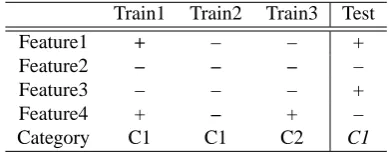
The classification process is illustrated in general terms in table 1, which shows three training instances and a test in-stance. The features can take the values plus or minus. The reader is encouraged to look for feature values that are the same for the test instance and the training instance. The test instance matches Train1 on Feature1 and Feature2, and it matches Train2 on Feature2 and Feature4, while Train3 only matches on Feature2. Thus, Train1 and Train2 constitute the set of nearest neighbors for Test. Since the majority (in this case all) of the nearest neighbors share the C1 category, this category is also selected for the Test in-stance.
Train1 Train2 Train3 Test
Feature1 + – – +
Feature2 – – – –
Feature3 – – – +
Feature4 + – + –
Category C1 C1 C2 C1
Table 1: Classification based on nearest neighbors.
4.
Anaphora Resolution
We use a corpus which has been automatically annotated for part-of-speech tags and syntactic categories, and hand annotated for coreference. The algorithm was trained on a subset of 41970 tokens, of which 35780 were words and the rest typographical annotations. From these 35780 words, we have 11831 markables (potential members of reference chains).
In order to experiment with a more limited material, we selected a set of pronouns which had all been marked either with or without an antecedent. Pronouns with-out antecedents refer to something not present in the (preceding) text. The chosen pronouns were han “he”, hun, “she”, seg “himself/herself/itself/themselves”, den “it” masc./fem., and de “they”. The set of pronouns consisted of 2199 anaphor candidates, of which 2129 were marked with a coreferential antecedent in the text. Cataphors were excluded from the training set.
4.1. Salience
Mar-tin, 2000, pp.678–684). We use information from a ma-chine annotated corpus, so not all of these factors necessar-ily have correct values. The factors are as follows (see also table 3):
• Do the lemmas of the anaphor candidate and the antecedent
candidate match?
• Do the anaphor candidate and the antecedent candidate have
the same
– syntactic function?
– grammatical gender? (We also want to add natural gen-der in the future.)
– number?
• Is the anaphor candidate a distinctly human pronoun (han
“he” or hun “she”) and the antecedent candidate a proper name?
– If so, do they have the same (natural) gender?
• Is the anaphor candidate a reflexive and the antecedent
can-didate its closest subject?
• Is the antecedent candidate a subject?
• Is the number of sentence boundaries, as detected by the
tagger (e.g. some conjunctions, and punctuation), between anaphor and antecedent candidates
– less than 2?
– less than 3?
• The lemmas of the anaphor and the antecedent candidates
concatenated
Note that we have no information about natural gender for lexical noun phrases, which is information we would want to have, in addition to grammatical gender. Various ways of finding the natural gender (Hale and Charniak, 1998, inter al., for English) will be tried out later in our project. Since we are using memory-based learning for this task, the full impact of each feature is determined after the near-est neighbors have been found. A feature that is highly valuable in some contexts may simply not add anything in other contexts, for example if all the selected nearest neighbors contain the same feature. This is an advantage of memory-based learning, since it does not rely heavily on global statistics. TiMBL may also weigh features by their informativeness, by calculating the information gain of each feature (i.e. how much we gain in classification ac-curacy by knowing the value of the feature). Still, TiMBL is essentially a selection mechanism and not a probabilistic mechanism.
4.2. Percolation
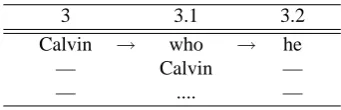
A strategy to percolate most of the matching features to the next referring expression in a chain was adapted. This means that the most recent antecedent candidate matches the union of its own matching features and those of the pre-ceding antecedent candidates of the same chain. Sometimes information is not available immediately, but will be known after we have established coreference (see table 2) .
3 3.1 3.2
Calvin → who → he
— Calvin —
— .... —
Table 2: Percolation of Calvin to who
Take for example the following discourse, adapted and translated from a folk tale: ”[Three brothers lived in a for-est.] The oldest was calledAdam1, the secondBert2, and the youngestCalvin3,who3.1used to tend to theashes4. TheSunday5when thenotice6from theKing7about the
ship8was posted,he3.2happened to be there. Whenhe3.3 came home and told aboutit6.1,Adam1.1wanted to set out immediately, and prepared somef ood9for thejourney10. Forhe?wanted to find out ...”
The second time that he refers to Calvin at point3.2, the information from the first mention of Calvin at point3has been percolated to the who at 3.1. After linking up, the information in3.2contains the (lemma)/name ”Calvin”, the functional roles of position 3 (predicate filler), 3.1 (subject), and 3.2 (subject), as well as the number (singular), and the gender (masculine).
feature 3 3.1 3∪3.1 match on
lemma – – –
syn.func. – + +
gender – – –
number + + +
human pro.
and prop. + – +
and gen – – –
refl+subject – – –
subject-ant – + +
dist. <2 + + +
dist. <3 + + +
Table 3: Match between he at 3.2. and antecedents Calvin(3), or who (3.1), or3∪3.1) with percolation
are not percolated, but contain the value of the candidate antecedent and the anaphor.
Table 4 shows the match vectors, after percolation, for
he? matching with either Adam or Calvin. As can be seen, Calvin matches on more features than Adam. Still, Adam might be selected as antecedent because it is closer to the anaphor. This is due to the fact that the search for an antecedent moves backwards in the text, starting at the anaphor and stopping as soon as there is a positive classifi-cation. Hence, if the match vector for Adam has more pos-itive than negative nearest neighbors in the instance base, Adam will be selected as antecedent, and Calvin will never be considered.
feature 1.1 3.3
match on
lemma – +
syn.func. + +
gender – +
number + +
human pro.
and prop. + +
and gen – –
refl+subject – –
subject-ant + +
dist. <2 – –
dist. <3 + –
Table 4: Match vectors for he?, with Adam1.1, and
he3.3/Calvin
Two important points are illustrated. First, that a closer an-tecedent will have an advantage, because it will be selected before its competitors if TiMBL decides for it, since the search for an antecedent is stopped when there is a positive classification. Second, that the final categorization does not depend on how many matches are recorded, but on how the full vector and its neighbors have been classified previ-ously. A last point is that proper names are assumed to be in the singular; however, for some types of proper names (e.g. organizations) the number feature may have a different de-fault than singular, or may come from a knowledge base. This is crucially an issue of what our lexical resources will deliver.
5.
Training and Testing
Several different combinations of the available features were tried, and the previously presented 9 features were those that gave the highest scores. They are most likely not the optimal features, but they are the features that are available in our machine tagged example collection. We have only scored hits on the closest antecedent in a chain, whereas it could be argued that a hit on any antecedent in a chain would suffice.
Feature percolation allows previously found antecedents of a chain to influence the decision on anaphoric status. Fea-tures percolate and accumulate towards the most recent member of a chain.
Training consists of providing postive and negative exam-ples to the memory-based learner. Positive examexam-ples are
pairs of anaphor and antecedent candidates, described by how they match on the features we have decided to include. Negative examples are pairs consisting of an anaphor and any markable that is closer to the anaphor than the actual antecedent. Typically, there are many more negative exam-ples than positive examexam-ples.
In testing, we start searching from the pronoun (or potential anaphor, in the more general case of coreference detection) backwards in the text until the algorithm finds a markable that is classified as an antecedent for the pronoun. The clas-sification decision is binary, so we assign the first found candidate marked by the mechanism as an antecedent. We have experimented with using the strength of the classifica-tion decision (recalculated into z-scores, for general com-parison), but this did not improve the results and was aban-doned.
The classification decision is simplistic: The memory-based learner is consulted for each markable that is en-countered. If the positive nearest neighbor examples in the database outvote the negative examples, the classification is a yes, otherwise a no. When the mechanism says yes, there is no need to search further.
The results of our cross-validation experiments are shown in table 5. The overall F-measure is 62.14. It should be noted, however, that the system performs much better in those cases where the anaphor and the antecedent are iden-tical than in cases where they are not ideniden-tical. Closely related to this observation is the fact that in 78% of the test cases, the classifier selects an antecedent that is identical to the anaphor. This strong tendency to select identical pairs is likely due to the fact that 67% of all manually annotated anaphor–antecedent pairs in the training data fit this charac-teristic. This is particularly noticeable for han “he” and hun “she”, which also account for 78% of the relevant pronouns. The problem with this pattern is that we often miss many of the more interesting pairs, where there is a non-pronoun as antecedent. The examples favor a negative classification, simply because this is correct most of the time. A sim-ple bias towards positive answers will hurt our precision, but this could be worth it if we could quantify how much more such a pair is worth. This is a highly task dependent decision. In many tasks, chains containing only pronouns would not make much difference, whereas a correct chain that links with keywords would be highly valuable (for ex-ample in estimating the topic of a paragraph).
Selection Proportion Recall Precision F-measure
Identical anaphor-antecedent 67% 83.95 78.88 81.31
Non-identical anaphor-antecedent 33% 40.75 40.32 40.51
All cases 100% 62.12 62.18 62.14
Table 5: Results from 10-fold cross-validation experiments.
research (Markert and Nissim, 2005; Markert et al., 2003, inter al.) has shown that the web provides very good cov-erage, even compared to very large corpora with extensive mark-up, such as the British National Corpus. We will look into how we can use the web to gain more detailed and use-ful information with a high degree of coverage. Another source of information are lists, which are available on the web via various government organizations.
6.
Integrating Automated Coreference
with easy Editing
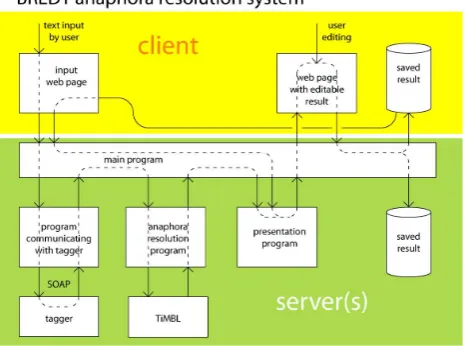
The process of finding coreference chains starts up sev-eral subprocesses: format the text, analyze the text to find the needed features, create representations, and match vec-tors for each anaphor-antecedent candidate, and then start a TiMBL server that will provide the decisions as to which pairs could be considered coreferent.
Figure 1: System architecture
The result of the analysis is an interactive web page where the user may point at a candidate noun phrase (indicated by a grey box) and see the requested information. For ex-ample, the user may request to look at referents before and after the selected candidate, but only the nearest referents. The available choices for direction are to 1) show only an-tecedents (preceding the selected), and 2) anaphors (suc-ceeding the selected candidate) or 3) to choose both an-tecedents and anaphors for display. The depth of the anal-yses may either be 1) only the nearest available candidates, or 2) the whole reference chain.
At the moment, the success rate for automatically finding complete reference chains is low, but we hope to improve this using a variety of techniques.
6.1. Editing the automatic suggestion for coreference
The relations the machine has found may easily be edited. Selecting two markables with a link between them unlinks
them, and any intermediate candidates between them keep their internal links. For example, consider a coreference chainA←B←C←Dsuggested by the automatic coref-erence finder. SelectingD and thenAcreates a new link between them. ThenDcannot continue to be linked toC, andB cannot continue to be linked toA, because of the constraint that chains should have no branching. This re-sults inA←DandB←Cas two separate chains . If we instead had decided to unlinkDfromC(by first selecting
Dand thenC) we would be left withA←B←C, andD. Just select the two words you wish to link, or unlink. The action of linking or unlinking is based on whether there ex-ists a relation or not. If the user selects (clicks on) two noun phrases (grey rectangles) that are already related, the ex-isting relation is removed. If the user clicks on two noun phrases that are not related, a relation between the noun phrases is added. When a relation is added any conflict-ing relations are automatically removed. Conflicts arise when relations form branches. The system allows relations to form chains, but not branches, i.e, a noun phrase can-not have more than one antecedent and can-not more than one anaphor. Another constraint is that relations can only run in one direction, i.e, anaphor follows antecedent (and click-ing the two noun phrases in different order will not change that).
Enforcing the structure of coreference chains facilitates editing the chains. For example, our current rules do not allow chains to branch, which then implies unchaining in-termediate candidates when needed.
The user can save the result at any point. The result is saved as a file to the user’s computer, with a copy stored at the server, thus helping us to extend our database. The user can later upload her/his file for further editing.
After the editor is satisfied with the result, the annotated text can be stored in a format that includes the efforts of the mechanisms used (e.g. part-of-speech tagging, and func-tional roles) as well as the final annotation of coreference. The final result is presented as an xml-tagged file, which is available for both the editor, and the research group that provided the mechanism over the net. We hope this will lead to increased co-operation in creating larger databases of coreference in multiple languages. We are tentatively investigating the possibility to bootstrap models for newly added languages, by utilizing examples from other ana-lyzed languages. This seems feasible, since most of the features we are currently using are based on the concept of match, and not on storing the feature value itself.
6.2. The demonstrator as an editor for other projects
for chain structures might use our demonstrator to do the work. The user who wants to use the editor for other projects should beware that ”difficult” attribute values (characters like ’<’, ’>’ and ’&’, ’) are encoded as html entities (’<’, ’>’ and ’&’). The system has not been tested with editing on data without ’feature’ and ’lemma’ attributes.
Example xml input: Grunnen er et kjemisk middel The reason is a chemical substance
<?xml version=”1.0” encoding=”UTF-8”?> <data>
<br/>
<np id=”np0”>
<word features=”subst mask be ent” id=”w0” lemma=”grunn”> Grunnen
< /word> < /np>
<word features=”verb” id=”w1” lemma=”være”> er
< /word>
<np id=”np1”>
<word features=”det nøyt ent kvant @det>” id=”w2” lemma=”en”>
et < /word>
<word features=”adj nøyt ub ent pos @adj>” id=”w3” lemma=”kjemisk”>
kjemisk < /word>
<word features=”subst appell nøyt ub ent @s-pred” id=”w4” lemma=”middel”>
middel < /word> < /np>
< /data>
7.
Conclusion
We have shown a demonstrator for handling coreference and anaphora. The demonstrator is mainly targeted at Nor-wegian bokm˚al. The automatic annotation of anaphora is work in progress. Improvement of this subtask will need lexical and semantic resources with a high coverage, and we have pointed out the web as a likely source of such in-formation. The demonstrator contains a graphical editor that can be used to quickly edit reference chains. The re-sults are stored at the server so that we can use the rere-sults to improve our database, and it is also sent to the user as a community service. There is also a possibility to use our demonstrator to edit any chain structure which is encoded in the correct format in an xml-file.
Acknowledgements The BREDT project is supported by a grant from the Norwegian Research Council under the KUNSTI programme to the last author. The first author is supported by a Ph.D. grant from the University of Oslo. A demonstrator of early results for anaphora resolution is available from http://bredt.uib.no
8.
References
Chinatsu Aone and S. Bennett. 1995. Evaluating auto-mated and manual acquisition of anaphora resolution strategies. In Proceedings of the 33rd Annual Meeting of the Association for Computational Linguistics, pages 122–129.
C. Cardie and K. Wagstaff. 1999. Noun phrase coreference as clustering. In Proc. of the joint SIGDAT Conf. on Em-pirical Methods in NLP and Very Large Corpora, pages 82–89.
W. Daelemans, J. Zavrel, K. van der Sloot, and A. van der Bosch. 2004. TiMBL: Tilburg Memory-Based Learner, Version 5.1, Reference Guide. Technical Report ILK 04–02, the ILK Group, Tilburg, the Netherlands. B.J. Grosz, A. Joshi, and S. Weinstein. 1995. Centering:
A framework for modeling the local coherence of dis-course. Computational Linguistics, 21(2):203–225. K. Hagen, J. Bondi Johannessen, and A. Nøklestad. 2000.
A Constraint-Based Tagger for Norwegian. In C.-E. Lindberg and S. Nordahl Lund, editors, 17th Scan-dinavian Conference of Linguistics, volume 19(I) of Odense Working Papers in Language and Communica-tion, Odense.
J. Hale and E. Charniak. 1998. Getting Useful Gender Statistics from English Text. Technical Report CS-98-06, Comp. Sci. Dept. at Brown University, Providence, Rhode Island.
J.R. Hobbs. 1978. Resolving pronoun references. Lingua, 44:311–338.
J. Bondi Johannessen, K. Hagen, ˚A. Haaland, A. Bj¨ork J´onsdottir, A. Nøklestad, D. Kokkinakis, P. Meurer, E. Bick, and D. Haltrup. 2005. Named entity recogni-tion for the mainland scandinavian languages. Literary and Linguistic Computing, 20(1):91–102.
C. Johansson and A. Nøklestad. 2005. Detecting Refer-ence Chains in Norwegian. In Proceedings of the 15th NoDaLiDa Conference, pages 1–10, Joensuu, Finland. University of Joensuu electronic publications in linguis-tics and language technology.
D. Jurafsky and J.H. Martin. 2000. Speech and Language Processing. Prentice Hall, New Jersey.
C. Kennedy and B. Boguraev. 1996. Anaphora for every-one: Pronominal anaphora resolution without a parser. In Proceedings of the 16th International Conference on Computational Linguistics., Copenhagen, Denmark. S. Lappin and H. J. Leass. 1994. An algorithm for
pronom-inal anaphora resolution. Computational Linguistics, 20(4):535–561.
K. Markert and M. Nissim. 2005. Comparing knowledge sources for nominal anaphora resolution. Computational Linguistics, 31.
K. Markert, N. Modjeska, and M. Nissim. 2003. Using the web for nominal anaphora resolution. In EACL Work-shop on the Computational Treatment of Anaphora, cite-seer.ifi.unizh.ch/markert03using.html.
J. F. McCarthy and W. G. Lehnert. 1995. Using decision trees for coreference resolution. In C. Mellish, editor, Proceedings of the Fourteenth International Conference on Artificial Intelligence, pages 1050–1055.
Wee Meng Soon, Hwee Tou Ng, and D. Chung Yong Lim. 2001a. A machine learning approach to corefer-ence resolution of noun phrases. Computational Linguis-tics, 27(4):521–544.