Discriminant-Based MRS Banking
Stephan Oepen
♣♠and Jan Tore Lønning
♣♣Universitetet i Oslo, Boks 1102 Blindern; 0317 Oslo (Norway) ♠Center for the Study of Language and Information, Stanford, CA 94305 (USA)
{[email protected]|[email protected]}
Abstract
We present an approach to discriminant-based MRS banking, i.e. the construction of an annotated corpus where each input item is paired with a logical-form semantics. Semantic annotations are produced by parsing with a broad-coverage precision grammar, followed by manual disambiguation. The selection of the preferred analysis for each item (and hence its semantic form) builds on a notion of semantic discriminants, essentially localized dependencies extracted from a full-fledged, underspecified semantic representation.
1. Background — Motivation
Minimal Recursion Semantics (MRS; Copestake, Flickinger, Sag, & Pollard, 1999) has gained popu-larity in computational semantics for its balance of formal and computational properties. Much like similar approaches (Reyle, 1993, Bos, 1995, inter alia), MRS fa-cilitates underspecification of common scope ambiguities by means of separating dominance relations and ‘regular’ argument binding. Based on a designated type of ‘handle’ variables plus dominance constraints on how these can be realized over an otherwise flat multi-set of semantic relations, scopal relations are effectively factored out from the ‘gist’ of the semantics. MRS is used as the meaning representation language in the Norwegian LOGON project, a research initiative aiming for high-quality machine translation of tourism texts (Oepen et al., 2004).1 LOGON
pursues a relatively conventional approach to MT based on semantic transfer. A Norwegian sentence is analyzed into its MRS form. This semantic representation of the content of the Norwegian sentence is mapped into an MRS repre-sentations of the target language through semantic transfer, and subsequently realized using grammar-based generation for English. For analysis, an existing Norwegian parser (NorGram; Dyvik, 1999, Butt, Dyvik, King, Masuichi, & Rohrer, 2002) based on LFG and implemented in XLE was extended and equipped with an MRS projection (in the LFG co-description approach). For English generation, the LinGO English Resource Grammar (ERG; Flickinger, 2000) and DELPH-IN HPSG tools2 were applied. All
interface terms among LOGON components are MRS for-mulae. Despite current streams of fashion of using purely satistical methods for MT, the LOGON approach assumes that long-term success in MT will require integration of symbolic and stochastic approaches. In addition to the rule-based semantic transfer architecture, LOGON applies statistical methods for selecting and ranking between alternatives both in its parsing and generation phases.
1See ‘http://www.emmtee.net/’ for background infor-mation on the LOGON initiative, including a comprehensive bib-liography and access to the open-source core of the system.
2See ‘http://www.delph-in.net/’ for the DELPH-IN open-source repository of ‘deep’ NLP components and multi-lingual resources.
Both for project-internal diagnostics and for training of domain-specific stochastic processes, the project requires a way of manually identifying intended analyses for a set of outputs obtained from batch parsing a development cor-pus. Besides, hand-picking the target reading(s) among parser outputs, of course, also helps identify (and thus sup-press) legitimate but dis-preferred analyses. Such annota-tion immediately benefits the work on transfer (since trans-fer grammarians can focus on the analyses for each input that the NorGram developers find intended). Quite gener-ally, it results in better quality MRSs (because of the reg-ular in-depth scrutiny of each individual output). It further provides a foundation for work on training stochastic parse selection models, and we expect a medium-size MRS bank will suffice to train a domain-specific parse selection model for Norwegian. In a related spirit, Oepen, Flickinger, & Bond (2004) argue that maintaining a set of reference cor-pora in treebanked form throughout releases can be a valu-able grammar engineering and regression testing facility.
2. Discriminant-Based Treebanking
The LinGO Redwoods treebanking environment (Oepen et al., 2002; Oepen, Flickinger, Toutanova, & Manning, 2004) is a combination of two devices, viz. (i) a tree com-parison tool for HPSG analyses (similar in spirit to the SRI Cambridge TreeBanker; Carter, 1997) and (ii) the
[incr tsdb()]profiling environment (essentially a specialized database recording fine-grained parsing results obtained from aHPSGsystem; Oepen & Carroll, 2000). The LinGO Redwoods treebank of around 25,000 annotated utterances3
was constructed by batch processing domain corpora using the LinGO ERG, recording all results in [incr tsdb()], and subsequently having annotators select the preferred analy-sis for each input. Crucially, both the resulting preferences and all decisions made by annotators are recorded in the
[incr tsdb()]database.
The tree comparison tool presents annotators, one sentence at a time, with the full set of analyses produced by the gram-mar together with a condensed view of where the ambiguity
3. Variable-Free Semantics
In order to adapt the basic Redwoods approach to cross-framework MRS banking, we propose a procedure for re-ducing an MRS into ‘variable-free’ elementary dependen-cies. The main motivation for variable elimination is our goal of comparing semantic properties across multiple anal-yses, e.g. the set of competing parses for a token input, since there is no (straightforward) way of making sure that related pieces of semantics across analyses actually use par-allel variables. For example, the EPs associated to an NP constituent shared among two analyses might well inter-nally end up using distinct (albeit abstractly equivalent) se-mantic variables.
A central notion of this reduction step—moving from a full-fledged underspecified logical form to a localized depen-dency graph—is the concept of adistinguished variablein each semantic relation (EP). For most types of relations, the distinguished variable corresponds to its main index (ARG0
in MRSs), e.g. an event variable for verbal relations, a ref-erential index for nominals. Assuming further that, by and large, there is a unique relation for each semantic variable for which that variable serves as the main index (thus as-suming, for example, that prepositions, adjectives, and ad-verbs all introduce event variables of their own, which can be motivated in predicative usages at least), a set of MRSs can be broken down into a set of basic contrasting prop-erties, called semanticdiscriminants. Much like with syn-tactic discriminants (in the original LinGO Redwoods en-vironment), looking at such basic semantic contrasts can make it (a lot) easier to work out where exactly analyses differ. Adapting the Redwoods paradigm to the MRS uni-verse, discriminants for MRSs come in one of the following three forms:
(a) relationi
(b) relationirolejrelationk
(c) relationipropertyjvaluej
Here, eachrelationis the predicate name of an EP, androles
are theARG0,ARG1, et al. role labels within EPs. Further-more, (semantic)propertiesare attributes likeGEND,NUM,
TENSE, et al. inside of MRS variables, andvaluesare ap-propriate (atomic) instantiations for these properties. To extract such triples from an MRS, it is converted into a variable-free form, called anelementary dependency graph. Based on the distinguished variable notion sketched al-ready, each variable of the full MRS is coupled with its ‘representative’ relation. In a few corner cases where the uniqueness constraint on the introduction of main indices is not maintained, there usually exist linguistically moti-vated disambiguation heuristics. We commonly opt for a nominal EP, for example, as the representative relation for a referential index, rather than for the associated quantifier EP.
Furthermore, roles that take scopal arguments (h-type
vari-ables) are given a special treatment. Handle constraints of the formhi=q hj (‘equal modulo quantifier insertion’) in
an MRS express that either the two are equal or that hi
outscopeshj, i.e. formally that the formula depicted byhj
is a subformula of the formula depicted by hi. An MRS
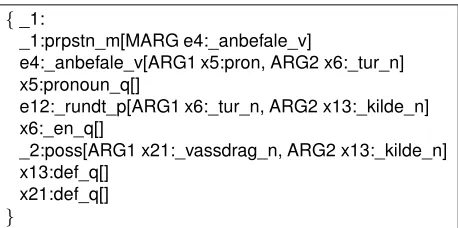
{_1:
_1:prpstn_m[MARG e4:_anbefale_v]
e4:_anbefale_v[ARG1 x5:pron, ARG2 x6:_tur_n] x5:pronoun_q[]
e12:_rundt_p[ARG1 x6:_tur_n, ARG2 x13:_kilde_n] x6:_en_q[]
_2:poss[ARG1 x21:_vassdrag_n, ARG2 x13:_kilde_n] x13:def_q[]
x21:def_q[]
}
Figure 2: Elementary dependency view on the sample MRS from Figure 1. The nodes are comprised ofMRSrelations, of which most are contributed by lexical entries but also allowing for semantic contributions from grammatical con-structions (e.g. the representation of illocutionary force by virtue of so-called messages; Ginzburg & Sag, 2000). Arcs of the dependency graph are labeled by MRS role labels (ARG1,MARGet al.).
can be viewed as a set of scopal tree fragments associated with a set of constraints (plus some general logical-form wellformedness conditions) on how handles can be equated in order to form one or more fully connected trees. In the localized dependency graphs constraints of the formhi=q hj are treated as if they were actually equatinghi andhj,
so as to directly ‘link up’ EPs in moving from the under-specified MRS to an elementary dependency graph. For grammars that only use handle constraints of the=q type,
like NorGram and the ERG in LOGON, equating their top and bottom variables is acceptable for the purpose of lo-cal dependency extraction as we will not be concerned with further scope specification.
The elementary dependency view on the MRS from Fig-ure 1 is shown in FigFig-ure 2. In this form, each relation is prefixed with its distinguished variable, where it is le-gitimate for multiple relations to share one distinguished variable—a common configuration with nominal EPs and the quantifier binding their instance variable, for example. Conversely, where variables appear as arguments within re-lations, the elementary dependency representation will con-sistenly show the one ‘representative’ relation
For overt lexical ambiguity (Norwegiankortcan be the ad-jective ‘short’ or the noun ‘card’), type (a) discriminants are often suitable, as picking either the adjectival or nomi-nal predicate is an appropriate localization of the contrast in this case. Regarding our type (b) discriminants, the ambi-guity in, say, the Norwegianen tur(‘a hike’ or ‘one hike’), would give rise to the following discriminants:
_en_q ARG0 _tur_n udef_q ARG0 _tur_n card(1) ARG1 _tur_n
Here the semantic contrast is reflected in the alternation of quantifiers potentially binding the _tur_nentity (where
_en_q is a plain indefinite, and udef_qis the grammati-cized, covert definite used in conjunction with cardinal adjectives. Likewise, the card(1)intersective modifier on
in principle suffice, but when choosing among quantifiers it will typically be a lot easier for annotators to judge a con-trast when the quantifier is actually coupled with the repre-sentative predicate of the entity bound by the quantifier. Finally, our third type of MRS discriminants, type (c), con-trasts properties within the main index (ARG0, i.e. the dis-tinguished variable) of a single relation. For a nominal re-lation that is ambiguous between a singular or plural inter-pretation (Norwegiandyr, ‘animal’ or ‘animals’), we might see something like:
_dyr_n NUM sg _dyr_n NUM pl
In terms of actual annotation practice, we find it conve-nient to present discriminants in a ‘staged’ process, where annotators can advance from less specific to more specific discriminants—types (a) to (c)—as they see fit.
Using discriminants over a set of MRSs corresponding to the competing analyses of a single input, annotation of the intended reading(s) can now be accomplished by virtue of binary (and more or less independent) decisions on indi-vidual discriminants, where each decision selects or rejects a sub-set of the available analyses. Toggling the singu-lar_dyr_nin the example above to ‘yes’, say, will reduce the set of active trees only to those compatible with this property. Typically, a relatively small number of decisions among discriminants allows one to fully disambiguate (aka identify the preferred analysis from) even large sets of anal-yses. Finally, to cope with situations where the same se-mantic predicate is used more than once in an MRS (which is not uncommon for quantifiers, for example), we require that each instantiated semantic relation (EP) be linked to the ‘surface’ form(s) that gave rise to this piece of seman-tics in one fashion or another. In LOGON, the analysis sys-tem straightforwardly associates each constituent (lexical or phrasal) with a sequence of token identifiers (pointing back to the underlying basic building blocks for this con-stituent), such that EPs projected off such constituents will remain distinguishable even where they share the same se-mantic predicate.
4. MRS Banking — Current State of Play
We have implemented the elementary dependency reduc-tion and extracreduc-tion of semantic discriminants as part of building the LOGON MT system. Already, the resulting discrimant-based MRS comparison tool has been used ac-tively in grammar and system development, specifically by the transfer team when presented with a set of candidate readings for a token input. More recently, we have coupled the MRS comparison tool with the[incr tsdb()]Redwoods environment and thus created the infrastructure for actual MRS banking.
Figure 3 presents the (HTML interface to the) Redwoods MRS banking environment. In the state shown here, our ex-ample sentence has already been partially disambiguated: the[4 : 6] display in the summary line indicates that four analyses remain active—i.e. compatible with discriminant decisions made so far—while six have already been re-jected. There are two remaining sources of ambiguity in
this example, viz. (a) the choice of analyzingenas an indef-inite or (singleton) cardinal and (b) the contrast of attach-ing therundt(‘around’) PP within the object NP or to the verbal projection. In terms of corresponding semantic dis-criminants, this ambiguity manifests itself in variation for theARG1value of the_rundt_pdependency triple, where in one reading the argument of the PP modifier is an entity (_tur_n; ‘hike’) and in the other it is an event (_anbefale_v; ‘recommend’).
In order to meet some of the LOGON objectives sketched in Section 1 above (in-depth scrutiny of semantic forms, iden-tification of unwanted readings, and creating infrastruc-ture for stochastic modelling), we are about to start MRS banking on part of the LOGON development corpus (some 5,000 sentences of running text on back-country activities in Norway). At this phase, the focus of our MRS banking activities will be on confirming the utility of the approach. It will be particularly interesting to compare MRS bank-ing efficiency to ‘traditional’ Redwoods treebankbank-ing, both in terms of the initial learning curve for annotators, as well as in terms of annotator throughput and consistency.
5. Discussion — Outlook
We have presentend an adaption of the discriminant-based Redwoods approach of semi-automated treebank construc-tion to the semantic realm. Based on a noconstruc-tion of reducing a logical-form semantics into a localized, ‘variable-free’ de-pendency graph, we have proposed three types of basic se-mantic discriminants. We conjecture that simple sese-mantic contrasts will prove equally easy to judge by non-expert annotators and, furthermore, that the specific types of dis-criminants developed in Section 3 will strike a good balance of formal power and simplicity. In other words, we believe that these three basic types will always be sufficient to fully resolve all kinds of ambiguities presented in semantic forms delivered by grammars like NorGram or the ERG while the total set of discriminants for any given input will be small enough for annotators to navigate at ease.
complement. Semantically, there is only one event though (the ARG0of an_arrive_vEP or something, whose tense and aspect properties may be further specified by the auxil-iary). Thus, in terms of their semantics, the two distinct parse trees would collapse at the level of the MRS pro-jection, and there would not be semantic discriminants to choose either analysis. From a purist (semanticist) point of view, such an ambiguity could be considered spurious, and at least in the LOGON approach to MT, there is no way for grammar-internal distinctions that are not reflected in the MRS interface terms to affect downstream processing. At the same time, there will often be good linguistic (or grammar-internal) reasons calling for such ‘spurious’ am-biguity, or the granularity of semantic description simply remains insufficient.
To the extent that one reason to treebank (or MRS bank) is to build annotated training material for stochastic processes—a parse selection model, say, to identify likely readings—there is no way of predicting which level of rep-resentation will be best-suited for a stochastic model to cap-ture frequency distributions. The TrePil treebank of full LFG analyses (and likewise the original Redwoods HPSG treebanks) facilitates training of richer stochastic models, in the sense that they can condition on arbitrary c- or f-structure properties (and potentially MRS aspects too, of course). Conversely, an MRS bank built using the ap-proach presented presently would limit the inventory of features accessible to a stochastic MRS selection model to just properties of MRSs. On the one hand, such a model would only see a reduced granularity of linguistic variation among competing outputs; on the other hand, it would also be confronted with less ambiguity (as ‘spurious’ MRS du-plicates can be eliminated mechanically) and it would, at the same time, be trained on the actual, downstream ap-plication task—viz. ranking competing semantic hypothe-ses, irrespective of underlying syntactic structures. It is impossible to predict strong and weak points of either ap-proach to parse selection, and we expect to investigate both paradigms in the remaining project duration.
Acknowledgments
The work presented here is embedded in a large collabora-tive effort, specifically the original Redwoods research, the LOGON consortium, and the larger DELPH-IN commu-nity. We are grateful to numerous colleagues and friends for inspiration and helpful discussions. Specifically, Dan Flickinger, Victoria Rosén, Francis Bond, and Rob Malouf have had a great deal of influence on this work.
References
Bond, F., Fujita, S., Hashimoto, C., Kasahara, K., Nariyama, S., Nichols, E., Ohtani, A., Tanaka, T., & Amano, S. (2004). The Hinoki Treebank. A treebank for text understanding. InProceedings of the 1st Interna-tional Joint Conference on Natural Language Processing
(pp. 158 – 168). Hainan, China.
Bos, J. (1995). Predicate logic unplugged. In Proceed-ings of the tenth Amsterdam colloquium(pp. 133 – 142). Amsterdam, The Netherlands.
Butt, M., Dyvik, H., King, T. H., Masuichi, H., & Rohrer, C. (2002). The Parallel Grammar project. InProceedings of the COLING Workshop on Grammar Engineering and Evaluation(pp. 1 – 7). Taipei, Taiwan.
Carter, D. (1997). The TreeBanker. A tool for supervised training of parsed corpora. InProceedings of the Work-shop on Computational Environments for Grammar De-velopment and Linguistic Engineering. Madrid, Spain. Copestake, A., Flickinger, D., Sag, I. A., & Pollard, C.
(1999). Minimal Recursion Semantics. An introduction.
In preparation, CSLI Stanford, Stanford, CA.
Dyvik, H. (1999). The universality of f-structure. Discov-ery or stipulation? The case of modals. InProceedings of the 4th International Lexical Functional Grammar Con-ference.Manchester, UK.
Flickinger, D. (2000). On building a more efficient gram-mar by exploiting types.Natural Language Engineering,
6 (1), 15 – 28.
Ginzburg, J., & Sag, I. A. (2000). Interrogative investiga-tions. The form, meaning, and use of English interroga-tives. Stanford, CA: CSLI Publications.
Oepen, S., & Carroll, J. (2000). Performance profiling for parser engineering. Natural Language Engineering, 6 (1), 81 – 97.
Oepen, S., Dyvik, H., Lønning, J. T., Velldal, E., Beer-mann, D., Carroll, J., Flickinger, D., Hellan, L., Johan-nessen, J. B., Meurer, P., Nordgård, T., & Rosén, V. (2004). Som å kapp-ete med trollet? Towards MRS-based Norwegian – English Machine Translation. In Pro-ceedings of the 10th International Conference on Theo-retical and Methodological Issues in Machine Transla-tion. Baltimore, MD.
Oepen, S., Flickinger, D., & Bond, F. (2004). Towards holistic grammar engineering and testing. Grafting tree-bank maintenance into the grammar revision cycle. In
Proceedings of the IJCNLP workshop Beyond Shallow Analysis. Hainan,China.
Oepen, S., Flickinger, D., Toutanova, K., & Manning, C. D. (2004). LinGO Redwoods. A rich and dynamic treebank for HPSG. Journal of Research on Language and Com-putation,2(4), 575 – 596.
Oepen, S., Toutanova, K., Shieber, S., Manning, C., Flickinger, D., & Brants, T. (2002). The LinGO Red-woods treebank. Motivation and preliminary applica-tions. InProceedings of the 19th International Confer-ence on Computational Linguistics. Taipei, Taiwan. Reyle, U. (1993). Dealing with ambiguity by
under-specification. Construction, representation, and deduc-tion. Journal of Semantics,10, 123 – 179.