Developments in the TIGER Annotation Scheme
and their Realization in the Corpus
Sabine Brants , Silvia Hansen
Computational Linguistics, Saarland University Postfach 151150, 66041 Saarbr¨ucken, Germany
sabine, hansen @coli.uni-sb.de
Abstract
This paper presents the annotation of the German TIGER Treebank. First, issues concerning the annotation, representation as well as querying of the treebank are discussed. Within this context, the annotation tool ANNOTATE, the export and XML formats of the TIGER Treebank and the TIGER search tool are briefly introduced. Secondly, the developments of the TIGER annotation scheme and their realization in the corpus are introduced focussing on the differences between the underlying NEGRA annotation scheme and the further developed TIGER annotation scheme. The main differences are concerned with verb-subcategorization, coordination, appositions and parentheses as well as proper nouns. Thirdly, the annotation scheme is assessed through an evaluation and a problem discussion of the above mentioned changes. For this purpose, inter-annotator agreement in the TIGER project has been analyzed focussing on exactly these changes. This analysis shows where the annotators’ decision problems are. These difficulties are discussed in greater detail on the basis of annotation examples. The paper concludes with some suggestions for the improvement of the TIGER annotation scheme.
1.
Introduction
There has been an increasing interest in recent years in the enrichment of natural language corpora in terms of an-notation with syntactic information. One of the best known treebanks is the English Penn Treebank (Marcus et al., 1994) - but comparable treebanks exist for English, such as the Susanne Corpus (Sampson, 1995), the Lancaster Parsed Corpus (Leech, 1992) and the British part of the Interna-tional Corpus of English (Greenbaum, 1996), as well as for other languages, such as the Prague Dependency Treebank for Czech (Hajic, 1999). Recently, treebank projects for other languages have come to life as well, e.g. for French (Abeill´e et al., 2000b), Italian (Bosco et al., 2000), Span-ish (Moreno et al., 2000), TurkSpan-ish (Oflazer et al., 1999) and Russian (Boguslavsky et al., 2000). More initiatives for lin-guistically interpreted corpora can be found in (Uszkoreit et al., 1999) and (Abeill´e et al., 2000a).
For German there are three syntactically annotated cor-pora: the Verbmobil Corpus (Wahlster, 2000), the NEGRA Corpus (Skut et al., 1998) and the TIGER Treebank (Dip-per et al., 2001). Since the Verbmobil Corpus is rather restricted in its domains (i.e. spontaneous speech for the appointment negotiation domain) and the NEGRA Corpus in its size (20,000 syntactically annotated sentences), the annotation of the TIGER Treebank as a comprehensive re-source for German linguists was more than overdue.
2.
Annotation of a German Treebank
The basis of the TIGER Treebank are texts from the German newspaper ’Frankfurter Rundschau’. The linguis-tic annotation of each sentence in the TIGER Treebank is represented in terminal nodes (for parts-of-speech), non-terminal nodes (for phrase categories) and edges (for syn-tactic functions). Furthermore, a supplementary annotation on the word level is used to encode information on lem-mata and morphology. Secondary edges are used to encode coordination information.
In order to provide accurate results, each sentence of the TIGER Treebank is annotated independently by two an-notators followed by a consistency check. After the first project phase, the TIGER Treebank consists of approxi-mately 50,000 syntactically annotated sentences. The aim of the second project phase is to extend this amount to about 80,000 sentences.
2.1. Corpus annotation
The annotation is done with a system called ANNO-TATE (under development in the NEGRA and TIGER projects), which allows interactive parsing, i.e. a parser carries out a shallow parse and a human may disambiguate or correct the proposed parse (Plaehn and Brants, 2000). ANNOTATE uses the TnT tagger for part-of-speech tag-ging (Brants, 2000) and Cascaded Markov Models for the analysis of phrase categories (node labels) and syntactic functions (edge labels) (Brants, 1999). For the analysis of lemmata and morphological tags, ANNOTATE is inter-leaved with a tool called TigerMorph. For part-of-speech tagging as well as morphological annotation the Stuttgart-T¨ubingen-Tagset (Schiller et al., 1999) is used in a slightly modified version ((Kramp and Preis, 2000) and (Smith and Eisenberg, 2000)).
In addition to the interactive annotation combining au-tomatic probabilistic parsing and human intervention, the TIGER corpus is parsed on the basis of LFG (using the Xe-rox Linguistic Environment) followed by semi-automatic disambiguation and the conversion of the LFG annotation into the TIGER format (Zinsmeister et al., 2001).
2.2. Corpus representation
0 1 2 3 4 5 6 7 8 9 10 11
500 501 502
503 504
500 501 502
0 1 2 3 4 5 6 7
500 501 502
503
500 501 502
0 1 2 3 4 5 6 7 500
501 502
Der
ART
the Film
NN
movie "
$( Einer
PIS
one flog
VVFIN
flew übers
APPRART
over_the
Kuckucksnest
NN
cuckoo’s nest "
$(
AC NK
SB HD
PP MO
NK NK
S NK NP
Figure 7: Treatment of structured proper nouns in NEGRA
0 1 2 3 4 5 6 7
500 501
502 503
Der
ART the
Film
NN movie
"
$( Einer
PIS one
flog
VVFIN flew
übers
APPRART over_the
Kuckucksnest
NN cuckoo’s nest
"
$(
AC NK
SB HD
PP MO S
PNC
NK NK
PN NK NP
Figure 8: Annotation of structured proper nouns in TIGER
Secretary of the Interior Otto Schily [(Social-Democrats)]APP
Cases like the last one are characterized by the lack of coreference between the inserted phrase and the main phrase, the presence of which is a prerequisite for true ap-positions; the label PAR (parenthesis) has been added to the annotation scheme to cover these cases more adequately:
Innenminister Otto Schily [(SPD)]PAR
The annotation of ’true’ appositions (i.e. with corefer-ence) remains the same in TIGER.
3.4. Proper nouns
The label PN marks proper nouns, for instance ’George W. Bush’. The components of a proper noun are marked with the edge label PNC (proper noun component). In NE-GRA, the label PN was also used for multitoken company names, newspaper names (e.g. ’The New York Times’) etc. In the TIGER annotation scheme, this label was extended to titles of films, books, exhibitions etc. that have a com-plex, often sentence-like structure. In these cases, the title is structurally annotated and receives an additional parent-label PN.
Figures 7 and 8 show the different treatment of struc-tured proper nouns. The TIGER annotation scheme thus facilitates the identification of names that do not feature the part-of-speech label NE (proper noun) in one of their ter-minal nodes.
precision recall F-score
OP 91.14% 71.64% 80.22%
CVC 83.33% 80.00% 81.63%
sec SB 96.51% 91.21% 93.78%
sec OA 100.00% 100.00% 100.00%
sec HD 86.67% 78.79% 82.54%
sec MO 80.00% 77.78% 78.87%
APP 91.27% 90.55% 90.91%
PAR 93.42% 65.74% 77.17%
’new’ PN 100.00% 62.50% 76.92%
’old’ PN 93.91% 96.98% 95.42%
overall 92.84% 94.97% 93.89%
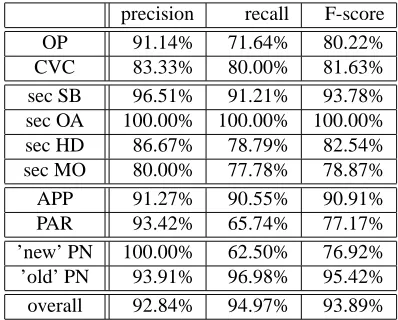
Table 1: Precision, recall and F-scores for the new labels
4.
Assessment of the annotation scheme
4.1. Evaluation
For the evaluation of the changes described in section 3., a sample of 2000 annotated sentences has been extracted. We compared two versions of this sample, namely the first version of the annotation and the final version which was annotated and compared by two annotators. The latter is taken as the true annotation. The first versions were taken from three different annotators in order to level out personal preferences. We computed precision and recall for the first annotations compared to the final version in order to inves-tigate how precise and how comprehensive the annotation can be performed on the basis of the new rules in the an-notation scheme. Additionally, we also used the F-score value (harmonic mean of precision and recall), which is an appropriate measure for inter-annotator agreement.
Table 1 contains the precision, recall and F-score values for the new labels concerning verb-subcategorization (OP, CVC), appositions and parentheses (APP, PAR), secondary edge labels (sec SB, sec OA, sec HD, sec MO) as well as proper nouns (’new’ PN). For the sake of comparison, we included precision, recall and F-scores for two additional features, namely for regular proper nouns (’old’ PN) and for the used corpus sample, taking into account all nodes, edges and labels (overall).
Comparing the values for the new labels, we can see that precision is in most cases higher than recall. This re-sult shows that the annotators do not have problems with assigning the labels correctly in simple cases. Nevertheless, they frequently miss relevant matches, which is reflected in the low recall values. Thus, the new rules guarantee a high degree of correctness for non-ambiguous phenomena (i.e. high precision) whereas the differentiation between labels in unclear cases still poses problems (i.e. low recall).
The difference between precision and recall is not in all cases significant. However, the fact that precision is higher than recall is a striking pattern in table 1. The only ex-ception for the new labels occurs for secondary edge direct objects (sec OA); for this phenomenon, we could not find an explanation.
annotation and comparison
discrepancy between annotation scheme
and data
changes in annotation scheme, tests for operationalization
Figure 9: Stages in the development of the annotation scheme
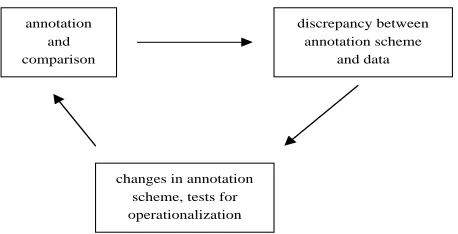
for precision. The reason for this could be that for the older labels that have been used for years, there are not that many unclear phenomena anymore since the annota-tors developed strategies and rules to disambiguate difficult cases. This assumption is also supported by the higher F-scores for the reference values; with only one exception (the already-mentioned sec OA values), the F-scores for the new labels are considerably lower than the reference F-scores. The reason for this is illustrated in figure 9: there are dif-ferent stages in the development of the annotation scheme and thus the annotation of the treebank. First, rules are de-veloped and then used in the annotation of the corpus and the subsequent comparison between the annotators. In the course of the annotation and comparison, discrepancies be-tween the annotation scheme and the corpus data become obvious. These discrepancies lead to changes in the scheme and to the development of tests for better operationaliza-tion. This cycle results in the cross-fertilization of the cor-pus and the annotation scheme. Therefore, the scheme im-proves with the number of times this cycle is run through. Therefore, we expect the new labels to show higher recall values once they have passed through the different stages of this development cycle.
4.2. Problem discussion
In the following, the annotation changes described in section 3. will be critically discussed, taking into account the values that were computed in section 4.1.. We will also show some problems that arise from the new annotation scheme. Furthermore, this section contains ideas on how to improve some of the new rules and on their extension to other phenomena.
4.2.1. Verb-subcategorization
Generally speaking, the annotation concerning the verb-subcategorization still poses some problems. The tests for the labels OP and CVC are apparently not yet suffi-ciently operationalized in order for the annotators to reach a high level of agreement. The F-score values for the verb-subcategorization labels are among the lowest in table 1.
One problem arises from the use of prepositional ob-jects in NPs. If the head of an NP is derived from a verb, the PP-complement that would be labeled ’OP’ in connec-tion with the verb is also labeled ’OP’ in the noun phrase:
tr¨aumen [vom Gl¨uck]OP der Traum [vom Gl¨uck]OP
to dream [of happiness]OP the dream [of
happi-ness]OP
The problem stems from the large amount of composite nouns in German whose main component is one of those derived nouns, but which are not themselves derived from a verb (e.g. Wunschtraum (’wish-dream’)). It is not clear whether they should be treated like the derived nouns (i.e. receive the label OP for their complements) or like other ’regular’ nouns (i.e. receive the label MNR for their PP-complements).
Furthermore, it must be considered whether the use of the label OP should be extended to PPs in adjective phrases where the adjective is derived from a verb:
der [vom Gl¨uck]OP?tr¨aumende Mann
the [of happiness]OP? dreaming man (the man who
dreams of happiness)
This would clearly add to the consistency of the anno-tation.
4.2.2. Coordination
As was shown above, the introduction of a new layer of annotation, the secondary edges, is a very useful addi-tion to the annotaaddi-tion scheme. It considerably increases the adequacy of the linguistic description. As can be seen in ta-ble 1, the secondary edge labels reach the highest F-scores among the new labels (with one exception). This means that the rules concerning the secondary edges turn out quite satisfactory.
There are, however, some inconsistencies when it comes to the inclusion of superordinated sentences in the coordination. On the one hand, there are sentences like
Steffi hat [geschlafen und getr¨aumt]CVP
Steffi has [slept and dreamed]CVP
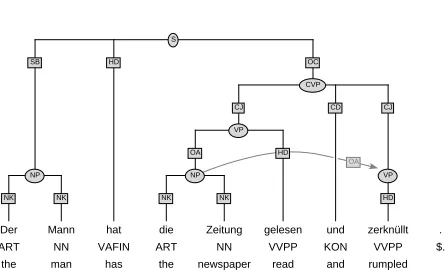
where there would be no secondary edges to indicate the eliptical character in the second part of the coordina-tion. On the other hand, trees like the one in figure 10 can be found in the corpus where the annotator went to great lengths to indicate the elipsis. One aim in the future devel-opment of the annotation scheme must be to find a common rule for these cases which also helps to avoid the excessive use of secondary edges like in figure 10.
Furthermore, it might be a good idea to indicate am-biguities in the attachment of modifiers through the use of secondary edges. This was once tried in NEGRA for a short period of time, but was unfortunately discontinued. This part of the annotation would provide valuable information about attachment ambiguities.
4.2.3. Appositions and parentheses
510 510 508 504 506 508 508
0 1 2 3 4 5 6 7 8 9 10 11 12 13 14 15 16 17 18 19 20 21
500 501 502
I. Boguslavsky, S. Grigorieva, N. Grigoriev, L. Krei-dlin, and N. Frid. 2000. Dependency treebank for rus-sian: Concept, tools, types of information. In 18th
International Conference on Computational Linguistics COLING-2000, Saarbr¨ucken, Germany.
C. Bosco, V. Lombardo, D. Vassallo, and L. Lesmo. 2000. Building a treebank for italian: A data-driven anno-tation schema. In Proceedings of the Second
Interna-tional Conference on Language Resources and Evalua-tion LREC-2000, pages 99 – 106, Athens, Greece.
T. Brants, R. Hendriks, S. Kramp, B. Krenn, C. Preis,
W. Skut, and H. Uszkoreit. 1999. Das
NEGRA-Annotationsschema. Technical report, Dept. of Compu-tational Linguistics, Saarland University, Saarbr¨ucken, Germany.
T. Brants. 1997. The NEGRA export format. CLAUS Re-port 98, Dept. of Computational Linguistics, Saarland University, Saarbr¨ucken, Germany.
T. Brants. 1999. Tagging and parsing with Cascaded
Markov Models - automation of corpus annotation.
Saarbr¨ucken Dissertations in Computational Linguistics and Language Technology (Bd. 6), Saarbr¨ucken, Ger-many: German Research Center for Artificial Intelli-gence and Saarland University.
T. Brants. 2000. TnT – a statistical part-of-speech tagger. In Proceedings of the Sixth Conference on Applied
Nat-ural Language Processing ANLP-2000, Seattle, WA.
S. Dipper, T. Brants, W. Lezius, O. Plaehn, and G. Smith. 2001. The TIGER Treebank. In Third Workshop on
Linguistically Interpreted Corpora LINC-2001, Leuven,
Belgium.
S. Greenbaum, editor. 1996. Comparing English
world-wide: The International Corpus of English. Clarendon
Press, Oxford, UK.
J. Hajic. 1999. Building a syntactically annotated corpus: The Prague Dependency Treebank. In E. Hajicova, ed-itor, Issues of valency and meaning. Studies in honour
of Jarmila Panevova, Prague, Czech Republic. Charles
University Press.
S. Kramp and C. Preis. 2000. Konventionen f¨ur die Ver-wendung des STTS im NEGRA-Korpus. Technical re-port, Dept. of Computational Linguistics, Saarland Uni-versity, Saarbr¨ucken, Germany.
G. Leech. 1992. The Lancaster Parsed Corpus. ICAME
Journal, 16(124).
W. Lezius and E. K¨onig. 2000. Towards a search engine for syntactically annotated corpora. In Proceedings of
the Fifth KONVENS Conference, Ilmenau, Germany.
W. Lezius, H. Biesinger, and C. Gerstenberger. 2002a. Tiger-xml quick reference guide. Technical report, IMS, University of Stuttgart.
W. Lezius, H. Biesinger, and C. Gerstenberger. 2002b. Tigerregistry manual. Technical report, IMS, University of Stuttgart.
W. Lezius, H. Biesinger, and C. Gerstenberger. 2002c. Tigersearch manual. Technical report, IMS, University of Stuttgart.
M. Marcus, G. Kim, M.A. Marcinkiewicz, R. MacIntyre, A. Bies, M. Gerguson, K. Katz, and B. Schasberger.
1994. The Penn Treebank: Annotating predicate argu-ment structure. In Proceedings of the ARPA Human
Lan-guage Technology Workshop, San Francisco, CA.
Mor-gan Kaufman.
A. Moreno, R. Grishman, S. L´opez, F. S´anchez, and S. Sekine. 2000. A treebank of spanish and its appli-cation to parsing. In Proceedings of the Second
Interna-tional Conference on Language Resources and Evalua-tion LREC-2000, pages 107 – 112, Athens, Greece.
K. Oflazer, D. Hakkani-T¨ur, and G. T¨ur. 1999. Design for a turkish treebank. In Proceedings of the Workshop
on Linguistically Interpreted Corpora LINC-99, Bergen,
Norway.
O. Plaehn and T. Brants. 2000. Annotate - an efficient interactive annotation tool. In Proceedings of the Sixth
Conference on Applied Natural Language Processing ANLP-2000, Seattle, WA.
G. Sampson. 1995. English for the computer. The
SU-SANNE corpus and analytic scheme. Clarendon Press,
Oxford, UK.
A. Schiller, S. Teufel, and C. St¨ockert. 1999. Guide-lines f¨ur das Tagging deutscher Textcorpora mit STTS. Technical report, University of Stuttgart, University of T¨ubingen.
W. Skut, T. Brants, B. Krenn, and H. Uszkoreit. 1998. A linguistically interpreted corpus of german newspa-per text. In Proceedings of the Conference on Language
Resources and Evaluation LREC-98, pages 705–711,
Granade, Spain.
G. Smith and P. Eisenberg. 2000. Kommentare zur Ver-wendung des STTS im NEGRA-Korpus. Technical re-port, University of Potsdam.
G. Smith. 2000. Encoding thematic roles via syntactic categories in a german treebank. In Proceedings of the
Workshop on Syntactic Annotation of Electronic Cor-pora, T¨ubingen, Germany.
H. Uszkoreit, T. Brants, and B. Krenn, editors. 1999.
Pro-ceedings of the Workshop on Linguistically Interpreted Corpora LINC-99, Bergen, Norway.
W. Wahlster, editor. 2000. Verbmobil: Foundations of
Speech-to-Speech Translation. Springer, Heidelberg, Germany.
H. Zinsmeister, J. Kuhn, and S. Dipper. 2001. From LFG Structures to TIGER Treebank Annotations. In Third
Wokshop on Linguistically Interpreted Corpora (LINC),