Query Expansion on Compounds
Bolette Sandford Pedersen
Center for Sprogteknologi, University of Copenhagen Njalsgade 80, DK-2300 S
Abstract
Compounds constitute a specific issue in search, in particular in languages where they are written in one word, as is the case for Danish and the other Scandinavian languages. For such languages, expansion of the query compound into separate lemmas is a way of finding the often frequent alternative synonymous phrases in which the content of a compound can also be expressed. However, it is crucial to note that the number of irrelevant hits is generally very high when using this expansion strategy. The aim of this paper is to examine how we can obtain better search results on split compounds, partly by looking at the internal structure of the original compound, partly by analyzing the context in which the split compound occurs. We perform an NP analysis and introduce a new, linguistically based threshold for retrieved hits. The results obtained by using this strategy demonstrate that compound splitting combined with a shallow linguistic analysis focusing on the recognition of NPs can improve search by bringing down the number of irrelevant hits.
1.
Search on Compounds in Danish – a
Query Expansion Topic
During the last decades, several researchers and developers have experimented with language technology techniques in order to improve information retrieval, cf. Gonzales et al., 1998 for an experiment with EuroWordNet and Voorhees, 1994, Voorhees, 1994, Smeaton & Quigley, 1996 for experiments concerning the use of Princeton WordNet. In these experiments, synonymy and other semantic relations such as hyponymy have been applied for enhancing queries. Also the TREC reports describe experiments with language technology in information retrieval, and they are generally neutral in their conclusions, stating that natural language processing seem to provide only quite modest results at its current stages (see for instance Strzalkowski et al., 1996, Strzalkowski et al., 1997 and Strzalkowski et al., 1998).
In this paper we apply language technology in order to improve search on Danish compounds. Compounds constitute a specific issue in search, in particular in languages where they are written in one word, as is the case for Danish and the other Scandinavian languages. For such languages, expansion of the query compound into separate lemmas is a way of finding the often frequent alternative synonymous phrases in which the content of a compound can also be expressed. In other words, if we
search for apoteksovertagelse
(farmacyFUGE1takeover, ‘farmacy takeover’),
search results containing overtagelse af apotek
(takeover of a farmacy) are presumably relevant, since the two expressions are synonymous.
Recent experiments for Swedish – a language which has the same characteristics as Danish regarding compounding – show that compound splitting improves search results substantially, mainly due to the fact that many queries
1FUGE stands for linking element which can be either -s-, -e- or zero.
containing compounds simply do not produce any search results without query expansion, cf. Chen & Gey (2003), and Dalianis (2005). In spite of these improvements in search, it is crucial to note that Dalianis gets 23% non-relevant hits when expanding to split compounds. The same scenario is reported on for Danish by Ankiro - a Danish company who develops language-based search engines for Danish, and who also performs compound splitting in several of their systems in order to improve search results (www.ankiro.dk).
Summing up, the aim of this paper is to examine how we can obtain better search results on split compounds, partly by looking at the internal structure of the original compound, partly by analyzing the context in which the split compounds occur. The experiments reported on have been carried out in the Danish research project, VID (VIden og Dokumenthåndtering med Sprogteknologi – Knowledge and Document Handling with Language Technology) in co-operation with five Danish companies, among others the technology provider Ankiro. The project was funded by the Danish Centre for IT research. A full account of the query expansion experiment will be given in Pedersen (forthcoming).
2.
Compounds and Synonymous NPs
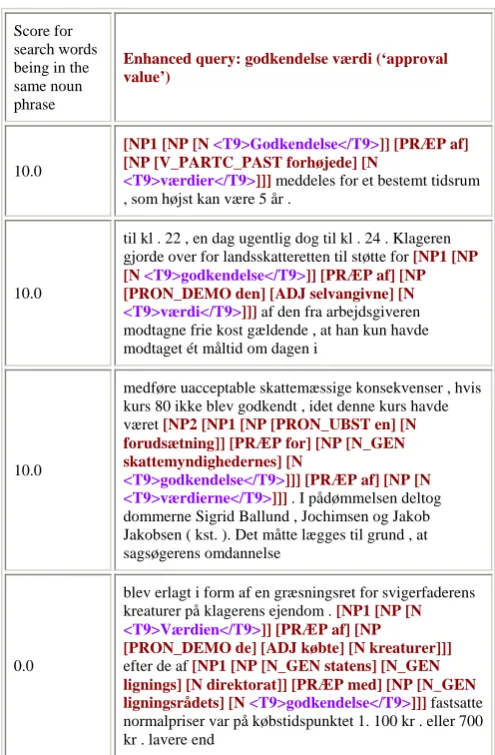
We have had two assumptions as a basis for our experiments: 1) that some compounds are more likely to have synonymous ‘split’ counterparts than others; and 2) that search results where both the search words (obtained by splitting a compound noun) occur in the same noun phrase, are more likely to contain a synonymous phrase to the original compound query.
An investigation of the first assumption calls for an analysis of the internal structure of the compound to see for instance if compounds where the head is derived from a verb act in a particular way and are eventually safer candidates for expansion than more lexicalized, non-predicative compounds. From several studies on compound nominalizations such as Levi (1978), Grimshaw (1990), Lapata (2002), and Ørsnes (1995), we know that verb-derived compounds follow certain phrase-like patterns inherited from the verb from which they are derived. It is therefore reasonable to assume that the content of verb-derived compounds is expressed also by several other phrase-like constructions - which can only be found by query expansion. Since syntactic valency features on nominalizations are encoded in the Danish computational lexicon, STO (Braasch & Olsen, 2004)2, this assumption can be pursued by associating these syntactic features to all compound heads.
To test the second assumption it is necessary to look at the context of the split compound. This strategy can be seen as a variant to the classical closeness criterion: hits where the search words are close to each other are generally better than hits where they are far apart. However, the syntactically-based criterion opens for a more fine-grained analysis where hits with the two search words far apart – but still in the same noun phrase – can be given a high priority. This is desirable for instance in example 1 where the following hit can be found for the query
apoteksovertagelse (pharmacyFUGEtakeover):
2
STO – Sprogteknologisk Ordbase is a computational lexicon for Danish negotiated through European Language Resource Association (ELRA). The lexical database contains 65.000 entries with morphological and syntactic information, cf. www.cst.dk/sto.
1) Udgifter i forbindelse med overtagelse, nyanlæg eller flytning af et apotek
Expenses in relation to takeover, foundation or movement of a pharmacy
In example 1, the two search words are five words apart and yet belong to the same, complex NP. The hit is highly relevant to the query since overtagelse ... af et apotek
(takeover ... of a pharmacy) is synonymous to
apoteksovertagelse. In contrast, in example 2 the search words are found within the distance of four words, but they do not belong to the same NP. The hit is in fact less relevant since we are no longer dealing with a synonym phrase to apoteksovertagelse:
2) Han lod ved overtagelsen foretage en optælling af apotekets varelager
He let at takeover-THE make a counting of pharmacy-THE-GEN3 stock
In 2) the two query words are in the same sentence but not in the same NP. In conclusion, the second assumption opens for a more nuanced analysis of the context in which the split compound occur. By focusing on the NP we believe it is possible to locate with greater precision the split compound occurrences which are actually synonyms to the original compound.
3.
The Test Bed
For test purposes the firm Ankiro generated a compound list of 1000 Danish compounds selecting randomly from a list of 60.000 compounds harvested from a text database, KommuneInformation, provided by the general Danish
municipalities. This database (www.kommuneinformation.dk) is a large public database
containing text material relevant to all Danish citizens such as government orders, laws, departmental circulars, as well as more general municipality information. When the experiment was run, the database contained 64 million running words. The text material is generally characterized by complex sentence structures influenced by the fact that it lies mostly within the juridical domain. All compounds were automatically split using the firm’s compound analyzer which applies a firm-specific computational lexicon and a set of exception rules. In cases of more than two lemmas in a compound, the coherent boundary was calculated in order to identify which two lemmas (of which one was itself a compound) to carry on with in search; as in aktie / beskatningsregel
(share / taxationFUGErule) in contrast to
arbejdsgiver / medlem (workFUGEgiver / member, ‘employer member’).
The query test set was modeled as a list containing (split) compounds in isolation - i.e. not with compounds as part of longer queries. The split compounds were used to search in the same database. Hits for split compounds have been defined as text excerpts where the two query words – in any inflectional form – were found within a
3
group seems to be less predictable and much more heterogeneous. In other words, some queries give very
good results, husholdningsaffald
(householdFUGErubbish) (precision:1.0, recall 0.8),
whereas others give very bad results, e.g. ledelsesstilling
(managingFUGEposition) (precision: 0.33, recall: 0.12).
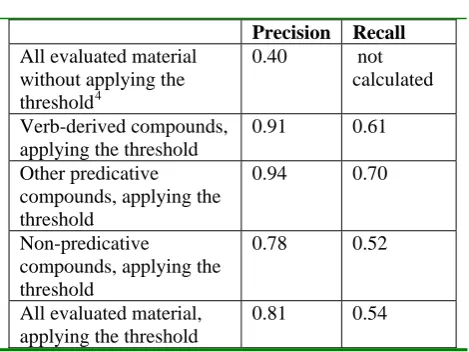
In figure 3 we sum up the test results for the three categories of compounds as well as the average precision and recall for all the evaluated categories. For comparison, the figure also contains the precision obtained when applying no threshold, i.e. when searching on split compounds without any further linguistic restrictions. It should be noted again that the relevance criterion applied is very strict; only when a hit is considered to contain a fully synonymous phrase to the original compound, the hit is categorized as relevant.
Precision Recall
All evaluated material without applying the threshold4
0.40 not
calculated
Verb-derived compounds, applying the threshold
0.91 0.61
Other predicative compounds, applying the threshold
0.94 0.70
Non-predicative
compounds, applying the threshold
0.78 0.52
All evaluated material, applying the threshold
0.81 0.54
Figure 3: Search results on enhanced compound queries
6.
Conclusions
In conclusion, both assumptions put forward seem to hold. Some compounds are more likely to have synonymous ‘split’ counterparts than others, namely compounds where the head takes arguments, as is the case for verb-derived compounds or other predicative compounds. For almost all compounds in these two groups, the split compound strategy produces search results, and they generally follow a predictable pattern relating to the subcategorisation structure of the compound head. In contrast, non-predicative compounds in many cases do not produce search results whatsoever to a split query, and when they do, the number of irrelevant hits is higher. Furthermore, this group proved to be much more heterogeneous and less predictable regarding patterns of context.
4
Precision without a threshold is calculated by taking the intersection of all the originally retrieved hits (column D in figure 3) and the relevant hits (subtracting all the non-relevant hits from the total number of hits) and dividing it by the number of originally retrieved hits.
These results relate directly to our second assumption, according to which search results where both the search words (obtained by splitting the compound) are in the same noun phrase, are more likely to contain a synonymous phrase to the original compound query. Again, the first two groups clearly demonstrate that this is the case: precision is high for these two groups meaning that very few of the documents passing the NP threshold, are irrelevant. Non-predicative compounds show a much more blurred picture, both precision and recall being lower and the results in general being very heterogeneous. One serious defect of the shallow linguistic analysis generally influenced the results negatively: the NP recognition in several cases proved to be unsuitable to the document types which include many juridical texts with very complex NPs. In future work we will experiment with an extended NP recognizer capable of recognizing complex coordinated NPs in order to see if recall can be improved without aggravating precision too much. In spite of the reservations on the technical level of the applied language tools, the experiments performed above clearly demonstrate that compound splitting combined with a shallow linguistic analysis focusing on subcategorisation information and on the recognition of NPs, can improve search by bringing down the number of irrelevant results. When we compare with the precision obtained where no threshold is applied, we see that all three categories of compounds present improved results when applying a linguistically based threshold.
Acknowledgements
Thanks to the VID project participants Bart Jongejan, University of Copenhagen, for implementing the weighting algorithm and Steen Bøhm Andersen, Ankiro, for providing the split compounds list and the corresponding search results.
References
Abney, S. (1996). Partial Parsing via Finite-State Cascades. In: Journal of Natural Language Engineering Vol. 2(4):337-344.
Braasch, A. & Olsen, S.(2004). STO: A Danish Lexicon Resource - Ready for Applications In: Proceedings of LREC-2004, 4:1079-1082, Lisboa.
Chen, A. and F. Gey (2003). Combining Query Translation and Document Translation in Cross Language Retrieval. Proceedings of CLEF Conference p. 108-121, 2003.
Dalianis, H, (2005). Improving search engine retrieval using a compound splitter for Swedish. Proceedings of Nodalida, Joensuu, Finland, May 20-21, 2005.
185-207, Kluwer Academic Publishers, The Netherlands.
Grimshaw, (1990) Argument Structure. MIT Press, Cambridge, London.
Haltrup, D. (2000). NP-genkendelse i OntoQuery.
Technical Report. Center for Sprogteknologi, Københavns Universitet.
Jongejan, B., B.S. Pedersen, C. Navarretta (2004). Automatisk analyse af Zaccos og Ankiros tekstmateriale. VID rapport no. 3, Center for Sprogteknologi, University of Copenhagen.
Lapata, M. (2002) The Disambiguation of Nominalzations. In: Computational Linguistics Vol. 28, Number 3 pp. 357-388, MIT Press.
Levi, J. (1978) The Syntax an Semantics of Complex Nominals, Academic Press. N.Y.
Pedersen, B.S. (Forthcoming). Using shallow linguistic analysis to improve search on Danish compounds. In: J. Tate (ed.) Natural Language Engineering. Cambridge University Press.
Smeaton, A. & I. Quigley (1996). Experiments on Using Semantic Distances between Words in Image Caption Retrieval, in : Proceedings of the 19th International Conference on Research and Development in IR. 174–180. Zurich, Switzerland.
Strzalkowski, T., L. Gurthrie, J. Karlgren, J. Leistensnider, F. Lin, J. Perez-Carballo, T. Straszheim, J. Wang, J. Wilding (1996). Natural Language Information Retrieval: TREC-5 Report p.291-314. The Fifth Text Retrieval Conference, NIST Special Publication.
Strzalkowski, T., F. Lin, J. Perez-Carballo (1997). Natural Language Information Retrieval: TREC-6 Report p.347-366. The Sixth Text Retrieval Conference, NIST Special Publication.
Strzalkowski, T., G. Stein, G. Bowden Wise, J. Perez-Carballo, P. Tapanainen, T. Jarvinen, A. Voutilainen, J. Karlgren (1998). Natural Language Information Retrieval: TREC-7 Report p.217-226. The Seventh Text Retrieval Conference, NIST Special Publication.
Voorhees, E. (1993). Using WordNet to disambiguate word senses for text retrieval. In: Korfhage, Robert, Edie Rasmussen and Peter Willett, eds., Proceedings of the 16th Annual ACM SIGIR Conference on Research and Development in Information Retrieval, 171–180, Pittsburgh.
Voorhees, E. (1994). Query expansion using lexical-semantic relations. In: Croft, W. Bruce and C. J. van Rijsbergen, eds., Proceedings of the 17th Annual ACM SIGIR Conference on Research and Development in Information Retrieval, 1994, pp. 61 - 69.
Ørsnes, B. (1995). The Derivation and Compounding of Event Nominals in Modern Danish – an HPSG