CSEIT1831164 | Received : 15 Jan 2018 | Accepted : 03 Feb 2018 | January-February-2018 [(3) 1 : 32-36 ]
International Journal of Scientific Research in Computer Science, Engineering and Information Technology © 2018 IJSRCSEIT | Volume 3 | Issue 1 | ISSN : 2456-3307
32
Semantics Based Automatic Check Detection
Sushant Gaikwad, Neha Bhoir, Mayuri Nimase, Jyoti Vekhande, Prof. Priya Shimpi Department of Computer Science, V.O.G.C.E, University, Mohili, Maharashtra, India
ABSTRACT
Most of the web services exist without explicit associatedsemantic descriptions. As a result many services that are relevant to a specific user service request may not be considered during service discovery. In this project, we address the issue of web service discovery given no explicit service description semantics that match a specific service request. Our approach to semantic based web service discovery involves semantic-based service categorization and semantic enhancement of the service request. ontology framework based solution achieves the functional level. Additionally, I utilize clustering for accurately classifying the web services based on service functionality
Keywords : Semantic, Ontology, Syntax-Based
I.
INTRODUCTION
large number of web services structure service oriented architecture (SOA) and facilitate the creation of distributed applications over the web. These web services offer various functionalities in the areas of communications, data enhancement e-commerce, marketing, utilities among others. Some of the web services are published and invoked in-house by various organizations. These web services may be used for business applications, or in government and military. However, this requires careful selection and composition of appropriate web services. The web services within the service registry (UDDI) have predefined categories that are specified
by the service providers. As a result, similar services may be listed under different categories. Given the large number of web services and the distribution of similar services in multiple categories in the existing UDDI infrastructure, it is difficult to find services that satisfy the desired functionality. Semantic categorization of web services will facilitate service discovery by organizing similar services together.
Semantic categorization of web services will facilitate service discovery by organizing similar services together. However, this is not sufficient to improve the selection and matching process. Most service descriptions that exist to date are syntactic in nature.. This syntax-based matchmaking returns discovery results that may not accurately match the given service request.
tagged descriptions. Second, descriptions of the vast majority of already existing web services are specified using WSDL and do not have associated semantics.
II.
SERVICE SELECTION
Service selection is differentiated into two groups namely, single service selection and composite service selection.
Only one kind of service is requested from the user to perform an autonomic task in single service selection scenarios.
All functionally appropriate services will be ranked, returning to the user a list of suggested by services ordered ranking scores.
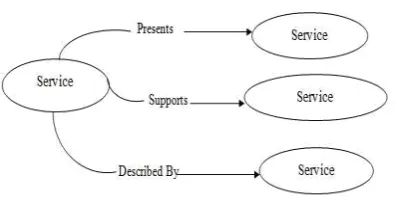
Figure 1. Service selection scenarios
III.
SEMANTIC STRUCTURE OF THE
DISCOVERY ARCHITECTURE
As shown in Fig1thecontextual information and service descriptions are expressed using a machine-readable ontology that is shared among all the entities.
To determine the JID of the discovery component, first time users/agents send a simple discovery query defined by the built-in discovery protocol to the central Jabber server, which responds with a list of supported features and services. The user/agent can utilize it according to its invocation scheme This
invocation can be manual or autonomous. In the latter case, a software agent or program inspects the results of a
discovery query, understands the necessary invocation details and invokes the service by supplying appropriate inputs. On the other hand, manual invocation requires a software agent to be pre-conjured by a human that inspects the invocation details manually and programs the agent accordingly.
IV.
EXISTING SYSTEM
To find any services or any relevant data from the web, the services use the principle of ranking in the search engine. The page which has the highest hits has a higher rank is a relevant information according to this concept but some time it may be a non –relevant data. Service discovery may involve searching a large number of categories to find appropriate services.
Therefore, we try to categorize web services based on their functional semantics instead based on the classifications of service providers. Semantic categorization of web services will facilitate service discovery by organizing similar services together. However, this is not sufficient to improve the selection and matching process.
Most service descriptions are syntactic in nature. Existing service adopt keyword- matching technologies to locate the published web services.
V.
PROPOSED SYSTEM
Presentation Modeling :
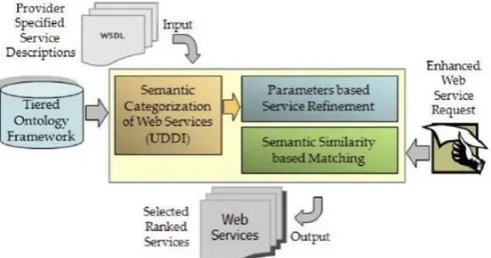
We provide a brief background of the methodologies utilized for semantic categorization of web services, parameters-based service refinement, and semantic similarity-based matching. Semantic relationship among ontology concepts is generally ranked based on three parameters including relevance, specificity, and the span of the relationship .
Relevance (Rel):
Concepts may be associated with each other with reference to multiple domains that are specific to user applications. The associated domain for a particular concept may be expressed as a high-level concept in an upper ontology.
For example, the concepts kilogram and centimeter are associated in the human domain as well as in the particle reactivity domain. These domains may be represented by the weight and size concepts in an upper ontology, respectively. Relevance comprises the associated domain concept specified by the user and is indicative of the contextual relationship between the concepts
Specificity (Sp):
The concepts are classified based on their position in the concept hierarchy. Concepts in the lower level of the hierarchy are specific concepts where the higher level concepts are termed as generic concepts. For example, the entity location may be conveyed through concepts address and postal code. Address is a generic concept where postal code is a specific concept.
Fig 2
Presentation modeling
ADVANTAGES
A simple syntax in terms of a list of keyword phrases,
Open vocabularies wherein the users can use their own words to express their information requirement.
The familiarity of the user with these interfaces due to their widespread usage.
This approach takes advantages from keyword-based search such as simplicity and from semantic web emergent technologies to automate the discovery process of web services that a large number of web service descriptions have overlapping categories. The addition of terms related to these overlapping domains creates additional noise which is not resolved by the clustering algorithm.
MODULES
The following are the list of modules, User Registration
Service Categorization Service Refinement Semantic matching
MODULE DESCRIPTION
User Registration
modules will also communication established between client and web based service.
Service Categorization
where in we combine ontologies with an established hierarchical clustering methodology. Following the service description vector a corresponding concept is located in the relevant ontology. If there is a match the concept is added to the description vector match the concept is added to the description vector.
Service refinement
The next step is service selection from the relevant category of services using parameter based service refinement web service parameter that is input, output and description and service refinement through narrowing the set of appropriate services matching the service request. The relationship between web service input and output parameters may be represented as statistical associations.
Semantic matching
The parameter-based refined set of web services is then matched against an enhanced service request as part of Semantic Similarity-based Matching process involves matching of parameter based refined set with enhanced service request. A key part of this process involves enhancing the service request. The work proposed provides an approach for semantic based discovery of Web services. We lay stress on the fact that, since users often have little knowledge about Web-service-related technologies and implementation details, a discovery framework that has a user query expressed in natural language as input is needed. Web-service-discovery-based is enabled by the framework mechanism on keywords written in natural language with no constraints about the used Web service description language.
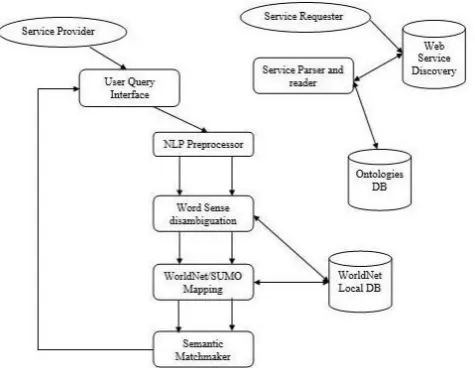
Fig 3.
Proposed system architecture
VI.
CONCLUSION
A possible approach to overcome this effect would be needed to consider addition of concepts from the ontology to only the relevant terms, accounting for context. The ontology serves as a guide for clustering that incorporates domain knowledge and more focused information. Some of our work in progress is aimed at extending our approach to service discovery, to support service invocation and workflow composition Service requests that are formed using specialized query languages. We can then match these requests to semi annotated services that are described using formats such as SAWSDL, OWL-S among others. We can also extend our work for web service composition. Typically, multiple services have to be discovered so that they together match a service request. It should be possible to utilize ontologies, and explicitly return the sequence of individual service invocations to be performed in order to achieve the desired composite service.
VII.
REFERENCES
[1]. N. Oldham, C. Thomas, A. Sheth, and K.
Verma, “METEOR-S Web Service Annotation
Framework with Machine Learning
[2]. A.V. Paliwal, N. Adam, and C. Bornhoevd, “Adding Semantics through Service Request
Expansion and Latent Semantic
Indexing,”Proc. IEEE Int’l Conf. Services Computing (SCC), July 2007.
[3]. A.V. Paliwal, N. Adam, H. Xiong, and C.
Bornhoevd, “Web Service Discovery via
Semantic Association Ranking and
Hyperclique Pattern Discovery,” Proc.
IEEE/WIC/ACM Int’l Conf. Web Intelligence, 2006.
[4]. A. Sajjanhar, J. Hou, and Y. Zhang,
“Algorithm for Web Services Matching,” Proc. Asia-Pacific Web Conference (APWeb), pp. 665-670,2004. for Information Science, vol. 41,no. 4, pp. 288-297, 1990.
[5]. G. Salton and C. Buckley, “Improving
Retrieval Performance by Relevance