by Jacqueline Young
Complementary
Medicine
FOR
by Jacqueline Young
Complementary
Medicine
FOR
About the Author
Jacqueline Youngis uniquely qualified to write this book. She has worked in
both the fields of orthodox and complementary medicine internationally for over 20 years, practising, studying, teaching, writing, researching, and serv-ing on committees.
Jacqueline is a qualified clinical psychologist, oriental medical practitioner, naturopath, and nutritionist. She is also trained in a whole host of comple-mentary therapies including herbal medicine, homeopathy, flower remedies, Tibetan medicine, Ayurveda, applied kinesiology, massage, shiatsu, iridology, nature cure, sound therapy, and various types of bodywork and healing. In between she qualified as a Sivananda yoga instructor and found time to squeeze in a brown belt in karate!
On the academic front Jacqueline holds a Bachelor’s degree in Psychology and a Master’s degree in Clinical Psychology and has completed postgradu-ate education in nutrition, epidemiology, and clinical education. She’s done her bit serving on professional committees involved in setting national stan-dards for clinical psychology, acupuncture, and nutrition. She’s taught com-plementary medicine to doctors, nurses, postgraduates, the general public, and school children – and anyone else who’s interested.
Jacqueline has practised her skills in hospitals, clinics, and health centres in several countries. She is an enthusiastic medical volunteer for Care & Share International with whom she has had the privilege of running complementary medicine clinics in a tent high in the Himalayas and in Bhopal, India.
She’s written several books on complementary medicine and often con-tributes to national magazines, newspapers, radio, television, and Web sites including BBC Health.
Jacqueline practises in central London, and is the Education Director for the Revital Health Education Centre (www.revital.com). Outside work she is still trying to master the art of growing really tasty vegetables that even her son will eat!
She’s exercised her brain, and stretched the patience of friends and family and her publishers, in writing this compendium and hopes you’ll find it handy to have around and a useful guide on your healing path.
Dedication
This book is for all those people who are willing to have an open yet discern-ing mind about complementary medicine. It is also dedicated, with thanks, to all my complementary medicine teachers, patients, students, and colleagues.
Yes, we need to explore and research complementary therapies so that we can be confident about their safety and effectiveness. Yet at the same time we should not allow barriers to be erected that may obstruct new learning and deny access to therapies that could provide a powerful healing force in our world.
Author’s Acknowledgements
I am very grateful to my family and friends who have supported me in the long time it took to write this book. Mum, Don, Mark and Ken, Issy and Jamie, Tanya, Olesya and Tommy, Irina and Alina, Titi, John and Marjie, Fred and Chris, Annie and Jake, Michael and Jasmine, Jarek and Suzie, Selina and Theo, Nic, Kirsten and Emilie, Ikuyo, Connie, Drid and Jane Garton – you’ve all played your part, even when you didn’t know it. My son, Michael, deserves a special mention because he has endlessly had to spare me to the computer, but we’ve had fun making up for it in other ways on other days too! So does Alfonse – because he always makes me laugh!
I also acknowledge my precious ‘departed family’ – you live on in my heart and are one of my motivations to work in the field of health and healing: My irreplaceable best friend Mary, my dear friend Maria, and my inspirational friend and godmother to my son, Penny Brohn. All were overcome, but not beaten, by the cruel ravages of cancer, and Penny’s outstanding and pioneer-ing work on the role of complementary medicine in cancer care lives on (www.pennybrohncancercare.org). I also credit my much-loved father, Alan Young, who introduced me to yoga and home grown veg, and my dear grandparents, who loved a good cup of comfrey tea.
(Acupuncture); Etsuko Kobira MIFA; and Anne McIntyre FNIMH. Also Dr Jovan Djurovic DO for his chiropractic exercise, Mike Burrows for his eloquent quote in the dedication, and Dr Rory Hafford MSc, PhD, Dip. Psych. for his willingness to contribute. I was always pleasantly surprised when chapters came back with virtually no red ink but take full responsibility that any remaining errors or omissions are my own.
I owe a great debt to my ‘publishing family’ too: Alison Yates, Commissioning Editor; Rachael Chilvers, Project Editor; and Mike Kelly, Developer at Wiley have been patient and helpful throughout and contributed a great deal. Thanks to Julia Lampam and Jamie McOuat (Publicity and Rights) for work-ing their magic too.
Publisher’s Acknowledgements
We’re proud of this book; please send us your comments through our Dummies online registration form located at www.dummies.com/register/.
Some of the people who helped bring this book to market include the following:
Acquisitions, Editorial, and Media Development
Project Editor: Rachael Chilvers
Development Editor:Mike Kelly
Content Editor:Steve Edwards
Commissioning Editor:Alison Yates
Executive Editor:Jason Dunne
Executive Project Editor:Martin Tribe
Brand Reviewer:Jennifer Bingham
Copy Editor:Kate O’Leary
Proofreader:Lesley Green
Cover Photo: © GettyImages/ Digital Vision
Cartoons: Rich Tennant, www.the5thwave.com
Production
Project Coordinator: Jennifer Theriot
Layout and Graphics: Carl Byers, Brooke Graczyk, Stephanie D. Jumper, Melanee Prendergast, Christine Williams
Proofreaders:Todd Lothery, Susan Moritz
Indexer: Aptara
Publishing and Editorial for Consumer Dummies
Diane Graves Steele, Vice President and Publisher, Consumer Dummies
Joyce Pepple, Acquisitions Director, Consumer Dummies
Kristin A. Cocks, Product Development Director, Consumer Dummies
Michael Spring, Vice President and Publisher, Travel
Brice Gosnell, Associate Publisher, Travel
Kelly Regan,Editorial Director, Travel
Publishing for Technology Dummies
Andy Cummings,Vice President and Publisher, Dummies Technology/General User
Composition Services
Gerry Fahey,Vice President of Production Services
Contents at a Glance
Foreword ...xxi
Introduction ...1
Part I: Finding Out about Complementary Medicine ...7
Chapter 1: Understanding Complementary Medicine ...9
Chapter 2: Diagnosing in Complementary Medicine ...19
Chapter 3: Reading Your Body ...31
Part II: Exploring Traditional Healing Systems ...39
Chapter 4: Uncovering Traditional Chinese Medicine (TCM) ...41
Chapter 5: Revealing Ayurveda’s Science of Life ...55
Chapter 6: Balancing Health with Tibetan Medicine ...71
Chapter 7: Exploring Japanese Medicine ...85
Chapter 8: Dipping Your Toes into Nature Cure ...107
Part III: Using Popular Complementary Therapies ...121
Chapter 9: Getting to the Point of Acupuncture...123
Chapter 10: Homing In on Homeopathy ...143
Chapter 11: Unearthing Herbal Medicine...161
Chapter 12: Nibbling on Nutritional Therapy ...177
Chapter 13: Diving into Naturopathy ...199
Part IV: Treating Your Body...215
Chapter 14: Opening Up with Osteopathy ...217
Chapter 15: Getting to the Crunch with Chiropractic...237
Chapter 16: Moving with Bodywork Therapies ...253
Chapter 17: Enjoying Massage Therapies ...267
Part V: Healing Your Mind and Spirit ...283
Chapter 18: Calming Down with Breathing, Meditation, and Relaxation Therapies ...285
Chapter 19: Scenting Out Aromatherapy ...297
Chapter 20: Connecting with Healing Therapies...309
Chapter 21: Getting Your Head Around Psychological Therapies ...321
Chapter 22: Feeling the Buzz of Energy Medicine ...337
Part VI: The Part of Tens ...369
Chapter 24: Ten Complementary Medicine Tips for Healthy Living...371
Chapter 25: Ten Superfoods for Great Health...377
Chapter 26: Ten Great Herbal Remedies ...383
Appendix: An A–Z Guide to
Complementary Therapies...389
Table of Contents
Foreword...xxi
Introduction...1
About This Book...1
Conventions Used in This Book ...2
Foolish Assumptions ...3
How This Book Is Organised...3
Part I: Finding Out about Complementary Medicine ...3
Part II: Exploring Traditional Healing Systems ...4
Part III: Using Popular Complementary Therapies ...4
Part IV: Treating Your Body ...4
Part V: Healing Your Mind and Spirit ...4
Part VI: The Part of Tens ...5
Icons Used in This Book...5
Where to Go from Here...6
Part I: Finding Out about Complementary Medicine ...7
Chapter 1: Understanding Complementary Medicine . . . .9
Finding Out about Complementary Medicine ...10
What do all the names mean? ...10
What is complementary medicine?...11
What’s the evidence? ...12
All in the mind? ...13
Going carefully but breaking down barriers ...13
Using Complementary Medicine ...13
Things you need to check out: Safety and effectiveness ...14
What’s complementary medicine good for? ...15
Choosing the Right Complementary Therapy...16
Counting the Cost of Complementary Therapies ...17
Chapter 2: Diagnosing in Complementary Medicine . . . .19
Finding Out about Diagnosis in Complementary Medicine ...20
Questioning ...20
Observation ...22
Physical diagnosis ...25
Complementary versus Orthodox Medical Diagnosis ...27
Taking the necessary precautions ...28
Weighing up the evidence ...29
Chapter 3: Reading Your Body . . . .31
Finding Out about Self-Diagnosis ...31
Exploring Tongue Diagnosis ...32
Reading signs of the tongue proper ...32
Observing tongue coatings ...33
Organ correspondences ...33
Tongues in Ayurvedic and Tibetan medicine ...35
Exploring Face Diagnosis ...35
Checking out face shape...35
Investigating the eyes ...35
Examining the nose ...36
Observing the mouth ...36
Considering Other Forms of Self-Diagnosis ...36
Ayurvedic urinalysis ...36
Stool analysis ...37
Taking the Necessary Precautions...37
Part II: Exploring Traditional Healing Systems...39
Chapter 4: Uncovering Traditional Chinese Medicine (TCM) . . . .41
A (Very) Brief History of TCM ...41
Understanding TCM Concepts of Health and Disease...42
Exploring yin and yang ...43
Understanding the power of qi...44
Traversing the meridians ...45
Exploring the Five Elements ...45
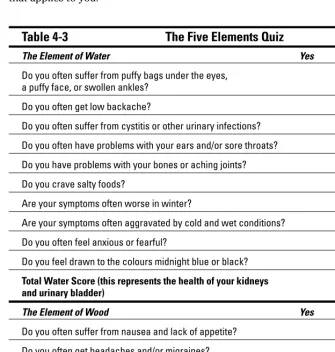
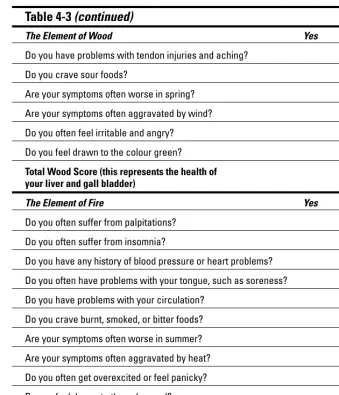
Taking the Five Elements quiz ...47
Helping yourself: Five Elements self-care...49
Diagnosing in TCM ...51
Chapter 5: Revealing Ayurveda’s Science of Life . . . .55
A (Very) Brief History of Ayurvedic Medicine...56
Deciphering Disease in Ayurvedic Medicine ...57
Understanding Your Health the Ayurvedic Way ...59
Making Diagnoses in Ayurvedic Medicine ...61
Restoring Balance with Ayurvedic Therapies ...62
Ayurvedic medicines ...64
The Panchakarma purification techniques ...65
Ayurvedic dietary therapy ...66
Lifestyle modification (pathya) ...67
Meditation and other spiritual remedies ...67
Deciding when to use Ayurvedic therapies ...68
Finding Out Whether Ayurvedic Medicine Works ...68
Finding a Practitioner of Ayurvedic Medicine...68
Chapter 6: Balancing Health with Tibetan Medicine . . . .71
A (Very) Brief History of Tibetan Medicine ...72
Grasping the idea behind Tibetan medicine...73
Understanding Tibetan medical concepts of health and disease...73
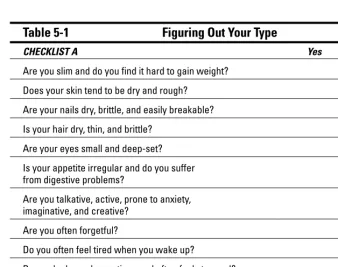
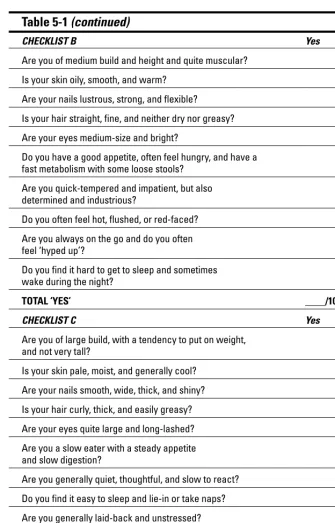
Determining Your Body Type According to Tibetan Medicine ...75
Taking the Tibetan medical humour quiz ...75
Determining your type...77
Helping Yourself with Tibetan Medicine Self-Care Approaches...78
Exploring Disease Types in Tibetan Medicine ...79
Restoring Balance with Tibetan Medicine Therapies...81
Examining the Evidence for Tibetan Medicine...82
Finding a Tibetan Medicine Physician...82
Chapter 7: Exploring Japanese Medicine . . . .85
A (Very) Brief History of Japanese Medicine...85
Deciphering Disease in Japanese Medicine ...87
Understanding Your Health – the Japanese Way ...88
Determining your type according to Japanese medicine...88
Adopting self-care for your type...89
Understanding Diagnosis in Japanese Medicine...91
Diagnosis by palpation (Setsu-shin) ...91
Diagnosis by observation (Bo-shin) ...92
Diagnosis by listening and smelling (Bun-shin) ...93
Diagnosis by questioning (Mon-shin) ...93
Restoring Balance with Japanese Therapies ...94
Japanese acupuncture and moxibustion (warming therapy)...94
Kanpo (herbal medicine) ...97
Japanese massage techniques (including shiatsu and anma)...98
Ampuku (abdominal massage and therapy)...100
Japanese manipulation techniques...101
Japanese hydrotherapy ...102
Japanese dietary therapy ...103
Spiritual medicine ...103
Deciding When to Use Japanese Therapies...104
Exploring the Evidence for Japanese Medicine...104
Finding a Practitioner of Japanese Medicine...105
Chapter 8: Dipping Your Toes into Nature Cure . . . .107
What Is Nature Cure? ...107
Deciphering Disease in Nature Cure ...110
Diagnosis in Nature Cure...111
Restoring Health with Nature Cure...112
Nature Cure dietary therapy...113
Finding out about fasting...114
Hydrotherapy: The wonders of water cure...116
Electrotherapy ...116
Heliotherapy: The healing power of the sun ...117
Air baths ...117
Other Nature Cure therapies ...118
Finding Out if Nature Cure Works ...119
Deciding When to Use Nature Cure Therapies...120
Finding a Practitioner of Nature Cure...120
Part III: Using Popular Complementary Therapies ...121
Chapter 9: Getting to the Point of Acupuncture . . . .123
Finding Out about Acupuncture...124
A (very) brief history of acupuncture ...124
Acupuncture today...125
Understanding How Acupuncture Works...125
Exploring Different Types of Acupuncture ...126
Discovering Whom and What Acupuncture Is Good For ...129
Evidence that it works ...130
When not to use acupuncture ...130
What to Expect in a Typical Consultation...131
Questioning ...131
Diagnostic methods ...132
Having acupuncture ...132
Other types of treatment...134
Finding yourself at the end of the treatment ...135
Duration and frequency...136
Knowing Whether Your Acupuncture Is Working ...136
Common Questions about Acupuncture Treatment ...136
Finding a good acupuncturist ...138
Questioning your acupuncturist ...139
Counting the cost of acupuncture...139
Acupuncture safety tips ...140
Ensuring satisfaction ...140
Helping Yourself with Acupuncture ...141
Chapter 10: Homing In on Homeopathy . . . .143
Finding Out about Homeopathy...144
A (very) brief history of homeopathy ...144
Grasping the idea behind homeopathy ...146
Homeopathy today...150
Discovering Whom and What Nutritional Therapy Is Good For ...189
Conditions that nutritional therapists treat ...189
Evidence that it works ...190
When not to use nutritional therapy ...191
What to Expect in a Typical Consultation...192
Questioning ...192
Diagnostic methods ...192
Types of treatment ...194
Duration and frequency...194
Knowing whether your nutritional therapy treatment is working ...196
Finding a Good Nutritional Therapist or Nutritionist ...196
Counting the cost of nutritional therapy...197
Ensuring satisfaction ...197
Helping Yourself with Nutritional Therapy...197
Chapter 13: Diving into Naturopathy . . . .199
Finding Out about Naturopathy ...200
A (very) brief history of naturopathy...200
Naturopathy today ...202
Grasping the idea behind naturopathy ...203
Understanding how it works...204
Exploring Naturopathic Diagnosis ...205
Finding Out about Naturopathic Treatment ...205
Discovering Whom and What Naturopathy Is Good For...207
When not to use naturopathy ...208
Evidence that it works ...208
What to Expect in a Typical Consultation...209
Knowing Whether Your Naturopathy Treatment Is Working...209
Common Questions about Naturopathy Treatment ...210
Finding a Naturopath ...211
Questions to ask your naturopath ...212
Counting the cost of naturopathy ...213
Ensuring satisfaction ...213
Helping Yourself with Naturopathy ...213
Part IV: Treating Your Body ...215
Chapter 14: Opening Up with Osteopathy . . . .217
Finding Out about Osteopathy ...218
A (very) brief history of osteopathy...218
Grasping the idea behind osteopathy ...219
Osteopathy Today...220
Exploring Different Types of Osteopathy...221
Cranial osteopathy ...221
Paediatric osteopathy...222
Feldenkrais technique ...258
Hellerwork...259
Metamorphic technique ...259
Polarity therapy...260
Rolfing ...261
Tragerwork...262
Yoga, qi gong, t’ai chi, kum nye, and do-in ...263
Zero balancing ...264
Helping Yourself with Bodywork Therapies ...265
Chapter 17: Enjoying Massage Therapies . . . .267
Finding Out about Massage ...268
A (very) brief history of massage ...268
Grasping the idea behind massage ...269
The benefits of massage ...270
Massage today ...271
Evidence that it works ...271
Exploring Different Types of Massage ...271
Understanding Massage Diagnosis ...276
Finding Out about Massage Treatment ...276
Discovering whom and what massage is good for...276
When not to use massage...277
What to Expect in a Typical Consultation...277
After the massage...278
Duration and frequency...278
Knowing Whether Your Massage Treatment Is Working...279
Common Questions about Massage Treatment ...279
Finding a Good Massage Therapist...280
Questions to ask your massage therapist ...281
Counting the cost of massage...281
Ensuring satisfaction ...281
Helping Yourself with Massage...282
Part V: Healing Your Mind and Spirit...283
Chapter 18: Calming Down with Breathing, Meditation,
and Relaxation Therapies . . . .285
Finding Out about Relaxation Therapies ...286
Looking at Popular Relaxation Therapies Today ...287
Breathing therapies...287
Relaxation therapies ...290
Meditation ...293
Chapter 19: Scenting Out Aromatherapy . . . .297
Finding Out about Aromatherapy ...298
A (very) brief history of aromatherapy...298
Grasping the idea behind aromatherapy ...299
Aromatherapy today ...300
Finding Out How It Works ...300
Exploring Different Types of Aromatherapy...301
Discovering What Aromatherapy Is Good For ...301
When not to use aromatherapy...302
Possible side effects...302
Evidence that it works ...303
What to Expect in a Typical Treatment...303
Questioning ...303
Selecting the oils ...303
Aromatherapy treatment...304
Common Questions about Aromatherapy Treatment...305
Finding a Good Aromatherapist ...306
Counting the cost of aromatherapy ...306
Ensuring satisfaction ...306
Helping Yourself with Aromatherapy ...306
Chapter 20: Connecting with Healing Therapies . . . .309
A (Very) Brief History of Healing ...309
Exploring Different Types of Healing ...310
Looking at Popular Healing Therapies Today ...311
Crystal healing ...312
Johrei ...313
Psychic healing ...313
Reiki...315
Shamanic healing...316
Spiritual healing...317
Therapeutic Touch...318
Other healing therapies...319
Helping Yourself with Healing Therapies...319
Chapter 21: Getting Your Head Around Psychological Therapies . . . .321
Finding Out about Psychological Therapies...322
Exploring Modern-day Complementary Therapies for the Mind...322
Autogenic therapy (AT) ...323
Biofeedback...323
Biorhythms...324
Brief therapy ...325
Emotional freedom techniques (EFT)...326
Part VI: The Part of Tens ...369
Chapter 24: Ten Complementary Medicine Tips for
Healthy Living . . . .371
Be Aware...371 Eat Well ...372 Boost Immunity ...372 Balance Those Bones...373 Breathe ...373 Move It! ...374 Rest and Sleep Well ...374 De-stress...375 Create and Express Yourself ...376 Satisfy Your Soul...376Chapter 25: Ten Superfoods for Great Health . . . .377
Garlic...377 Watercress...378 Ginger ...378 Nettle ...378 Sunflower Seeds ...379 Flax Seeds...379 Lecithin...380 Bioflavonoids ...380 Seaweed...380 Sprouted Seeds...381Chapter 26: Ten Great Herbal Remedies . . . .383
Camomile ...383 Dandelion ...384 Elderflower...384 Lavender...384 Parsley ...385 Peppermint ...385 Rosemary ...385 Sage ...386 Thyme...386 Valerian...387Appendix: An A–Z Guide to
Foreword
I
have known and worked with Jacqueline Young for over 10 years and have great respect for her ability to condense often very complicated issues into simple and understandable text. Complementary Medicine For Dummiesdoes just that. All sorts of claims and counter-claims are made about whether therapies work, are safe, or are just simply a ‘confidence trick’. Jackie guides us through this morass of information in a thoughtful, sensible, and humorous manner so that you really will understand what’s going on and what you might be able to safely use to help yourself.One of the great strengths of complementary medicine is its ability to empower. Understanding why you might be using a particular approach to improve your health and maintain wellbeing allows you to take back sensible control of your health and use the best of both conventional and complementary medicine. That’s what most people want for themselves and indeed what most medical practitioners want for both themselves and their patients.
I hope you enjoy Complementary Medicine For Dummiesbut above all else I hope you find it valuable, empowering, and humorous.
George Lewith
Dr George Lewith, MA DM FRCP MRCGP
Reader in Complementary Medicine, University of Southampton Visiting Professor, University of Westminster
Complementary Medicine Research Unit Primary Medical Care
Aldermoor Health Centre Aldermoor Close
Introduction
C
omplementary medicine is growing in popularity all the time, and is becoming a significant part of modern-day healthcare, with millions of treatments taking place each year. It reaches back into the distant past, drawing on health wisdom from ancient cultures such as the Greeks, Egyptians, and Chinese, and yet is also bang up-to-date with new health innovations and the latest technological advances.Complementary medicine also excites lots of controversy, with animated debates between those who are convinced it works and those who believe that it’s all hocus-pocus and quackery.
I take a middle path, giving you the low-down on each of the therapies, presenting you with evidence on their effectiveness (or the lack of it), and leaving you to make your own informed opinions and choices.
My aim is to give you easy access to all the information you need to know to use complementary medicine safely and effectively, with a few entertaining stories, quizzes, and useful health tips thrown in along the way.
If you care about your health you’re bound to find something to interest you in this book that you may be inspired to try out. I’m passionate about com-plementary medicine and have devoted most of my working life to practising, teaching, writing about, discussing, researching, and studying it! I’m excited to have this opportunity to share my enthusiasm with you and to guide you through the complementary medicine maze.
About This Book
The field of complementary medicine is vast, ranging from well-established therapies regulated by law through to the more unconventional ones.
I also include a couple of chapters on complementary diagnosis so that you can discover how to read your body’s health signs, such as what it means if your tongue develops a thick, white coating, and the different types of diag-nosis used by practitioners.
This book covers the most popular therapies, from ancient to modern, and as many as possible of the lesser known ones too. For easy reference, you’ll find a handy A–Z of therapies towards the back of the book, plus lots of Web and phone links throughout the book to help you find out more.
Your health matters, and having comprehensive, reliable, and up-to-date complementary medicine reference resources all in one book, is invaluable. Why suffer unnecessarily if a therapy can help ease your discomfort, pro-mote your health, or even help prevent future health problems? Yet where do you start if you haven’t a clue about what therapy to go for? And what if you wisely don’t want to waste your money or risk putting yourself in the hands of someone incompetent who could cause you harm?
This book can help you by doing the following:
Introducing you to the range of complementary therapies practised today. Helping you discover which type of therapy may best suit you or ease
your current health problem.
Telling you about the latest information and research evidence to help you decide whether the therapy is safe or effective.
Showing you how to know whether a person is qualified and providing you with the most up-to-date resources for trained practitioners. Suggesting questions you need to ask to be sure that you’re in good hands. Letting you know what to do if things go wrong.
Conventions Used in This Book
This book is a jargon-free zone; I set out the information in a practical way so that you can quickly and easily get the information you want on the therapy you’re interested in. When I introduce a new term, I italiciseand define it.
Foolish Assumptions
I’m assuming the following about you:
You want to know more about complementary medicine and what may be good for you.
If you’re a sceptic, you’re willing to have an open mind and consider the facts.
If you’re a convert, you’re prepared to read the information carefully and make intelligent choices.
You’re willing to spend time delving into this book for the sake of your health but you want the information to be handy, relevant, and accurate.
How This Book Is Organised
As with all For Dummiesbooks, you don’t have to read this book from cover to cover. You can simply dip in wherever and whenever you like and find the information that you need. You can search for a particular therapy, look up an ailment, investigate a type of diagnosis, find a self-help tip to try out in an idle moment, or just enjoy looking at the cartoons.
The Table of Contents and the Index can help you find where you want to go and I’ve added lots of links throughout the book to take you from one relevant section to another.
Here’s an overview to help point you to where you want to go.
Part I: Finding Out about
Complementary Medicine
Part II: Exploring Traditional
Healing Systems
In this part, I explore the ancient healing wisdom and health practices of some of the great traditions that have survived and flourished to this day. You can find essential information on Chinese, Tibetan, and Japanese tradi-tional medicine; the Ayurvedic tradition from India; and the European Nature Cure tradition. But this part isn’t a dry, historical read. It’s a vibrant account of how these traditions are being practised today and what you can expect if you consult one of their practitioners.
Part III: Using Popular Complementary
Therapies
This part gives you the information you need to know about five of the most popular complementary therapies practised in the West today: Acupuncture, herbal medicine, homeopathy, nutritional medicine, and naturopathy.
Part IV: Treating Your Body
In Part IV, I home in on the myriad of therapies that have been developed to work directly on your body. Starting with the most popular and regulated, osteopathy and chiropractic, I move on to the joys of massage and all the other therapies in between. Delve into this part if you want to know your Alexander technique from your Bowen therapy or to explore therapies from applied kinesiology to zero balancing.
Part V: Healing Your Mind and Spirit
Part VI: The Part of Tens
This nifty part – an element of every For Dummiesbook – gives you a bird’s eye view of elements of complementary medicine, including tips for healthy living, superfoods to incorporate into your diet, and herbal remedies to boost your health.
You’ll also find a handy A–Z of therapies that you can use as a reference guide or to direct you to the appropriate place in the book.
Icons Used in This Book
These icons help you find your way through the maze of complementary medicine, highlighting important bits and showing you where you can find some entertaining tales.
The fun part! These icons spotlight some of the juicy tales in the history of complementary medicine, from the fighting over cornflakes by the Kellogg brothers (Chapter 8 if you can’t wait to find out) to Daniel David Palmer (the founder of chiropractic) being run over by his son. They also include a few real-life accounts about people who’ve tried out different therapies and some of my own experiences, too.
Can’t tell your acupressure from your chiropractic? Never heard of a merid-ian or a hydropathist? Don’t worry – wherever you see this icon you find each term explained in straightforward English.
This icon draws your attention to important points to keep in mind.
This icon highlights lots of useful complementary medicine tips, from what to do with homeopathic remedies when you’re flying, to how to make an aromatherapy gargle for a sore throat.
Where to Go from Here
Where to go from here? Wherever you like. You can dive into Part I and explore tongue and face diagnosis, or leap to Part II to find out about ancient health secrets. Or you can select a therapy of your choice and go to the relevant chapter, or simply flick through the pages reading whatever takes your fancy.
Finding Out about
Complementary
In this part . . .
Chapter 1
Understanding Complementary
Medicine
In This Chapter
Finding out what complementary medicine is all about
Discovering who uses it and the most popular therapies
Exploring what it may be good for
Knowing how to use it safely and effectively
C
omplementary medicine is an increasingly popular form of healthcare in the Western world. Millions of consultations take place every year, and according to some surveys, almost one in three people have tried it. People with chronic conditions, such as long-term pain, make use of complementary medicine particularly frequently.Gradually, acceptance of complementary medicine is increasing in orthodox medical circles with more and more doctors training in, or referring patients for, complementary therapies or incorporating complementary practitioners into their practices. You can find complementary medicine in hospitals, spe-cialist clinics, hospices, schools, beauty clinics, and gyms.
At the same time, people are becoming more discerning about the comple-mentary therapies that they use and asking for proof of effectiveness and safety. Practitioners are increasingly well trained and many of their profes-sional associations have been working hard to raise standards.
Finding Out about Complementary
Medicine
This section starts right at the beginning by sorting out the confusion over names used to describe this form of therapy.
What do all the names mean?
At one time, people often used the term alternative medicinebecause people tended to select this therapy as an alternative to mainstream medicine – that is, the medicine practised by doctors and nurses and offered in GP surgeries, hospitals, and so on. Mainstream medicine is generally referred to as ortho-dox,allopathic, or conventionalmedicine. So, alternative medicine has also sometimes been called unconventionalor unorthodoxmedicine.
Some practitioners liked the term alternative medicine, because they believed their approach did provide a real alternative to orthodox healthcare. However, others felt the term was too confrontational, creating a ‘them’ and ‘us’ situa-tion between medics and alternative medicine practisitua-tioners. These people preferred the term complementary medicine, because they saw their work as complementary to orthodox medicine and believed the two were perfectly capable of working alongside one another.
Gradually, the term CAM– complementary and alternative medicine– evolved to reconcile these two perspectives and has been quite widely used.
However, as CAM therapies become more incorporated into the mainstream, people are dropping the word ‘alternative’. Also, the term CAM is itself now making way for the buzz phrase integrated medicine, referring to what Prince Charles calls ‘the best of both worlds’. This incorporates the best of both orthodox and complementary approaches to provide the most appropriate form of healthcare for different health problems and individuals.
However, this situation doesn’t mean that all therapies are immune to contro-versy. A subtle form of osteopathy, known as cranial osteopathy, has been par-ticularly under attack (read more about this in Chapter 14), and homeopathy, developed in the 18th century in Germany by Dr Samuel Hahnemann, excites major disagreement as to whether it is effective or ‘all in the mind’ (jump to Chapter 10 to work out your views on that one).
Other less well-established therapies are regarded by many as truly weird and wacky. These include crystal, colour, and light therapy, chakra healing, and so on. Yet each of these therapies also has many serious and committed practitioners and research may yet confirm their effectiveness.
In this book, I aim to cover as many as I can of the therapies that you are likely to come across, or want to consider using, and to present a balanced view for each. Go to Part II to find out more about the traditional medical sys-tems, to Part III for more on some of the most popular therapies, to Part IV for more on manipulation and massage therapies, or to Part V for healing and other mind/body therapies. I tell you exactly what each therapy involves and what it may be good for, but I also point out potential dangers and how you may distinguish the charlatans from the professionals.
What’s the evidence?
Complementary medicine can generate huge amounts of controversy, with the argument ranging between those who are convinced that it works to those who are dead set against it and determined that it’s all ‘quackery’. Probably a middle path is a more reasonable approach, where each therapy is considered in the clear light of evidence examining its effectiveness.
Critics often argue that little or no good research supports the use of comple-mentary medicine, but this simply isn’t true. Many of the well-established therapies, such as acupuncture, herbal medicine, naturopathy, osteopathy and chiropractic, have quite a number of good quality scientific studies on their use. Research has been carried out around the world, including in Europe, the US, China, Japan, and India. However, researchers often find it difficult to get funding for this kind of research (only a tiny portion of public or private money is spent on complementary medicine research compared to medical research in most countries) and many early studies have design flaws. More good quality research is underway and much needed.
All in the mind?
Some critics argue that complementary medicine is all placebo, that is, that the treatments work simply because the patients want them to work rather than through any value of their own and that benefits are ‘all in the mind’ or are due to the increased personal attention and time spent with patients in complementary consultations. The growing body of scientific evidence doesn’t really justify such a claim and yet all treatments involve placebo to some extent. For example, studies have shown that, even in orthodox medi-cine, patients do better if they have strong confidence in their doctor or the treatment/medicine that they’re receiving. So some researchers argue that placebo is a power to be harnessed rather than dismissed.
Prince Charles famously said, ‘The unorthodoxy of today may well become the orthodoxy of tomorrow’, and so it may prove that some of the therapies that are so maligned and ridiculed now prove to be accepted and common-place in years to come.
Going carefully but breaking down barriers
Carefully investigating what sort of evidence is available before deciding to undergo a particular therapy is certainly worthwhile. However, also remember that orthodox, or conventional, medicine is itself relatively new, and many of its treatments have also developed through trial and error and even accident (such as the discovery of penicillin!). Many of its medicines, such as aspirin, are based on old herbal remedies and even extensive medical research cannot always guarantee safety. In fact, certain orthodox treatments have triggered terrible side effects (consider thalidomide) and the British Medical Journal has concluded that many have only limited or unknown proven effectiveness. So complementary medicine deserves the chance to be carefully considered and investigated, along with other forms of medicine, rather than being rejected simply because it is unconventional. Building barriers may in fact obstruct new learning that could be beneficial to health!
Using Complementary Medicine
Check out the qualifications and experience of any practitioner you’re thinking of consulting. Don’t be afraid to ask questions and to ask for an explanation of letters after the practitioner’s name, their membership of a professional and/or regulatory body, and their years of experience – particularly with your specific type of health problem. Check out indi-vidual chapters in this book for more details on all these issues for each therapy and its practitioners. Don’t use unqualified, unregistered practi-tioners that aren’t members of a reputable professional body.
Check that the practitioner is fully insured and follows standards for safe practice, such as using disposable needles for acupuncture and disposing of them properly (again, more details on safety appear in each chapter of this book).
Ask about and consider the number of treatments that you’re likely to need, what sort of improvements you may expect, and what the likely costs are. Investigate whether the therapy is available on the NHS or covered by health insurance if you have any.
Consider consulting or informing your doctor about having complemen-tary medicine. Very few people do inform their doctor about this, fearing that such information won’t be well received, but many doctors are now better informed and open to complementary medicine, and most com-plementary practitioners are happy to communicate with GPs too. If in doubt, seek advice from one of the professional organisations
men-tioned in the various chapters of this book.
What’s complementary medicine good for?
Complementary therapies can have a real role to play alongside orthodox medicine, especially for the treatment of long-standing conditions that don’t readily respond to conventional treatments, such as back and neck pain, osteoarthritis of the knee, nausea, stress, anxiety, and depression.
In fact, lots of people would like to see complementary therapies made more readily available. A recent National Health Service poll asked if the NHS should fund certain complementary therapies and 7,030 people responded. The affirmative results included 84 per cent for acupuncture, 74 per cent for reflexology, 71 per cent for homeopathy, 52 per cent for shiatsu, and 19 per cent for crystal therapy. Just 4 per cent of poll participants wanted none of the therapies made available. (Chiropractic and osteopathy were excluded from the poll because they are now regulated.)
In each chapter in this book, I list the type of ailments for which some research evidence exists that the therapy may be beneficial.
‘Natural’ does not necessarily mean ‘better’, ‘safe’, or even ‘effective’. Complementary therapies should not be regarded as a substitute for ortho-dox medical care in case of serious health concerns. Well-trained complemen-tary practitioners are taught how to spot serious medical conditions that require medical referral but not all therapists have had this training. If you’re in any doubt about your condition, consult your GP.
Choosing the Right Complementary
Therapy
Choosing the right complementary therapy is always tricky. You need to con-sider the nature of your ailment, the track record for resolving it with differ-ent therapies, any evidence of effectiveness, and any possible side effects or negative outcomes. In practice, the most common ways that people choose a therapy is by word of mouth from friends or colleagues, by recommendation from a GP or other practitioner, or by reading or learning about the therapy from a book, TV, radio programme, or the Internet.
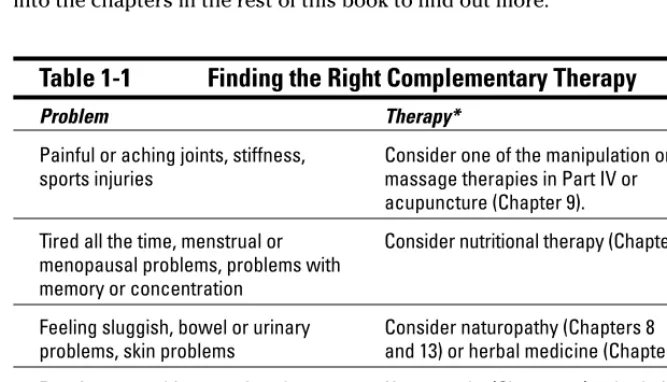
To start you off, Table 1-1 may help point you in the right direction, but delve into the chapters in the rest of this book to find out more.
Table 1-1
Finding the Right Complementary Therapy
Problem Therapy*
Painful or aching joints, stiffness, Consider one of the manipulation or sports injuries massage therapies in Part IV or
acupuncture (Chapter 9).
Tired all the time, menstrual or Consider nutritional therapy (Chapter 12). menopausal problems, problems with
memory or concentration
Feeling sluggish, bowel or urinary Consider naturopathy (Chapters 8 problems, skin problems and 13) or herbal medicine (Chapter 11).
Respiratory problems such as hay Homeopathy (Chapter 10) or herbal fever or asthma, migraines, remedies (Chapter 11) may bring relief, headaches, or childhood ailments or try Traditional Chinese Medicine
Problem Therapy*
Stressed out, anxious, irritable, and Explore relaxation, breathing, and heal-not sleeping well ing therapies. Aromatherapy can help,
too. (All are covered in Part V.)
Digestive problems, blood sugar Ayurveda, Japanese, or Tibetan imbalance, Type II diabetes, gall medicine (Chapters 5, 6, and 7) or bladder problems nutritional therapy (Chapter 12) may
bring relief.
You’re really motivated and in search Check out the health tips in Part VI. of some self-help tips that you can try
out at home
* Please note that this table represents a very simplified set of recommendations to get you started. Many therapies treat the same types of health problems and a lot depends on your personal preferences. Remember that many of the above problems may also require medical investigation to rule out serious health concerns.
Counting the Cost of Complementary
Therapies
Because the majority of complementary therapy treatments aren’t covered by the NHS or health insurance, the costs can soon mount up. Typical costs per session are around £25 to £35 but can be as little as £15 (such as in teach-ing clinics) or as much as £100 or more for top private specialists in expen-sive locations.
So instead of throwing your hard-earned money away, give yourself a budget to work with and ask your practitioner a few questions such as the following:
How many treatments am I likely to need before I start to see results? What kind of improvements can I reasonably expect?
How much experience have you had in treating my particular condition? What sort of success has your treatment led to?
What is the total cost of my treatment likely to be?
Are any other additional costs expected, such as supplements, herbs, or other remedies or goods?
Of course, getting exact answers to each of these queries may not be possi-ble, because a lot depends on how your body responds to the treatment, but at least you gain a reasonable idea of what to expect.
Full benefits may take time, so don’t give up after only one treatment if you haven’t experienced earth-shattering results. But equally, don’t go on and on with treatment hoping it will make a difference if nothing is happening.
Staying healthy
Even if you get the best therapist and therapy inthe world, your health and healing still rest to some extent in your own hands. Help yourself by practising the following:
Start each day in a positive frame of mind.
Eat healthily and sensibly, with lots of fresh vegetables, fruits, whole grains, nuts, seeds, and other healthy proteins, and avoid junk foods, saturated fats, and excess sugars and salt.
Drink plenty of fresh water; eight glasses sipped during the course of the day is a good amount to aim for.
Get regular exercise of both the vigorous (aer-obic) and gentle, stretching (such as yoga, pilates, and t’ai chi) varieties. Two to three sessions a week of at least 20 minutes – enough to build up a bit of a sweat – is a good goal.
B-r-e-a-t-h-e well! Lots of people simply stop breathing when they are concentrat-ing, or they breathe very shallowly. Focus on your breath at regular intervals during the day and ensure even, free breaths. (Check out the section on Buteyko breath-ing in Chapter 18 if you want a way to really improve your breathing habits.)
Limit your vices! Moderate alcohol intake and stop or at least cut down on the cigarettes.
De-stress. Practise stress management and aim for a good work-rest-play life balance with time for socialising, creativity, and enjoyment.
Get plenty of good quality sleep.
Chapter 2
Diagnosing in Complementary
Medicine
In This Chapter
Understanding complementary medicine diagnosis
Asking questions about your health
Examining the tongue and pulse for clues to your health
Exploring complementary medicine testing and diagnostic devices
Looking at the evidence for diagnoses
C
omplementary medicine practitioners use a range of techniques to assess your health and diagnose the root cause of your illness or imbal-ance. They use this diagnostic information to determine the best course of treatment for you.Some diagnostic approaches are more art than science, with their roots going back hundreds or even thousands of years. These approaches include tongue and pulse diagnoses, as used by practitioners of traditional Chinese, Japanese, Tibetan, and Ayurvedic (Indian) medicine. These diagnostic methods involve great sensitivity and skill on behalf of the practitioners who claim they’re really useful tools in ‘reading’ the body. However, many modern medics reject these techniques because they haven’t been scientifically proven.
Other diagnostic methods are more firmly rooted in science and some 21st century complementary medicine practitioners use many diagnostic tech-niques that are also used by orthodox medical doctors, such as laboratory tests, blood analyses, and x-rays.
Finding Out about Diagnosis
in Complementary Medicine
In this section, I discuss the following main forms of diagnosis used by complementary practitioners:
Questioning:Includes questions about your physical and emotional
health, symptoms, lifestyle, diet, and sleep patterns
Observation:Includes examination of your tongue, your general
appear-ance, and gait, as well as iris diagnosis and micro-diagnosis
Palpation:Includes checking pulse and pressure points, hara(abdominal)
diagnosis, and foot reflexology
Physical diagnosis:Includes muscle testing and mobility testing
Clinical signs:Includes examining changes in the appearance of your
skin, hair, nails, and eyes
Charting and calculations:Includes food diaries, sleep diaries, and
Tibetan medical astrology
Testing:Includes laboratory tests and electro-diagnostic measurement
devices
‘Energetic’ diagnosis: Includes methods for sensing the electro-magnetic
field around your body
Questioning
Many practitioners start by asking you to describe any current symptoms that you’re concerned about. They’re interested in when the symptoms started, their nature and severity, and what alleviates or aggravates them. Your practitioner will also want to know of any treatment you may have had so far and its effect. The practitioner will also ask about your medical history, including any previous ailments, accidents, or surgery, and details of any pre-sent or past medication.
Other questions are likely to cover your diet, lifestyle, stress levels, mental and emotional health, and your daily habits such as sleep, exercise, and recreation. Homeopaths, for example, use answers to lifestyle questions to build a picture of your ideal constitutional remedy (for more about this, see Chapter 10 on homeopathy).
Most complementary practitioners consider you from a holistic viewpoint. They use these different bits of information to build a picture of your current symptoms in the context of your overall health and well-being.
You don’t have to have a health complaint to go to a complementary medi-cine practitioner. Some people are symptom-free but choose complementary medicine because they believe that it can help them optimise their health and prevent disease. In such cases, the questioning may be more focused on your existing lifestyle and health and desired optimal health goals.
Observation
In observational diagnosis, the practitioner may examine a particular part of the body to identify signs that reflect something going on in another part of the body, or may observe the movement and appearance of the whole body to determine more general underlying factors. This section includes descrip-tions of some of the more common types of observational diagnosis.
Tongue diagnosis
Tongue diagnosis is used by most traditional Chinese, Japanese, Tibetan, and Ayurvedic (Indian) medicine practitioners. You’re asked to stick out your tongue so that the practitioner can observe its shape, colour, coating, and any movement. According to these traditional medicine systems, different tongue shapes and appearances can give valuable information about specific internal organ function as well as general health. For example, a thick, yellow coating in the middle of the tongue is considered indicative of sluggish bowels and constipation.
Chinese and Japanese tongue diagnoses are the most detailed, with more than 100 different types of tongues identified, all relating to different patterns of indi-vidual organ balance. Tibetan and Ayurvedic medicine use a more simplified form of tongue diagnosis that concentrates on establishing the general balance within the body’s constitution, rather than focusing on individual internal organs. Western medicine also uses a simple form of tongue diagnosis.
Iris diagnosis
Also known as iridology, in this form of diagnosis the practitioner examines your iris (the coloured part of your eye) by means of either a special mea-surement device or a hand-held magnifying glass designed for eye inspection.
The practitioner looks for specific marks and signs in particular parts of the iris that are believed to correspond with specific parts of the body. This form of diagnosis is often used by naturopaths or nature cure practitioners and sometimes by people solely trained in this technique. Some slight evidence supports the use of this technique but more research is needed.
For more about this intriguing form of diagnosis, read Chapters 8 and 13 on nature cure and naturopathy.
Micro-diagnosis
The face, ears, abdomen, back, feet, fingers, and toes can be used diagnostically to reflect the body as a whole. This is called micro-diagnosis. For example, in TCM face diagnosis, the areas under the eyes are linked to the kidneys, so grey bags under the eyes are believed to be indicative of adrenal exhaustion. In Japanese finger diagnosis the thumbs are linked to the lungs, so deformed or weak thumb nails may be indicative of past or underlying lung conditions such as asthma. However, the evidence for this is only anecdotal so this form of diag-nosis is not accepted by many doctors.
More on this type of diagnosis appears in Chapter 7 on Japanese medicine.
Appearance and gait
Before diagnosis, the practitioner observes you from the moment you enter the room, noticing your gait and general appearance in case either has a bearing on your symptoms. For example, you may visit an osteopath because of back pain and as you walk in, the practitioner may observe that you have a very lopsided gait. Further physical investigation may reveal that one leg is longer than the other and that this leg discrepancy causes pelvic and lower-back imbalance, which causes the lower-back pain. By re-adjusting pelvic alignment and recommending the use of special inner soles for your shoes, called orthotics, your back pain may be dramatically relieved.
This type of observational diagnosis can have preliminary importance but then needs to be backed up with other diagnosis to confirm the significance of the observation.
Palpation
Palpationinvolves applying light pressure to different parts of the body to determine the body’s response, or to feel for areas of tenderness, pain, heat, and so on. The most commonly used forms of palpation are pulse diagnosis, pressure point diagnosis, and abdominal diagnosis.
Pulse diagnosis
Traditional Chinese, Japanese, Ayurvedic, and Tibetan medicine practitioners rely strongly on pulse diagnosis. In Western medicine, only a single pulse is taken at the wrist to determine the rate of blood flow with each heartbeat. However, in the traditional medical systems, pulses are taken at three points on each wrist and at different depths. Each position is said to correspond to a different internal organ and to give information about its functioning.
The well-known Tibetan physician, Dr Yeshe Donden, was invited to carry out a ward round at an American hospital. He was presented with patients with-out being given any information abwith-out their medical condition or medical history and invited to diagnose them simply with his pulse-taking skills. The American doctors were amazed when, without any questions to the patients, Dr Donden was able to accurately diagnose health problems, including a faulty heart valve.
Western medicine finds it hard to comprehend this concept of tuning into the body using just the artery on the wrist and because this technique is difficult to measure and verify scientifically, many medics dismiss it.
More information on different types of pulse-taking appears in the chapters of Part II.
Pressure points
Many complementary medicine practitioners palpate the skin in order to determine points of sensitivity or pain known as pressure points. Pressure points can give information about the condition of underlying tissues and organs but may also be used to give information about related internal organs according to meridianor other body maps. For example:
Reflexologists use painful points on the feet to diagnose internal organ health according to a zone system that links specific points on the feet with specific internal organs and body parts.
Acupuncturists palpate to locate points where the flow of vital energy, or qi, may be blocked in the acupuncture meridians (energy channels).
Painful pressure at certain points is believed to indicate malfunction in related internal organs. For example, a point on the upper side of the foot, above the groove between the big and the fourth toes (known as the Liver 3 point) is said to become very sensitive if a person has a hangover and a weakened liver due to excess alcohol!
Little evidence supports these forms of diagnosis, other than the fact that they’ve been used for thousands of years. Many medics reject these forms of diagnosis, and more research is needed.
For more on these approaches see the relevant chapters that cover osteopa-thy, acupuncture, and reflexology.
Abdominal palpation
Another form of palpation is abdominal diagnosis, also known as hara diagno-sis orampuku. This involves firm pressure to different parts of the abdomen, which is used both diagnostically and to give treatment. No real scientific evi-dence supports the use of this technique, although it’s been used clinically for hundreds of years, which many feel is a testimony to its effectiveness.
For more on abdominal diagnosis check out Chapter 7 on Japanese medicine.
Physical diagnosis
Physical examination is an important part of diagnosis for several types of practitioners, especially osteopaths and chiropractors. These practitioners usually ask you to bend your spine and move your joints in different ways to determine your level of mobility and your range of movement.
Kinesiologists and Touch for Health practitioners use muscle testing as part of their examination. This testing involves ‘challenging’ a muscle by applying gentle pressure that you have to resist. Kinesiologists believe that the mus-cles are linked to specific internal organs and body systems and that muscle weakness reflects internal organ or body system weakness.
Clinical signs
Clinical signs are like signposts on the road to a destination (the diagnosis). These signs may be changes in the appearance of your skin, hair, nails, eyes, and so on, or perhaps a bloated abdomen or swollen glands. All these signs may be linked to specific diseases or imbalances according to the various complementary medicine approaches. So, for a practitioner of Traditional Chinese Medicine, spots around the mouth would be linked to problems with the large intestine and digestion, according to the meridian pathways. Ridged nails may indicate a zinc deficiency to a nutritionist.
Complementary medical practitioners who’ve completed a full, professional training course of several years (usually a degree course that also includes practical training in clinical skills) are also carefully trained to recognise spe-cific physical, emotional, or mental signs that may indicate serious diseases requiring medical attention – for example, excessive thirst and weight loss are potentially linked to diabetes, while chest pain and breathlessness may be linked to heart disease.
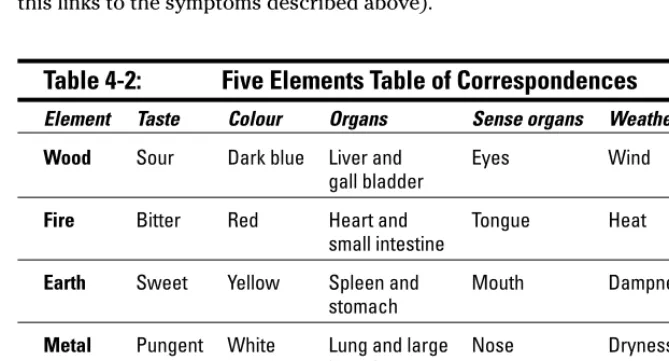
Sometimes, clinical signs may all be linked together to confirm a diagnosis. To an acupuncturist, for example, headaches, irritability, abdominal fullness and bloating, a love of sour foods, and an aggravation of symptoms in the spring are all linked to a liver imbalance. This diagnosis is according to the system of correspondences of Five Element Theory (to find out more about this, see Chapter 4) and makes perfect sense to a TCM practitioner, but wouldn’t make a lot of sense to an orthodox medic with no background in TCM.
Charting and calculations
Several complementary medicine disciplines use charting or paper calcula-tions as part of their diagnosis. A nutritionist is likely to ask you to complete a food diary and uses it to analyse your nutritional status and the suitability of your diet. Tibetan and Ayurvedic physicians sometimes calculate your birth chart and use astrology to determine what sort of diseases you may be predisposed to. Naturopaths may ask you to keep sleep, food, and lifestyle records that may be analysed for patterns as part of the diagnostic process.
Testing
Laboratory or home-kit testing used by complementary practitioners can include blood, saliva, hair, urine, and stool tests. These tests may be used to determine many things including vitamin and mineral status, allergies, food intolerance, hormone balance, the presence of parasites, and more.
Many of these forms of testing are also used by medical doctors and are well-accepted in orthodox medicine although some of the newer tests, such as tests for food intolerances remain controversial despite growing scientific evidence to support their use.
Other methods of testing may involve specially designed devices such as the equipment used to examine the eyes in iridology or the electro-acupuncture devices used to measure the flow of vital energy (qi) in the acupuncture meridians (see Chapter 22 for details on these energy medicine devices). These are less well-accepted in orthodox medicine and have little scientific evidence to support their use.
Energetic diagnosis
Energetic diagnosis involves assessing the auraor electro-magnetic field believed to surround each person and may be determined using the hands or a measurement device.
In manual diagnosis the practitioner runs their hands above the surface of your body to detect subtle changes in the electro-magnetic field according to changes in sensations felt in the hands that may indicate health problems.
In other cases a diagnostic measurement device may be used. An example of this is Kirlian photography, whereby images of the energetic field around the body are alleged to be captured photographically, (see Chapter 22 for more about such energy medicine techniques).
These methods of ‘energetic’ diagnosis are controversial and aren’t accepted within conventional medicine because no real scientific evi-dence supports them.
Complementary versus Orthodox
Medical Diagnosis
Many different forms of diagnosis are used in complementary medicine. Different therapies employ different techniques and the diagnoses may not always agree. The diagnoses can also be quite different from orthodox medical ones.
Taking the necessary precautions
Certain symptoms are regarded as red flags that require proper medical investigation. A well-trained complementary medicine professional should spot these and refer you on to your GP or other medical specialist. However some complementary therapists who have only undergone a very short train-ing, such as a short course in a particular type of massage, may not know how to spot these warning signs.
If you have any of the symptoms listed below, or are in any doubt about a diagnosis you’ve been given, seek a second opinion from a medical practi-tioner or another well-qualified complementary medicine practipracti-tioner:
Chest pain or discomfort, especially if accompanied by sudden shortness of breath.
Persistent cough or coughing up of blood. Prolonged difficulty breathing or swallowing.
Unexplained bleeding, such as from the vagina or anus. Persistent headaches or head pain.
Blurred vision or other persistent visual disturbance. Unexplained lumps, swellings, or persistent pain.
Changes in size or appearance, or presence of lumps, in breasts or testicles, plus any discharge.
Unexplained dizziness, mental changes, or memory loss. Persistent stomach or abdominal pain.
Changes in size, shape, or colour of any mole on the skin or any sudden itching or bleeding from a mole.
Sudden skin changes, such as a rash, especially if accompanied by high fever.
Unexplained swelling of the legs or abdomen. Severe allergic reactions.
Prolonged, unexplained weight loss and/or loss of appetite and/or excessive thirst.
Difficulty urinating, such as experiencing blockage and being unable to maintain flow (men) or increased frequency and painful, burning urination (women).
High fever or loss of consciousness. Prolonged, unexplained fatigue.
All these symptoms may be indicative of serious health conditions and need to be investigated fully.
Weighing up the evidence
Although many of the complementary medicine diagnostic techniques have little, or no, scientific evidence to support their use, don’t forget that many of them have been used for hundreds or even thousands of years.
Chapter 3
Reading Your Body
In This Chapter
Understanding self-diagnosis
Examining your tongue
Reading your face
Looking at other types of self-diagnosis
Finding out more about self-diagnosis
S
elf-diagnosis is all about discovering how to read the body’s everyday signs and signals that reflect your state of health. Analysing your own body isn’t a substitute for orthodox or complementary medical diagnosis in the case of illness. Rather, self-diagnosis is a way of monitoring your health and possibly preventing disease by detecting early signs of imbalance.In this chapter, I describe some common forms of self-diagnosis that have their roots in complementary therapies and traditional medicine. You’ll find out how to read your tongue, face, and various other body parts. Their signs can give you important health clues.
You can use some of these diagnostic techniques to have a bit of fun and develop quite a handy party trick or even a new chat-up line – ‘Would you like to stick out your tongue at me and let me read it for you?’ (Well, maybe not!) Seriously, though, you can use these self-diagnostic techniques to increase your awareness and get to know your body much better.
Finding Out about Self-Diagnosis
In those ancient times, people were able to read their environment by knowing what weather to expect from observing the behaviour of birds and insects or observing the form and movements of clouds. They also seem to have been able to read the body any try to remedy any upsets.
This chapter offers some examples of these ancient techniques that you can use to understand your own body better.
Exploring Tongue Diagnosis
Stick out your tongue in front of a mirror and look at its shape, colour, coating, and any movement.
According to Traditional Chinese Medicine (TCM), the tongue proper(that is, the shape and colour of the tongue itself) links to the various organs and also reflects general circulation and overall hydration of the body. The tongue coating, which lies on the surface, can indicate your health condition or the nature and stage of a particular disease.
A normal tongue is light red in colour, has free motion, and has a thin layer of clear, or slightly white, coating that is neither too dry nor too moist.
Reading signs of the tongue proper
Take a look at your own tongue and use the guide below to detect signs that, according to TCM, may indicate some imbalance:
A pale tongue indicates problems such as frequent colds, kidney or adrenal weakness, or joint problems.
A red tongue indicates conditions such as pain, inflamed joints, irritable bowel, and allergies.
A deep red tongue can indicate the late stage of fever.
A purple tongue can indicate blood stagnation and poor circulation of vital energy as seen in premenstrual syndrome (PMS) and fatigue syndromes.
A full, flabby, soft tongue with teeth marks shows weak digestion, catarrh, and heavy, aching limbs.
A tongue with a red tip indicates stress and circulation problems and sometimes heart problems.
A ‘thorny’ tongue with lots of little raised red bumps on the surface can indicate ‘internal heat’, often inflammation of the liver or intestines, and may also be due to vitamin B deficiency.
A tongue that can’t stop quivering, or that is deviated to one side, can indicate liver imbalance, for example, due to too much stress, alcohol or sweet foods, or an excess of catarrh and phlegm.
Observing tongue coatings
The tongue coatinglies on the surface of the tongue (it isn’t the colour of the body of the tongue itself). Here’s what the tongue coating can tell you:
A thin white coating can indicate a fairly recent ‘cold’ or ‘deficiency’ condition such as a common cold.
A thick white coating suggests food retention and sluggish digestion. A sticky white coating indicates excess phlegm.
A thick yellow coating can be a sign of digestive problems such as con-stipation. If the coating is dry, the problem is usually with the stomach and intestines; if it is wet you may have excess phlegm.
A thin yellow coating can signify a lung infection.
A greyish or black tongue coating (yes, the coating can actually be black!) usually indicates a significant health problem. If your tongue is either of these colours, consult a health professional as soon as possible. A peeled tongue, sometimes called a ‘geographic tongue’ because it
looks like a map, can indicate a crisis point in a long illness.
Always observe the tongue in good daylight and exclude obvious false phe-nomena such as a purple tongue after sucking a blackcurrant lolly or a red tip after burning it on a hot drink.
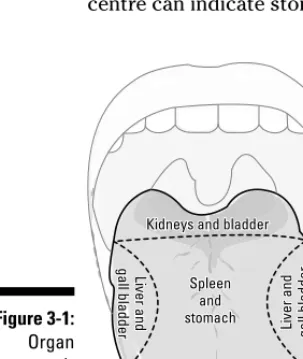
Organ correspondences
Tongues in Ayurvedic and Tibetan medicine
In Ayurveda, abnormalities in the tongue reflect abnormalities in the three doshas, or ‘vital energies’. A dry, rough, cracked tongue with a dark coating indicates vata(wind) disturbance; a red, hot tongue with a burning sensation indicates pitta(choler or bile) disturbance; and a pale tongue that’s wet, slimy, and white-coated indicates kapha(phlegm) disturbance. (For more about what thes