CSEIT172664 | Received : 05 Nov 2017 | Accepted : 15 Nov 2017 | November-December-2017 [(2)6: 149-153]
International Journal of Scientific Research in Computer Science, Engineering and Information Technology © 2017 IJSRCSEIT | Volume 2 | Issue 6 | ISSN : 2456-3307
149
Cost Minimizing Data Storage System in Geo Distributed Clouds
1Afrin Begum,
2Dr. Md Ateeq Ur Rahman
1CSE Department, Shadan College of Engineering and Technology, Hyderabad, Telangana, India
2Professor, PG Department of CSE, Shadan College of Engineering and Technology, Hyderabad, Telangana, India
ABSTRACT
Distributed computing allows the client to realize resources increasingly and flexibly. A remarkable check in quality provisioning system is to come to a decision the acceptable live of resources needed for the execution of process keeping in mind the tip goal to limit the financial value from the purpose of read of purchasers and to expand the quality use from the point of view of specialist co-ops. In this way, Cloud registering is one of the favoured choices in the present undertaking. This paper additionally proposes a client self-provisioning gateway with four modules, information proprietor, client, overseer, CDN board. Information Owner is the client who looks for the cloud resources and transfers the substance into mists by paying just to the resources that are being utilized as of now.
Keywords : Cloud platform, Hybrid cloud, Content distribution, Dynamic control, Contents, Geo-distributed data centres.
I.
INTRODUCTION
In Cloud scenario the Main Importance according to the customer point of view on storing their personal content in a remote server is cost. Customer requirements vary from individuals to organizations, some customer focus on the security and all time support from their cloud service providers. Other customers focus on cost reliability with good performance. There is a big challenge to cloud service providers to fulfil customer’s requirements according to their needs. Many studies have been conducted so far to overcome these issues but they lies nearby to the complete requirement. Cloud service a provider provides data storage service according to the organizational level but fails to provide the same for individuals. So there is a need to focus on this area where individuals as well as organizations gets benefitted of all services provided by cloud like data security in cloud, all time supports to customers, good performance of the application and storage, and majorly minimizing the cost with all these features. Distributed computing is the normal traditional expression in the present Information Technology. Distributed computing stages are quickly rising because the favoured various for facilitating applications in varied business settings.
An essential element of the cloud that separates it from standard administrations is its obviously limitless live of plus limit (e g. CPU, stockpiling, Network) offered at a focused rate. It dispenses with the requirement for setting up foundation which takes a while. New businesses require not contribute on the foundation on the grounds that the resources are accessible in the cloud. Distributed computing empowers distributers to gain resources progressively and flexibly. A noteworthy sign on quality provisioning system is to work out the appropriate live of resources required for the execution of labour keeping in mind the tip goal to limit the financial value from the aim of browse of purchasers and to expand the quality use from the view point of specialist co ops. In this way, Cloud registering is one of the favoured choices in the present undertaking.
that the cloud specialist co-op will know what number of examples of the resources and what resources are required for a specific application.
With dynamic provisioning, the supplier assigns more resources as they are required and evacuates them when they are most certainly not. The client is charged on a compensation for each utilization premise. At the point when dynamic provisioning is utilized to make a mixture cloud, it is infrequently alluded to as cloud blasting.
With client self-provisioning (otherwise called cloud self-benefit), the client buys resources from the cloud supplier through a web shape, making a client account and paying for resources with a charge card. The supplier's resources are accessible for client use inside hours, if not minutes.
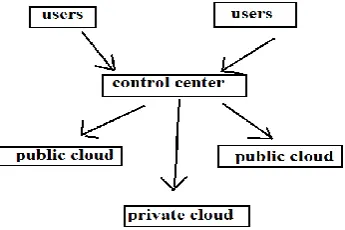
Figure 1. System Architecture
II.
EXISTING AND PROPOSED SYSTEMS
2.1 Existing System
Two noteworthy parts exist in an ordinary substance conveyance application, to be specific back-end stockpiling for keeping the substance, and front-end web administrations to serve the solicitations. Each is affected to the cloud substance is place away servers within the cloud, and demands is confiscated to cloud-based net administrations.
2.1.1 Disadvantages of Existing System
Onetime ideal administration arrangement is considered.
They just propose avaricious procedure based heuristics without provable properties.
2.2 Proposed System
This paper additionally proposes a client self-provisioning gateway with four modules, information proprietor, client, overseer, CDN board .Information Owner is the client who looks for the cloud resources and transfers the substance into mists by paying just to the resources that are being utilized as of now.
2.2.1 Advantages of Proposed system
Resource allocation is done dynamically
Cost minimization for users.
Profit maximization for the cloud service providers.
III. METHODOLOGY
We assess the execution of the dynamic calculation with a model conveyed on six VMs that are situated in six server farms (in the urban areas of Dallas, Fremont, Atlanta, Newark, London, Tokyo) of Drive HQ Cloud and a bunch living in our lab in the University of Hong Kong. We convey the online interface and the control fixate on one Drive HQ VM and utilize it to imitate the private cloud in the meantime, while we utilize the staying five Drive HQ VMs to copy five server farms of general society cloud. At the point when taught by the control focus, the Requester module at people in general cloud is in charge of asking for a duplicate of a file from the Uploader module at the private cloud.
IV. IMPLEMENTATION AND RESULTS
After the product outline we go ahead for the product usage. It is the way toward having the new application and develop documents of information expected to utilize it. This stage is less imaginative than framework plan hierarchical structure or an individual end-client.
This shows that the ADMIN is enter the user name and password and click on Login button.
O u t p u t s c r e e n s h o t 2 : F i l e u p l o a d p a g e
This shows the total file uploads by Data Owners who have registered with the cloud.
Output screen shot 3:User registration page
User registration form is provided to user who wants to upload data in cloud environment,in this form data have username,password,email id,address and mobile number to register.
Output screen shot 4: User login page
The user is logged into the page of his account by using his Username and password. That can be shown in above figure.
Output screen shot 5: Secret key page
In this page the user can be logged into his Email id by using his user name and password when the Email id is given at the time of his registration. The secret key sent to this mail id. The page can show that.
O u t p u t s c r e e n s h o t 6 : U s e r f i l e d e t a i l s p a g e
User view the files status and if the file is in waiting state he will not be able download that file. But, when the file is in accepted state user has the right to download the file which file he want from the files.
In this page user enter his/her account details to download files from the server.
O u t p u t s c r e e n s h o t 8 : F i l e d o w n l o a d p a g e following above figure shows the downloaded file.
Output screen shot 9: CDN Login page The above figure shows the CDN login page.
Output screen shot 10: CDN File verify page
The file needs to be viewed by the TPA by clicking on the view label then file can be opened.The above figure shows that.
Output screen shot 11: Owner login page
By using the User name and Password the DataOwner
Output screen shot 12: Owner file upload page
In this page the file can be browsed from the system by data owner. It contains the file size and content based on that cost can be displayed below the field. Then click on upload button.
V.
CONCLUSION
As the resources provided with the cloud service providers are not being totally used we propose a Third-Party Application. Our proposed system follows the user self-provisioning technique so that the more usage of the resources provided can be increased. As most of the resources allocated users is not being completely used by them, the resources are neither being useful to cloud service provider nor to the user who is buying the resources. The proposed project permits users to upload the files into cloud resources and pay just for the space being used by them such that user's cost can be minimized and at the same time the resources that are idle can be provided to some other user who requests for it. The cost to be paid by the users for the resources they are using is calculated dynamically by the Third-Party Application (i.e., The project that we propose) based on the type, content and size of the file. This increases the profit to the cloud service providers and users who are storing their files to the cloud. The files uploaded by data owner are made globally available by the CDN Panel and the users who wish to download the files can download them by paying money in which the data owner will also be getting some share. This project helps in migrating contents to the cloud and also helps in increasing the profits to cloud resource providers, users and assures the maximum utilization of cloud resources.
VI. REFERENCES
[2]. "Energy optimal control for time varying wireless networks," IEEE Tran. On Information Theory, no. 7, pp. 2915–2934, July 2006.
[3]. S. T. Mauler, R. Spirant, and L. Ying, "Stochastic Models of Load Balancing and Scheduling in Cloud Computing Clusters," in Proc. of IEEE INFOCOM, 2012.
[4]. S. Ren, Y. He, and F. Xu, "Provably-Efficient Job Scheduling for Energy and Fairness in Geographically Distributed Data Centres," in Proc. of IEEE ICDCS, 2012
[5]. S. H. Owen and M. S. Daskin, "Strategic Facility Location: A Review," pp. 423–447, 1998. [6]. M. Charikar, S. Guha, E. Tardos, and D. B.
Shmoys, "A constant factor approximation algorithm for the k-median problem," in Proc. of the 31st Annual ACM Symposium on Theory of Computing (STOC’99), 1999