Combining Language Resources Into A Grammar-Driven Swedish Parser
Malin Ahlberg, Ramona Enache
Department of Computer Science & Engineering Gothenburg University
Box 8718, SE-402 75 Gothenburg, Sweden [email protected], [email protected]
Abstract
This paper describes work on a rule-based, open-source parser for Swedish. The central component is a wide-coverage grammar implemented in the GF formalism (Grammatical Framework), a dependently typed grammar formalism based on Martin-L¨of type theory. GF has strong support for multilinguality and has so far been used successfully for controlled languages (Angelov and Ranta, 2009) and recent experiments have showed that it is also possible to use the framework for parsing unrestricted language. In addition to GF, we use two other main resources: the Swedish treebank Talbanken and the electronic lexicon SALDO. By combining the grammar with a lexicon extracted from SALDO we obtain a parser accepting all sentences described by the given rules. We develop and test this on examples from Talbanken. The resulting parser gives a full syntactic analysis of the input sentences. It will be highly reusable, freely available, and as GF provides libraries for compiling grammars to a number of programming languages, chosen parts of the the grammar may be used in various NLP applications.
Keywords:GF, Swedish, Parsing
1.
Introduction
Our goal is to implement a wide-coverage grammar and parser for Swedish using the GF formalism, and thereby investigate how GF can be used for open-domain parsing. We compile a large-scale grammar to a parser and combine it with the extensive lexicon SALDO. The Swedish tree-bank Taltree-banken provides manually tagged trees which we use for improving and evaluating the grammar. The parser will additionally be evaluated by an expert.
We chose our resources so that both our grammar and parser can be freely available and open-source. The target language is Swedish, a North-Germanic language closely related to Norwegian and Danish. The languages share most of their grammatical structures and are mutually in-telligible. Swedish is also one of the official languages in Finland and altogether spoken by approximately 9 million people. Swedish syntax is often similar to English, but the morphology is richer and the word order slightly more in-tricate. It is a verb-second language: the second constituent of a declarative main clause must consist of a verb. The first constituent of the clause is usually made up of the subject, although it likewise could consist of adverbial phrases or objects. Fronting the finite verb marks questions.
This paper will briefly introduce GF, Talbanken and SALDO in Section 2. Section 4. explains how we extract a lexicon, section 5. how we translate Talbanken to GF an-notation and section 6. presents the work on the grammar implementation.
2.
Background
2.1. Grammatical Framework
Grammatical Framework (Ranta, 2011) is a grammar for-malism based on functional programming.
The key idea is to divide a grammar into abstract and con-crete parts. The abstract grammar gives a logical repre-sentation of the semantics, modeled as abstract trees. The
concrete grammars tell how to translate the abstract trees to a given language, and deal with issues such as word order, case and agreement. The framework enables us to parse strings into abstract trees as well as linearize trees into strings.
The grammar acts as an independent module and reusabil-ity is further supported by the separation between resource grammars and application grammars. The resource library provided with GF implements morphological and syntacti-cal rules for more than 20 different languages. Hence the writer of an application grammar can start her work at a higher level and does not need to describe how to form stan-dard sentences, phrases or inflect words.
Since many of the languages in the GF library resemble each other grammatically, they can share much of their im-plementations. This is usually done by using aFunctor by which we avoid code duplication and which aids the code maintenance.
GF has so far been used in a number of projects, MOLTO1,
TALK (Ljungl¨of et al., 2005) and WebAlt (Caprotti, 2006) to mention a few. All those are special domain applications, dealing with controlled natural language. This project takes a different approach by using GF for open domain lan-guage, similar to the recently conducted work on translation of patents (Espa˜na-Bonet et al., 2011).
Using the Swedish resource grammar as our starting point, we get a basic description of the language. The framework provides tools such as parsing, generation and a well-tested interpretation of the parse trees. Furthermore, there are tools for using GF grammars in a number of programming languages like Haskell and Java.
2.2. Talbanken
For development and evaluation, we use the Swedish treebank Talbanken (Einarsson, 1976). It was assembled
1
in the 1970s at Lund University and later enriched with annotation for a full phrase structure analysis (Nivre et al., 2006). Although Talbanken contains both written and spoken Swedish, only the prose material, consisting of 6316 sentences, is used in this project. This part was also used when training the data-driven parser Maltparser (Hall et al., 2007).
2.3. SALDO
SALDO (Lars Borin, 2008) is an open source lexicon re-source based on Svenskt Associationslexikon. It is de-veloped at Spr˚akbanken at Gothenburg University and in-tended for usage in language technology research. We have developed tools for extracting GF lexicons from SALDO, described in section 4.
3.
Related work
Many years of research have lead to many interesting language technology tools for Swedish. An example is the well-known data-driven Maltparser (Hall et al., 2007), trained on Talbanken. There are also a number of grammar-based parsers, although none is freely available. The cas-caded finite state parser CassSwe (Kokkinakis and Kokki-nakis, 1999) and The Swedish Constraint Grammar (Birn, 1998) give syntactic analyses. Swedish FDG (Voul-tanien,2001) uses the Functional Dependency Grammar (Tapanainen and J¨arvinen, 1997), an extension of the Con-straint Grammar formalism, and produces a dependency structure focusing on finding the nominal arguments. The LinGO Grammar Matrix (Bender et al., 2002), is a starter-kit for building Head-Driven Phrase Structure Grammars (Pollard and Sag, 1994) (HPSG) providing com-patibility with tools for parsing, evaluation, semantic repre-sentations etc. Translation is supported by using Minimal Recursion Semantics (Copestake et al., 2005) as an inter-lingua. There is a collection of grammars implemented in this framework, giving broad-coverage descriptions of English, Japanese and German. The Scandinavian Gram-mar Matrix (Søgaard and Haugereid, 2005) covers com-mon parts of Scandinavian, while Norsource (Hellan and Haugereid, 2003) describes Norwegian. A Swedish version was based upon this by Ahrenberg, covering the morphol-ogy and some differences between Swedish and Norwe-gian. Further, there is the BiTSE grammar (Stymne, 2006), also implemented using the Lingo Matrix, which focuses on describing and translating verb frames.
The Swedish version of the Core Language Engine (CLE) (Gamb¨ack, 1997) gives a full syntactic analysis as well as semantics represented in ‘Quasi logical form’. A transla-tion to English was implemented and the work was further developed in the spoken language translator (Rayner et al., 2000). Unfortunately, it is no longer available.
In the TAG formalism (Joshi, 1975), there are projects in getting open-source, wide-coverage grammars for English and Korean, but, to our knowledge, not for Swedish. The ParGram (Butt et al., 2002) project aims at mak-ing wide coverage grammars usmak-ing the Lexical Functional Grammar approach (Bresnan, 1982). The grammars are im-plemented in parallel in order to coordinate the analyses of
different languages and there are now grammars for En-glish, German, Japanese and Norwegian.
Extract (Forsberg, 2007) is a tool for lexicon extraction compatible with GF, sharing its basic ideas with our lexical acquisition tool. Extract does however not consider parts-of-speech and our tool is developed closer to GF, while still having additional mechanisms for robustness and human support for accuracy.
4.
Extracting a large lexicon
The lexicon provided with the GF resources is far too small for open-domain parsing. This section describes the pro-cess of importing SALDO, which is compatible with GF, and easily translated to GF format. As SALDO is continu-ously updated, the importing process has been designed to be fast and stable enough to be redone at any time.
4.1. Implementation
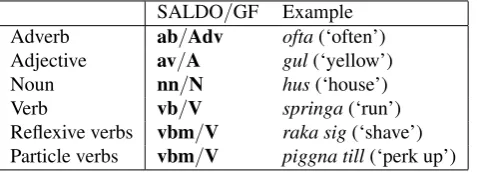
The basic algorithm for importing SALDO was imple-mented by Angelov (2008) and produces code for a GF lexicon. For each word in SALDO, it decides which forms should be used as input to the GF smart paradigms. The smart paradigm is a function which given one form of a word, can infer which paradigm it most likely belongs to. For verbs, this will in most cases mean giving the present tense form, see figure 1.
mkV "knyter" ;
Figure 1: First code produced for the verbknyta(‘tie’)
All assumed paradigms are printed to a temporary lexicon, which will produce an inflection table for every entry when compiled. The tables are compared to the information given in SALDO and if the tables are equal the code for the word is saved. If the table is erroneous, another try is made by giving more forms to the smart paradigm. For example 1, the smart paradigm will fail to calculate the correct inflection table. In the next try both the present and the past tense are given:
mkV "knyter" "kn¨ot" ;
Figure 2: Second output for the verbknyta
The program is run iteratively until the GF table matches the one given in SALDO, or until there are no more ways of using the smart paradigm. The verb knyta will need three forms:
mkV "knyter" "kn¨ot" "knutit"
ROOT
MS
S
SS FV SP IP
NP BVPS AJKP IP
HD ET
NNDD PP
katten PR HD
PR NNDD
på bilen
blir större .
PhrUtt : Phr
NoPConj : PConj UttS : Utt NoVoc : Voc
UseCl : S
TTAnt : Temp PPos : Pol PredVP : Cl
TPres : Tense ASimul : Ant UsePron : NP ComplSlash : VP
i_Pron : Pron SlashV2a : VPSlash DetCN : NP
see_V2 : V2 DetQuant : Det UseN : CN
DefArt : Quant NumSg : Num cat_N : N
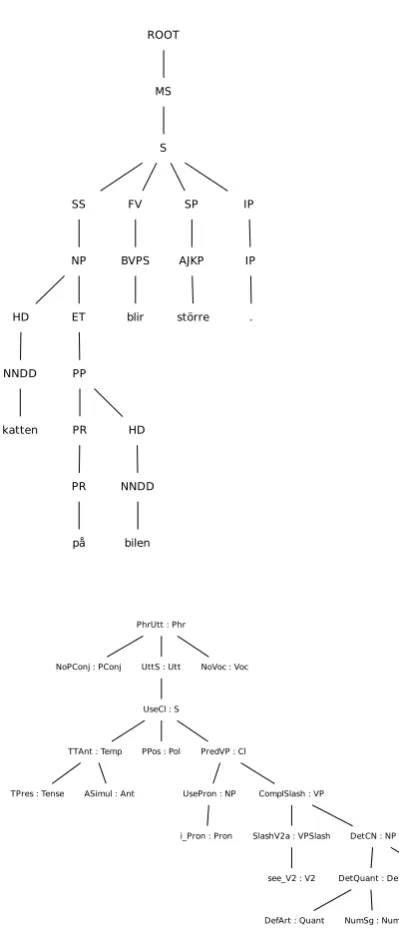
Figure 6: The Talbanken tree and the GF tree for the sen-tence“Katten p˚a bilen blir st¨orre”.
good source for this information.
5.1. Results and evaluation
The development was mostly example-driven, and at least one rule for the translation of every Talbanken-tag has been implemented. Shorter sentences, with less than 10 words, have been prioritized in order to get a coverage of the most fundamental constructions.
When evaluating the mapping, the results strongly depend on which restrictions we put on the input. One of the rea-sons why a node cannot be translated, is the use of the tags show in figure 7. ThePUtag is used for graphic listings, and not for fluent text. In our grammar there is naturally no
corresponding function; the listings are meant for making the text look nice in folders etc and are outside the scope for the grammar itself. The tags XXandNACare often used since Talbanken makes a difference between subject and object noun phrases. The analysis of elliptical expres-sion in (1)
(1) F¨or stora krav. “Too high demands.”
contains the tags XX and NAC, since it is not obvious whether the noun phrase is used as subject or an object. The tags shown in figure 7 occur quite frequently in the treebank and are always translated to metas, which lowers our result.
NAC Not a constituent
XP Other (non-coordinated) phrase
DB Doubled function
PU List item
XX Unclassifiable part-of-speech
Figure 7: Untranslatable tags
The main goal has been to be able to translate shorter sen-tences, with no idioms or conjunction. If we assure that the lexicon contains the correct word class for all lemmas in-volved, we can restore more than 85 % of the nodes in the original tree. If we lift all the restrictions excluding thePU, we get 65 % coverage. If we test randomly collected sen-tences that do not contain any of the tags listed in figure 7, 72 % can be restored (see figure 8)
No list items 65 %
No special punctuation or bad tags 72 % Short sentences with known words 85 %
Figure 8: Number of nodes in each translated tree not put to meta
6.
Development of the grammar
An important part of this project has been to develop the Swedish GF grammar and to adapt it to cover construc-tions used in Talbanken. As a grammar implementation can never be expected to give full coverage of a language, we aim for a grammar fragment which gives a deep analysis of the most important Swedish constructions. The starting point has been the GF resource grammar and the new im-plementation is still compatible with this.Bj¨orn Gamb¨ack. 1997. Processing Swedish Sentences: A Unification-Based Grammar and Some Applications. Ph.D. thesis, The Royal Institute of Technology and Stockholm University, Dept. of Computer and Systems Sciences.
Johan Hall, Joakim Nivre, and Jens Nilsson. 2007. A Hy-brid Constituency-Dependency Parser for Swedish. InIn Proceedings of NODALIDA–2007, pages 284–287. Lars Hellan and Petter Haugereid. 2003. The NorSource
Grammar - an excercise in the Matrix Grammar building design. InProceedings of Workshop on Ideas and Strate-gies for Multilingual Grammar Engineering.
Aravind K. Joshi. 1975. Tree adjunct grammars. Journal of Computer and System Sciences archive.
Dimitrios Kokkinakis and Sofie Johansson Kokkinakis. 1999. A Cascaded Finite-State Parser for Syntactic Analysis of Swedish. InIn Proceedings of the 9th EACL, pages 245–248.
Lennart L¨onngren Lars Borin, Markus Forsberg. 2008. The hunting of the BLARK - SALDO, a freely avail-able lexical database for Swedish language technology. Resourceful language technology. Festschrift in honor of Anna S˚agvall Hein, pages 21–32.
Peter Ljungl¨of, Bj¨orn Bringert, Robin Cooper, Ann-Charlotte Forslund, David Hjelm, Rebecca Jonson, and Aarne Ranta. 2005. The talk grammar library: an inte-gration of gf with trindikit.
Joakim Nivre, Jens Nilsson, and Johan Hall. 2006. Tal-banken05: A Swedish treebank with phrase structure and dependency annotation. In In Proceedings of the fifth international conference on Language Resources and Evaluation (LREC2006), pages 24–26.
C. Pollard and I. Sag. 1994.Head-Driven Phrase Structure Grammar. University of Chicago Press.
Aarne Ranta. 2011. Grammatical Framework: Program-ming with Multilingual Grammars. CSLI Publications, Stanford.
Manny Rayner, David Carter, Pierrette Bouillon, Vassilisi Digalakis, and Mats Wir´en. 2000. The spoken language translator. Cambridge Univerisy press.
Anders Søgaard and Petter Haugereid. 2005. A brief docu-mentation of a computational HPSG grammar specifying (most of) the common subset of linguistic types for Dan-ish, Norwegian and Swedish. Nordisk Sprogteknologi 2004, pages 247–56.
Sara Stymne. 2006. Swedish-English Verb Frame Di-vergences in a Bilingual Head-driven Phrase Structure Grammar for Machine Translation. Master’s thesis, Link¨oping University.