An Evaluation of the Effect of Automatic Preprocessing
on Syntactic Parsing for Biomedical Relation Extraction
Md. Faisal Mahbub Chowdhury
1,2and Alberto Lavelli
11Fondazione Bruno Kessler (FBK-irst), Italy 2University of Trento, Italy
[email protected] [email protected]
Abstract
Relation extraction (RE) is an important text mining task which is the basis for further complex and advanced tasks. In state-of-the-art RE approaches, syntactic information obtained through parsing plays a crucial role. In the context of biomedical RE previous studies report usage of various automatic preprocessing techniques applied before parsing the input text. However, these studies do not specify to what extent such techniques improve RE results and to what extent they are corpus specific as well as parser specific. In this paper, we aim at addressing these issues by using various preprocessing techniques, two syntactic tree kernel based RE approaches and two different parsers on 5 widely used benchmark biomedical corpora of the protein-protein interaction (PPI) extraction task. We also provide analyses of various corpus characteristics to verify whether there are correlations between these characteristics and the RE results obtained. These analyses of corpus characteristics can be exploited to compare the 5 PPI corpora.
Keywords:relation extraction, parsing, preprocessing.
1.
Introduction
Relation extraction (RE) is an important text mining task which is the basis for further complex and advanced tasks (e.g. event extraction, literature based discovery, . . . ). The goal of RE is to identify all the relations of interest that hold between two (or more) entities inside a given text. For example, consider the following sentence:
“NativeC8 also formed a heterodimer with C5, and low concentrations of polyionic ligands such as protamine and suramin inhibited the in-teraction.”
After identification of the relevant named entities (NE, in this caseProteins)C8 andC5, the RE task determines whether there is a PPI relationship between the entities (which istruein the example above).
Biomedical RE (henceforth, bio-RE) approaches have evolved from the exploitation of statistics about co-occurrences of entities, and the use of shallow linguistic information and patterns, to methods that take advantage of full syntactic parsing (Zweigenbaum et al., 2007). The importance of syntactic relationships among words for bio-RE is evident in the state-of-the-art techniques. This is also due to the fact that currently state-of-the-art parsing techniques achieve on biomedical texts performance not far from the best achieved on newspaper articles (McClosky, 2010; Rimell and Clark, 2009; Sagae et al., 2008).1
Statistical parsers obviously rely on the sentence con-structions found in the corresponding treebanks used for training. One of the issues regarding treebanks is that they (practically) cannot have examples that cover
1However, portability of syntactic parsing between different
domains and text genres remains an open issue.
all the types of linguistic constructions. Furthermore, since state-of-the-art parsers exploit probabilities, certain syntactic structures which are found only a few times in treebanks might be ignored in favor of syntactic structures which are more frequent. A further element is that natural language sentences, especially in biomedical texts, are often long and ambiguous.
The objective of various automatic preprocessing tech-niques2 is to fix (as much as possible) inconsistencies or irregularities (which are not necessarily erroneous or wrong sentence constructions) inside the input sentences. In other words, the goal is to make the sentence construc-tions as much uniform as possible. Such preprocessing techniques could be helpful to “adapt” the sentences to the idiosyncrasies of the treebank on which the parser was trained. This could reduce the errors produced by tokenization and POS (part-of-speech) tagging, leading to the reduction of parsing errors and thus contributing to the overall performance on the target NLP task (e.g. RE) that uses a syntactic parser as a component.
Obviously, how to preprocess the input text is itself related to the target NLP task in which the parse trees will be used. Simplifying or removing some parts of the sentences as preprocessing might risk losing important information as well as distorting the originally intended meaning of the sentence. But for a task like RE, this could actually help to reduce redundant or non informative information. Because, not all the words (and not whole parse tree) are exploited by RE approaches. RE approaches usually focus on the words or the parts of the sentence which might contain possible cues.
2
Corpora
Charactersitics Description LLL IEPA HPRD50 AIMed BioInfer
AvWordBetEntPair Avg. no. of words between each entity pair 10.46 8.89 7.11 6.92 8.44
AvWordPerEnt Avg. no. of words per entity name 1.05 1.22 1.21 1.29 1.24
AvEntPerSen Avg. no. of entities per sentence 3.10 2.30 2.79 3.25 4.05
AvEntWordPerSen Avg. no. of words in (all) entity names per sent. 3.26 2.80 3.38 4.19 5.03 AvNonEntWordPerSen Excluding entities avg. no. of words per sent. 22.57 26.07 20.93 19.71 21.93
AvWordPerSen Avg. no. of words per sentence 25.83 28.87 24.31 23.90 26.96
%OfSubtokEnt Percentage of subtoken entities 15.06% 12.18% 6.91% 14.23% 11.6%
Table 2: Statistics of different characteristics of the 5 benchmark PPI corpora. All sentences (in each corpus) are considered during analyses.
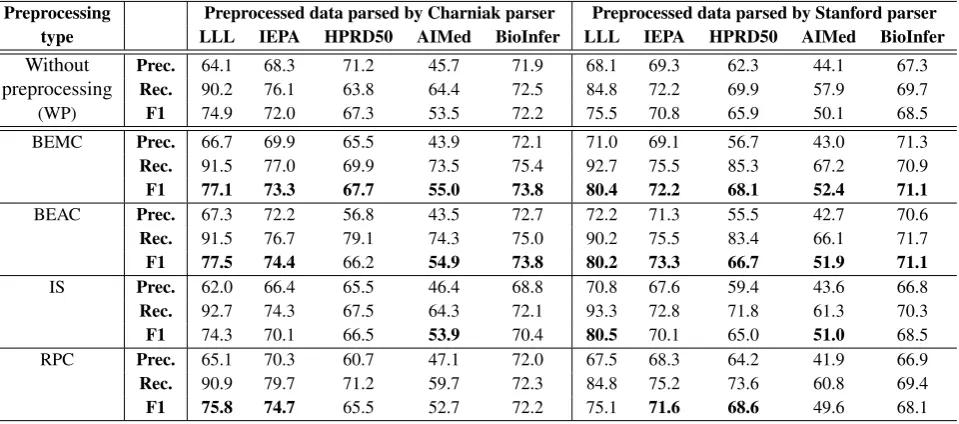
Preprocessing Preprocessed data parsed by Charniak parser Preprocessed data parsed by Stanford parser type LLL IEPA HPRD50 AIMed BioInfer LLL IEPA HPRD50 AIMed BioInfer
Without Prec. 64.1 68.3 71.2 45.7 71.9 68.1 69.3 62.3 44.1 67.3 preprocessing Rec. 90.2 76.1 63.8 64.4 72.5 84.8 72.2 69.9 57.9 69.7
(WP) F1 74.9 72.0 67.3 53.5 72.2 75.5 70.8 65.9 50.1 68.5
BEMC Prec. 66.7 69.9 65.5 43.9 72.1 71.0 69.1 56.7 43.0 71.3 Rec. 91.5 77.0 69.9 73.5 75.4 92.7 75.5 85.3 67.2 70.9 F1 77.1 73.3 67.7 55.0 73.8 80.4 72.2 68.1 52.4 71.1 BEAC Prec. 67.3 72.2 56.8 43.5 72.7 72.2 71.3 55.5 42.7 70.6 Rec. 91.5 76.7 79.1 74.3 75.0 90.2 75.5 83.4 66.1 71.7 F1 77.5 74.4 66.2 54.9 73.8 80.2 73.3 66.7 51.9 71.1 IS Prec. 62.0 66.4 65.5 46.4 68.8 70.8 67.6 59.4 43.6 66.8 Rec. 92.7 74.3 67.5 64.3 72.1 93.3 72.8 71.8 61.3 70.3 F1 74.3 70.1 66.5 53.9 70.4 80.5 70.1 65.0 51.0 68.5 RPC Prec. 65.1 70.3 60.7 47.1 72.0 67.5 68.3 64.2 41.9 66.9 Rec. 90.9 79.7 71.2 59.7 72.3 84.8 75.2 73.6 60.8 69.4 F1 75.8 74.7 65.5 52.7 72.2 75.1 71.6 68.6 49.6 68.1
Table 3: Comparison of the resultsusing the PET kernel (constructed on the phrase structure tress)on different prepro-cessed data. The 5 corpora are preproprepro-cessed separately and then each of them is parsed using either Charniak or Stanford parser. BoldF1score indicates performance improvement with respect to the results obtained without preprocessing.
assume that %Of SubtokEnt (percentage of subtoken entities) might help to understand the changes in the results for the insertion of spaces at entity name boundaries (IS).
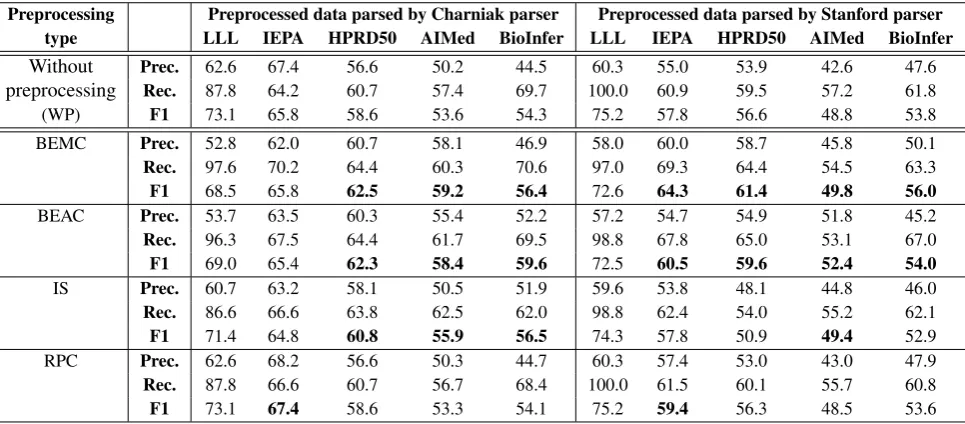
Tables 3 and 4 show a comparison of the PPI extraction results without and with the preprocessing techniques. Each of the preprocessing steps is applied on the sentences before parsing them using the two parsers. We limit our study on the usage of single preprocessing technique rather than applying multiple techniques together.
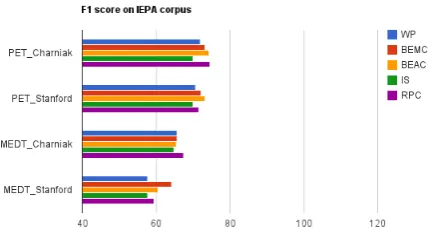
Figures 2, 3, 4, 5 and 6 illustrate a graphical representation of the results on different individual corpora using different parsers and the two syntactic tree kernels.
5.1. Using phrase structure tree output of the two parsers
5.1.1. How preprocessing affects tokenization of subtoken entities
Among all the 5 corpora, AIMed and LLL have compar-atively higher %Of DisconEnt. Interestingly, when the
IS preprocessing is applied on the corpora, the results improved only for AIMed and LLL. For AIMed this improvement is observed for both of the parsers, while for LLL only Stanford parser’s output has managed to produce better results.
During analysis of the parsed data, we observed that Charniak parser is more robust on providing correct POS tags than Stanford parser. We also found that sometimes
Figure 1: Chart of different corpora characteristic values in log scale.
• By Stanford parser:
– Without preprocessing: sigmaB/JJ -/: and/CC sigmaF-dependent/JJ promoters/NNS
– After applyingIS:sigmaB/JJ-/:and/CC sigmaF/JJ-/: dependent/JJ promoters/NNS
• By Charniak parser:
– Without preprocessing:sigmaB-/JJ and/CC sigmaF-dependent/JJ promoters/NNS
– After applying IS: sigmaB/NN -/CC and/CC sig-maF/NNdependent/JJ promoters/NNS
Note that the values of AvW ordP erEnt and
AvEntP erSen are lower for LLL than for AIMed. As a result, despiteIShas enabled separation of different entities (which otherwise would be part of a larger token) in separate tokens,AvW ordP erEntandAvEntP erSen
might be not significant enough for LLL to compensate POS tagging and tokenization errors introduced by IS
when Charniak parser is used.
5.1.2. When parenthetical remarks are removed
As we can see, only the results (using both parsers) on the IEPA corpus improve whenRP Cpreprocessing is ap-plied. We assume this is becauseAvW ordBetEntP air∗ AvN onEntW ordP erSen for IEPA is considerably higher than for other corpora.
5.1.3. When entities are blinded
As the results show, even minor differences in seemingly the same preprocessing can have different impact on the outcome. For example, forentity blinding technique, the experiments show that the usage ofBEAC(e.g.ENTITY1) andBEM C(e.g.Entity1) produces different results.
After checking the parsed data we have found in most cases that Stanford parser attaches the POS tag NNS (noun, com-mon, plural) to tokens like“Entity1”and NN (noun, com-mon, singular or mass) to tokens like“ENTITY1”. We have
Figure 2: Graphical representation of results on LLL cor-pus.
Figure 3: Graphical representation of results on IEPA cor-pus.
also noticed that Stanford parser can do better NP identifi-cation whenBEM C is used instead of BEAC. For ex-ample, consider the following sentence preprocessed using
BEM C:
“Cotransfection of Entity0 and Entity1 in embryonic kidney 293 cells activated the anti-apoptotic transcription factor Entity2.”
Stanford parser correctly recognizes the NP “Entity0 and Entity1 in embryonic kidney 293 cells” (which forms a larger NP with “Cotransfection of ”). However, if BEAC is adopted as a preprocessing step instead of BEMC, the parser fails to recognize the NP“ENTITY0 and ENTITY1 in embryonic kidney 293 cells”as a whole.
In the case of Charniak parser, we have observed that in most cases it attaches either NNP (noun, proper, singular) or NN tag to tokens like“Entity1”, and NN to tokens like “ENTITY1”. Like Stanford parser, better NP identification by Charniak parser is noticed whenBEM Cis used instead ofBEAC. For example, consider the following sentence preprocessed usingBEM C:
Figure 4: Graphical representation of results on HPRD50 corpus.
Figure 5: Graphical representation of results on AIMed cor-pus.
the Entity0 subunit or the Entity1 and Entity2 monomer.”
Charniak parser correctly recognizes that “the Entity0 subunit or the Entity1 and Entity2 monomer” is an NP which later forms a larger NP with “F beta alpha and”. However, if BEAC is applied instead of BEM C, the parser wrongly identifies“F beta alpha and the ENTITY0 subunit”as an NP and then forms the larger NP with“or the ENTITY1 and ENTITY2 monomer”.
In addition, we also observe that:
• In all of the corpora, using both parsers,BEM C pre-processing produced improved results (with respect to the results doing no preprocessing). An almost similar trend is seen forBEAC except that the usage of the output of Charniak parser on HPRD50 produced lower results.
• Interestingly, regardless of the corpus and of the blind-ing technique used (i.e.BEACorBEM C), improve-ment of results (with respect to the results when no preprocessing is done) using Stanford parser output is always higher than that using Charniak parser output.
Figure 6: Graphical representation of results on BioInfer corpus.
• It is also noticeable that, without preprocessing, re-sults are always better when Charniak parser output is exploited rather than Stanford parser output. But when entity blinding is applied the results using Stanford parser either gets better (in case of LLL and HPRD50) or closer to that using Charniak parser.
5.2. Using dependency trees obtained through the syntax tree output of the two parsers
As mentioned in Section 2., previous studies show that different dependency formats provide very similar perfor-mance. SD is arguably the most widely used dependency format in bio-RE. So, we used the SD format (which are obtained from the phrase structure trees) during our experiments with the MEDT kernel.
Empirical results show that the application, before parsing, of a preprocessing technique which might have improved the results when phrase structure trees are used, does not necessarily guarantee that the exploitation of the dependency trees derived from those phrase structure trees would lead to a better result as well.
However, we note that there are significant improvements of the results on BioInfer, AIMed and HPRD50 corpora when BEM C, BEAC and IS are used before parsing with Charniak parser.
5.3. Other observations
As the empirical outcomes show, results on AIMed and HPRD50 are much lower than on the other corpora. Perhaps, this can be partly explained by the fact that these two corpora have lower values forAvW ordBetEntP air,
Preprocessing Preprocessed data parsed by Charniak parser Preprocessed data parsed by Stanford parser type LLL IEPA HPRD50 AIMed BioInfer LLL IEPA HPRD50 AIMed BioInfer Without Prec. 62.6 67.4 56.6 50.2 44.5 60.3 55.0 53.9 42.6 47.6 preprocessing Rec. 87.8 64.2 60.7 57.4 69.7 100.0 60.9 59.5 57.2 61.8
(WP) F1 73.1 65.8 58.6 53.6 54.3 75.2 57.8 56.6 48.8 53.8
BEMC Prec. 52.8 62.0 60.7 58.1 46.9 58.0 60.0 58.7 45.8 50.1 Rec. 97.6 70.2 64.4 60.3 70.6 97.0 69.3 64.4 54.5 63.3 F1 68.5 65.8 62.5 59.2 56.4 72.6 64.3 61.4 49.8 56.0 BEAC Prec. 53.7 63.5 60.3 55.4 52.2 57.2 54.7 54.9 51.8 45.2 Rec. 96.3 67.5 64.4 61.7 69.5 98.8 67.8 65.0 53.1 67.0 F1 69.0 65.4 62.3 58.4 59.6 72.5 60.5 59.6 52.4 54.0 IS Prec. 60.7 63.2 58.1 50.5 51.9 59.6 53.8 48.1 44.8 46.0 Rec. 86.6 66.6 63.8 62.5 62.0 98.8 62.4 54.0 55.2 62.1 F1 71.4 64.8 60.8 55.9 56.5 74.3 57.8 50.9 49.4 52.9 RPC Prec. 62.6 68.2 56.6 50.3 44.7 60.3 57.4 53.0 43.0 47.9
Rec. 87.8 66.6 60.7 56.7 68.4 100.0 61.5 60.1 55.7 60.8
F1 73.1 67.4 58.6 53.3 54.1 75.2 59.4 56.3 48.5 53.6
Table 4: Comparison of the results using the MEDT kernel (constructed on the dependency graphs obtained using the phrase structure tress)on different preprocessed data. The 5 corpora are preprocessed separately and then each of them is parsed using either Charniak or Stanford parser. BoldF1score indicates performance improvement with respect to the results obtained without preprocessing.
6.
Conclusion
In this paper, we have presented an empirical evaluation of various preprocessing techniques (before parsing) and their contribution in a specific bio-RE task, i.e. PPI extraction, using a phrase structure tree based and a dependency tree based syntactic kernels. We have also provided analyses of different corpora characteristics of the 5 corpora used in our experiments. Based on the empirical results of our study and analyses of the output of two different parsers, we have made an attempt to relate different characteristics of a corpus with the different preprocessing techniques used. We have provided supporting examples to show how the preprocessing techniques affect output of the parsers.
We speculate that some of the preprocessing steps might complement some of the other steps and would produce larger gains in results if they are combined. However, in this paper we have limited our study to the contribution of individual techniques. Empirical results show some interesting findings, e.g. even apparently minor differences in seemingly same preprocessing can have different impact on the outcome. Also, it turns out that having an improve-ment (due to preprocessing) using phrase structure trees do not necessarily implies that an improvement would be also obtained using dependency trees. Finally, we present analyses of different corpora characteristics which can be exploited to compare the 5 PPI corpora.
7.
Acknowledgements
This work was carried out in the context of the project “eOnco -Pervasive knowledge and data management in cancer care”. The authors would like to thank Matteo Negri and the three anonymous reviewers for reading the initial extended abstract of the paper and providing feedback.
8.
References
Q. Bui, S. Katrenko, and P.M.A. Sloot. 2010. A hybrid approach to extract protein-protein interactions. Bioin-formatics.
R. Bunescu, R. Ge, R.J. Kate, E.M. Marcotte, R.J. Mooney, A.K. Ramani, and Y.W. Wong. 2005. Comparative ex-periments on learning information extractors for proteins and their interactions. Artificial Intelligence in Medicine, 33(2):139–155.
E. Charniak and M. Johnson. 2005. Coarse-to-fine n-best parsing and maxent discriminative reranking. In Pro-ceedings of ACL 2005.
M.F.M. Chowdhury and A. Lavelli. 2012. Combining tree structures, flat features and patterns for biomedical rela-tion extracrela-tion. InProceedings of EACL 2012.
M.F.M. Chowdhury, A. Lavelli, and A. Moschitti. 2011. A study on dependency tree kernels for automatic ex-traction of protein-protein interaction. InProceedings of ACL 2011 BioNLP Workshop.
A. Clegg and A. Shepherd. 2007. Benchmarking natural-language parsers for biological applications using depen-dency graphs.BMC Bioinformatics, 8(1).
M.-C. de Marneffe, B. MacCartney, and C. D. Manning. 2006. Generating typed dependency parses from phrase structure parses. InProceedings of LREC 2006.
J. Ding, D. Berleant, D. Nettleton, and E. Wurtele. 2002. Mining MEDLINE: abstracts, sentences, or phrases? Pacific Symposium on Biocomputing, pages 326–337. K. Fundel, R. K¨uffner, and R. Zimmer. 2007. Relex–
relation extraction using dependency parse trees. Bioin-formatics, 23(3):365–371.
D. Klein and C.D. Manning. 2003. Accurate unlexicalized parsing. InProceedings of ACL 2003.
thesis, Department of Computer Science, Brown Univer-sity.
M. Miwa, R. Sætre, Y. Miyao, T. Ohta, and J. Tsujii. 2008. Combining multiple layers of syntactic information for protein-protein interaction extraction. InProceedings of SMBM 2008, pages 101–108.
M. Miwa, R. Sætre, Y. Miyao, T. Ohta, and J. Tsujii. 2009. Protein-protein interaction extraction by leveraging mul-tiple kernels and parsers. International Journal of Medi-cal Informatics, 78.
M. Miwa, S. Pyysalo, T. Hara, and J. Tsujii. 2010. A com-parative study of syntactic parsers for event extraction. In Proceedings of ACL 2010 BioNLP Workshop, pages 37–45.
Y. Miyao, K. Sagae, R. Sætre, T. Matsuzaki, and J. Tsu-jii. 2009. Evaluating contributions of natural language parsers to protein–protein interaction extraction. Bioin-formatics, 25(3).
A. Moschitti. 2004. A study on convolution kernels for shallow semantic parsing. InProceedings of ACL 2004. C. N´edellec. 2005. Learning language in logic - genic
in-teraction extraction challenge.Proceedings of the ICML 2005 workshop: Learning Language in Logic (LLL05), pages 31–37.
S. Pyysalo, F. Ginter, J. Heimonen, J. Bj¨orne, J. Boberg, J. Jarvinen, and T. Salakoski. 2007. Bioinfer: a cor-pus for information extraction in the biomedical domain. BMC Bioinformatics, 8(1):50.
S. Pyysalo, A. Airola, J. Heimonen, J. Bj¨orne, F. Ginter, and T. Salakoski. 2008. Comparative analysis of five protein-protein interaction corpora. BMC Bioinformat-ics, 9(Suppl 3):S6.
L. Rimell and S. Clark. 2009. Porting a lexicalized-grammar parser to the biomedical domain. Journal of Biomedical Informatics, 42(5).
K. Sagae, Y. Miyao, and J. Tsujii. 2008. Challenges in mapping of syntactic representations for framework-independent parser evaluation. In Proceedings of the Workshop on Automated Syntatic Annotations for Inter-operable Language Resources.
Y. Tateisi, A. Yakushiji, T. Ohta, and J. Tsujii. 2005. Syn-tax annotation for the GENIA corpus. InProceedings of IJCNLP 2005, pages 222–227.