Annotation Facilities for the Reliable Analysis of Human Motion
Michael Kipp
University of Applied Sciences Augsburg An der Hochschule 1
86161 Augsburg, Germany [email protected]
Abstract
Human motion is challenging to analyze due to the many degrees of freedom of the human body. While the qualitative analysis of human motion lies at the core of many research fields, including multimodal communication, it is still hard to achieve reliable results when human coders transcribe motion with abstract categories. In this paper we tackle this problem in two respects. First, we provide facilities for qualitative and quantitative comparison of annotations. Second, we provide facilities for exploring highly precise recordings of human motion (motion capture) using a low-cost consumer device (Kinect). We present visualization and analysis methods, integrated in the existing ANVIL video annotation tool (Kipp, 2001), and provide both a precision analysis and a “cookbook” for Kinect-based motion analysis.
Keywords:Multimodal Communication, Annotation Tool, Human Motion Analysis
1.
Reliability
The existing ANVIL video annotation tool is mostly used in the area of multimodal communication research, often in-volving the modalities of speech and various categories of body motion (most notably gesture). The tool has recently been extended by motion capture playback and reliability analysis features (Kipp, 2012b; Kipp, 2012a). The purpose of this paper is to introduce a lost-cost method to capture motion capture data using a Kinect. Moreover, since we argue that motion capture brings more objectivity to cod-ing we also present a number of features that potentially increase the reliability of coding.
Transcribing human motion usually involves a certain amount of interpretation on the side of the human coder. It is therefore not surprising that reported reliability mea-sures are quite low. For instance, in the area of gesture re-search, it has proven quite hard to consistently code move-ment phases(preparation, stroke, retraction etc.) (Kita et al., 1998): It is difficult to exactly pinpoint the time point where one phase transitions to another (segmentation prob-lem) but also to determine the category based on objective criteria (classification problem). The reliability of coding depends, on the one hand, on how cleanly defined the cod-ing scheme is but also, on the other hand, on information and facilities that the annotation tool provides. Facilities for analyzing coders’ disagreement are important to pro-vide feedback to human coders and to improve the defini-tion of poorly performing categories in the coding scheme. Bottom-up vs. top-down CodingIn multimodal commu-nication research, it is common that information pieces re-late to each other in terms of a subsumption or constituency relationship. Consider the encoding of syllables, words and sentences on different tiers. Syllables are subsumed by a word, words are subsumed by a sentence. In gesture research, gestural motion is often decomposed into small motion units called phases that constitute a larger over-all motion, cover-alled a phrase (Kita et al., 1998). This can be operationalized in coding by defining two tracks, one
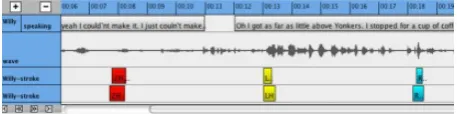
Figure 1: Comparing annotations of track “Willy-stroke” by two different coders in time alignment.
for phases, one for phrases, and imposing a constituency relationship between the two tracks. Withtop-down cod-ingwe refer to the method of first defining the larger seg-ments (phrases) and then subdividing those into smaller units (phases). Bottom-up coding works vice versa, i.e. first identifying the small segments (phases) and then join-ing them into the larger phrases. In ANVIL, bottom-up coding has been realized using thespanrelationship. We now added thesubdivisionrelationship1which allows top-down coding. ANVIL also offers point elements which contain only a single time point. For a number of coding schemes this is necessary (e.g. if only interested in the onset of a signal) and providing this annotation type con-tributes to keeping the coding non-redundant and thus less error-prone. Providing a wide range of track relationships also facilitates interoperability with other annotation tools like ELAN or Exmaralda (Schmidt et al., 2008).
Qualitative side-by-side comparison of codingsANVIL has an integrated facility for computing reliability scores, both for single file comparison and whole corpora (Kipp, 2012b). While numerical measures of agreement like kappa are important to get an overall impression of coding relia-bility (Carletta, 1996), such measures are of limited help when it comes to identifying thecausesfor disagreement. For this, a qualitative analysis is necessary, directly
com-1
paring the different codings. We have implemented a flexi-ble way of doing this by allowing to insert arbitrary tracks from other files into the current annotation file. Thus, the coder can then see the coding of two different coders in time alignment (Fig. 1). The coder can also hide and re-size arbitrary tracks to enhance the visibility of the two (or more) tracks under investigation. Ideally, this should be complemented with automatic methods that highlight “hot spots”, i.e. regions of strong disagreement. Note that there is always the principal distinction of segmentation disagree-ment (where are the boundaries of eledisagree-ments) and categori-cal disagreement. Both aspects need to be addressed.
2.
Motion Analysis
2.1. Visualization
In a previous publication we suggested to visualize the path of a hand movement as motion trails, color-coded in the colors of the annotation elements on the timeline (Heloir et al., 2010). Similar visualizations can be found in tools for 3D animation, e.g. in the open-source Blender2 software where they are calledmotion paths.
Velocity visualizationTo become an effective tool in man-ual annotation, the 3D view must integrate as much infor-mation as possible without cluttering the view. Therefore, to add velocity and motion direction, we introducedmotion circles(Fig. 2). While the motion direction is orthogonal to the circle’s plane, the radius of the circle is proportional to the current speed. We found this visualization both intuitive and non-distracting.
Local frames of reference The human body is often viewed as a hierarchical articulated structure of rigid bones, connected by rotational joints. Any point in space (includ-ing e.g. the position of the hand) can be expressed either in the global “world” frame of reference or in the local frame of reference of a particular joint. This is relevant to cod-ing because frequently the motion of the hand may be more meaningful if looked on as in the local frame of reference of the upper body3, instead of using the global “world” frame of reference. Therefore, we introduce the notion of “pin-ning” the skeleton. It means that the skeleton is fixed at the hip joint (like a butterfly on a pin) so that all upper boy motion is relative to the hip joint. Fig. 3 shows a motion where the hand is actuallyalmost stillbut because the hip moves (posture shift) the hand floats to the side which is re-flected in the motion trail (left frame). If pinning is active, this motion is much reduced (right frame) as one would ex-pect, given that the hand is still when seen relative to the body. Note that whether pinning makes sense may depend on the situation. The hip motion may deliberately be used by the performer to move the hand or the hip motion may be a “coincidence”. Our tool lets motion analysts make the “pinning” decision with the switch of a button. Note also that there are multiple ways to performpinningusing other frames of reference (e.g. using the shoulder joints or the thorax joint).
Possible future extensionsFor the future, we envision to extend the visualization by derived measures. A tangent
2
www.blender.org
3
This could be realized using e.g. the hip joint or the thorax joint.
Figure 2: Circles depict velocity direction (orthogonal to the circle’s plane) and amount (proportional to its radius).
Figure 3: The same hand motion trails without pinning (left) and with pinning at the hip joing (right).
arrowcould facilitate the detection of discontinuities. One could also highlight the key point with the highest amount of direction change, possibly in a color-coded fashion like a heat map (of course, this would be a selectable alternative view to the current timeline color-coding).
2.2. Continuous Data and Objective Measures
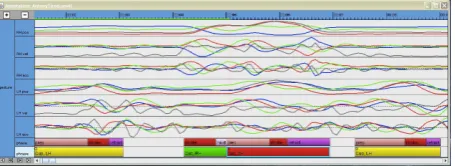
As mentioned before, coding reliability primarily depends on the crisp definition of categories. Motion capture for the first time allows to actually use objective numerical infor-mation to do this. On the basis of continuous data, i.e. the angular changes in the joints, which is in turn sampled with a certain frame rate (usually between 25-50 frames per sec), we are able to derive objective measures and thresholds to guide manual coding.