Evaluation of Discourse Relation Annotation in
the Hindi Discourse Relation Bank
Sudheer Kolachina
∗, Rashmi Prasad
†, Dipti Misra Sharma
∗, Aravind Joshi
‡∗LTRC, IIIT-Hyderabad
[email protected], [email protected]
†HIA, University of Wisconsin-Milwaukee [email protected]
‡IRCS, University of Pennsylvania [email protected]
Abstract
We describe our experiments on evaluating recently proposed modifications to the discourse relation annotation scheme of the Penn Discourse Treebank (PDTB), in the context of annotating discourse relations in Hindi Discourse Relation Bank (HDRB). While the proposed modifications were driven by the desire to introduce greater conceptual clarity in the PDTB scheme and to facilitate better annotation quality, our findings indicate that overall, some of the changes render the annotation task much more difficult for the annotators, as also reflected in lower inter-annotator agreement for the relevant sub-tasks. Our study emphasizes the importance of best practices in annotation task design and guidelines, given that a major goal of an annotation effort should be to achieve maximally high agreement between annotators. Based on our study, we suggest modifications to the current version of the HDRB, to be incorporated in our future annotation work.
Keywords:discourse relation annotation, discourse structure, annotation evaluation
1.
Introduction
Following the development and release of the Penn Dis-course Treebank (PDTB) (Prasad et al., 2008), a large-scale annotated corpus of discourse relations, interest in cross-linguistic studies of discourse relations has led to the initia-tion of similar PDTB-based annotainitia-tion projects in a number of languages, such as Arabic (Al-Saif and Markert, 2010), Chinese (Zhou and Xue, 2012), Czech (Mladov´a et al., 2008), Hindi (Oza et al., 2009b; Oza et al., 2009a), Ital-ian (Tonelli et al., 2010), Tamil (Rachakonda and Sharma, 2011), and Turkish (Zeyrek and Webber, 2008). The Hindi discourse relation bank (HDRB) project is aimed at the creation of a large scale corpus of Hindi texts annotated with discourse relations (e.g., causal, contrastive, elabo-ration and temporal relations). The source corpus con-sists of 400K words, comprising multi-domain news arti-cles in Hindi, taken from a leading daily newspaper,AMAR UJALA. There are three other levels of linguistic annota-tion currently being carried out on the same corpus: syn-tactic dependency relations (Begum et al., 2008), lexical predicate argument structure, and phrase structure, which, together with the HDRB, form a level and multi-representational linguistically annotated resource (Xia et al., 2008; Bhatt et al., 2009; Palmer et al., 2009).
In adapting the PDTB annotation scheme and guidelines to annotate discourse relations in Hindi texts, our previ-ous work (Oza et al., 2009b; Oza et al., 2009a) proposed extensions and modifications to the scheme, motivated by the need to introduce more conceptual clarity and semantic uniformity in the PDTB sense classification and to increase
annotation quality and specificity. In this paper, we inves-tigate the impact of these modifications on the annotation quality, based on the results of an inter-annotator agreement study. Our results indicate that some aspects of the scheme lead to greater difficulty in annotation, as reflected in the lower inter-annotator agreement. Our study emphasizes the importance of best practices in annotation task design and guidelines, given that a major goal of an annotation effort should be to achieve maximally high agreement between annotators. In Section 2., we present an overview of the HDRB annotation scheme as proposed in Oza et al. (2009b; 2009a) and discuss the points of departure from the PDTB scheme (Prasad et al., 2008). In section 3., we present our experiments on applying the HDRB scheme on a subset of the corpus and the inter-annotator agreement evaluation. We discuss the evaluation in terms of its impact on design-ing the annotation task and guidelines, and accorddesign-ingly pro-pose revisions to the HDRB scheme in our concluding dis-cussion in Section 4.
2.
Current Guidelines and Task Design
annotator judgements for this difficult task, thereby boost-ing annotation reliability.
As in the PDTB, the HDRB project annotates both explicit and implicit discourse relations, their abstract object (AO) arguments, called Arg1 and Arg2, and the senses of dis-course relations.1 Here, we first provide an overview of
the HDRB annotation scheme and guidelines, and then dis-cuss the main differences of the scheme with that of the PDTB. The complete annotation scheme and guidelines are described in the HDRB manual.2. (In all examples in the
paper, the relation is underlined, Arg1 is enclosed in square brackets, and Arg2 is enclosed in curly braces.) The anno-tation is done over the raw text, without reference to other layers of annotation, such as syntax, and the annotation rep-resentation format is fully stand-off. We used the PDTB annotation tool, which provides support for multiple lan-guages, including Hindi.3
2.1. Types of Discourse Relations
Discourse relations between two AOs can be realized in one of three ways:
Explicit connectives. These are ‘closed-class’ expres-sions drawn from four well-defined grammatical classes: subordinating conjunctions (Ex. 1), coordinating conjunc-tions (Ex. 2), sentential relatives (Ex. 3), discourse ad-verbials (Ex. 4). The task of identifying explicit connec-tives involves functional disambiguation, since words and phrases that function as discourse connectives can have other non-discourse functions as well.4
(1)
[
aAj dFyA jlAyA gyA h{]
kyo\Ek{
mrF vqgA\W h{।}
‘[Today the lamp has been lit] because{it is my birthday}.’
(2)
[
s\G k s\gWn ank h{\]
Ek\t{
EvcArDArA ek hF h{।}
‘[There are many groups in the Sangh] but{there is just one ideology.}.’
(3)
[
sArA kAm Cowkr vh us EcEwyA ko uWAkr dvA Gr kF aor BAgA]
Ejss{
uskA shF ilAj EkyA jA sk।}
‘[Dropping all his work, he picked up the bird and ran towards the dispensary] so that {it could be given proper treatment}.’
(4)
[
dAnvF lhro\ k kArZ a\XmAn k pE[cmF tV pr tVFy vn-ptF prF trh bbAd ho gyF।]
isk alAvA{m\g
kF cÓAno\ ko BF nksAn haA h{।}
‘[The coastal vegetation on the west coast of the
1The distinct relation of attribution, annotated in the PDTB
for discourse relations and each of their two arguments (Prasad et al., 2007), is currently not in the scope of HDRB, although it is planned for future work.
2
http://researchweb.iiit.ac.in/˜sudheer.kpg08/hdrb-guidelines-0.1.pdf. 3
The tool is available from:
http://www.seas.upenn.edu/˜pdtb/PDTBAPI. 4
The class of subordinators and particles are also included within the scope of connectives. However, because they are rel-atively much harder to identify and distinguish from their non-discourse roles, their annotation has been postponed to a later stage of the project.
Andaman has been completely destroyed due to wild waves]. In addition,{the coral reefs have also been damaged}.’
Implicit connectives. In many cases, although a dis-course relation can be inferred between abstract objects, no explicit connective occurs to express the relation. In such cases, the annotator must “insert a connective” that best ex-presses the inferred relation. Thus, in Example (5), there is a clear consequence relation inferred between the high-lighted AOs although no explicit connective is present to express this relation, and the implicit connective inserted by the annotator isisEly. Implicit discourse relations are taken to be triggered in adjacent sentence contexts, that is, they are annotated between every adjacent pair of sentences (otherwise unrelated by an explicit connective).5
(5)
{
is gm k sAr EKlAwF sEcn tdSkr s BF mhAn h{\।
}
Implicit=isEly[
inko ?lFn boSX krnA EksF k bs kF bAt nhF\।]
‘{All players in this game are greater than even Sachin Tendulkar}Implicit=therefore [it is not pos-sible for anyone to get them clean bowled.]’
Alternative Lexicalization (AltLex). If a discourse re-lation is inferred but insertion of an implicit connective leads to a perception of “redundancy” in the expression of the relation, it suggests that the second sentence of the pair contains an alternatively lexicalized non-connective expression. The relation is tagged as “AltLex” (Alterna-tive Lexicalization), and the AltLex expression is identified and marked. An AltLex expression is any expression that doesn’t belong to any of the grammatical classes identified for explicit connectives. Example (6) illustrates an AltLex annotation.
(6)
{
bA\`lAdf m\ kAnn-&yv-TA kF hAlt m\ sDAr haAh
{।
}
AltLex[
isF vjh s BArt n sMmln m\ fAEml hon kA '{slA EkyA h{।]
‘{Bangladesh’s judiciary has seen an improve-ment}. That is why [India has decided to partici-pate in the conference.]’
When adjacent sentences are not related by a discourse relation. If no discourse relation is inferred between two adjacent sentences, an attempt is made to identify an entity-based relation across the two sentences. In an entity-entity-based relation, the only relational inference made by the reader is that the second sentence identifies one or more entities from the previous sentence, and provides a further descrip-tion about this entity (or entities). Such a reladescrip-tion is tagged as “EntRel” (Entity Relation). Example (7) illustrates an EntRel annotation, where the only purpose of the second sentence is to provide the reader with some additional in-formation about “Jha’s second film”. No discourse relation, such as a causal or contrastive relation, is inferred between the sentences. If neither a discourse relation nor an EntRel is found, a ‘NoRel’ (no relation) tag is assigned.
5
(7)
[
E'Sm mho(sv m\ prkAf JA kF nI E'Sm aphrZ kA BF prFEmyr honA h{।]
EntRel{
g\gAjl k bAd JA kF yh EksF alg Evqy pr bnF dsrF E'Sm h{।}
‘[Prakash Jha’s latest film Apaharan will be pre-miered at the film festival.] {This is Jha’s second film on a different subject after Gangajal.}’
2.2. Arguments of Relations
The two arguments of a relation are labeled Arg1 and Arg2, and the label assignment is semantically driven, in that it is based on thesenseof the relation to which the arguments belong. Thus, each sense definition for a relation specifies the sense-specific semantic role of each of its arguments, and stipulates one of the two roles to be Arg1, and the other, Arg2. For example, the ‘cause’ sense definition, which in-volves a causal relation between two eventualities, specifies that one of its arguments is the cause, while the other is the effect, and further stipulates that the cause will be assigned the label Arg2, while the effect will be assigned the label Arg1. The effect of this convention can be seen with Ex-amples (8) and (9). The connectives in both the sentences have the ‘cause’ sense, but while the cause appears after the effect in Example (8), it appears before the effect in Example (9). With the sense-specific labelling convention for ‘cause’, these argument label orderings are Arg1-Arg2 (cause after effect) for Example (8), and Arg2-Arg1 (cause before effect) for Example (9).
(8) prEtyoEgtA k bAd sonl n btAyA Ek
[
EvjtA k !p m\ jb uskA nAm pkArA gyA to us kC dr tk Kd pr EvfvAs nhF\ haA]
,kyo\Ek{
vh mAn kr clrhF TF Ek yh prEtyoEgtA E'?s h{।
}
‘After the competition, Sonal said that [when her name was announced as the winner, she could not believe herself for some time], because{she was thinking that the competition was fixed}.’
(9) '{fn EXsAinro\ kA khnA h{ Ek sbs >yAdA nkl yA corF monopolF EXsAin kF hotF h{।
{
EXsAinr in bAto\ ko bKbF jAnt h{\}
isEly[
kI bAr @yAn nhF\ dt h{\।]
‘Fashion designers say that the most preva-lent thefts or copies are of monopoly designs.
{Designers know this fact very well} so [it does not matter to them many times].’
Arguments of explicit connectives can appear anywhere in the text, which means that they can be non-adjacent in the text. On the other hand, arguments of all the other re-lation types must be adjacent. Annotation of spans for the arguments of discourse relations (i.e., those expressed by explicit connectives, implicit connectives, and AltLex) follows the ‘minimality principle’ which, while adding no maximal constraint on the extent of the argument, stipulates that only as much is selected as the argument text span as is minimally necessary to interpret the relation. Any addi-tional text deemed as relevant to the arguments’ interpreta-tion is annotated as supplementary material: Sup1 for ma-terial supplementary to Arg1, and Sup2 for mama-terial supple-mentary to Arg2. Arguments of EntRel must contain com-plete sentences but can include multiple sentences, while
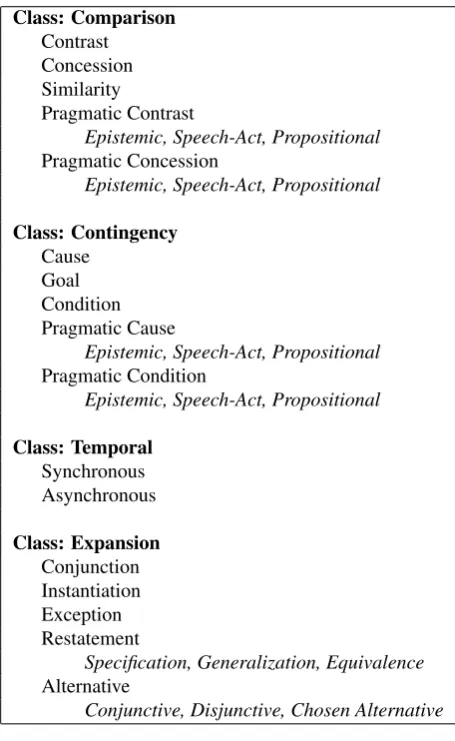
Class: Comparison
Contrast Concession Similarity
Pragmatic Contrast
Epistemic, Speech-Act, Propositional Pragmatic Concession
Epistemic, Speech-Act, Propositional
Class: Contingency
Cause Goal Condition Pragmatic Cause
Epistemic, Speech-Act, Propositional Pragmatic Condition
Epistemic, Speech-Act, Propositional
Class: Temporal
Synchronous Asynchronous
Class: Expansion
Conjunction Instantiation Exception Restatement
Specification, Generalization, Equivalence Alternative
Conjunctive, Disjunctive, Chosen Alternative
Figure 1: HDRB Sense Classification
arguments of NoRel must contain all and only the two ad-jacent sentences.
2.3. Senses of Discourse Relations
Each discourse relation is assigned a sense label which characterizes the semantics of the relation. The sense clas-sification is hierarchical with three levels, where the lower level labels specify meaning refinements of the higher level labels. Thus, the notion of inheritance is inherent in the sense scheme. Since multiple senses are possible for a rela-tion, annotators were allowed to enter upto two senses for a relation. The complete HDRB sense classification is shown in Figure 1. The top “class” level is shown in bold, the second “type” level is in normal font, while the third “sub-type” level appears in italics. As can be seen in the figure, while all sense classes have second-level sense types, some sense types are not further specified at the subtype level. This does not reflect a strict belief that no further meaning refinements can be described for these sense types. Rather, it was felt that further refined distinctions in the meaning of the relations would be hard to annotate.
2.4. Annotation Task Workflow
Annotation of all the different relation types was carried out simultaneously during a sequential reading of the text. Thus, for each new sentence encountered during the read-ing, annotators identified the sentence-internal relations as well as the relation of the sentence to its prior context. No particular order was imposed on which type of relation to annotate first (e.g., explicits before implicits, or intra-sentential before inter-intra-sentential). For identifying explicit connectives, annotators were provided with an initial list as a guide for detecting connectives, but the basic instruction was to “discover” explicit connectives. This was primarily due to lack of resources with comprehensive cataloguing of discourse connectives for the language. For each relation (of any type), annotators also marked at the same time its arguments and it sense.
2.5. Differences with PDTB
The current version of the HDRB scheme differs in some significant ways from the PDTB scheme (Oza et al., 2009a), as described below:
Changes in task workflow. In contrast to the HDRB, where the different relation types were annotated simul-taneously, the PDTB task workflow consisted of multiple independent subtasks. First, explicit connectives were col-lected in a list from various resources and provided to an-notators, who were instructed to annotate one connective at a time over the entire corpus before moving on to the next connective. Annotation of implicit connectives was done after the annotation of explicit connectives, and here, annotators, read the text sequentially while annotating im-plicit relations between adjacent sentences where needed. Because the PDTB scheme was to some extent developed incrementally, the categories of EntRel and AltLex were devised after the annotation of implicit connectives, when the annotation revealed that annotators were not able to in-sert a connective in many cases. A subsequent annotation phase looked specifically at such cases, and labeled them as one of EntRel, AltLex, or NoRel. In all cases, arguments and senses were annotated at the same time as the relation type.
The simultaneous annotation of all the relation types in HDRB had a dual motivation. The first was to abstract away from the incremental development of the PDTB scheme and to design the workflow based on the final scheme. The second was the hypothesis that simultaneous annota-tion was necessary to ensure that the annotators were tak-ing the full context of the discourse into account durtak-ing the annotation. This was especially so for explicit connectives which need not occur in every sentence in the text, and there was no clear way to ensure that annotators would take the complete prior context into account when annotating any particular connective.
Modification to the sense classification and semantic la-beling convention for arguments. In PDTB, the assign-ment of the Arg1 and Arg2 labels to a discourse relation’s arguments is syntactically driven, in that the Arg2 label is assigned to the argument with which the connective is syn-tactically associated, while the Arg1 label is assigned to the
‘other’ argument. In the HDRB, on the other hand, a se-mantic criterion is used for argument naming, as described in Section 2.2. This modification was based on the obser-vation that many of the subtype-level senses of the PDTB did not in fact specify further refinements of meaning, but rather reflected differences in the order of the arguments. The modification in HDRB aimed to specify only mean-ing distinctions in the sense classification, and accordmean-ingly, eliminated the argument ordering labels from the PDTB sense hierarchy. All levels in the HDRB sense hierarchy thus have the purpose of specifying the semantics of the re-lation to different degrees of granularity. The relative order-ing of the arguments is instead specified in the definition of the type-level senses, which then forms the basis for the ar-gument naming convention, as described for Examples (8) and (9).
Restricted back-offs: In the PDTB, annotators were al-lowed to back off to higher levels in the hierarchy when they found it difficult to identify the more refined senses at the lower levels. Thus, for example, they could se-lect “Comparison” at the class level instead of “Compar-ison.Contrast” or “Comparison.Concession” if they were unable to disambiguate between “Contrast” and “Conces-sion”. In HDRB, however, such back-offs are allowed only up to the type level. This constraint was enforced based on the belief that class-level senses are too coarse-grained to be useful.
3.
Annotation and Evaluation
In this section, we discuss an inter-annotator agreement study conducted to evaluate the quality of the annotation and also, the performance of annotators on different aspects of the annotation task. The study was conducted using a sample set of 11texts (5K words). These texts were an-notated by two annotators following the same set of guide-lines.
In our annotation experiment, we follow the method de-scribed by Miltsakaki et al. (2004) to estimate inter-annotator agreement.
For agreement on the spans of arguments of connectives, Miltsakaki et al. (2004) use two diagnostics, both of which are based on the exact match criterion6which is a very
con-servative measure of inter-annotator agreement.
Diagnostic 1: Arg1 and Arg2 are treated as independent tokens. The total number of tokens is therefore, twice the number of connective tokens. For any Arg1 or Arg2 token, agreement was recorded as 1 when both annotators made identical textual selections for the an-notation and 0 otherwise (exact match).
Diagnostic 2:Arg1 and Arg2 are treated together as part of the connective token. The total number of tokens is the number of connective tokens. For any connective token, agreement is 1 only when both annotators made identical textual selections for the annotation of both arguments and 0 otherwise. This is a more conserva-tive measure of the agreement.
6
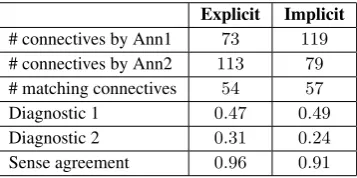
Explicit Implicit
# connectives by Ann1 73 119 # connectives by Ann2 113 79 # matching connectives 54 57 Diagnostic 1 0.47 0.49 Diagnostic 2 0.31 0.24 Sense agreement 0.96 0.91
Table 1: Inter-annotator agreement statistics for explicit and implicit connectives in HDRB
Inter-annotator agreement was also estimated with respect to the sense type of the discourse relation inferred. In our experiment, we use the four class-level labels (comparison, contingency, temporal and expansion) as the basic types to estimate agreement in annotation of the sense of implicit connectives. Agreement in sense type is estimated as the Dice coefficient of the two sets of senses of implicit con-nectives annotated by the two annotators.
The inter-annotator agreement statistics estimated using the method described above are shown in Table 1. The first three rows in the table contain information about the num-ber of connective tokens annotated by each of the annota-tors (Ann1 and Ann2) and the number of matching tokens for explicit as well as implicit connectives. Inter-annotator agreement estimates based on the above diagnostics are shown in the next three rows.
One consequence of annotating discourse connectives over continuous text seems to be that the number of connectives annotated is not the same across annotators (cf. first two rows in Table 1). This was not the case in PDTB (Milt-sakaki et al., 2004), where annotation was carried out connective-wise. This suggests that the notion of a connec-tive itself was quite challenging for the annotators, proba-bly due to the substantial annotation load in simultaneously annotating different kinds of connectives over continuous text. In particular, the distinction between connectives and AltLex expressions in Hindi seems to be a difficult one. In the next section, we discuss a strategy to break down the annotation task into multiple phases in order to handle this issue.
Inter-annotator agreement for annotation of argument spans was low regardless of connective type. Furthermore, agree-ment estimated using diagnostic2was much lower than that of diagnostic1 for both explicit and implicit connectives. Such low values suggest two possible issues:
1. While annotating the spans of arguments of con-nectives, the minimality principle was not followed strictly. And since the diagnostics used to estimate agreement were based on the exact match criterion, the values are particularly low. If this is true, it also means that training annotators based on the minimal-ity principle alone can bring immediate improvements in annotation quality.
2. The second and the more serious possibility is that annotators seem to prefer the syntactic (linear-order) convention for argument naming (followed in PDTB)
Explicit Implicit
matching Arg1 0.38 0.37 matching Arg2 0.56 0.61
Table 2: Inter-annotator agreement: Arg1 versus Arg2
rather than the semantic one proposed for HDRB. This is evident from the relatively higher agreement val-ues when matching Arg2 alone as compared to Arg1 alone, shown in Table 2. The main reason for this preference could be due to the relatively lower com-plexity of a syntactic naming convention as opposed to a semantic one. While the semantic convention re-quires that the annotator understand the semantics of the discourse relation to be able to assign argument names, the syntactic naming convention is invariant (Arg2 always the one in which the connective occurs and Arg1 is the ‘other’ argument), and therefore, rela-tively simpler to adhere to. This then suggests that we may need to reconsider the semantic naming conven-tion proposed in earlier work.
The most encouraging outcome of our evaluation study is the high degree of inter-annotator agreement achieved with respect to the sense type of the connective both for explicit and implicit connectives (cf. last row in Table 1). Such high values confirm the efficacy of the hierarchical sense clas-sification scheme for annotating senses of discourse con-nectives. However, it must be noted that annotators were allowed to back-off to the coarser type level sense labels (cf. section 2.5.) since argument naming was assumed to be based on a semantic naming convention. However, in case of a rollback to a syntactic convention for argument naming (which seems necessary), annotators will have to assign sub-type level sense labels to the connectives. Another oft-noticed phenomenon in Hindi discourse is im-plicit connectives between non-adjacent sentences, an ex-ample of which is as follows.
(10)
[
vEr W mAkpA ntA nFlo(pl bs k mtAEbk aAm bjV m\ yntm sAJA kAym kF Jlk sAP njr aAtF h{।]
vAmdl lgAtAr srkAr pr Ef"A,-vA-Ly v rojgAr "/o\ m\ bjV prAvDAn bxAn k Ele dbAv bnAe he T। bjV m\ in sBF "/o\ pr @yAn EdyA gyA h{। ... Implicit=dsrF aor
{
aArespF k avnF rAy n khA Ek bjV m\ CoV EksAno\ k Ele kC nhF\ EkyA gyA h{।}
lG udyog k Ele n{i yojnA nhF\ h{ aOr k-Vm yVF m\ kVOtF kA sFDA asr Grl udyog pr pwgA। ...‘[According to senior CPI(M) leader Mr.Nilotpal Basu, the general budget clearly reflects aspects of the Common Minimum Programme.] The left parties had been continuously exerting pressure on the government to increase allocation to
ed-ucation, health and employment sectors. And
industry and the drop in custom duty will have a di-rect adverse impact on cottage industries...’
In the above example, a discourse relation of contrast type (juxtaposition) can be inferred between the highlighted text spans. An implicit discourse connective needs to be in-serted between these non-adjacent sentences. Such in-stances seem to be quite common in Hindi discourse. This could possibly be due to the high incidence in Hindi of connective classes that take distant arguments (such as dis-course adverbials). Annotation of implicit connectives was done only between adjacent sentences in PDTB and the same practice was adopted in HDRB. However, based on our observations in the annotation experiment, we plan to revise this earlier decision and allow for annotation of im-plicit connectives between non-adjacent sentences.
4.
Discussion and Conclusion
In an attempt to introduce more uniformity in the PDTB sense classification and task workflow, the HDRB annota-tion scheme of Oza et al. (2009a) proposed some modi-fications to the PDTB scheme. In this paper, we gave an overview of the HDRB scheme, discussing the modifica-tions to the PDTB, and described our application of the scheme to a subset of the HDRB source corpus. Our results have shown that annotation quality is negatively affected by some of the changes. Moving forward for future anno-tation in the HDRB, we propose the following revisions to the current version of the HDRB scheme.
First, in order to annotate connectives over continuous text and yet keep the annotation load on annotators manageable, the annotation workflow should be split into two steps. This two-step annotation strategy is currently being tried out.
1. Annotate all inter-sentential relations, which include explicit and implicit connectives and AltLex expres-sions as well.
2. Annotate all intra-sentential relations, which mostly include explicit connective classes such as subordina-tors, sentential relatives and possibly AltLex expres-sions.
Second, annotators must be trained specifically to follow the Minimality principle when selecting the spans of a con-nective’s arguments. This is expected to boost the agree-ment on arguagree-ment span selection.
Third, a rollback to the older syntactic argument naming convention followed in PDTB will be implemented. This is based on our observations about the annotators’ preference to adhere to a linear order-based convention rather than a semantic one. Relatedly, if the argument naming conven-tion is syntactic, annotaconven-tion of senses of connectives must be done at the fine-grained subtype level.
Finally, implicit connectives between non-adajcent sen-tences must be annotated and guidelines for their annota-tion developed.
A revision of the HDRB guidelines based on these conclu-sions is currently underway. We expect that the resultant new version will help smoothen the process of training an-notators and also increase the annotation quality.
Acknowledgements
This work was partially supported by NSF grant IIS-07-05671.
5.
References
A. Al-Saif and K. Markert. 2010. The Leeds Arabic Discourse Treebank: An-notating Discourse Connectives for Arabic. InProceedings of the 7th Interna-tional Conference on Language Resources and Evaluation (LREC-2010), Val-letta, Malta.
R. Begum, S. Husain, A. Dhwaj, D.M. Sharma, L. Bai, and R. Sangal. 2008. Depen-dency Annotation Scheme for Indian Languages.Proceedings of IJCNLP-2008. R. Bhatt, B. Narasimhan, M. Palmer, O. Rambow, D.M. Sharma, and F. Xia. 2009. A Multi-Representational and Multi-Layered Treebank for Hindi/Urdu. In Pro-ceedings of the Third Linguistic Annotation Workshop, pages 186–189. Associa-tion for ComputaAssocia-tional Linguistics.
E. Miltsakaki, R. Prasad, A. Joshi, and B. Webber. 2004. Annotating Discourse Con-nectives And Their Arguments. InProceedings of the HLT/NAACL Workshop on Frontiers in Corpus Annotation, pages 9–16.
L. Mladov´a, ˇS. Zik´anov´a, and E. Hajiˇcov´a. 2008. From Sentence to Discourse: Building an Annotation Scheme for Discourse Based on Prague Dependency Treebank. InProceedings of the 6th International Conference on Language Re-sources and Evaluation (LREC 2008).
U. Oza, R. Prasad, S. Kolachina, S. Meena, D.M. Sharma, and A. Joshi. 2009a. Ex-periments with Annotating Discourse Relations in the Hindi Discourse Relation Bank. InProceedings of the 7th International Conference on Natural Language Processing (ICON-2009), Hyderabad, India.
U. Oza, R. Prasad, S. Kolachina, D.M. Sharma, and A. Joshi. 2009b. The Hindi Dis-course Relation Bank. InProceedings of the Third Linguistic Annotation Work-shop, pages 158–161. Association for Computational Linguistics.
M. Palmer, R. Bhatt, B. Narasimhan, O. Rambow, D.M. Sharma, and F. Xia. 2009. Hindi Syntax: Annotating Dependency, Lexical Predicate-Argument Structure, and Phrase Structure. InThe 7th International Conference on Natural Language Processing, pages 14–17.
R. Prasad, N. Dinesh, A. Lee, A. Joshi, and B. Webber. 2007. Attribution and its an-notation in the Penn Discourse TreeBank.Traitement Automatique des Langues, Special Issue on Computational Approaches to Document and Discourse, 47(2). R. Prasad, N. Dinesh, A. Lee, E. Miltsakaki, L. Robaldo, A. Joshi, and B. Webber. 2008. The Penn Discourse Treebank 2.0. InProceedings of the 6th International Conference on Language Resources and Evaluation (LREC 2008), pages 2961– 2968. Citeseer.
R. T. Rachakonda and D. M. Sharma. 2011. Creating an Annotated Tamil Corpus as a Discourse Resource. InProceedings of the 5th Linguistic Annotation Workshop, pages 119–123, Portland, OR.
S. Tonelli, G. Riccardi, R. Prasad, and A. Joshi. 2010. Annotation of Discourse Relations for Conversational Spoken Dialogs. InProceedings of the Seventh In-ternational Conference on Language Resources and Evaluation (LREC 2010), Valletta, Malta.
F. Xia, O. Rambow, R. Bhatt, M. Palmer, and D.M. Sharma. 2008. Towards a Multi-Representational Treebank. Proceedings of the 7th International Workshop on Treebanks and Linguistic Theories (TLT-7), pages 207–238.
D. Zeyrek and B. Webber. 2008. A Discourse Resource for Turkish: Annotating Discourse Connectives in the METU Corpus.Proceedings of IJCNLP-2008. Hy-derabad, India.
Y. Zhou and N. Xue. 2012. PDTB-style Discourse Annotation of Chinese Text. In