Example-Based Treebank Querying
Liesbeth Augustinus, Vincent Vandeghinste, Frank Van Eynde
Centre for Computational Linguistics KU Leuven
[email protected], [email protected], [email protected]
Abstract
The recent construction of large linguistic treebanks for spoken and written Dutch (e.g. CGN, LASSY, Alpino) has created new and exciting opportunities for the empirical investigation of Dutch syntax and semantics. However, the exploitation of those treebanks requires knowledge of specific data structures and query languages such as XPath. Linguists who are unfamiliar with formal languages are often reluctant towards learning such a language. In order to make treebank querying more attractive for non-technical users we developed GrETEL (Greedy Extraction of Trees for Empirical Linguistics), a query engine in which linguists can use natural language examples as a starting point for searching the Lassy treebank without knowledge about tree representations nor formal query languages. By allowing linguists to search for similar constructions as the example they provide, we hope to bridge the gap between traditional and computational linguistics. Two case studies are conducted to provide a concrete demonstration of the tool. The architecture of the tool is optimised for searching the LASSY treebank, but the approach can be adapted to other treebank lay-outs.
Keywords:Dutch, treebank, querying
1.
Introduction
The recent construction of large linguistic treebanks (or syntactically annotated text corpora) for spoken and writ-ten Dutch such as CGN (van der Wouden et al., 2003), (Van Eynde, 2009), LASSY (van Noord et al., 2006; van Noord et al., in press), and Alpino Treebank (van der Beek et al., 2002) has created new and exciting opportunities for the empirical investigation of Dutch syntax and semantics. However, the exploitation of those treebanks usually re-quires knowledge of specific data structures and/or query languages, which may discourage linguists to use them. In this paper, we present a user-friendly search application for the exploitation of treebanks by linguists who are not familiar with nor interested in data formats or query languages. By allowing linguists to search for similar constructions as the example they provide, we hope to bridge the gap between traditional linguistics and treebank builders. This conforms with one of the project goals of CLARIN1 to open up language resources for human and social sciences. In section 2 we will shortly discuss the most common querying issues. In section 3 we will present the concept of example-based querying and the architecture of our search application, which will be illustrated by the elaboration of two examples in section 4. Finally, we will draw conclusions and touch on some topics for future research in section 5.
2.
Querying Issues
In the literature on treebank querying we are faced with the same problems over and over again. A major obstacle is the
limited user-friendlinessof the query languages and search tools. That problem is closely related to another issue of treebank mining: thelack of standardisationin both tree-banks and query languages. See amongst others: Lai and
1
http://www.clarin.eu
Bird (2004), Hellmann et al. (2010), and ˇStep´anek and Pa-jas (2010).
Nowadays there are many natural language treebanks and almost as many formal languages to query those treebanks. For example, the Penn Treebank (Marcus et al., 1993) should be queried with TGrep2 (Rohde, 2005), the TIGER Treebank (Brants et al., 2002) and CGN can be queried with TIGERSearch (Lezius, 2002), and for LASSY the W3C standards XPath2 and XQuery3 can be used for search-ing and extractsearch-ing information from the treebank with ap-plications like dtsearch (Bouma and Kloosterman, 2002; Bouma and Kloosterman, 2007) or DACT.4Because of that
overload of query languages, annotation formats and data structures, many linguists give up treebank mining as they do not easily find what they are looking for. It requires time and effort to learn a formal language, since queries get long and complex relatively quickly.
As it is quite a hassle to learn such query languages and data structures, some search tools offer a GUI in order to shield the linguist from the internal formalisation of the treebank, e.g. TIGERin (Voormann and Lezius, 2002), and SearchTree (Nygaard and Johannesen, 2004). Unfortunately, the linguist still has to be familiar with the exact tree lay-out and hence the underlying linguistic theories of the treebank builders in order to formulate what (s)he is looking for. Therefore such GUIs are in factless user-friendlythan they are supposed to be.
Since standardisation5 in the highly evolving field of treebank building and querying is still far off,6 we decided
2http://www.w3.org/TR/xpath 3
http://www.w3.org/TR/xquery 4
http://rug-compling.github.com/dact/ 5
Although a standard format for linguistic annotation is not de-fined yet, the FoLiA format (van Gompel, 2011) is a first attempt towards such a format for Dutch.
lan-to tackle the problem in another way. Instead of developing yet another query language or designing yet another GUI, we present a query engine which does not ask for any formal input query. As input, the tool takes something linguists are familiar with:natural language.
3.
Example-Based Querying
Since linguists tend to start their research from example sentences, example-based querying allows to use those ex-amples as a starting point for treebank search. Work related to our approach are the Linguist’s Search Engine (Resnik and Elkiss, 2005), a tool that makes use of example-based querying, and the TIGER Corpus Navigator (Hellmann et al., 2010), which is a Semantic Web system used to classify and retrieve sentences from the TIGER corpus on the basis of abstract linguistic concepts.
We present GrETEL (Greedy Extraction of Trees for Empirical Linguistics), a tool for example-based query-ing. The implementation is optimised for querying LASSY Small,7 the manually annotated part of the LASSY tree-bank (van Noord et al., 2006; van Noord et al., in press), which consists of unordered dependency trees. Since those trees are in XML format, they can be queried with XPath and XQuery.
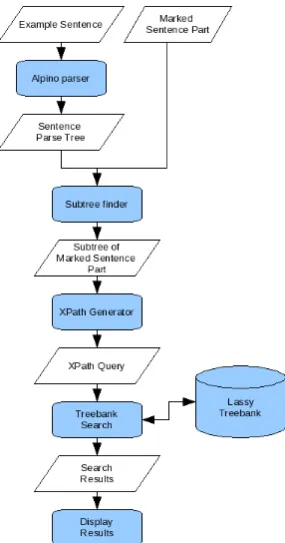
Figure 1 presents the architecture of GrETEL. The system takes as input an example of the syntactic construction the user is looking for. The input construction is not necessarily a full sentence. The user can indicate which parts of the input construction are relevant. Next, the construction is parsed with the Alpino parser (van Noord, 2006) and the relevant parts are annotated in the parse tree. Then, the Subtree Finderlooks for the annotations in the parse tree in order to ‘cut out’ the subtree. That subtree is the input of the XPath Generator, which converts the subtree into an XPath query. After the conversion the user has the option to adapt the query if necessary. In the final step the query is matched against the LASSY Small treebank. If any matching constructions are found, the results are displayed to the user.
Our approach of example-based querying could be adapted to work for any other treebank if there exists a parser which outputs trees similar to the trees in the treebank, such as the Charniak parser (Charniak, 1997) and the Penn
guage treebanks: XML for data storage, XPath/XQuery for searching treebanks (e.g. LASSY, Alpino Treebank). Sometimes tools for linguistic purposes are extensions of those fundamental standards. An example is LPath (Lai and Bird, 2010), a query language based on XPath. Although it is easier to learn LPath if one is already familiar with XPath, such extensions to existing standards do not solve the problem of query language overload. A different approach to solve the standardization problem is the creation of a query language that covers several treebanks such as PML ( ˇStep´anek and Pajas, 2010).
7
We have made some changes to the Lassy treebank and the Alpino parses of the input sentences, aiming at a generalisation in query patterns. The Alpino parser and the Lassy treebank do not allow unary branching. When a single noun occurs, it will hence not be placed under anoun phrase(NP). We have applied a transduction on the whole treebank to put suchbarenouns and names under an NP, allowing unary branching in this case.
Figure 1: Architecture of GrETEL
Treebank. Furthermore, terminal nodes of the parse trees should contain part of speech (POS), lemma, and token (word form). In order to be compatible with GrETEL, the treebank should be converted to the Alpino XML structure or a similar XML data structure. Such a conversion is generally possible for treebanks with a tree-like data structure, e.g. Penn Treebank, and the monolingual sides of the treebanks described in (Kotz´e et al., 2012). Less important aspects are the linguistic framework of the tree-bank (e.g. whether the treetree-bank is phrase structure-based or dependency-based) and the (natural) language of the treebank.
4.
Two Case Studies
Two examples are presented in order to give a detailed elaboration of treebank mining using GrETEL. The first case considers Dutch nominalisations (section 4.1). The second example investigates the position of separable verb particles in Dutch subclauses (section 4.2), which is a more complex case as the word order is taken into account. Both examples will show that GrETEL returns sentences similar to the input example.
4.1. Case 1: Nominalisations
If one is interested in deverbal nominalisations with deter-minerhet[E: ‘the’] and a direct object introduced by prepo-sitionvan[E: ‘of’], a possible input sentence is (1).
(1) Het the
doden kill
van of
olifanten elephants
is is
The input construction is presented in a matrix (Figure 2), allowing the user to indicate the parts of the sentence that are relevant for the syntactic construction (s)he is querying. Initially thenot relevantbutton is selected for all words. The user can indicate for each word whether (s)he is interested in the part of speech (POS), the lemma or the token. If the user is looking for non-lexical similarities,pos
should be selected. Thelemmabutton should be indicated to abstract over word forms, and the tokenbutton should be selected for retrieving specific word forms.8 If the input contains words that are no part of the target construction, thenot relevantbutton should remain selected.
Figure 2: Input matrix for example (1)
It should be noted that the dependency relation and thePOS
of all relevant nodes are taken into account. For example, if the lemma button would be selected for doden [E: ‘to kill’], sentences like (2) will match. Sentences in which
doden[E: ‘(the) death’] is a plural noun, such as (3) will not match. The tool thus considers lemmas and tokensin contextinstead of mere string matching.
(2) Het the
doden kill
van of
mensen humans
is is
verboden. forbidden ‘Killing humans is prohibited.’
(3) Het the
aantal amount
doden deaths
van of
dat that
treinongeval train accident
stijgt. rises ‘The death toll from that train accident is rising.’
In order to find more matches, we only indicatedposfor both the nominalised verb and the noun in its PP sister. The lemmas of the determinerhetand the prepositionvan
are indicated, since those words are inherent parts of the nominalised constructions we are looking for.
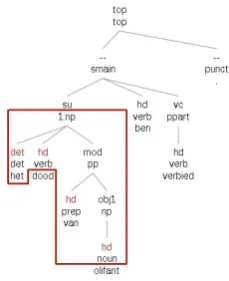
The input construction is parsed with the Alpino parser (van Noord, 2006), which is also used as a starting point for the treebank annotations of the LASSY treebank. The information provided in the input matrix is then added to the parse tree, allowing us to extract a subtree from the full parse tree, as shown in Figure 3.9 The top of the
8
For invariable word forms such ashetandvanin example (1), it does not matter whether lemma or token is selected for those words.
9The graphical representation only shows per node (from top to bottom) the dependency relation, the syntactic category orPOS,
subtree is the lowest node that dominates the relevant items.
Figure 3: Alpino parse of example (1) with selected subtree
The subtree is used as input for theXPath Generator, which converts them into XPath queries. The query in (4) is gen-erated from the subtree indicated in Figure 3.
(4) //node[@cat="np" and node[@rel="det" and @root="het" and @pos="det"] and
node[@rel="hd" and @pos="verb"] and
node[@rel="mod" and @cat="pp" and
node[@rel="hd" and @root="van" and
@pos="prep"] and node[@rel="obj1"
and @cat="np" and node[@rel="hd" and
@pos="noun"]]]]
The XPath query contains all elements that are present in the subtree (i.e. dependency relation [@rel], POS
[@pos]and for some nodes lemma[@root]).10 After the query is generated, the user has the option to choose betweenbasicandadvancedsearch mode.
In basic search mode, the XPath query is immediately matched against the corpus. The user has the option to search the complete LASSY Small treebank (65k sen-tences) or to select one or more subcorpora. For the query in (4) we have found 1288 hits in 1206 sentences in the complete corpus. Five matches are presented in (5 - 9).
(5) Het the
samenleven together-live
van of
verschillende different bevolkingsgroepen
communities
gaat goes
niet not
vanzelf by-itself
.
‘It is not easy for different communities to live to-gether.’
(6) Controle control
op on
het the
naleven comply
van of
de the
regelgeving rules binnen
within de the
beschermde protected
gebieden areas
‘Controlling the compliance of the rules within the protected areas’
and the lemma. 10
Figure 4: Input matrix for example (16)
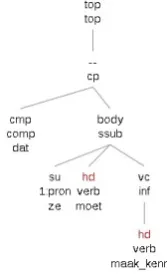
Figure 5: Alpino parse of example (16) with selected sub-tree
examples as well, the query finds the total amount of sen-tences with separable verb particles in subclauses: 98 hits in 95 sentences.
(17) //node[@cat="ssub" and node[@rel="hd" and @pos="verb"] and node[@rel="vc"
and @cat="inf" and node[@rel="svp"
and @pos="part"] and node[@rel="hd"
and @pos="verb"]]]
In order to investigate the position of separable verb parti-cles with GrETEL we need (at least) two input sentences: one with a non-verbal element (separable verb particle) within the verbal complex and one in which the separable verb particle does not occur within the verb cluster. Ex-ample (15) is a possible input sentence to investigate the first scenario (interruption). A similar sentence without in-terruption is presented in (18); the subclause we have pre-sented to the system is given in (19).
(18) De the
gedachte thought
dat that
ze she
kennis acquintance
moet has
maken make met
with haar her
schoonmoeder mother-in-law
stemde make-feel
haar her
niet not gelukkig.
happy
‘The thought that she had to meet her mother-in-law did not make her feel happy.’
(19) dat that
ze she
kennis acquaintance
moet has
maken make
‘that she had to meet’
Since the Alpino parser generates dependency trees, the structure of the parse of the non-interruption example will be exactly the same as the parse of the interruption example. The difference lies in the surface position of the terminal nodes, which is included in thebeginfeature of each node.12 As the Alpino parser includes information on the position of terminal nodes, it is possible to respect the word order of the input sentence. However, the formulation of such XPath queries is rather complex, because the abso-lute word position values have to be compared in a relative way. In order to do that computation automatically, we have created anOrdering Filterthat takes the surface order of the words into account while generating the XPath query.
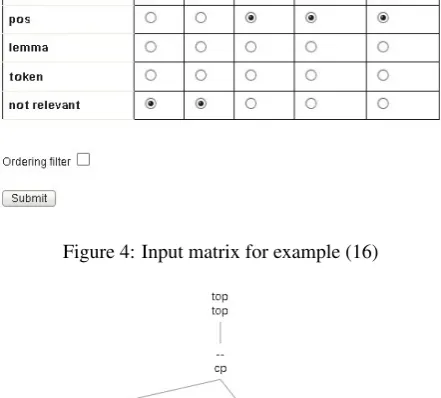
The following query (20) is generated from the subtree derived from the interruption example dat ze moet kennis maken. The input matrix looks similar to Figure 4, but the
Ordering Filterbox is checked:
(20) //node[@cat="ssub" and node[@rel="hd" and @pos="verb" and @begin
< ../node[@rel="vc" and
@cat="inf"]/node[@rel="svp"
and @pos="part"]/@begin] and
node[@rel="vc" and @cat="inf" and
node[@rel="svp" and @pos="part"
and @begin < ../node[@rel="hd" and
@pos="verb"]/@begin]]].
That query matches with 4 hits in 4 sentences, which are presented in (21 - 24).
(21) Als If
we we
echt really
willen want
vooruit forward
komen come
met with
Europa Europe moeten
must we we
geen no
“verdrag “treaty
min” minus”
maar but
een a “verdrag
“treaty plus” plus”
afsluiten off-close .
‘If we really want to move forward with Europe we should not make a “treaty minus” but a “treaty plus”.’
(22) Dit this
is is
het the
schooljaar school-year
v´o´or before
uw your
kind child
in in
een a welbepaalde
specific
school school
effectief actually
zal will
school school
lopen go
.
‘This is the school year before your child actually goes to a specific school.’
(23) Vanaf From
dit this
ogenblik moment
zijn are
er there
drie three
verkozenen elected die
who zich them
fulltime full time
met with
de the
realisatie realisation
van of
het the groene
green
gedachtegoed idea
kunnen can
bezig busy
houden keep
.
‘From now on there are three members elected who can work on the realisation of the green thought.’
5.
Conclusion and Future Research
We have presented GrETEL, a tool for querying a tree-bank with natural language examples instead of a formal input query. The tool allows to search in treebanks without knowledge about the tree representations, treebank query languages, nor the specific linguistic theories in the tree-bank. The user provides the query engine with an exam-ple sentence, marking which parts of the sentence are the focus of the query. Through automated parsing of the ex-ample sentence and subtree extraction of the sentence part under focus the treebank is queried for the extracted sub-tree. GrETEL then returns sentences similar to the input example. In order to demonstrate GrETEL as a tool for treebank mining, two case studies were conducted. Future research involves the creation of a web version of the example-based query mechanism for the LASSY tree-bank, integrated with the actual search mechanism, instead of the XPath query engine we currently use, backing off to more abstract subtrees, when no results are found. Further-more, we want to include more treebanks, such as CGN and LASSY Large. Ultimately, we want to build a faster query engine, based on the Varro tree indexing toolkit (Martens, 2011), as XPath is rather slow, especially on large tree-banks.6.
Acknowledgements
This paper as well as the development of the GrETEL tool is part of Nederbooms, a CLARIN project that is funded by the Flemish Community.
7.
References
Gosse Bouma and Geert Kloosterman. 2002. Querying Dependency Treebanks in XML. In Proceedings of LREC’02, pages 1686–1691, Las Palmas, Spain. Gosse Bouma and Geert Kloosterman. 2007. Mining
Syn-tactically Annotated Corpora with XQuery. In Proceed-ings of the Linguistic Annotation Workshop, pages 17– 24, Prague, Czech Republic.
Sabine Brants, Stefanie Dipper, Silvia Hansen, Wolfgang Lezius, and George Smith. 2002. The TIGER Treebank. InProceedings of TLT-1.
Eugene Charniak. 1997. Statistical Parsing with a Context-free Grammar and Word Statistics. In Proceedings of the Fourteenth National Conference on Artificial Intel-ligence, Menlo Park. AAAI Press/MIT Press.
Walter Haeseryn, Kirsten Romijn, Guido Geerts, Jaap de Rooij, and Maarten van den Toorn. 1997. Algemene Nederlandse Spraakkunst. Martinus Nijhoff/Wolters Plantyn, Groningen/Deurne, second edition.
Sebastian Hellmann, J¨org Unbehauen, Christian Chiarcos, and Axel-Cyrille Ngonga Ngomo. 2010. The TIGER Corpus Navigator. In Proceedings of TLT-9, pages 91– 102, Tartu, Estonia.
Gideon Kotz´e, Vincent Vandeghinste, Scott Martens, and J¨org Tiedemann. 2012. Large Aligned Treebanks for Syntax-Based Machine Translation. In Proceedings of LREC’12, Istanbul.
Catherine Lai and Steven Bird. 2004. Querying and updat-ing treebanks: A critical survey and requirements
analy-sis. InProceedings of the Australasian Language Tech-nology Workshop, pages 139–146.
Catherine Lai and Steven Bird. 2010. LPath+: A First-Order Complete Language for Linguistic Tree Query. In
Proceedings of PACLIC 19.
Wolfgang Lezius. 2002. TIGERSearch - ein Such-werkzeug f¨ur Baumbanken. In Stephan Busemann, ed-itor,Proceedings of KONVENS-02, Saarbr¨ucken. Mitchell P. Marcus, Beatrice Santorini, and Mary Ann
Marcinkiewicz. 1993. Building a large annotated corpus of English: the Penn Treebank. Computational Linguis-tics, 19(2):313–330.
Scott Martens. 2011. Quantifying Linguistic Regularity. Ph.D. thesis, KU Leuven, Leuven, Belgium.
Lars Nygaard and Janne Bondi Johannesen. 2004. SearchTree - a user-friendly treebank search interface. In
Proceedings of TLT-3, page 183–189, T¨ubingen. Philip Resnik and Aaron Elkiss. 2005. The Linguist’s
Search Engine: An Overview. In Proceedings of the ACL Interactive Poster and Demonstration Sessions, pages 33–36, Ann Arbor.
Douglas L.T. Rohde, 2005. TGrep2 User Manual.
Leonoor van der Beek, Gosse Bouma, Robert Malouf, and Gertjan van Noord. 2002. The Alpino Dependency Treebank. In Computational Linguistics in the Nether-lands 2001.
Ton van der Wouden, Ineke Schuurman, Machteld Schouppe, and Heleen Hoekstra. 2003. Harvesting Dutch trees: Syntactic properties of Spoken Dutch. In Computational Linguistics in the Netherlands 2002, pages 129–141, Amsterdam.
Frank Van Eynde. 2009. A Treebank-Driven Investiga-tion of Predicative Complements in Dutch. In Compu-tational Linguistics in the Netherlands 2009, pages 131– 145, Utrecht.
Maarten van Gompel. 2011. FoLiA: Format for Linguis-tic Annotation. ILK Research Group, Tilburg University, September.
Gertjan van Noord, Ineke Schuurman, and Vincent Van-deghinste. 2006. Syntactic annotation of large corpora in STEVIN. InProceedings of LREC’06, pages 1811– 1814, Genoa, Italy.
Gertjan van Noord, Gosse Bouma, Frank Van Eynde, Daniel de Kok, Jelmer van der Linde, Ineke Schuur-man, Erik Tjong Kim Sang, and Vincent Vandeghin-ste. in press. Large Scale Syntactic Annotation of Writ-ten Dutch: Lassy. In Essential Speech and Language Technology for Dutch: resources, tools and applications. Springer.
Gertjan van Noord. 2006. At Last Parsing Is Now Opera-tional. InTALN 2006, pages 20–42.
Holger Voormann and Wolfgang Lezius. 2002. TIGERin - Grafische Eingabe von Benutzeranfragen f¨ur ein Baumbank-Anfragewerkzeug. In Stephan Busemann, editor,Proceedings of KONVENS-02), Saarbr¨ucken. Jan ˇStep´anek and Petr Pajas. 2010. Querying Diverse