International Journal of Scientific Research in Computer Science, Engineering and Information Technology © 2017 IJSRCSEIT | Volume 2 | Issue 4 | ISSN : 2456-3307
Direct Sequence Based Performance Evaluation of OLSR having
11 Mbps Data rate Using OPNET
Indu1, Sandeep Gupta2, Jonish 3¹M-Tech Department of CSE, HCE, Sonepat, Haryana, India ²Assistant Professor, Department of CSE, HCE, Sonepat, Haryana, India
³Department of CSE, Sonepat, Haryana, India
ABSTRACT
In this paper analysis and performance of OLSR is done for 11 mbps data rate. We used OPNET Simulation tool we created a network containing 18 mobile nodes with data rate 11 Mbps with transmission power 0.005 watts and buffer size 256000 bits each node moves randomly in the network and simulation time was 1200 sec with high willingness. OLSR routing protocol is compared in terms of FTP Download Response Time (sec), HTTP Traffic received (pkt/sec), WLAN Delay (sec) and WLAN Media Access Delay (sec). According to the resulted performance OLSR with parameters of table no IV performed better then the OLSR with parameters of table no III. The simulation result of the research has practical reference value for further study.
Keywords : OLSR, MANET, QOS, OPNET, MPR
I.
INTRODUCTION
The Optimized Link State Routing Protocol (OLSR) is developed for mobile ad hoc networks (MANET’s). It is a proactive protocol, i.e., exchanges topology information with other nodes of the network regularly. Each node selects a set of its neighbor nodes as "multipoint relays" (MPR). In OLSR, only nodes, selected as such MPR’s, are responsible for forwarding control traffic, intended for diffusion into the entire network.
MANET is a dynamic distributed network. Due to the dynamic nature the network topology keep changes randomly. The mobility of nodes in MANETs results in frequent changes of network topology making routing in MANETs a challenging task. Protocols like OLSR in MANET helps node to send and receive packets and each node acts both as a router and as a host. Nodes are like laptop, computers and wireless phones have a limited transmission range for direct transmission. The success of communication depends on cooperation of other nodes. [1]
Routing protocol is the major issue in data communication’s performance of MANET. Hence, routing protocol required is to be effective and accurate so as to handle mobility of nodes and to give best utilization to technology. Routing protocol is a standard that determines how nodes find the way to forward packets between devices in the network. In this paper performance of OLSR protocol is evaluated by using FTP and HTTP application type of IEEE 802.11a/b/g WLAN Standard. [2]
TABLE I
IEEE 802.11 CLASSIFICATIONS
II.
RELATED WORK
moves randomly in the network and simulation time was 1500 sec. TORA and OLSR routing protocols were compared in terms of Traffic Received, Traffic Sent, Network Load, Retransmission Attempts and Throughput. According to the resulted performance OLSR performed better then TORA in both 1 Mbps and 2 Mbps
Anjali [2] analyzed the performance of AODV, OLSR and GRP routing protocols is evaluated for FTP based application traffic on IEEE 802.11 WLAN Standard and 48 Mbps data rate. The network performance is evaluated by using OPNET simulator based on various quantitative metrics- Network Load, Throughput, Retransmission Attempts and Media Access Delay by varying physical characteristics and number of nodes. A comparative performance analysis of these protocols have been carried out in this paper and in the last conclusion will be presented which demonstrate that performance of routing protocols differs by varying the network and selection of accurate routing protocol according to the network ultimately influences the efficiency of the network in a magnificent way.
Ravinder Ahuja [4] evaluated performance of three types of routing protocols (AODV, OLSR and ZRP) based on random waypoint mobility model. In this paper they analyze and compare the performance of protocols using Qualnet 4.5 from scalable network .These routing protocols were compared in terms of Packet delivery ratio, Average end-to end delay and Throughput when subjected to change in no. of nodes and pause time. Simulation results show that Reactive protocols better in terms of packet delivery ratio and throughput
Narender[5] In this paper analysis and performance of OLSR is done for 1 and 11 mbps data rate. We used OPNET Simulation tool we created a network containing 27 mobile nodes with data rate 1 Mbps and 11 Mbps with transmission power 0.005 watts and buffer size 256000 bits each node moves randomly in the network and simulation time was 2000 sec. OLSR routing protocol is compared in terms of OLSR Performance Topology changes, FTP Download Response Time(sec), HTTP Object Response Time (sec), WLAN Retransmission Attempts (packets) and OLSR MPR count .
III.
MANET ROUTING PROTOCOLS
The vision of mobile ad hoc networking is to support robust and efficient operation in mobile wireless networks by incorporating routing functionality into mobile nodes. Such networks are envisioned to have dynamic, sometimes rapidly-changing, random, multi-hop topologies which are likely composed of relatively bandwidth-constrained wireless links.
A number of routing protocols are created to be implemented on MANET categorized in three different types according to the functionality
A. Proactive Protocols B. Reactive Protocols C. Hybrid Protocols
OLSR is well suited for networks, where the traffic is random and sporadic between a larger set of nodes rather than being almost exclusively between a small specific set of nodes. As a proactive protocol, OLSR is also suitable for scenarios where the communicating pairs change over time: no additional control traffic is generated in this situation since routes are maintained for all known destinations at all times. OLSR is a proactive routing protocol for mobile ad-hoc networks (MANETs). [1][2] It is well suited to large and dense mobile networks, as the optimization achieved using the MPRs works well. The larger and more dense a network, the more optimization can be achieved as compared to the classic link state algorithm. OLSR uses hop-by-hop routing, i.e., each node uses its local information to route packets. [6][7]
IV.
SIMLATION SETUP
This research used software known as OPNET Modeler, Which is a tool provided by the OPNET Technologies in order to undertake the experimental evaluation; the version named OPNET Modeler 14.5 has been adopted for study [8].
TABLE II
SIMULATION PARAMETERS
Simulation Parameter Value
Simulator OPNET Modular 14.5
Area 1000*1000
Network Size 18 Nodes
Data Rate 11 Mbps
Mobility Model Random waypoint
Traffic Type FTP, HTTP
Simulation Time 1500 sec
Address Mode IPV4
Standard IEEE 802.11 Direct
Sequence
Routing Protocol OLSR
TABLE III
Neighbor Hold Time(Sec) 6.0 Topology Hold Time(Sec) 15.0 Duplicate Message Hold
Time(Sec)
30.0
Addressing Mode IPV4
TABLE IV Neighbor Hold Time(Sec) 10.0 Topology Hold Time(Sec) 20.0 Duplicate Message Hold
Time(Sec)
40.0
Addressing Mode IPV4
TABLE V
WIRELESS LAN PARAMETERS
Attribute Value
Physical Characteristics Direct Sequence
Data Rate 11 Mbps
Short Retry Limit 7
Long Retry Limit 4
Max Receive Lifetime (sec)
0.5
Buffer Size(bits) 256000 Roaming Capability Disabled
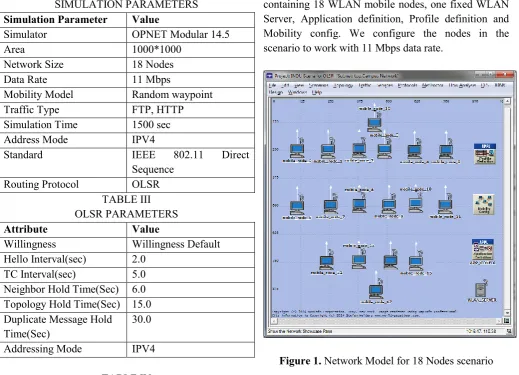
Fig. 1 shows the simulation environment of scenario containing 18 WLAN mobile nodes, one fixed WLAN Server, Application definition, Profile definition and Mobility config. We configure the nodes in the scenario to work with 11 Mbps data rate.
Figure 1. Network Model for 18 Nodes scenario
V.
PERFORMANCE MERICS
A. FTP Download Response Time (sec)
Time elapsed between sending a request and receiving the response packet. Measured from the time a client application sends a request to the server to the time it receives a response packet. Every response packet sent from a server to an FTP application is included in this statistic.
B. HTTP Traffic received (pkt/sec)
Average bytes per second forwarded to all HTTP applications by the transport layers in the network.
C. WLAN Delay (sec)
It is the time taken by a packet from the movement it is transmitted on the network by source node to reach the destination node.
It represents the global statistic for the total of queuing and contention delays of the data, management, delayed Block-ACK and Block-ACK Request frames transmitted by all WLAN MACs in the network.
VI.
SIMULATION RESULTS AND ANALYSIS
SIMULATION Progress
Figure 2. Simulation for OLSR 11 Mbps and OLSRSPL 11 Mbps
Figure below shows FTP Download Response Time (sec), HTTP Traffic received (pkt/sec), WLAN Delay (sec) and WLAN Media Access Delay (sec) in 18 mobile nodes scenario for IEEE 802.11 standard at 11 MBPS data rate with OLSR. The color scheme is showing the protocols behavior in different graphs which gives the average values. From these average values we will conclude the behavior of all these routing protocols.
A. FTP Download Response Time (sec)
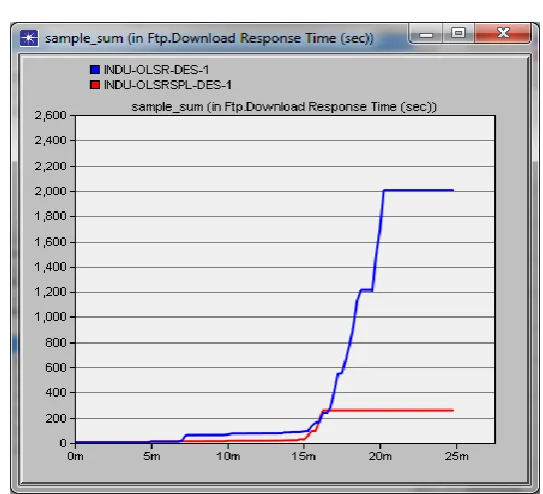
Figure 3. Sample Sum for FTP Download Response Time (sec) 11 Mbps
According to simulation, as we can see in Fig. 3, FTP Download Response Time (sec) is more in Normal condition than the conditions we derived specially. Here OLSR Special performed better.
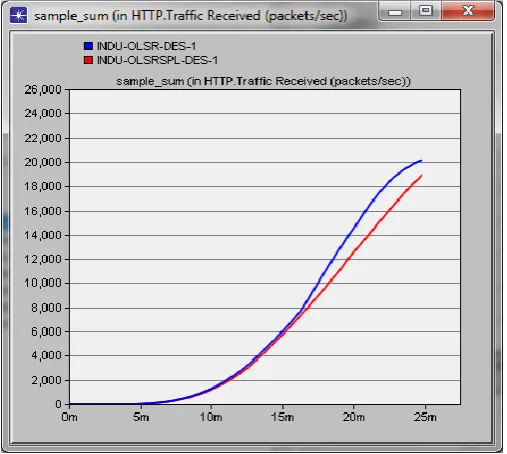
Figure 4. Sample Sum for HTTP Traffic received (pkt/sec) 11 Mbps
According to simulation, as we can see in Fig. 4, HTTP Traffic received (pkt/sec) 11Mbps is more in Normal condition than the conditions we derived specially. Here OLSR Normal performed better.
C. WLAN Delay (sec)
Figure 5. Sample Sum for WLAN Delay (sec) for OLSR 11 Mbps
According to simulation, as we can see in Fig. 5, WLAN Delay (sec) in OLSR is more in Normal
condition than the conditions we derived specially. Here OLSR Special performed better.
D. WLAN Media Access Delay (sec)
Figure 6. Sample Sum for WLAN Media Access Delay (sec) 11 Mbps
According to simulation, as we can see in Fig. 5, WLAN Media Access Delay (sec) in OLSR is more in Normal condition than the conditions we derived specially. Here OLSR Special performed better.
VII.
CONCLUSION
In this paper performance of OLSR is evaluated for metrics like FTP Download Response Time (sec), HTTP Traffic received (pkt/sec), WLAN Delay (sec) and WLAN Media Access Delay (sec) by using 18 nodes scenario with IEEE 802.11 Direct Sequence WLAN Standard in 11 Mbps data rate. From the above discussion we find out that OLSR performance as in table below.
TABLE VI RESULTING VALUES
S.
NO. PERFORMANCE METRICS PARAMETERS OLSR WITH OF TABLE III
OLSRSPL WITH PARAMETERS OF TABLE IV
1
FTP
D
OWNLOADR
ESPONSET
IME(
SEC)
2
HTTP
T
RAFFIC RECEIVED(
PKT/
SEC)
BETTER
3
WLAN
D
ELAY(
SEC)
BETTER
4
WLAN
M
EDIAA
CCESSD
ELAY(
SEC)
BETTER
VIII.
REFERENCES
[1] Jonish1, Kapil Chawla2 Frequency Hopping Based Performance Evaluation of TORA and OLSR Routing Protocols Using OPNET IJCSMC, Vol. 3, Issue. 11, November 2014, pg.514 – 522
[2] Anjali, Maninder Singh, “Performance Analysis of Proactive, Reactive and Hybrid MANET Routing Protocols on IEEE 802.11 Standard”, International Journal of Computer
Applications,pp.1-8,Volume
54-No.12,September 2012.
[3] Anjali, Maninder Singh, “Simulation and Performance Analysis of AODV,OLSR,GRP Routing Protocol by considering IEEE 802.11Standard”,IJARCSSE,Volume2 ,issue 6, pp-171-178,June 2012.
[4] Ravinder Ahuja, “Simulation based Performance Evaluation and Comparison of Reactive, Proactive and Hybrid Routing Protocols based on Random Waypoint Mobility Model”, International Journal of Computer Applications, Vol. 7, No.11, pp. 20-24, Oct. 2010.
[5] Narender, Ravi Antil, Jonish “Direct Sequence Based Performance Evaluation of OLSR for 1 Mbps and 11 Mbps Using OPNET”, IJCSMC, Vol. 4, Issue. 1, January 2015, pp. 26–35.
[6]Guo, Z, and Malakooti, S (2010) “Multi-objective OLSR for proactive routing in MANET with delay, energy, and link lifetime predictions” Applied Mathematical Modelling (Elsevier), vol. 35 (6),pp. 1413–1426.
[7] Guo, L, and Peng, Y. (2010) “Performance evaluation for on-demand routing protocol based
on OPNET modules in wireless mesh network” Computer and Electrical Engineering (Elsevier), vol. 37(2011), pp. 106-114.
[8] T.H. Clausen, ”The optimized link state routing protocol evaluating through experiments and simulation” mind pass centre for distributed system, Aalborg university ,Denmark.
[9] Kuldeep Vats, “Simulation and performance analysis of OLSR routing protocol using OPNET” IJARCSSE ,Vol. 2, Issue 2, Feb. 2012 .