Annotating “tense” in a tense-less language
Nianwen Xue
∗
, Hua Zhong
†
and Kai-Yun Chen
‡
University of Colorado
The Center for Computational Language and Education Research Boulder, CO 80309-0594, USA
Nianwen.Xuecolorado.edu∗, Hua.Zhongcolorado.edu†, Kaiyun.Chencolorado.edu‡
Abstract
In the context of Natural Language Processing, annotation is about recovering implicit information that is useful for natural language applications. In this paper we describe a “tense” annotation task for Chinese, a language that does not have grammatical tense, that is designed to infer the temporal location of a situation in relation to the temporal deixis, the moment of speech. If successful, this would be a highly rewarding endeavor as it has application in many natural language systems. Our preliminary experiments show that while this is a very challenging annotation task for which high annotation consistency is very difficult but not impossible to achieve. We show that guidelines that provide a conceptually intuitive framework will be crucial to the success of this annotation effort.
1.
Introduction
The notion of tense is a subject of lively debate in recent theoretical Chinese linguistics literature. Much of the con-troversy surrounds the question of whether tense is a use-ful theoretical construct. Huang (1984) and Li (1990) sug-gest there is a finite-nonfinite distinction in Chinese syn-tax which implies the existence of a phonologically empty tense category in the syntactic representation of a clause. Other researchers (Hu et al., 2001; Lin, 2003; Lin, 2006; Smith and Erbaugh, 2005) contend that such an abstract notion of tense is not justified for Chinese. In spite of this controversy, there is a general agreement that Chinese does not have grammatical tense. That is, Chinese does not have tense morphemes that are dedicated to mark the tempo-ral location of situations, like English. However, Chinese speakers, like speakers of other world languages, use the moment of speech as the temporal deixis to temporally lo-cate situations in their communication. One piece of ev-idence for this is that temporal adverbials like8U (“to-day”), ²U(“tomorrow”) and U(“yesterday”) all as-sume a temporal deixis that is the moment of speech.
Corpus annotation provides a new perspective from which we can look into how Chinese speakers interpret situations temporally. Through linguistic annotation, we can deter-mine whether Chinese speakers consistently identify the temporal locations of situations. To the extent that they do, this information would be highly useful for natural lan-guage processing systems that can learn from the human interpretations through statistical and machine learning ap-proaches. For example, this information would be highly valuable to Machine Translation. To translate a language like Chinese into a language like English in which tense is grammatically marked with inflectional morphemes, an MT system will have to infer the necessary temporal informa-tion to determine the correct tense for verbs. Statistical MT systems, the currently dominant research paradigm, typi-cally do not address this issue directly. As a result, when evaluated for tense, current MT systems often perform mis-erably. For example, when a simple sentence like “¦/he ²U/tomorrow £/return þ°/Shanghai” is given to
Google’s state-of-the-art Machine Translation system1, it produces the output “He returned to Shanghai tomorrow”, instead of the correct “he will return to Shanghai tomor-row”. The past tense on the verb “returned” contradicts the temporal expression “tomorrow”. Ye et al (2006), for ex-ample, reported that the best MT systems only get the tense correct 47% of the time, worse than the 69.5% when the most frequent tense (which is the past tense) is assigned. In this paper we report a preliminary study in which we ask Chinese native speakers to temporally locate situations denoted by verbs in naturally occurring text and assign a label that indicates their temporal relations to the document creation time.
2.
Deciding on a tag set
The three temporal points, Speech Time, Reference Time and Situation Time are generally accepted as important to temporal interpretation since Reichenbach (1947) first pro-posed them. Speech Time and Reference Time are impor-tant to the interpretation of tense. Speech Time is the mo-ment of speech, and Reference time is the temporal per-spective from which the speaker invites his audience to con-sider a situation, and Situation Time is the time at which the situation actually occurs. In the “tense” annotation study we report here, we annotate the relation between Speech Time and Situation Time instead of the relation between Speech Time and Reference time, which in our judgment is too subtle to be annotated consistently. In determining the different values of tense, one important question to ask is whether one should use the tense taxonomy of a partic-ular language like English, or use a tag set that abstracts away from the language-specific properties. In a previous pilot tense annotation study motivated by Chinese-English machine translation, Ye (2007) used a tagset that is a di-rect reflection of the English tense system. She used a set of 11 tags that represent different combinations of the three tenses (present, past and future) and aspect (perfect, pro-gressive). However, there are reasons for not borrowing the English tense taxonomy directly. First, the English system does not consistently encode the relation between Speech
Bounded-“This shows that they have made preparations to escape at any time.”
Modal verbs in Chinese include¬(“will”), (“should, will”), ò (“will”), AT (“should”), U (“may”), ±(“may”), 7L(“must”), etc.). Many modal verbs in-dicate futurity. The verb complement of these modals tend to be temporally located in the future, that is, they indi-cate situations that have not yet happened. For example, in (7), the verbÜ(“cooperate”) is temporally located in the future because of the modal. Note that in some cases denotes intension and is not necessarily a modal verb in all context. Even whenis not a modal verb, it is still a future-oriented verb. So situations modified byalways has a sense of futurity.
(7) V two sides
L« indicate
will
?Ú further
Ü cooperate
" .
”The two sides indicate that they will cooperate fur-ther.”
Not modals are future-oriented. For example, the verb com-plement ofU(“can) does not indicate futurity. The default tense is the present unless overwritten by an overt temporal adverbial:
(8) ¦ he
U can
Ð do-well
ù this
CL ó job
" .
”He can do this job well.”
Future-oriented verbs include verbs of future having (e.g., y(“guarantee”),«ì(“pledge”), verbs of future situ-ation (e.g., JÆ(“propose”),Oy(“plan”) ,O (“pre-pare”), etc.), verbs of wish and desire (e.g., (“want”), $ (“dream”), I (“need”) , (“look forward to”), verbs of future events (e.g., ýw (“foretell”) , (“want”)§ýó(“predict”) and verbs of future
preven-tion (e.g., üØ (“preclude”),{ (“prevent”). Future-oriented nouns are often derived from these future-Future-oriented verbs and they often co-occur with a support verb. For ex-ample,O(“prepare”) is a future-oriented verb (9a) and its complement,l(“withdraw”) is located in the future relative to the temporal location ofO. Even when the O (“preparation) is nominalized, as in (9b), the situa-tion denoted by its complement clause is still located in the future relation to this nominalized verb.
(9) a. ¢» Kosovo
Õá
independence U may
Úu cause
ÖÏ riot
§
.
éÜI UN <
personnel ® already
O prepare
l withdraw
" .
”Kosovo independence may cause riot. UN per-sonnel have already prepared to leave.”
b. ¢»ÕáUÚuÖÏéÜ I< ®Ð[l]O"
3.2. Inferring Relative tense
The temporal interpretation of one situation is often bound by the temporal location of a reference situation. One com-mon scenario in which this kind of dependency occurs is
when the target situation, the situation we are interested in at the moment, is embedded in the reference situation as a complement. Just as the absolute “tense” represents a tem-poral relation between the situation time and the moment of speech or document creation time, the relative “tense” represents a relation between the temporal location of a sit-uation and its reference sitsit-uation. The target sitsit-uation can be anterior to (10a), simultaneous with (10b), or posterior to the reference situation (10c).
(10) a. <Z Indonesian
´ police
ß³ reveal
coÚ ex-president
M÷ Suharto ®²
already k die
" .
“The Indonesian police revealed that ex-president Suharto had already died.”
b. ûi¤
roaming charges fy testimony
L witness
ß³ reveal ÃÅ
mobile phone ûi roaming
¤ cost
Ø less than
5 five
© fen a
money " .
“The witnesses at the testimony on roaming charges revealed that the cost for roaming was less than 0.05 Chinese yuan.”
c. úi company
ó personnel
ß³ reveal
5 “
(S2 Star 2
6 ”
ÿÁ trial
version
=ò
soon ¡
face the world " .
“The company personnel revealed that ‘Star 2’ trial version would soon face the world.”
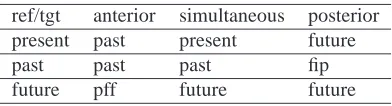
Relative “tense” is invoked when the absolute (in relation to moment of speech) temporal location of a situation can only be determined through the temporal location of a ref-erence situation. For example, in (10c), the temporal loca-tion of¡ (“face the world”) is posterior to the reference situationß³ (“reveal”), and thus the absolute temporal location of¡depends on the temporal location ofß³. If the reference situation is located in the present, the target situation is located in the future. If the reference is located in the past, then the temporal location of the target situation is a future-in-past. If the reference situation is located in the future, then the temporal location of the target situation is the future of future. The combination of absolute “tense” of the reference situation and the relative temporal ordering of the reference and target situations yields nine possibilities, listed in Table 1.
ref/tgt anterior simultaneous posterior present past present future
past past past fip
future pff future future
Table 1: Nine possibilities (Acronyms: ref=reference, tgt=target, pff=past-from-future, fip=future-in-past)
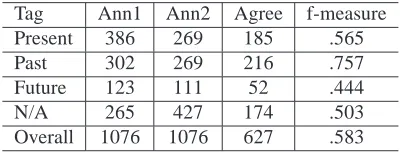
rel-Tag Ann1 Ann2 Agree f-measure
Present 386 269 185 .565
Past 302 269 216 .757
Future 123 111 52 .444
N/A 265 427 174 .503
Overall 1076 1076 627 .583
Table 2: Inter-annotator agreement without guidelines
should consider when making their judgment on the tense selection. The guidelines are presented as a set of rules that can be overwritten when “hard evidence” such as temporal adverbials are present. The second experiment was done on a different set of verbs taken from six different articles from the first experiment. The results (Table 3) show that even with this set of very simple guidelines, there has been sub-stantial improvement (17%) in inter-annotator agreement, from the 58% in Experiment 1 to the 75% in Experiment 2. One interesting observation is that the past tense is anno-tated with very high inter-annotator agreement (86%) while the future and present tenses are much harder to annotate. This is something that we will try to explain in future work.
Tag Ann1 Ann2 Agree f-measure
Present 276 123 106 .531
Past 501 480 424 .864
Future 180 320 171 .684
N/A 134 168 122 61
Overall 1091 1091 823 .754
Table 3: Inter-annotator agreement with guidelines
5.
Conclusion and future work
In the context of natural language processing, annotation is about recovering implicit information that is useful for natural language applications. In this sense annotation of Chinese tense would be a highly rewarding endeavor if suc-cessful. Our preliminary experiments show that providing a set of intuitive of guidelines is crucial to Chinese tense an-notation. Although the inter-annotator agreement we report here has not yet reached satisfactory levels, we are confi-dent that with refined guidelines the inter-annotator agree-ment can be further improved.
6.
References
Jianhua Hu, Haihua Pan, and Liejiong Xu. 2001. Is there a finite-nonfinite distinction in Chinese. Linguis-tics, 39:1117–1148.
James C.T. Huang. 1984. On the distribution and reference of empty pronouns. Linguistics Inquiry, 15:531–574. Audrey Yen-hui Li. 1990. Order and Constituency in
Man-darin Chinese. Dordrecht: Kluwer Academic Publish-ers.
Jo-Wang Lin. 2003. Temporal Reference in Mandarin Chi-nese. Journal of East Asian Linguistics, 9:259–311. Jo-Wang Lin. 2006. Time in a language without tense: The
case of Chinese. Journal of Semantics, 23:1–53.
Carlota S. Smith and Mary Erbaugh. 2005. Temporal inter-pretation in Mandarin Chinese. Linguistics, 43(4):713– 756.
Z. Xiao and A. McEnery. 2004. Aspect in Mandarin Chi-nese: A corpus-based study. Amsterdam, John Ben-jamins.
Yang Ye, Victoria Li Fossum, and Steven Abney. 2006. Latent features in automatic tense translation between Chinese and English. In The Proceedings of the 5th SIGHAN Workshop on Chinese Language Processing, Sydney, Australia.