Coding Emotional Events in Audiovisual Corpora
L. Devillers, J-C. Martin
LIMSI-CNRS; France {devil, martin}@limsi.fr
Abstract
The modelling of realistic emotional behaviour is needed for various applications in multimodal human-machine interaction such as the design of emotional conversational agents (Martin et al., 2005) or of emotional detection systems (Devillers and Vidrascu, 2007). Yet, building such models requires appropriate definition of various levels for representing the emotions themselves but also some contextual information such as the events that elicit these emotions. This paper presents a coding scheme that has been defined following annotations of a corpus of TV interviews (EmoTV). Deciding which events triggered or may trigger which emotion is a challenge for building efficient emotion eliciting protocols. In this paper, we present the protocol that we defined for collecting another corpus of spontaneous human-human interactions recorded in laboratory conditions (EmoTaboo). We discuss the events that we designed for eliciting emotions. Part of this scheme for coding emotional event is being included in the specifications that are currently defined by a working group of the W3C (the W3C Emotion Incubator Working group). This group is investigating the feasibility of working towards a standard representation of emotions and related states in technological contexts.
1.
Introduction
Interest in affective computing has grown over the past decade. The success of the recent international conference on “Affective Computing and Intelligent Interaction”, and the developments from the European Network of Excellence Humaine (www.emotion-research.net), show that “emotions” are now considered as significant factors in the design of Human-Computer Systems. The choice of the appropriate corpus for training computational models is fundamental. The training data must be as close as possible to the behaviours observed in the real application. Thus, expressions of emotion should be collected as they occur in everyday action and interaction rather than as idealised archetypes.
Natural databases highlighted a descriptive challenge: the expressions of emotions that they contain are not adequately described by a few theoretically derived labels, such as basic emotions (Cowie and Cornelius 2003, Devillers, Vidrascu & Lamel 2005, Devillers et al., 2006). There is indeed a significant gap between the affective states observed in artificial data (acted data or induced data) and those observed with “real-life spontaneous data in situ”. This difference is mainly due to the “Real” context. We define “context” here as the events that are at the origin of the affective state of a person.
In our previous empirical studies on real-life audio and audio-visual data (Devillers & al, 2005) (Devillers, Abrilian, Martin, 2005), we have shown that there are many complex mixtures of emotion. In the same idea, (Wilhelm, Schoebi & Perrez 2004) have shown that while people never report their state as being completely unemotional, examples of full-blown emergent emotions are really quite rare.
Appraisal is the process by which an organism assesses its overall relationship with its environment including
not only its current condition but past events that led to this state as well as future prospects. In this paper, we describe a study exploring how to code the events that triggered spontaneous expressions of real-life emotions in audiovisual data.
Annotators can select up to three events, and have to specify the relations between these events. The new idea of this scheme is to add a temporal aspect of the events. We first classify events in short-term and long-term events. Then we specify the temporal-relation between events.
3.
The EmoTV study3.1. The corpus
The EmoTV corpus is described in details in (Devillers, Martin, Abrilian, 2005). It is a collection of video-clips, mainly extracted from TV news.
3.2. Theoretically derived descriptions
Theory suggests many possible ways for describing emotions other than everyday labels. The scheme that we defined here incorporates what seems to be the most important options for coding the events that we observed in our set of video clips.
A strong tradition distinguishes emotions in terms of the „appraisals‟ that they involve. Appraisals are perceptual evaluations of emotion-relevant aspects of the situation on a set of dimensions suggested by Scherer and his colleagues (Sander et al 2005). The following set of labels was used to describe the protagonist‟s appraisal of one event E at the focus of his/her emotional state. These items are grouped under four broader headings.
Relevance Suddenness of E; Familiarity of E; Predictability of E; Intrinsic pleasantness of E; Desirability of the consequences
Implications Agency responsible (self / other / group / nature); Underlying motive (negligence / intent ); Nature of likely consequences (negative vs. positive); Relation to expectation (consonant to dissonant); Conduciveness to goals (conducive vs. obstructive); Urgency (low vs. high)
Coping potential; Controllability (low vs. high); Controllability of consequences (low vs high);
Power of person to change the outcome of these events (low vs. high); Scope for person to adjust own goals (low vs. high);
Compatibility of the situation with standards With external standards (norms or demands of a reference group); With internal standards (self ideal or internalized moral code)
These are brief descriptions – fuller explanations are given by Sander et al. (2005).
3.3. Everyday labels that apply to naturalistic samples
Emotions in a strict sense
Emotion-related states
Anger (hot) Affection Interest Anger (cold) Amusement Irritation
Contempt Anxiety Pleased
Despair Boredom Relief
Disgust Courage Relaxation
Elation/joy Disappointment Satisfaction
Fear Doubt Serenity
Guilt Embarrassment Shock
Happiness Empathy Stress
Pride Excitement Worry
Sadness Friendliness Shame Helplessness
Surprise Hope
Table 1: everyday labels selected for the study
We use the term „everyday labels‟ (to describe words of the kind listed in Table 1 above. Table 1 aggregates the labels that were observed as being relevant to the annotation of naturalistic TV clips material (Devillers et al., 2006).
3.4. Events annotation
We defined a first scheme of annotation and tested it on a subset of EmoTV (28 clips). Our annotation strategy is to proceed in two steps. First we identify and annotate the emotional events. Second, we link the annotation of emotions to each of the events.
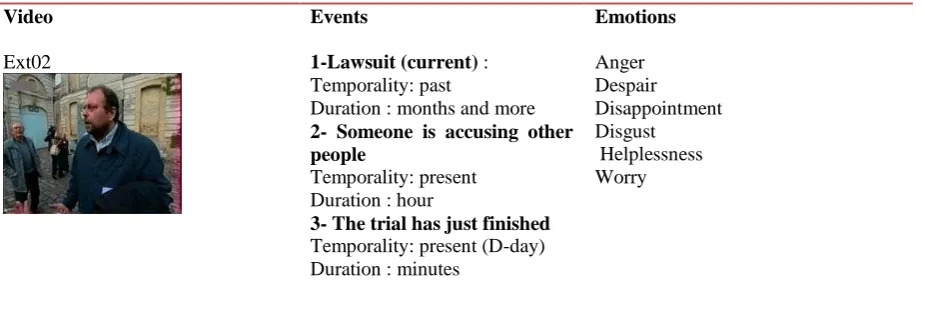
Video Events Emotions
Ext02 1-Lawsuit (current) :
Temporality: past
Duration : months and more 2- Someone is accusing other people
Temporality: present Duration : hour
3-The trial has just finished Temporality: present (D-day) Duration : minutes
Ext03 1 - Lawsuit and confinement of her father and brother Temporality: past
Duration : months and more 2- The trial has just finished Temporality: present (D-day) Duration : minutes
Anger Despair Disgust
Ext22
1-Bathing in the see Temporality: present (D-day) Duration : hours
2- Examination of the French school diploma BAC in one month
Temporality: future Duration : days
Serenity Worry
Ext24
1- Football cup Temporality: past
Duration : months and more 2- Football match
Temporality: close future Duration : hours
Serenity Pride
Ext36
1-Election campaign Temporality: past
Duration : months and more 2-Election results in the GQ Temporality: present (D-day) Duration : minutes
Anger Sadness Shame Disgust
Ext41
1- Election campaign Temporality: past
Duration : months and more 2- Election results
Temporality: present (D-day) Duration : minutes
Courage Disappointment Joy
Ext93
1-Problem of environment Temporality: past, present, future
Duration : months and more
Irritation
Ext82
1- Swindle in the “batiment” Temporality: past, close past Duration : months and more
Irritation
Ext97
1-The increase of the price of the coffee
Temporality: present (D-day) Duration : minutes
Irritation
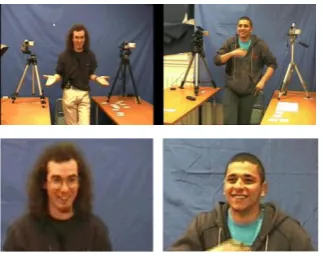
Figure. 2. The collected data features four viewpoints. The naive subject is on the left side, the
confederate is on the right side.
4.3 Events in EmoTaboo
For EmoTABOO, the timescales of the events eliciting emotions is not the same as those of the events observed in EmoTV: the EmoTABOO events are rather short term. The only long-term event is the game session. The observed events can be also described in EmoTABOO in term of dimensions of appraisal: For example the fact that the card contains the word "palimpsest" is estimated by the player as:
- recent
- unexpected (the player did not expect a word that he did not know)
- incompatible with his(her) purposes to win the game. Other events eliciting emotions include:
- The experimenter announces a penalty,
- the confederate proposes words with no relation at all with what is said by the naïve player
- the confederate finds the mimed word/does not find the mimed word
- the confederate is ironic
- the confederate criticizes the naïve player.
All these events can be described in term of appraisals and temporality. In that corpus, a lot of complex emotions has also been annotated that can be correlated to events. As an example, being relieved that the player find the mimed word and at the same time feeling disappointed because the experimenter announces a penalty.
5.
Conclusion
Describing emotional events in audiovisual corpora is required:
- for building emotional eliciting protocol, - for studying appraisals variables, - and for explaining complex emotions.
In the exploratory study described in this paper, we tried to show the potential of a scheme of emotional events in order to better understand the emotional states. We proposed to code the temporal aspects of the events: date and duration (short-time, long-time). We also proposed to code the events using the appraisal dimensions.
Future research include 1) studying the relations between the events and the perceived complex emotions, and 2) studying the relations between temporal and appraisal annotations.
Acknowledgement
This work was partly funded by the FP6 IST HUMAINE Network of Excellence (http://emotion-research.net).
6.
References
Abrilian, S., Martin, J-C., Devillers, L. (2005). A Corpus-Based Approach for the Modeling of Multimodal Emotional Behaviors for the Specification of Embodied Agents. HCI International 2005, Las Vegas, USA.
Cowie & Cornelius (2003). Describing the emotional states expressed in speech. Speech Communication, 40(1-2), pp. 5-32.
Devillers, L., Abrilian, S. and Martin, J.-C. (2005) Representing real life emotions in audiovisual data with non basic emotional patterns and context features. 1st International Conference on Affective Computing & Intelligent Interaction (ACII'2005) Beijing, China, October 22-24.
Devillers, Vidrascu & Lamel, (2005). “Challenges in real-life emotion annotation and machine learning based detection”, Neural Networks 18, pp. 407-422.
Devillers, L., Vidrascu, L. (2007), Emotion recognition, «Speaker characterization », Christian Müller, Susanne Schötz (eds.), Springer-Verlag.
Devillers, L., Cowie, R., Martin, J.-C., Douglas-Cowie, E., Abrilian, S., McRorie, M. (2006) Real life emotions in French and English TV video clips: an integrated annotation protocol combining continuous and discrete approaches. (LREC 2006), Genoa, Italy, 24-27 may.
Gratch, J., Marsella, S., (2004) A domain independent framework for modeling emotion. Journal of Cognitive Systems Research, 5 (4), 269-306.
Martin, J.-C., Abrilian, S., Devillers, L., Lamolle, M., Mancini, M. and Pelachaud, C. Levels of Representation in the Annotation of Emotion for the Specification of Expressivity in ECAs. 5th International Working Conference On Intelligent Virtual Agents (IVA'2005) Kos, Greece, Sept 12-14.
Ortony, A., Clore, G.L., Collins, A. (1988). The cognitive structure of emotions. Cambridge, U.K., Cambridge University Press.
Scherer, K. R., Schorr, A. and Johnstone, T., eds. (2001). Appraisal Processes in Emotion. New York: Oxford University Press.
Schroeder, M., Devillers, L., Karpouzis, K., Martin, J-C., Pelachaud, J-C., Peter, Ch., Pirker, H., Schuller, B., Tao, J. and Wilson I. (2007): What should a generic emotion markup language be able to represent?, ACII07, 2nd International Conference on Affective Computing & Intelligent Interaction.
Wilhelm, P., Schoebi, D., Perrez, M. (2004). Frequency estimates of emotions in everyday life from a diary method's perspective: a comment on Scherer et al.'s survey-study "Emotions in everyday life". Social Science Information 43: 647-665.