Using the Web as a Linguistic Resource to Automatically Correct
Lexico-Syntactic Errors
Matthieu Hermet
1, Alain Désilets
2, Stan Szpakowicz
1,31- University of Ottawa, 2- National Research Council of Canada, 3- Polish Academy of Sciences {mhermet, szpak}@site.uottawa.ca, [email protected]
Abstract
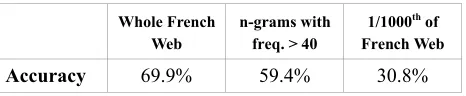
This paper presents an algorithm for correcting language errors typical of second-language learners. We focus on preposition errors, which are very common among second-language learners but are not addressed well by current commercial grammar correctors and editing aids. The algorithm takes as input a sentence containing a preposition error (and possibly other errors as well), and outputs the correct preposition for that particular sentence context. We use a two-phase hybrid based and statistical approach. In the first phase, rule-based processing is used to generate a short expression that captures the context of use of the preposition in the input sentence. In the second phase, Web searches are used to evaluate the frequency of this expression, when alternative prepositions are used instead of the original one. We tested this algorithm on a corpus of 133 French sentences written by intermediate second-language learners, and found that it could address 69.9% of those cases. In contrast, we found that the best French grammar and spell checker currently on the market, Antidote, addressed only 3% of those cases. We also showed that performance degrades gracefully when using a corpus of frequent n-grams to evaluate frequencies.
1. Introduction
In this paper, we describe and evaluate an algorithm that leverages the Web as a linguistic resource to automatically correct preposition errors in French texts written by second-language learners. This work is done in the context of Computer-Assisted Language Learning (CALL) — tools to assist with First-Language and Second-Language Acquisition (Davies, 2007).
Most CALL tools available today offer closed deterministic solutions such as fill-in-the-blank drills and multiple-choice questions; see Bax (2003) on the future of CALL. There is, however, a gradual shift towards supporting autonomous learning in more open-ended situations. Many of those scenarios call for systems that can automatically evaluate free-text material produced by the learner, and show them where and how it can be improved. Two types of technologies can be used for this task. Grammar checkers can analyze syntactic correctness, while corpus-based tools can check lexical relationships such as idiomatic noun co-occurences.
Unfortunately, corpora are rarely large enough to sufficiently cover the broad range of lexical patterns present in a given language, which means that some lexical phenomena are left unanalyzed. We believe however that using the whole Web as a linguistic corpus may help deal with that issue. This paper discusses a first attempt at automatically correcting lexico-syntactic errors using the Web as a corpus, and focuses specifically on preposition
errors.
Our work is in the vein of a very active recent area of research into the use of the Web as a linguisitic resource (Kilgarriff and Grefenstette, 2003; Cilibrasi and Vitanyi, 2007), including its use in a study of preposition collocations (Isaac et al., 2001).
2. Preposition Choice as an Important
Problem for Second-Language Learners
Prepositions sit somewhere between function words (determiners and pronouns) and content words (nouns, verbs, adjectives, adverbs). Like content words, prepositions tend to carry more meaning than function words, and their use tends to evolve with time. But like function words, the list of prepositions is small compared with the overall lexicon. In , for example, there are only 85 simple word prepositions and up to 222 compound prepositions. Also like function words, prepositions tend to occur very frequently in spite of their small number. According to some statistics (Fort and Guillaume, 2007), the percentage of prepositional tokens tends to hover around 14% in most languages.googleresearch.blogspot.com/2006/08/all-our-n-gram-are-belong-to-you.html
F. Isaac, T. Hamon, C. Fouquere, L. Bouchard, L. Emirkanian (2001), "Extraction informatique de donnees sur le web", Revue DistanceS 5(2), 195-210.
A. Kilgarriff, G. Grefenstette (eds.) (2003), Special Issue on the Web as Corpus. Computational Linguistics, 29(3).
P. Saint-Dizier (2007) "Regroupement des Prepositions par sens". Undated report, IRIT Toulouse.