Improving NER in Arabic Using a Morphological Tagger
Benjamin Farber
†
, Dayne Freitag
†
, Nizar Habash
‡
, Owen Rambow
‡
†Fair Isaac Corporation
{BenFarber,DayneFreitag}@fairisaac.com
‡Center for Computational Learning Systems, Columbia University
{habash,rambow}@ccls.columbia.edu
Abstract
We discuss a named entity recognition system for Arabic, and show how we incorporated the information provided by MADA, a full morphological tagger which uses a morphological analyzer. Surprisingly, the relevant features used are the capitalization of the English gloss chosen by the tagger, and the fact that an analysis is returned (that a word is not OOV to the morphological analyzer). The use of the tagger also improves over a third system which just uses a morphological analyzer, yielding a 14% reduction in error over the baseline. We conduct a thorough error analysis to identify sources of success and failure among the variations, and show that by combining the systems in simple ways we can significantly influence the precision-recall trade-off.
1.
Introduction
For a range of applications of natural language processing—from machine translation, to question answering, to information retrieval—it is often beneficial to devote one stage of processing to the identification of names. Automated named entity recognition (NER) has been demonstrated on a number of languages, and has reached near-human levels of performance on English. Not so on Arabic. Not only has less annotated training data been created for this task in Arabic, but Arabic exhibits greater lexical ambiguity and morphological variety than English, and written Arabic lacks the overt clue of capitalization.
In this study we investigate whether a morphological tag-ger can mitigate these sources of difficulty in Arabic. In general, a written Arabic word may have dozens of mutu-ally incompatible morphological analyses. This ambiguity is due in part to the orthography of conventional written Arabic, which does not require the inclusion of short vow-els. Confronted with a word form in context, the task of a morphological tagger is to determine all morphological properties of the word. The process is often called simply “part-of-speech tagging” in English, because the set of tags to completely describe the set of morphological forms of the language is much smaller than in Arabic (about 50 tags in English against thousands in Arabic).
Many proposed approaches to English NER do not make use of part of speech. We claim that in Arabic the informa-tion returned by a morphological tagger is critical to max-imize performance. Consistent with the state of the art, our Arabic NER system involves the application of mod-els trained with name-annotated Arabic data. In this paper we explore one way in which the analysis of the morpho-logical tagger can be integrated with such a system: The output of the tagger is converted into additional features of the input, which are made available to the learner responsi-ble for producing the NER model. Our experiments show that the morphological tagger provides critical information in the form of lexical disambiguation.
The rest of the paper is organized as follows. Section 2. de-scribes the training and configuration of our baseline NER system, which is essentially language-neutral. Section 3.
explores in greater depth the problem of Arabic morpholog-ical analysis, and describes the morphologmorpholog-ical tools we use in these experiments. Section 4. describes how these tools are integrated in the NER system and presents the empirical evidence that this integration is beneficial. We end with an error analysis in Section 5., which prompts a discussion of future work in the final section, Section 6..
2.
Named Entity Recognition
The current state of the art sees the problem of named en-tity recognition as one of sequence labeling (or “structured classification”), akin to problems like part-of-speech tag-ging. Given a stream of input words, typically a single sen-tence, the problem is to assign a label to each word in a way that unambiguously identifies any named entity men-tions. If the object is to distinguish the names of one type of entity (e.g., person), the use of BIO labeling is common, and is the labeling scheme we employ here. In BIO label-ing, the name-initial word is assigned aBlabel, any other name constituent anI, and all other words anO. This label-ing generalizes in an obvious way to one that accounts for multiple entity types simultaneously.
All of the approaches that have been tried for problems like part-of-speech have also been applied to NER, including decision trees (Baluja et al., 1999), log-linear models (max-imum entropy) (Borthwick, 1999), and support vector ma-chines (Isozaki and Kazawa, 2002). However, inasmuch as these paradigms do not naturally address the sequential nature of the problem, they have largely given way to ap-proaches that model labeling as a series of related decisions, in particular hidden Markov models (HMM) (Bikel et al., 1997), structured perceptrons (Collins, 2002), and condi-tional random fields (CRF) (McCallum and Li, 2003). The last two approaches are particularly appealing, because in contrast to generative approaches like HMMs, they make no unwarranted independence assumptions, and can there-fore fruitfully incorporate arbitrary features of the input.
2.1. Structured Perceptron for NER
LetSbe our input, a sequence of words, andSibe a single
;;WORD byn
bay~ana=[bay~an_1 POS:V +PV +S:3MS BW:+bay~an/PV+a/PVSUFF_SUBJ:3MS]=declare/demonstrate bayonu=[bayona_1 POS:N +NOM +DEF BW:+bayon/NOUN+u/CASE_DEF_NOM]=between/among
biyn=[biyn_1 POS:PN BW:+biyn/NOUN_PROP+]=Ben
Figure 1: Three BAMA analyses for the wordá K
.
byn.
3.3. MADA
MADA, The Morphological Analysis and Disambiguation for Arabic tool, is an off-the-shelf resource for Arabic dis-ambiguation (Habash and Rambow, 2005; Habash, 2007). MADAselects among BAMAanalyses using a combination of classifiers that tag words on all 14 orthogonal dimensions of Arabic morphology. The version of MADAused in this paper was trained on the Penn Arabic Treebank (PATB) part 3 (Maamouri et al., 2004). Habash and Rambow (2005) report disambiguation accuracy over 96% (ignoring case, idafa, mood and nunation) and word-level PATB tokeniza-tion accuracy over 99.3%.
4.
Incorporating Morphology into NER
An important product of MADA tagging, one which pro-vides the most immediate benefit to NER, is full lexical disambiguation. In Figure 1, for example, one of the anal-yses indicates that the wordá
K .
byn may correspond to the
English given name Ben. Thus, an accurate assessment by MADA that ‘Ben’ is the correct analysis, out of the 19 pos-sible, should serve as a powerful clue to the NER model that a name is present.
4.1. Enhanced NER Model
In order to pursue this intuition, we enhanced the baseline NER model by introducing two new feature classes depen-dent on the output of morphological analysis. One,
Gloss-Cap, is true in those cases where a word’s gloss is
cap-italized. The other, OOV, is true if no entry exists for a word in our morphological database. Both of these fea-ture types carry potentially important information for NER. GlossCap is of course a kind of substitute for the capitaliza-tion missing from written Arabic, which in English serves as an important clue. OOV signals the presence of an un-familiar word; such words are often names, in Arabic as in English. We also experimented with other features returned by MADA, including the core part-of-speech (noun, verb, preposition, . . . ), but only these two features provided an improvement.
As with the other feature classes, we define separate fea-tures for every offset relative to a target position up to three tokens on either side. Thus, the enhanced model includes a total of fourteen new features, seven from each of the two new feature classes.
Note that one may think that the disambiguation provided by MADA may not be strictly necessary: perhaps the set of all possible analyses returned by BAMA alone may be sufficient. This hypothesis is motivated by the fact that the NER model performs a kind of disambiguation itself, and it thus might derive just as much benefit from the information that a word form has a potential interpretation as a name as that it has a definitive one.
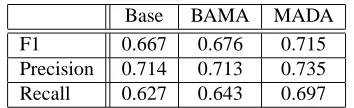
Base BAMA MADA
F1 0.667 0.676 0.715 Precision 0.714 0.713 0.735 Recall 0.627 0.643 0.697
Table 1: Summary F1, precision, and recall for three NER system variants.
We are thus interested in measuring the extent of the benefit provided by MADA’s disambiguation of the BAMA analy-sis. We therefore experiment with two variants of the en-hanced NER model. Features in the OOV class take the same value in either variant (i.e., a word is OOV for MADA if and only if it is OOV for BAMA). The difference is in the definition of GlossCap features:
• BAMA only. A GlossCap feature is true if the gloss of
any analysis returned by BAMA is capitalized.
• MADA. A GlossCap feature is true only if the gloss of
the analysis selected by MADA is capitalized.
Our use of BAMA in this approach is equivalent to having access to two large static lexical resources, one listing all known wordforms, the other listing all wordforms that can be construed as proper nouns. Arguably, MADA is pro-viding something subtler and more significant. The experi-ments below test this perspective.
4.2. Experiments
We divided the 221 documents randomly into five parti-tions, and conducted 5-fold cross-validation, for each fold training a model on the out-of-fold documents and testing its performance on documents in the fold. Performance numbers were then calculated on the combined data (i.e., performance metrics are micro-averaged).
Base MADA S&T S S&T T F1 0.650 0.695 0.696 0.757 Precision 0.703 0.752 0.723 0.787 Recall 0.604 0.646 0.670 0.730
Table 3: Summary F1, precision, and recall for the baseline BASE and the MADA-enhanced system, with an evalua-tion on the ACE05 corpus using the standard metric which requires a correct span and tag (S&T), as well as a relaxed metric which requires only a correct span (S)
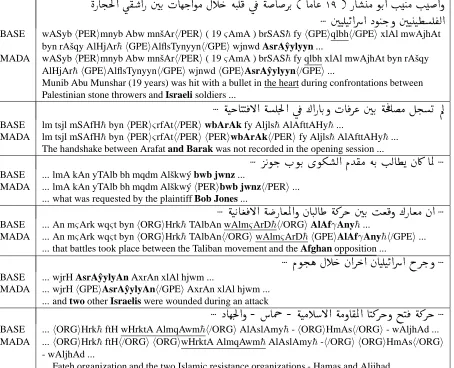
clearly recall-limited. Introduction of the MADA-based features supports an increase in recall of 7% while simulta-neously benefiting precision. Table 2 shows some examples in which the use of MADA improved recall, precision, or both.
The evidence clearly supports the idea that the lexical infor-mation provided by the morphological tagger benefits NER. Most of this benefit is attributable to the disambiguation af-forded by MADA. In the absence of such disambiguation, it is doubtful whether observed improvements are significant.
5.
Error Analysis
In an effort to understand the observed performance, we performed a sequence of error analyses. The first issue we investigated is whether the errors were primarily related to spans or to labels (recall that a correct NER detection re-quires both a correct span and a correct label). We extended the evaluation to include a second metric which measures only the spans and disregards the labels. The results for the baseline system BASE and the system including MADA are shown in Table 3. The results for the standard metric, marked “S&T”, are lower than shown in Table 1 because we are now evaluating on a subset of the ACE 2005 corpus, which appears to be harder. The relative results, however, are quite similar to the previous ones (obtained through cross-validation). From looking at the columns labeled “S”, which show the performance evaluating the span match only (and not the tag accuracy), we see that performance improved, but not by much: the baseline system reduced the F1 error only by 13%, while the MADA-enhanced sys-tem reduced the F1 error by 20%. We conclude that the harder problem in NER is the correct identification of the spans. We also note that MADA seems to help relatively more when we only evaluate on the spans: the F1 error re-duction is 20.5% over the baseline, while in the case of the stricter evaluation, we only reduce F1 error by 13.1%. This makes sense as we expect MADA to help specifically with the identification of constituent boundaries. The analysis suggests that improved morpho-syntactic processing (per-haps also using parsing) may be one of the most fruitful avenues for future work.
To further analyze this issue, we performed a more de-tailed error analysis on a smaller subset of the ACE 2005 newswire corpus (about 14,000 words). We automatically classified the errors as the following types: recall error (an NE was entirely missed), precision error (an NE was
falsely proposed), span error (the proposed span for the NE is wrong), and label error (the exact span for the NE was found but with the wrong label). Note that the ‘category “span error” typically includes what would in a simpler classification be called a recall error (our proposed span overlaps with the correct span but we do not identify the correct span) and a precision error (our proposed span is wrong). Furthermore, we are including in this count cases in which we propose several spans that overlap with one gold span. Thus, the numbers in this analysis do not add up in a straightforward manner to the numbers in the pre-vious analysis. We found that 44% of the errors are recall errors (we miss an NE), 16% are precision errors (we pro-pose a false NE), 25% span errors (we propro-pose one or more false span that overlap(s) with a gold span), and only 15% are label errors (the span is correct, the label is not). These numbers confirm the previous result that most errors are re-lated to the span, not the label. Furthermore, the bulk of the span errors are recall errors, as opposed to precision errors, or errors in the exact boundaries of the span: we miss NEs outright.
We investigated the error types in more detail. Surpris-ingly, most of the recall errors involve common NEs (such as regions, continents , states, world-famous leaders, and generic entity names such as ministry of health or the
oppo-sition), especially geo-political entities. This suggests that
the use of a gazetteer could improve the performance of our system. Geo-political entities also are the largest cat-egory of precision errors. The most common span error (nearly half the cases) is that the MADA-based system pre-dicts a smaller span than the gold standard. This is consis-tent with our system having mainly recall errors: spans are not found or are not fully found. This suggests that future work should concentrate on finding conditions on identify-ing spans and extendidentify-ing the currently found spans. Most la-bel errors (82%) involve geo-political entities, which again suggests further investigation into this type of NE.
tion, Part-of-Speech Tagging and Morphological Disam-biguation in One Fell Swoop. In Proceedings of the
43rd Annual Meeting of the Association for Computa-tional Linguistics (ACL’05), pages 573–580, Ann Arbor,
Michigan, June. Association for Computational Linguis-tics.
Nizar Habash, Abdelhadi Soudi, and Tim Buckwalter. 2007. On Arabic Transliteration. In A. van den Bosch and A. Soudi, editors, Arabic Computational
Mor-phology: Knowledge-based and Empirical Methods.
Springer.
Nizar Habash. 2007. Arabic Morphological Representa-tions for Machine Translation. In A. van den Bosch and A. Soudi, editors, Arabic Computational Morphology:
Knowledge-based and Empirical Methods. Springer.
H. Isozaki and H. Kazawa. 2002. Efficient support vector classifiers for named entity recognition. In Proceedings
of COLING 2002.
Mohamed Maamouri, Ann Bies, and Tim Buckwalter. 2004. The Penn Arabic Treebank: Building a large-scale annotated Arabic corpus. In NEMLAR Conference on
Arabic Language Resources and Tools, Cairo, Egypt.
A. McCallum and W. Li. 2003. Early results for named en-tity recognition with conditional random fields. In
Pro-ceedings of the Seventh Conference on Natural Language Learning (CoNLL 2003).
S. Miller, J. Guinness, and A. Zamanian. 2004. Name tag-ging with word clusters and discriminative training. In