International Journal of Scientific Research in Computer Science, Engineering and Information Technology © 2018 IJSRCSEIT | Volume 3 | Issue 1 | ISSN : 2456-3307
Image Processing Based Bacterial Colony Counter
Bhavika Jagga
*, Dr. Dilbag Singh
Department of Computer Science and Applications, Chaudhary Devi Lal University, Sirsa, Haryana, India
ABSTRACT
Enumeration of Bacterial Colonies is required in many fields such as in clinical diagnosis, biomedical research for prevention of harmful diseases and pharmaceutical industry to avoid contamination of products. Existing Bacterial Colony counter systems count Bacterial Colony manually which is a time consuming, less efficient and tedious process. Hence, automation for counting of bacterial colony was required. The proposed method count these colonies automatically using image processing techniques. This method will provide a greater degree of accuracy in counting of bacterial colonies. Proposed technique takes an image of bacterial colony and converts it into grayscale. Otsu thresholding is applied for segmentation of the image further its conversion into binary image. After that, morphological operations are applied to clean up the image by removing noise and unnecessary pixels. Distance and watershed transformations are applied on the binary image to create partitions among overlapped and joint bacteria. Region properties and labeling information of segmented image is used for counting of bacterial colony.
Keywords: Bacterial Colony, Thresholding, Morphology, Distance Transform and Watershed Segmentation.
I.
INTRODUCTION
Bacterial Colony is defined as a cluster of bacteria derived from one common bacterium. Microbiologists require accurate measure of the bacterial colonies for many biological procedures [1]. Enumeration of Bacterial Colonies is important for obtaining precise assessment of pathogens. Manual counting of bacterial colonies is a tedious and time consuming process. Automation of the process of counting bacterial colonies will save time and labor required for counting of colonies [2]. Image segmentation techniques are used to automate this counting process. Image segmentation changes the image into a form suitable for image analysis. In image segmentation, a digital image is divided into multiple segments. Image segmentation assigns label to each pixel of an image on the basis of visual characteristics. Image segmentation is very used in many areas such as object detection, image retrieval, object-based counting, tissue identification, cell counting and object tracking [3]. Watershed segmentation is widely used for counting microorganisms. It is classified as region-based segmentation approach. It is used to separate two
touching objects or overlapping objects. It considers image as a topographic surface in which the gray level of each pixel is considered to be the height on the surface and the two overlapping or touching objects as catchment basins. The motive is to find out watershed ridge lines separating the two catchment basins for separating the two overlapping objects [4] [5].
II.
LITERATURE REVIEW
Uppal and Goyal (2012) developed a system using image segmentation techniques for automatic counting of bacterial colonies. Numerous image processing operations have been applied for segmenting and enumerating the image of bacterial colony. They have applied morphological operations number of times which increased time and space complexity. This proposed technique could not produce accurate results for high density bacterial colonies and low contrast images [2].
Patel and Swaminarayan (2015) proposed an algorithm for automatic counting of bacterial colony using contrast stretching method. In this techni que firstly the image is segmented to obtain a binary image. Then to increase the contrast between the colonies and the medium of their growth morphological operations are applied to the binary image. Blob analysis is used to extract information from colonies such as mean intensity, area, perimeter to calculate the bacterial colonies in the image. This approach works for light and dark background. But for counting colonies from different images modification was required in the approach [6].
Minoi et.al (2016) designed a mobile based computer vision algorithm for automatic counting of bacterial colony. Bacterial colony image has been captured from android mobile and image processing techniques and morphological operations are applied to get the desired results. In this experiment illuminations and shadows lead to inaccurate results. They suggested that the proposed system can be improved by applying appropriate filters to remove noise, by enhancing the acquired images of colonies and by improving camera features of mobile devices [7].
III.
METHODOLOGY
The present work builds a system to count bacterial colony automatically using image processing techniques. In the present research work, experimental research method is used. A simulator is designed and executed in MATLAB showing the execution results. The system is built and implemented in MATLAB R2016a. The „m‟ script is used to execute the program. MATLAB has various tools which are used in mathematical, scientific, engineering etc. Image processing tool of MATLAB is used for the proposed system. Image of bacterial colony is used as data in the
proposed system in RGB format. To carry out image processing, these RGB images are converted into grayscale images and then further processing is carried out to achieve the desired results.
IV.
DESIGN OF BACTERIAL COLONY
COUNTER
In the proposed technique image of bacterial colony is used for counting bacterial colonies. The image is converted into grayscale image and Otsu thresholding is applied to obtain segmented binary image. The segmented binary image separates the foreground from the background.
Segmented binary image may contains some noise and small elements of no interest. Morphological operations are applied on this segmented binary image to remove small elements and noise from it. Opening morphological operation is performed on the segmented binary image using square structuring element. Structuring element gets fit into the foreground regions in the image and remove the foreground pixels where it cannot fit. It removes small unwanted white pixels from the image and clean up the image for proper segmentation. The image is then complemented resulting the foreground pixels as black and background pixels as white.
Distance transform is applied to this complemented binary image producing a distance matrix to compute distance of every pixel from nonzero-valued pixels. Watershed transform is applied after the distance transform that produces a labeled matrix as output. Labeled matrix contains zero values for watershed ridge lines that separates the two overlapping bacteria and nonzero-values for catchment basins (overlapping bacteria). Distance and watershed transformations is called as watershed segmentation that divides the overlapping and joint bacteria into segments. The region properties are extracted using blob analysis from the image and the count of bacterial colonies in the image is displayed.
The proposed algorithm for the proposed system is as follows:
1. The image is read in variable im.
2. Image is converted into grayscale and stored in imgray variable.
3. Thresholding is applied on the grayscale image stored in imgray variable using matlab graythresh() function and resultant binary image is stored in thresh variable.
4. Opening operation is applied on the segmented binary image in thresh variable using square structuring element and stored in variable iopen. 5. The opened image in iopen is complemented so
that foreground is black in color and background is white in color.
6. Distance transform is computed of the
complemented image that finds out distance of every pixel from the nearest non-zero pixel values. 7. Watershed transform is computed taking distance
transform as parameter which returns zeros for the watershed ridge line and non-zero values for the catchment basins. It gives output as labeled matrix. 8. The labeled matrix obtain in step 7 is given color in
RGB space to distinguish between the segments. 9. Region properties are extracted from the labeled
matrix and number of bacteria in the image is displayed.
VI.
EXPERIMENTAL RESULTS
A. Input to the proposed system
Snapshot 1Image of bacterial colony
The image of bacterial colony in RGB format shown in snapshot 1 is used for counting of bacterial colonies. Image has been downloaded from the internet. It is converted into appropriate form before applying operations on it for the counting process of colonies. In this proposed method image is first converted into
grayscale image and then into binary image before carrying out further processing.
B. Output of the proposed system
Snapshot 2 Output of count of bacterial colony
In snapshot 2 the count of bacterial colonies is shown as output for the input in snapshot 1. The output is obtained by applying watershed segmentation that separates the overlapping bacterial colonies. Region properties of image are extracted from the segmented image to count the separated bacterial colonies.
Snapshot 3
Snapshot 4
In snapshot 4 another image of bacterial colony and its output displaying the count of bacterial colony is shown. The increased number of bacterial colonies in the image is inputted to the simulator. The simulator gives accurate count of bacterial colonies as output.
Snapshot 5
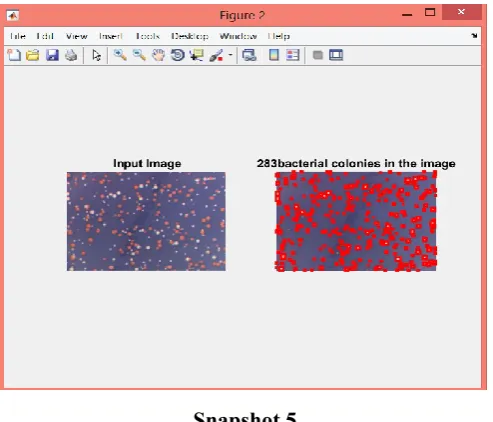
In snapshot 5 the number of bacterial colonies in the image is increased almost twice the previous image in snapshot 4. This image is given as input to the simulator. The proposed system is then executed on the image to obtain the accurate count.
Results of the simulator are summarized in table 1 as under:
TABLE 1
Summary of output of simulator
Sr.No Proposed Count Manual Count
1 20 20
2 27 27
3 139 139
4 283 283
The above table 1 shows the result of count of bacterial colonies by using different images for the proposed method. Table shows the count obtained by the proposed method and the manual method.
VII.
CONCLUSION
From the results we conclude that the “image processing based bacterial colony counter” is better than the traditional method of manual counting of bacterial colonies. It is clearly evident from the Table 1 that the proposed system produces accurate results. Difference between manual count and automated count is zero. Four results are shown in the table in Table 1. The bacterial colony with 20, 27, 139, 283 bacteria are counted using automated process and the result of automated process is same as manual count method, thereby producing accurate results. Manual counting of colonies is a tedious and time consuming task. The proposed system has eases this task. Chances of errors are also reduced. In proposed system few
morphological operations are used since
morphological operation parameters has to be varied manually according to the image, so excessive use of it is undesirable. The proposed system can even work for high density bacterial colonies images efficiently.
VIII.
FUTURE SCOPE
Image segmentation is a very extensive and prominent field which requires extensive research and hard work. The proposed work can be enhanced as:-
2. Excessive overlapping in the bacterial colony can still be improved.
IX.
REFERENCES
[1] Hemlata Sethi and Sunita Yadav, “Bacterial Colony Counter: Manual vs Automatic”, IRACST-Engineering Science and Technology: An International Journal (ESTIJ), 2012.
[2] Navneet Kaur Uppal and Raman Goyal, “Computational Approach to Count Bacterial Colonies”, International Journal of Advances in Engineering & Technology, Sept 2012.
[3] S.T Khandre, Akshay D. Isalkar, “A Survey Paper on Image Segmentation”, International Journal of Computer Science and Mobile Computing (IJCSMC), Vol 3 Issue.1, January -2014, Pg 441-446.
[4] Jos B.T.M. Roerdink and Arnold Meijster, “The Watershed Transform: Definitions, Algorithms and Parallelization Strategies”, Institute for Mathematics and Computing Science University of Groningen, IOS Press 2009.
[5] Lamia Jaafar Belaid and Walid Mourou, “Image Segmentation: A Watershed Transformation Algorithm”, 2009.
[6] Hasamukh Patel and Dr. Priya Swaminarayan, “Automated Counting of Bacterial Colonies: Simple Contrast Stretching Algorithm”, International Journal of Advanced Research in Computer Science and Software Engineering, Volume 5, Issue 9, September 2015.
[7] Jacey-Lynn Minoi, Tin Tze Chiang, Terrin Lim, Zaharin Yusoff Abdul Hafiz Abdul Karim, Azham Zulharnain , “Mobile Vision-based Automatic Counting of Bacteria Colonies” , IEEE, 2016.
[8] Rafael C. Gonzalez and Richard E. Woods, “Digital Image Processing in Matlab Third Edition”, USA, Pearson Prentice Hall, 2008.
[9] Salem Saleh Al-amri, N.V. Kalyankar and Khamitkar S.D, “Image Segmentation by Using Threshold Techniques”, JOURNAL OF COMPUTING, MAY 2010.
[10] Ms.K.Priyadharshini and Ms.Tripty Singh, “Research and Analysis on Segmentation and Thresholding Techniques”, International Journal of Engineering Research & Technology (IJERT), December 2012.
[11] P.P.Acharjya, A. Sinha, S.Sarkar, S.Dey and S.Ghosh, “A New Approach Of Watershed Algorithm Using Distance Transform Applied To Image Segmentation”, International Journal of Innovative
Research in Computer and Communication Engineering, April 2013.
[12] Nick Efford, “Digital Image Processing: A Practical Introduction Using JavaTM.” Pearson Education, 2000.
[13] Nilima Shah, Dhanesh Patel andAnjali Jivani , “Review on Image Segmentation, Clustering and Boundary Encoding”, International Journal of Innovative Research in Science, Engineering and Technology, November 2013.
[14] L. Najman and M. Schmitt, “Watershed of a continuous function”, In Signal Processing (Special issue on Mathematical Morphology.), 1994.
[15] Waseem Khan, “Image Segmentation Techniques: A Survey”, Journal of Image and Graphics December 2013.
[16] Arindrajit Seal, Arunava Das and Prasad Sen “Watershed: An Image Segmentation Approach”, International Journal of Computer Science and Information Technologies, 2015.
[17] K. Bhargavi and S. Jyothi, “A Survey on Threshold Based Segmentation Technique in Image Processing”, International Journal of Innovative Research & Development, November 2014.