RealText
asg: A Model to Present Answers Utilizing the Linguistic Structure
of Source Question
Rivindu Perera, Parma Nand
School of Computer and Mathematical Sciences Auckland University of Technology
Auckland, New Zealand
{rivindu.perera, parma.nand}@aut.ac.nz
Abstract
Recent trends in Question Answering (QA) have led to numerous studies focusing on psenting answers in a form which closely
re-sembles a human generated answer. These
studies have used a range of techniques which use the structure of knowledge, generic lin-guistic structures and template based ap-proaches to construct answers as close as pos-sible to a human generate answer, referred to as human competitive answers. This paper re-ports the results of an empirical study which uses the linguistic structure of the source ques-tion as the basis for a human competitive
answer. We propose a typed dependency
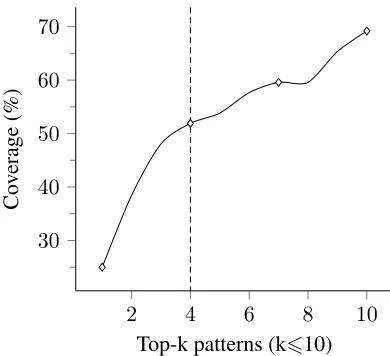
based approach to generate an answer sen-tence where linguistic structure of the ques-tion is transformed and realized into a sen-tence containing the answer. We employ the factoid questions from QALD-2 training ques-tion set to extract typed dependency patterns based on the root of the parse tree. Using iden-tified patterns we generate a rule set which is used to generate a natural language sentence containing the answer extracted from a knowl-edge source, realized into a linguistically cor-rect sentence. The evaluation of the approach is performed using QALD-2 testing factoid questions sets with a 78.84% accuracy. The top-10 patterns extracted from training dataset were able to cover 69.19% of test questions.
1 Introduction
Question Answering (QA) comprises of four main tasks; question processing, answer search, answer extraction, and answer presentation. The first three
tasks focus on extracting the answer while the last aims to present the extracted answer in a human-like format. With the rise of trend towards build-ing human-competitive QA systems, there been a corresponding demand for the extracted to be pre-sented in a human competitive form rather than the bare answer as a single word or a phrase. A wide range of answer presentation schemes have been reported including user tailored answers (Mendes and Coheur, 2013; Maybury, 2008; Kolomiyets and Moens, 2011; Perera and Nand, 2014a), justification based answers (Mendes and Coheur, 2013; May-bury, 2008; McGuinness, 2004; Saint-Dizier and Moens, 2011), presentation of paragraph level text summaries with the extracted answer (Mendes and Coheur, 2013; Lin et al., 2003; Perera, 2012b; Per-era, 2012a), presentation of hot links with answers (McGuinness, 2004), and presentation of navigable related answers and contextual information (Saint-Dizier and Moens, 2011; Perera and Nand, 2015a; Perera and Nand, 2014b; Perera and Nand, 2014c). All of the mentioned models aim to build an answer which closely resembles a human generated answer. However, an approach that has not been explored in the mentioned models is to exploit the structure of the question in the formulation of the answer. A hu-man generated answer is based both on the answer structure as well as how the question was formu-lated (Singer, 2013). For example, given the ques-tion “Which river does the Brookyln Bride cross?”, the expected answer sentence would be of the form of “The Brookyln Bridge crosses East River”.
It is essential to understand the types of ques-tions and their linguistic structure in order to
suc-206
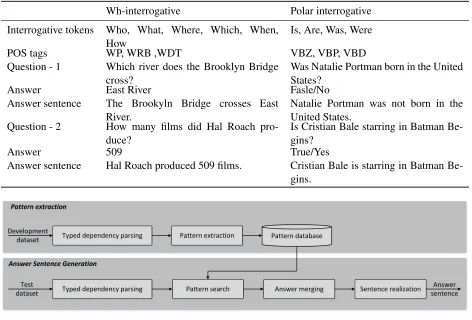
em-Table 1: Interrogative types with examples and associated POS tags. POS tags are compliant with the Penn Treebank guidelines.
Wh-interrogative Polar interrogative
Interrogative tokens Who, What, Where, Which, When, How
Is, Are, Was, Were
POS tags WP, WRB ,WDT VBZ, VBP, VBD
Question - 1 Which river does the Brooklyn Bridge cross?
Was Natalie Portman born in the United States?
Answer East River Fasle/No
Answer sentence The Brookyln Bridge crosses East River.
Natalie Portman was not born in the United States.
Question - 2 How many films did Hal Roach pro-duce?
Is Cristian Bale starring in Batman Be-gins?
Answer 509 True/Yes
Answer sentence Hal Roach produced 509 films. Cristian Bale is starring in Batman Be-gins.
Figure 1: Schematic representation of the overall Answer Sentence Generation (ASG) process
tag, the relative position in the sentence, and whether they belong to the wh-lexicons (who, when, what, etc.).
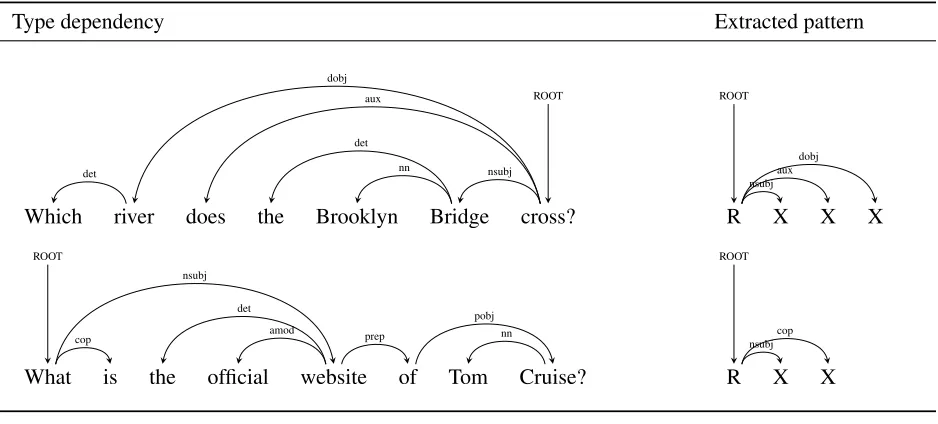
Once the interrogative type is identified, the pat-terns can be extracted using a development question set. Each pattern is a collection of first level typed dependency relations as a directed graph based on the root node of the parse tree whose nodes are generic. The order of typed dependency relations are not significant as linguistic structure may vary based on the formation of the question. Table 2 shows some patterns and with example questions.
Each extracted pattern is associated with rule sets to generate a sentence. These rules specify how nominal subject, direct object, clausal complements, and other typed dependency relations should be ag-gregated to form a natural sentence.
2.2 Identifying and applying patterns
Once the pattern database is built, an appropriate pattern for a given question can be retrieved by analysing the typed dependency parse of that ques-tion. In the identification process, the order of the relations in the typed dependency pattern is insignif-icant as we only consider the relations from the root node to another generic node.
Table 2: Syntactic patterns extracted from Typed dependency relations. The pattern is derived from the typed depen-dencies from the root token. The signXrepresents a slot which can be replaced with a single or multiple tokens even if there exist typed dependency relations among those multiple tokens. The signRrepresents the root token of the parse tree.
Type dependency Extracted pattern
Which river does the Brooklyn Bridge cross? det
dobj aux
det
nn nsubj ROOT
R X X X
ROOT
nsubj aux
dobj
What is the official website of Tom Cruise? ROOT
cop
det amod nsubj
prep nn
pobj
R X X
ROOT
nsubj cop
Table 3: Phrase extraction from typed dependencies
Type dependency Extracted phrases
Which river does the Brooklyn Bridge cross? det
dobj aux
det
nn nsubj ROOT
(i) Which river (ii) does
(iii) the Brooklyn Bridge (iv) cross
What is the official website of Tom Cruise? ROOT
cop
det amod nsubj
prep nn
pobj
(i) What (ii) is
(iii) the official website of Tom Cruise
2.3 Answer merging
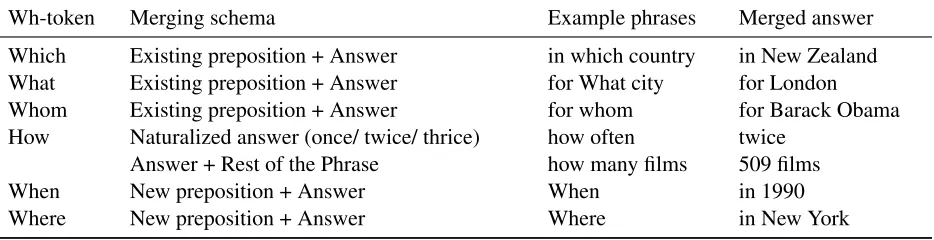
It is also required to embed the answer to the syn-tactic structure when the pattern has been identified to transform the question back into natural language sentence. In wh-interrogatives this require embed-ding another language segment, however for polar interrogatives this component should target on mod-ifying the polar token based on the answer.
For wh-interrogatives, we have designed the model to embed the answer based on the type of the
Table 4: Answer merging schema for wh-interrogatives. Existing preposition is a one that is already appeared in the phrase and new prepositions are added based on the answer.
Wh-token Merging schema Example phrases Merged answer
Which Existing preposition + Answer in which country in New Zealand What Existing preposition + Answer for What city for London
Whom Existing preposition + Answer for whom for Barack Obama
How Naturalized answer (once/ twice/ thrice) how often twice Answer + Rest of the Phrase how many films 509 films
When New preposition + Answer When in 1990
Where New preposition + Answer Where in New York
In addition to the answer merging schema shown in Table 4, the model also embeds measurement units and converts numbers to words. For exam-ple, if a number has appeared as the first word of an answer sentence, they are converted to a lexi-cal form (e.g., 31⇒ Thirty one). If a question re-quires the height of an entity (e.g.,person or moun-tain) as the answer then appropriate measurement unit is added which is extracted from the knowledge source utilized for the answer. However, the query built to extract the answer needs to be analysed in order to determine whether answer requires a mea-surement unit. The queries generated in QA sys-tems highly depend on the answer extraction source. For example, a QA system which utilizes a database will employ SQL as the query language and trans-forming the natural language question into a SQL query will be a major task for the query process-ing module of the QA system. The experiments described in this paper utilizes a Linked Data source, DBpedia, as the answer extraction data re-source (more information on this selection is de-scribed in Section 3.1). Use of DBpedia as the data resource required us to implement a SPARQL3 (SPARQLProtocol andRDFQueryLanguage) pro-cessing module. In particular, we used the Jena4to parse the SPARQL query and identify queried pred-icate from the SPARQL. The module then searches the queried predicate in a local lexicon database (this is built as a different task in this research (Perera et al., 2015; Perera and Nand, 2015b; Perera and Nand, 2015c)) to identify whether it is associated with a measurement unit. Listing 1 depicts an example
sce-3
SPARQL is the query language used for Linked Data 4
https://jena.apache.org/
nario of identifying the measurement unit associated withheightontology property of DBpedia.
2.4 Sentence realization
The sentence realization is based on a linguistic real-ization module which can further realize the answer sentence. However, by this stage, the answer sen-tence is nearly built except for the verb inflections. Therefore, this modules focuses on realization of pe-riphrastic tense in occasions where the verb can be inflected without compromising the semantics (e.g., does cross⇒ crosses). Also more importantly the formation of active voice based questions (identi-fied using POS tagging) often requires periphrastic tense embedded in the question (e.g., Which river does the Brooklyn Bridge cross? ⇒ does cross ⇒ crosses). We used a specially built verb infor-mation database to identify different inflections of verbs. This database was built using VerbNet and contains 3773 records where each corresponds to a unique verb. However, VerbNet does not provided verb inflections. Therefore, we reverse engineered the Porter stemming algorithm (Porter, 1980) to gen-erate the verb inflections.
An example set of records of this database is shown in Table 5.
3 Experimental framework
PREFIX res: <http://dbpedia.org/resource/>
PREFIX dbo: <http://dbpedia.org/ontology/>
SELECT DISTINCT ?height
WHERE {
res:Claudia_Schiffer dbo:height ?height . }
⇒ ?height⇒ dbo:height⇒ meters(m)
Listing 1: An example scenario of identifying the measurement unit associated with queried predicate by parsing the SPARQL query
Table 5: An example set of records from verb information database. (Base = Base form of the verb, PT = Past tense, PP = Past participle, TPS = Third person singular, Frames = aggregation of all frames found for the verb in VerbNet)
Base PT PP ING TPS Frames
abandon abandoned abandoned abandoning abandons NP V NP.initial location
abase abased abased abasing abases NP V NP.patient, NP V ADV-Middle, NP V NP PP.instrument
abash abashed abashed abashing abases NP.cause V NP, NP V NP, NP V ADV-Middle, NP V NP-PRO-ARB, NP V NP ADJ
to achieving the long-held illusive goal of accuracy, hence we have now started to also look at real-time performance and computational efficiency.
3.1 Datasets
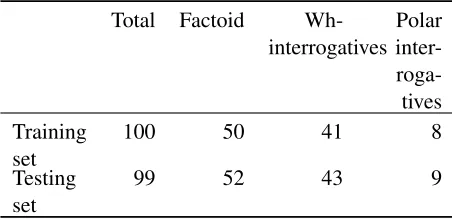
The experiments were carried out using factoid questions extracted from QALD-2 datasets. The QALD-2 training dataset is used to extract typed de-pendency patterns (as the development dataset) and the testing dataset is used to evaluate the framework. The statistics related to the dataset is summarized in Table 6. The training set contained a record “Give me the homepage of Forbes”. This record does not form a linguistic representation of any type of inter-rogative question and therefore could not be consid-ered for pattern extraction.
3.2 Results and discussion
The evaluation of the framework focused on two as-pects; the syntactic and semantic accuracy of the approach, and the memory and processing require-ment. The latter was employed to identify the via-bility of the methodology for real-time systems.
We were able to identify 18 distinct wh-interrogative patterns and 7 polar wh-interrogative
pat-Table 6: Statistics related to the question sets
Total Factoid Wh-interrogatives
Polar inter- roga-tives Training
set
100 50 41 8
Testing set
99 52 43 9
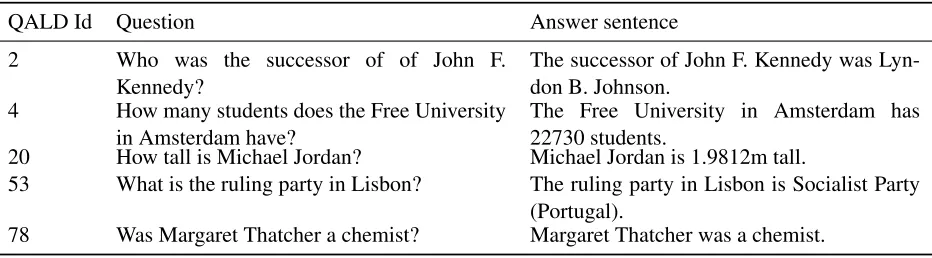
the errors in the typed dependency parse (for 1 ques-tion). Table 7 shows a selected set of generated an-swer sentences together with questions.
It is also important to analyse the coverage pro-vided for the test dataset by the extracted patterns from training dataset. Fig. 2 shows the number of testing dataset cases covered by top-k patterns ex-tracted from training dataset. The top-10 patterns were able successfully cover 69.19% of the ques-tions from the testing dataset. Furthermore, the cov-erage of 51.91% of the questions through top-4 pat-terns shows that the top patpat-terns are highly represen-tative.
2 4 6 8 10
30 40 50 60 70
Top-k patterns (k610)
Co
v
erage
(%)
Figure 2: The coverage provided for the test dataset by the extracted patterns from training dataset. The coverage is depicted as a percentage of questions transformed ac-curately by top-k patterns which are extracted from train-ing dataset. The dashed line shows the point where 50% coverage is reached.
Another aspect of the evaluation of the framework was to analyse the memory and execution analysis. Fig.3(a) and Fig.3(b) depicts the heap memory al-location for the answer sentence generation process and execution time analysis respectively. The re-markably high heap memory allocation (more than 600 Mb) indicates that the current architecture needs further work to work in limited-memory environ-ments. However, the execution time analysis shows that the framework can be adapted to real-time sys-tems.
(a) Heap memory allocation
(b) Execution time for key components
Figure 3: Memory and execution analysis for ASG pro-cess. The analysis is performed for test dataset which contains 52 factoid question.
4 Related work
A considerable amount of literature has been pub-lished on answer presentation. However, to the best of our knowledge answer sentence generation is not studied in any present model. Therefore, this section provides a broader review of answer presentation.
Benamara and Dizier (Benamara and Dizier, 2003) present the cooperative question answer-ing approach which generates natural language re-sponses for given questions. The idea of cooper-ative question answering dates back to 1986 with the invention of cooperative interface for informa-tion systems. Then several researchers involved the cooperative interfaces for QA systems. In essence, a cooperative QA system moves a few steps further from ordinary question answering systems by pro-viding an explanation of the answer, describing if the system is unable to find an answer or by provid-ing links to the user to get more information for the given question. However, the development of this description is entirely based on the external knowl-edge source, and the linguistic structure is not con-sidered to present the answer.
ex-Table 7: Selected set of generated answer sentences together with questions
QALD Id Question Answer sentence
2 Who was the successor of of John F. Kennedy?
The successor of John F. Kennedy was Lyn-don B. Johnson.
4 How many students does the Free University in Amsterdam have?
The Free University in Amsterdam has 22730 students.
20 How tall is Michael Jordan? Michael Jordan is 1.9812m tall.
53 What is the ruling party in Lisbon? The ruling party in Lisbon is Socialist Party (Portugal).
78 Was Margaret Thatcher a chemist? Margaret Thatcher was a chemist.
act answer by presenting users with additional in-formation in sentence form is presented by Bosma (Bosma, 2005) utilizing summarization techniques. In this research Bosma (Bosma, 2005) assumes that a QA system has already extracted a sentence that contains the exact answer. Then based on this candi-date sentence, Bosma (Bosma, 2005) tries to gener-ate an answer response by utilizing information ac-quired from a collection of sentences. He coins the term, an intensive answer to refer to the answer gen-erated from the system. The process of generating intensive answer is based on summarization using rhetorical structures.
Another answer presentation method based on summarization is presented by Demner-Fushman and Lin (Demner-Fushman and Lin, 2006). They introduce the concept of extractive summaries to present with extracted answer. This model has some similarity with the one presented by Bosma (Bosma, 2005), but like in Bosmas model, Demner-Fushman and Lin (Demner-Fushman and Lin, 2006) do not make use of specifically generated weighted graph to identify relevant sentences to include in the sum-mary. Instead Demner-Fushman and Lin (Demner-Fushman and Lin, 2006) generates the answer by ag-gregating the top three ranked sentences by a regres-sion model.
Vargas-Vera and Motta (Vargas-Vera and Motta, 2004) present an ontology based QA system, AQUA. Although AQUA is primarily aimed at ex-tracting answers from a given ontology, it also con-tributes to answer presentation by providing an en-riched answer. The AQUA system extracts ontology concepts from the entities mentioned in the question and present those concepts in aggregated natural
lan-guage. However, the research does not contribute towards identifying the most appropriate context for the given question and answer. In addition, no spe-cific effort is taken to identify how the aggregated concepts need to presented. However, the benefit that researchers achieved by building the enriching module on top of an ontology is that the related in-formation can be easily acquired using the relations in the ontology.
5 Conclusion and future work