A grammar design accommodating packed argument frame
information on verbs
Petter Haugereid
Division of Linguistics and Multilingal Studies, Nanyang Technological University, 14 Nanyang Drive, Singapore 637332, Singapore
Abstract. This paper presents a comparison of two designs for implementing argument frame information on verbs. In the first design, alternating verbs will be represented with one lexical entry pr. possible argument frame. In the other design, each verb form will be associated with only one lexical entry containing a packed representation of the possible ar-gument frames. The first design represents how valence alternations are treated in lexicalist grammars, while the second shows how valence alternations can be handled in a construction-alist grammar. The comparison is done with an implemented “deep” grammar of Norwegian.
Keywords: HPSG, grammar engineering, lexical representations, under-specification.
1
Introduction
In most “deep” grammar implementations, information about the argument frame of a verb is spec-ified in the lexicon. This can be observed in grammatical frameworks such as Head-driven Phrase Structure Grammar (HPSG) (Pollard and Sag, 1994), Lexical Functional Grammar (LFG) (Bresnan, 2001), and Combinatory Categorial Grammar (CCG) (Steedman, 2000). Deep grammars need to be as precise as possible since they are not only expected to parse grammatical sentences, but also not to parse ungrammatical sentences. So, in order to avoid overgeneration, the grammar needs, among numerous other things, to contain information about what syntactic frames a verb is expected to appear in. The most natural place to put this information is in the lexicon.
In this paper I will discuss one problem associated with the way argument frame information is specified in a lexicalist grammar, namely the use of multiple lexical entries for one verb form in cases where the verb may appear in more than one argument frame. Multiple lexical entries for one form leads to an increased processing effort for the parser. A possible solution to this problem is to pack the information from the different entries into one. I will present a constructionalist grammar design, where each verb form is assigned a single lexical entry with a packed representation of the possible argument frames of the verb, using a type hierarchy of argument frame types to account for argument frame alternations. I will show how the grammar design compares toHPSG, which is the framework mostly used for deep grammar implementations, and compare two versions of the implemented grammar, one with an expanded lexicon and one with a packed lexicon, with regard to competence and performance.
2
Valence in
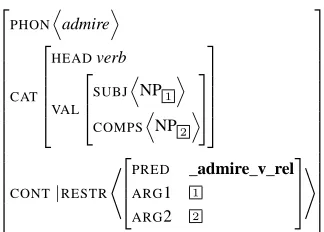
HPSGInHPSG, a transitive verb has the information in Figure 1. The figure illustrates how the valence requirements of a verb is represented by means of lists and also how the linking to the semantics is accounted for.
Copyright 2011 by Petter Haugereid
making parsing more efficient where local ambiguities are packed while parsing is going on, as shown in Oepen and Carroll (2000), where the packing is done by the parser.
3
Norsyg
Norsyg is a typed feature structure grammar for Norwegian, developed with resources from the open-source repository of the Deep Linguistic Processing withHPSG Initiative (DELPH-IN),3 in particular the LKBsystem (Copestake, 2002), which is a software for parsing and grammar
de-velopment, and the HPSGGrammar Matrix (version 0.8) (Bender et al., 2002), which the gram-mar Norsyg orignially is based on. Evaluation is done with the[incr tsdb()]system (Oepen and Flickinger, 1998).
Even though much of the feature geometry of the Grammar Matrix has been kept, the design is radically different from that of a standard HPSGgrammar. It is now more a constructionalist grammar, rather than lexicalist, inspired by the approach in Borer (2005a,b) and Åfarli (2007).
Norsyg (version 2011-07-28) is a grammar with 4,454 types, 133 features, 144,679 lexical entries (of which 1,436 are hand-built), 52 grammar rules, and 51 lexical rules. In comparison, theERG(version 2010-10-01) has 7,682 types, 202 features, 35,473 lexical entries, 175 grammar rules, and 73 lexical rules, andJACY(Jacy Japanese Grammar, version 2009-07-05) (Siegel and Bender, 2002) has 2524 types, 183 features, 56,944 lexical items, 51 grammar rules, and 69 lexical rules.
3.1
Linking types
In the approach taken in Norsyg, linking is done in the syntax rather than in the lexical types. Instead of assuming that a lexical entry has detailed information about a certain syntactic frame, which is crucial in an approach that does linking in the lexicon (see Figure 1), it is assumed that a lexical entry by default has little information about its syntactic environment. The syntactic frames are not projections of the lexicon. They are rather constructions made up of functional
signs, that is inflections, closed class lexical items, and syntactic rules. These signs do the linking
of the arguments of the open class lexical items that enter the syntactic frames, realizing what I refer to as subconstructions as they serve as part of a larger, overall construction. In order to avoid overgeneration, the open class lexical items are provided with information that restricts the number of argument frames they can enter.
3.2
Four valence features
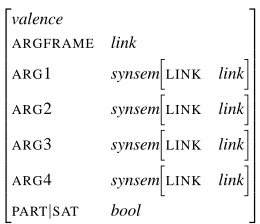
In the implementation of a grammar that does linking by means of functional signs realizing sub-constructions, I make use of four valence features (ARG1,ARG2,ARG3 andARG4), correspond-ing to what in GB is referred to as the “external argument” (ARG1), the “direct object internal argument” (ARG2), the “indirect object internal argument” (ARG3), and “goal/locative oblique” (ARG4). The four features have synsem as value.4 The type synsem is given the featureLINK. The value of theLINKfeature is the type link. In addition, there is a featureARGFRAMEwith the value
link. It is via this feature that a lexeme may put restrictions on what types of constructions it can
enter. There is also a featurePARTwhich allows a lexeme to select for particles. The type valence now has the definition in Figure 5, rather than the definition with the SUBJ and COMPS lists as presented in Figure 4.
rule looks for the first element on theCOMPSlist to promote it to subject, and will not be able to find the second element in case the first is not realized.
3http://www.delph-in.net. 4
valence
SUBJ list
SPR list
COMPS list
SPEC list
Figure 4: The type valence in the Grammar Matrix
valence
ARGFRAME link
ARG1 synsemhLINK linki
ARG2 synsem
h
LINK link
i
ARG3 synsemhLINK linki
ARG4 synsemhLINK linki
PART|SAT bool
Figure 5: The type valence in Norsyg
3.3
A hierarchy of linking types
The type link has a hierarchy below it. Directly under link, there are eight types, one positive and negative type for each of the valence features in Figure 5 (see Figure 6).5 So there is one arg1+, one arg1–, one arg2+, one arg2– and so on.
link
arg2+ arg1+ arg4+ arg3+ arg3– arg4– arg1– arg2–
arg1-12
arg12 arg1
Figure 6: The link hierarchy
Each of the types in the bottom of the hierarchy inherits from four of the top types. These types represent different argument frames. For instance, the type arg12 represents an arg12-construction, which is the frame type for transitive verbs like devour in John devoured the pizza. The type arg1 is the type for unergative intransitive verbs like smile in John smiled. If we study the hierarchy above the bottom types, we see that arg12 is a subtype of arg1+, arg2+, arg3–, and
arg4–, and that arg1 is a subtype of arg1+, arg2–, arg3–, and arg4–.
3.4
Packing of argument frames
The intermediate types in the hierarchy are inserted in order to allow something that can be thought of as packing of argument frames.6 These types have two or more bottom types as subtypes. So a verb that is specified in the lexicon with an intermediate link type will be compatible with all the frames that correspond to the subtypes of the intermediate link type.
The verb eat can occur with two valence frames, as illustrated in (1).7
(1) a. John eats.
b. John eats an apple.
5The hierarchy in Figure 6 is very simplified. Most of the intermediate and bottom types are left out in order to keep the illustration as simple as possible.
6
The term packing was suggested to me by Lars Hellan.
In (1a) eat has an arg1-frame, and in (1b) an arg12-frame. In order to allow the verb to enter both frames, it is given theARGFRAMEvalue arg1-12 in the lexicon. arg1-12 inherits from arg1+,
arg3-, and arg4-, but is underspecified with regard to arg2. It has two subtypes, namely arg1 and arg12, which means that eat can enter the relevant argument frames.
A verb like break can enter the frames illustrated in (2).
(2) a. John broke the cup.
b. John broke the cup to pieces. c. The cup broke.
d. The cup broke to pieces.
(2a) has a transitive frame (arg12-construction), (2b) has a transitive + resultative frame (arg124-construction), (2c) has an unaccusative frame (arg2-construction) and (2d) has an un-accusative + resultative frame (arg24-construction). In order to allow break in all these frames, it is specified with the intermediate link-type arg12-124-2-24, which has the four subtypes arg12,
arg124, arg2 and arg24 (not displayed in Figure 6). In all, the hierarchy below the type link
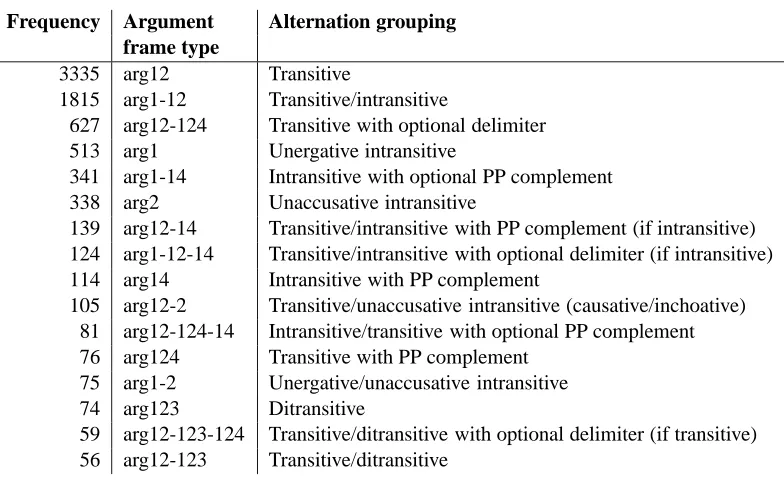
consists of 126 types. The most frequent argument frame types with linguistic definitions are given in Table 1. It shows that the most common alternation grouping among the verbs is the transitive/intransitive alternation, with 1815 occurrences. In comparison, the number of verbs alternating between (only) transitive and ditransitive is 56.
Table 1: The 16 most frequent argument frame types in Norsyg
Frequency Argument Alternation grouping frame type
3335 arg12 Transitive
1815 arg1-12 Transitive/intransitive
627 arg12-124 Transitive with optional delimiter 513 arg1 Unergative intransitive
341 arg1-14 Intransitive with optional PP complement 338 arg2 Unaccusative intransitive
139 arg12-14 Transitive/intransitive with PP complement (if intransitive) 124 arg1-12-14 Transitive/intransitive with optional delimiter (if intransitive) 114 arg14 Intransitive with PP complement
105 arg12-2 Transitive/unaccusative intransitive (causative/inchoative) 81 arg12-124-14 Intransitive/transitive with optional PP complement 76 arg124 Transitive with PP complement
75 arg1-2 Unergative/unaccusative intransitive 74 arg123 Ditransitive
59 arg12-123-124 Transitive/ditransitive with optional delimiter (if transitive) 56 arg12-123 Transitive/ditransitive
3.5
The composition of subconstructions
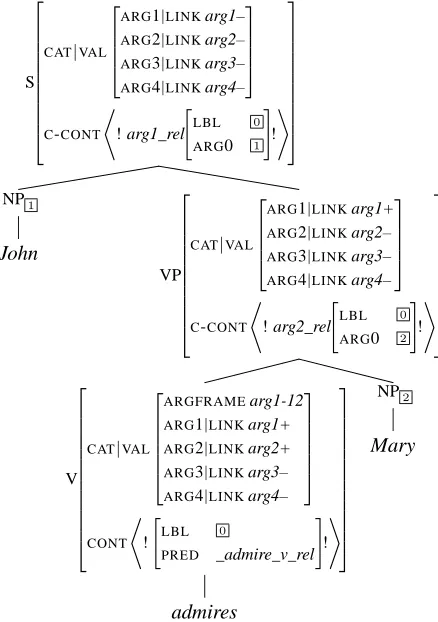
Figure 7 gives a simplified illustration of how the information about realized subconstructions in the syntax and argument structure information specified on the main verb is represented.8 As the figure shows, each valence rule switches a negative LINK value in the mother to a positive
8
featureOPTon syntactic arguments. ThePART|SATvalue is plus, which means that the verb is not a particle verb.
arg1-12_np_le
CAT|VAL
ARGFRAMEarg1-12
ARG2|CAT|HEADnominal
PART|SAT+
Figure 9: The arg1-12_np_le type
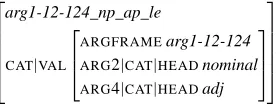
The lexical type for verbs like paint, which can be both intransitive, transitive and transitive resultative, is given in Figure 10. TheARGFRAMEvalue is specified as arg1-12-124, which means that it can enter an unergative frame, a transitive frame, and a transitive frame with a delimiter. TheHEADvalue ofARG2 is specified to be nominal, and theHEADvalue ofARG4 is specified to
be adj. This ensures that the internal argument is an NP, and that the delimiter is an adjective.
arg1-12-124_np_ap_le
CAT|VAL
ARGFRAMEarg1-12-124
ARG2|CAT|HEADnominal
ARG4|CAT|HEADadj
Figure 10: The arg1-12-124_np_ap_le type
Given the means I have described for restricting the syntactic environment of verbs in Norsyg, theARGFRAMEvalues, theHEADvalues of theARG2 andARG4 arguments, theKEYvalue of the
ARG4 argument, and thePREDvalue of the particles, one is free to give very specific constraints, only allowing one particular argument frame, or one can let the constraints be less specific, so that the verb can enter more frames.
3.7
Adaptation of Norsk Ordbank
Norsyg is adapted to Norsk Ordbank,10which is a full-form lexicon for Norwegian with 1,179,549 entries (148,141 different lemmas). The verbs in Norsk Ordbank are annotated with the argument frame information from the NorKompLeks project.11 A program convlex converts the lexicon into a format compatible with the Norsyg grammar (143,263 uninflected lexical entries, of which 8,647 are verbs). It gathers the argument frame information about each verb and creates the corre-sponding type if this type does not exist already. This is often necessary if a verb can enter many argument frames. The lexical types for verbs have five kinds of information. First, they spec-ify what kind of constructions the verb can enter. If the verb can enter the arg1-construction, the arg12-construction, and the arg124-construction, it is assigned theARGFRAMEvalue arg1-12-124. Second, they specify theHEADvalue of theARG2 argument (if applicable). If theARG2 is either an NP or a subordinate clause, the new verb lexical entry type inherits from the type arg2_cp-np. Third, the ARG3 value is specified to be a reflexive (if applicable). Forth, the new verb lexical types specify theARG4 value (if applicable). If theARG4 value is a PP, the type inherits from the
type arg4_pp. Fifth, the new verb lexical entry type specifies whether the verb is a particle verb. If it is a particle verb, it inherits from the type part-verb, and if not, it inherits from non-part-verb. Other information, like thePREDvalues of selected particles and prepositions, is specified on each
10
http://www.edd.uio.no/prosjekt/ordbanken/ 11
individual lexical entry. Based on the argument frame information specified on verbs in Norsk Ordbank, the lexicon conversion program builds 126 new types for verb lexical entries in addition to the 100 lexical entry types for verbs that already exist. An example of an automatically created verb lexical type is given in (3).
(3) arg12-124-2_part_np_pp_le := arg2_np & arg4_pp & part-verb & [ SYNSEM.LOCAL.CAT.VAL.ARGFRAME arg12-124-2 ].
The type in (3) is the type for the verbs etse (‘corrode’), helle (‘pour’/‘slope’), hive (‘throw’),
kippe (‘flip up’), and knalle (‘crack’). What these verbs have in common, is that they can enter
the arg12-construction, the arg124-construction, and the arg2-construction, hence theARGFRAME
value arg12-124-2. The verbs are particle verbs, so the type inherits from part-verb. The verbs require an NP as value of ARG2 and a PP as value ofARG4 (if applicable), so the type inherits from arg2_np and arg4_pp.
The entry of the infinitival form of helle in Norsk Ordbank is given in (4), where the fields in angle brackets show what argument frames the verb can enter, <intrans2>,<adv6>, and <part1/ut>.
(4) 27112 helle helle verb inf <intrans2> <adv6> <part1/ut> 021 1
These argument frame specifications are translated into the type in (3) according to a ta-ble distributed with the Norsyg grammar (‘nkl2lkb.txt’). When appearing alone, <intrans2> translates into the type arg2_np_le (the type for intransitive unaccusative verbs), <adv6> trans-lates into the type arg124_np_pp_le (the type for transitive verbs with PP complements), and <part1/ut> translates into the type arg12_part_np_le (the type for transitive particle verbs (thePREDvalue of the particle ut (‘out’) is specified on the lexical entry)). When these three ar-gument frames appear on the same lexical entry, the type arg12-124-2_part_np_pp_le is created, as shown above. It accommodates all the frames just mentioned.The lexical entry of helle in the Norsyg grammar is given in (5).
(5) helle-v := arg12-124-2_part_np_pp_le & [ STEM <"helle">,
INFLECTION v1,
SYNSEM.LKEYS.ALTKEYREL.PRED _ut_p_rel,
SYNSEM.LKEYS.KEYREL.PRED "_helle_v_rel" ].
4
Comparison of ‘packed’ vs. expanded lexicon
In order to check the impact of a lexicon with packed argument frame representations as described in the previous section, I used the convlex program to generate two versions of the lexicon. In the first version, all verbs were given packed representations, and in the other, each argument frame version of a verb was spelled out as a separate lexical entry.
This means that a verb that has the type arg1-12_np_le (see Figure 9) in the packed lexicon, in the expanded version is given two lexical entries, one of the type arg1_le and one of the type
arg12_np_le (one for each of the argument structure codes assigned by the original Norsk Ordbank
lexicon). 5,329 of the verbs from the Norsk Ordbank lexicon are listed with only one frame, and are therefore given only one lexical entry in the expanded lexicon, while 3,318 verbs are listed with more than one argument frame and are given the corresponding number of lexical entries. This gave me an expanded lexicon with 12,213 lexical entries for verbs, rather than the 8,647 lexical entries for verbs in the packed lexicon, an increase of 3,566.
next section. The grammar had a coverage of 5,105 sentences with the packed lexicon and 5,078 sentences with the expanded lexicon. Of the sentences that were parsed with both version of the lexicon, 3,446 sentences were given the same number of analyses with both versions. This set is referred to as Equal coverage in the next section. I also created a third set of sentences where I excluded the sentences containing the copula verb ‘å være’ ‘to be’ from the Equal coverage set, since they are likely to be overrepresented in the data. (Typical short sentences in the Wikipedia data are sentences like Lesotho er et land i Afrika ‘Leshoto is a country in Africa’.) This set is referred to as No copula in the next section and has 1,902 items.
5
Results
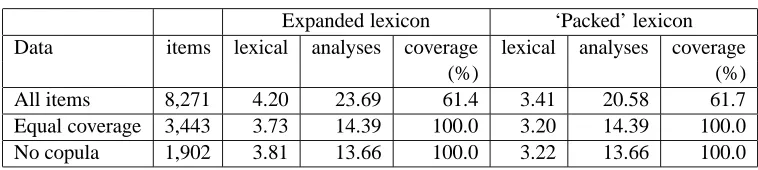
I let the grammar loaded with the two different lexicons (packed and expanded) parse the three sets of sentences described in the previous section (All items, Equal coverage, and No copula) and compared the results. Table 2 shows that the two versions of the grammar, as already noted, have similar coverage on the All items set (61.4% and 61.7%), and, as expected, the same coverage (100%) on Equal coverage, and No copula. The two versions produce slightly more analyses on average with the expanded lexicon (23.69) than the packed lexicon (20.58) for All items. For the
Equal coverage, and No copula sets, the two versions (as expected) produce the same number of
analyses (14.39 and 13.66, respectively). More importantly, the table also illustrates the difference in lexical ambiguity of the two grammars. The difference in lexical ambiguity of expanded vs. packed is 4.20 vs. 3.41 on All items, 3.73 vs. 3.20 on Equal coverage, and 3.81 vs. 3.22 on No
copula. This means that on average more lexical items are entered into the parse chart with the
expanded lexicon than with the packed lexicon.
Table 2: Comparison of competence
Expanded lexicon ‘Packed’ lexicon Data items lexical analyses coverage lexical analyses coverage
(%) (%)
All items 8,271 4.20 23.69 61.4 3.41 20.58 61.7 Equal coverage 3,443 3.73 14.39 100.0 3.20 14.39 100.0 No copula 1,902 3.81 13.66 100.0 3.22 13.66 100.0
Table 3 shows how the use of packed argument frames affects the performance of the parser, compared to the use of the expanded lexicon. When applied to the Equal coverage set, the number of tasks is reduced by 10.7%, and the use of space is reduced with 13.3%. Similarly, the number of tasks is reduced by 12.8%, and the use of space is reduced with 13.2%, when applied to No
copula. The numbers showing reductions for All data are less reliable, since the set includes
sentences where the two versions of the grammar produce different numbers of analyses.
Table 3: Comparison of performance
Expanded lexicon ‘Packed’ lexicon Reduction (%) Data items tasks space tasks space tasks space All items 8,271 3,265 208,324 2,480 139,430 24.0 33.1 Equal coverage 3,443 2,022 102,964 1,805 69,540 10.7 13.3 No copula 1,902 1,341 59,080 1,170 51,294 12.8 13.2
structure information could be implemented in a different way, that would make parsing more efficient. However, this comparison is only done for testing the impact of the packing of argument structure information in a grammar that is implemented similar to Norsyg.
6
Conclusion
I have compared two versions of a lexicon for a grammar implementation. One, where valence alternations are accounted for by means of multiple lexical entries, and one, where valence alter-nations are accounted for by means of packed type constraints. It has been demonstrated that the packed version of the lexicon introduces fewer lexical items in the parse chart. The use of the packed version of the lexicon also leads to a reduction of tasks performed and space used by the parser.
References
Bender, E. M., Flickinger, D., and Oepen, S. (2002). The grammar matrix: An open-source starter-kit for the rapid development of cross-linguistically consistent broad-coverage precision grammars. In J. Carroll, N. Oostdijk, and R. Sutcliffe, editors, Proceedings of the Workshop on
Grammar Engineering and Evaluation at the 19th International Conference on Computational Linguistics, pages 8–14, Taipei, Taiwan.
Borer, H. (2005a). Structuring Sense. An Exo-Skeletal Triology. Volume I. In Name Only. Oxford University Press.
Borer, H. (2005b). Structuring Sense. An Exo-Skeletal Triology. Volume II. The Normal Course of
Events. Oxford University Press.
Bresnan, J. (2001). Lexical-Functional Syntax. Blackwell Publishers.
Copestake, A. (2002). Implementing Typed Feature Structure Grammars. CSLI publications.
Flickinger, D. P. (2000). On building a more efficient grammar by exploiting types. Natural
Language Engineering, 6(1), 15–28.
Oepen, S. and Carroll, J. (2000). Ambiguity packing in constraint-based parsing. Practical results. In Proceedings of the 1st Conference of the North American Chapter of the ACL, pages 162 – 169, Seattle, WA.
Oepen, S. and Flickinger, D. (1998). Towards systematic grammar profiling. test suite technology ten years after. Journal of Computer Speech and Language: Special Issue on Evaluation, 12
(4), 441–437.
Pollard, C. J. and Sag, I. A. (1994). Head-Driven Phrase Structure Grammar. University of Chicago Press, Chicago.
Sag, I. A., Wasow, T., and Bender, E. M. (2003). Syntactic Theory: A Formal Introduction. CSLI Publications, Stanford, 2 edition.
Siegel, M. and Bender, E. M. (2002). Efficient deep processing of Japanese. In COLING:02, pages 1–8, Taipei, Taiwan.
Steedman, M. (2000). The Syntactic Process. Cambridge, MA and London: The MIT Press.