Finding The Best Model Among Representative Compositional Models
Masayasu Muraoka
†Sonse Shimaoka
‡Kazeto Yamamoto
†Yotaro Watanabe
†Naoaki Okazaki
†∗Kentaro Inui
†Tohoku University
†‡Japan Science and Technology Agency (JST)
∗{muraoka,kazeto,yotaro-w,okazaki,inui}
@ecei.tohoku.ac.jp
†[email protected]
‡Abstract
The field of distributional-compositional se-mantics has yielded a range of computational models for composing the vector of a phrase from those of constituent word vectors. Ex-isting models have various ranges of their expressiveness, recursivity, and trainability. However, these models have not been exam-ined closely for their compositionality. We implement and compare these models under the same conditions. The experimentally ob-tained results demonstrate that the model us-ing different composition matrices for differ-ent dependency relations achieved state-of-the-art performance on a dataset for two-word compositions (Mitchell and Lapata, 2010).
1 Introduction
Computing the meaning of a text has posed a chal-lenge in NLP for many years. Based on the distri-butional hypothesis (Firth, 1957), the meaning of a word is typically represented as a real-valued vector, with elements representing the frequencies of words that co-occur in the context of the word in a cor-pus. Numerous studies have demonstrated learned word vectors from a large text corpus (Bullinaria and Levy, 2007; Collobert and Weston, 2008; Tur-ney and Pantel, 2010; Mnih and Kavukcuoglu, 2013; Mikolov et al., 2013).
In contrast, the same approach is not scalable to a complex linguistic unit (e.g., phrase or sentence) because of the data sparseness problem: the longer the length of a phrase, the fewer times the phrase oc-curs in a corpus. For this reason, we cannot acquire
semantic information reliably from co-occurrence statistics of a phrase. Recently, numerous studies have explored compositional semantics, in which the meaning of a phrase, clause, or sentence is com-puted from those of its constituents (Mitchell and Lapata, 2008; Mitchell and Lapata, 2010; Guevara, 2010; Zanzotto et al., 2010; Socher et al., 2011; Ba-roni et al., 2012; Socher et al., 2012; Socher et al., 2013a; Socher et al., 2014). These studies mostly address theories and methods for computing a vec-tor of a phrase from the vecvec-tors of its constituents; the simplest but effective approach is to take the av-erage of the two input vectors.
A simple approach such as additive and multi-plicative compositions has been a strong baseline over more complex models (Blacoe and Lapata, 2012; Socher et al., 2013b). However, Erk and Pad´o (2008) argued the importance of syntax relations: the simple additive/multiplicative approach yields the same vector for phrasesa horse drawsanddraw a horse, ignoring the syntactic structure by which horsein the former phrase is a subject whereashorse in the latter is the object. They formulated a gener-alized composition function including such a com-position. However, this generalized composition is too complex to learn. These models usually do not work well for now.
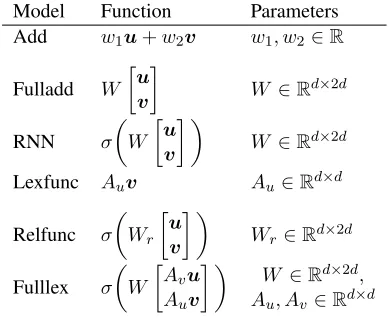
ex-extends theAdd model, applying a linear transfor-mation to inputs with a weight matrixW ∈Rd×2d. This model can not only scale but also rotate input vectors, unlike theAddmodel.
Regarding linear transformation with a matrixW, Recursive Neural Network (RNN) model (Socher et al., 2011) achieves a nonlinear transformation through the use of an activation function (e.g., sig-moid function andtanh).Lexfuncmodel (Baroni et al., 2012) represents a dependent wordu(e.g., ad-jective) as a matrixAuand composes a phrase vector with a matrix-vector productAuv. The underlying idea of representing a dependent as a matrix is that a modifier (dependent) changes some properties of a governer and that it is achieved using a matrix trans-forming a vector of the governer1.
ExtendingRNN, theRelfuncmodel (Socher et al., 2013a; Socher et al., 2014) incorporates syntactical relations in compositions, which composes phrase vectors with a different weight matrix for a syntactic relation between inputs. GeneralizingLexfuncand RNN, theFulllexmodel Socher et al. (2012) defines the meaning of each word as a tuple of a vector and matrix, where a vector represents the meaning of the word itself and a matrix provides a function to other words for compositions. In addition to these mod-els, theMultmodel and theDilmodel (Mitchell and Lapata, 2008; Mitchell and Lapata, 2010) have been proposed.
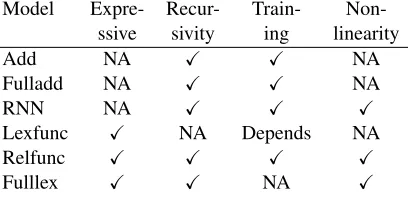
Table 2 presents the benefits and shortcomings of each model. It is easy to train theAddmodel because it has only two parameters. Apparently, the Add model has the least expressive power using very few parameters. However, this simple model has been a strong baseline in the literature (Blacoe and Lapata, 2012). Similarly to theAddmodel,Fulladduses a linear composition function; we can find a global op-timum for the convex training objective. In contrast, RNN,RelfuncandFulllexare neural network mod-els using nonlinear activation functions. The non-linearity enriches the expressive power, but it makes training difficult because the training objectives are not convex.
Regarding the performance of these models aside from Relfunc in the same condition, Dinu et al.
1For instance, we can regardredin the phrasered caras
changing the property ofcolorof the wordcar.
Table 2: Problems of representative models.
Model Expre- Recur- Train- Non-ssive sivity ing linearity
Add NA ! ! NA
Fulladd NA ! ! NA
RNN NA ! ! !
Lexfunc ! NA Depends NA
Relfunc ! ! ! !
Fulllex ! ! NA !
(2013) concluded that Lexfunc performed the best among these models. According to their explana-tion,Lexfuncperforms well because it considers lin-guistic relations between input words (e.g. modifi-cation, verb–object relation). However,Lexfunc can-not compose vectors recursively because of the dif-ferent types of input–output representations (vector or matrix).
In contrast, RNN,Relfunc, andFulllexcan com-pose vectors recursively. The recursivity is an im-portant property because it enables comparison of a phrase vector (e.g.,football player) with a word vec-tor (e.g.,footballer). However,Fulllexhas an enor-mous number of parameters, representing each word as a distinct tuple of a vector and a matrix. InRNN, on the other hand, all compositions are computed only by a single weight matrix. Consequently, it can-not distinguish different syntax relations in compo-sitions. Located betweenRNNandFulllex,Relfunc can compose various types of syntax relations more precisely thanRNNwith fewer parameters than Ful-llex.
backprop-Information (PMI) (Evert, 2005). Finally, we com-press the matrix into d dimension using Principal
Component Analysis (PCA) (Roweis, 1998) with EM algorithm5. In this way, we obtained 10,000
word vectors and 17,433 phrase vectors.
4.2 Gold-standard data
We conducted a human-correlation experiment us-ing the dataset6 created in Mitchell and Lapata
(2010). Each instance in the dataset is a triplet
⟨phrase1, phrase2, similarity⟩: a similarity is a se-mantic similarity between the phrases annotated by humans, with a value ranging from 1 (least similar) to 7 (most similar). We designate this as human-similarity. For example, the similarity between
vast amountandlarge quantity is 7 (most similar) whereas the similarity between hear word and re-member nameis 1 (least similar).
For each POS pair (adjective–noun, noun–noun, verb–noun), the dataset includes 108 instances anno-tated by 18 human subjects (1,944 in total). We mea-sure Spearman’sρbetween the human similarity and the cosine similarity between each input pair of two phrase vectors composed using a model. Because one POS pair can include dependency relations of several types ,Relfunccomposes phrase vectors in a POS pair with several matrices. A high correla-tion indicates that the model can compose a phrase vector that reflects its semantic meaning.
4.3 Training
Excluding the phrases in the evaluation dataset, our training set includes 16,845 phrase types for build-ing a trainbuild-ing set. For each phraseptype, we include
0.001×freq(p)duplicates in the training data, where freq(p)is the frequency of occurrences of the phrase
pin the corpora. In this way, we obtained a training
set consisting ofT = 175,899instances of phrases. We set other hyper-parameters as described be-low:
• Dimensiond∈{50,100,200}.
• Learning rateα= 1/1.1l−1.
lis an epoch count.
5To handle a large amount of data, we implemented an
on-line variant of PCA.
6http://homepages.inf.ed.ac.uk/s0453356/
share
• L1-regularization coefficientλ∈
{10−3,10−4,10−5,10−6}.
• Convergence condition:|Jl−1−Jl|<10−6
• Maximum number of epochs: 100
Because models are sensitive todandλ, we findd
andλwith the highest performance with respect to each model. We observed that all models converged in 50 to 100 epochs. We prepared 31 weight ma-tricesWr corresponding to all types of dependency
relations. A weight matrix and a weight of a bias term are initialized as (N(µ,σ2)denotes a normal
distribution with meanµand varianceσ2),
W = 0.01[Id×d,Id×d,0d×1]
+N(0(2d+1)×1,0.001I(2d+1)×d),
b=N(0.0,0.001).
(14)
We use a server running on four processors (12-core, 2.2 GHz, AMD Opteron 6174) with 256 GB main memory. Using 10 threads, approximately 7 hours were needed to train a model7. We use the
idea of Iterative Parameter Mixture (McDonald et al., 2010) to parallelize the training process. Each thread receives a subset of the training data, and es-timates parameters individually on the subset. After all threads finish an epoch for the subsets, we take the average of the parameters from all threads, and distribute it to the threads for the next epoch.
We trained models in Table 1 with the same exper-imental setting (the same objective, the same train-ing set, and the same hyper-parameters) except for
Lexfunc. This enables performance comparisons be-tween different models. The reason for the absence of Lexfuncis that it requires a vector and a matrix for composition of a phrase. Two constituents for a phrase are given as vectors in our experiments. Therefore, we cannot conduct an experiment with
Lexfuncon the same setting.
4.4 Results
Table 3 reports the correlation of similarity values with the gold-standard data. Upper-boundpresents the mean of inter-subject correlations (between a subject and the others). Corpus obtains a phrase 7We used Python modules numpy and multiprocessing for
Table 3: Spearman’sρof each POS pair, where∗ de-notes statistical significance (p <0.01) betweenRelfunc and the most competitive model among the other models:
Add-smp.
JJ-NN NN-NN VB-NN
Corpus 0.380 0.449 0.215
Add-smp 0.457 0.460 0.406
Add 0.335 0.304 0.338
Fulladd 0.359 0.359 0.366
RNN 0.364 0.360 0.367
Relfunc-add 0.440 0.455 0.388 Relfunc-cadd 0.419 0.445 0.413
Relfunc 0.469∗ 0.481∗ 0.430∗
Fulllex 0.322 0.160 0.222
Upper-bound 0.539 0.490 0.505
vector simply from the co-occurrence statistics in the corpora (similarly to the supervision instances). This setting corresponds to the distributional hy-pothesis applied to phrases without considering se-mantic composition. The reason for the low perfor-mance of this approach is that some phrase vectors are unavailable8or unreliable in the corpora because of the data sparseness problem.
Add-smpis the model in Table 1 with the weight
parameter fixed: w1 = w2 = 1.0. This approach
is equivalent to the simple additive baseline that adds two word vectors without training. As Table 3 shows, Add-smp model is a strong competitive model, beatingRNNandFulladdmodels. However,
theRelfuncmodel outperformed all the tested
mod-els including Add-smpin all relations. The differ-ences betweenRelfuncandAdd-smpare significant (p <0.01) in all relations.
Furthermore, Relfunc outperforms Relfunc-add
and Relfunc-cadd, which are the variants of
Rel-func. This result underscores the importance of non-diagonal elements of weight matrices.
Although we cannot compare these results di-rectly with those reported from other studies (Dinu et al., 2013; Blacoe and Lapata, 2012) because of the different computations of Spearman’sρ9, our
re-8When a phrase vector is not available from the corpus, we
define the similarity as zero.
9Reports of those studies did not describe explicitly how
they computed the correlation coefficient.
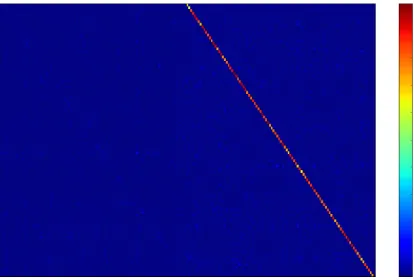
Figure 1: Weight matrix ofRNN.
sults are comparable. These results demonstrate the effectiveness of using a different weight matrix for each relation of compositions.
4.5 What the Learned Weight Matrices Look Like
To explore whyRelfuncoutperformsRNN, we visu-alize the weight matrices learned by the two models in Figures 1 and 2. In the figures, the left side (split by the center) presents the weights for the left word. The right side presents weights for the right word. The smaller a weight value in the matrix is, the dim-mer the element is visualized; the larger a weight value is, and the brighter the element is visualized.
Figure 1 visualizes the weight matrix trained by RNN. The diagonal elements in the left and right sides tend to be larger than the non-diagonal ele-ments. This fact indicates that thei-th elements of input word vectors most strongly influence thei-th element of a phrase vector. The diagonal elements of the right side are brighter than those of the left side, which implies thatRNNtreats a right word as more important than a left word in semantic compo-sitions. That implication is reasonable because the right word is usually the head of the phrase and is therefore more important. However, such is not al-ways the case. For example, in subject–predicate constructions, the subject should be regarded as be-ing as important as the predicate. TheRNNmodel cannot manage such cases.
(a) adjective modification (amod) (b) compound noun (nn)
(c) subject-predicate (nsubj) (d) determiner-noun (det)
Figure 2: Weight matrices ofRelfunc.
the weight matrices are learned differently depend-ing on syntactic dependency relations. In the matrix for adjective modification, for example, the elements of the right diagonal tend to be larger than those of the left, which reflects a tendency by which a modi-fied word (right word) is more important than a mod-ifier (left word); yet, the left diagonal is assigned reasonably large weight compared with that of the
RNNweight matrix. Different types of constructions
require different weight biases. Subject–predicate constructions, for example, assign more weight on the left diagonal.
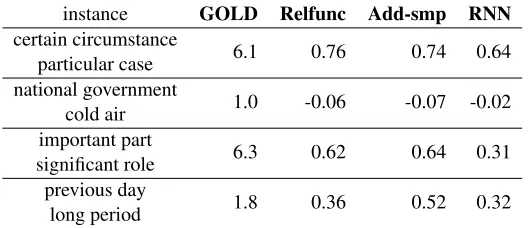
Next we examine the effects of this difference us-ing examples. Table 4 presents examples of simi-larity scores assigned by human judgment (averaged human-similarity scores) and those given by three
models: Relfunc,Add-smp, and RNN. For the first
two examples, the three models estimate the simi-larity almost equally well. For the third example, important part and significant role, RNN fails to
express that they are quite similar. This might be
true becauseRNNassigns too much weight to head
words,partandrole, and loses the information given
by their modifiers.
The fourth examples,previous day andlong
pe-riod, show the importance of learning the proper
bal-ance of weights between the left and right words. Add-smp overestimates the similarity between the
two phrases whereasRelfuncandRNNappropriately
and specifically examines the difference between the
head words,dayandperiod.
We have specifically addressed only the weights of the diagonal elements. However, it should also be noted that the diagonal elements play non-negligible roles as demonstrated by the performance
gain betweenRelfuncandRelfunc-cadd(see Table
Table 4: Examples of human-similarity and co-similarity of three models. instance GOLD Relfunc Add-smp RNN
certain circumstance
particular case 6.1 0.76 0.74 0.64 national government
cold air 1.0 -0.06 -0.07 -0.02 important part
significant role 6.3 0.62 0.64 0.31 previous day
long period 1.8 0.36 0.52 0.32
5 Conclusion and Future Work
As presented in this paper, we described the prop-erties of the previous methods: the expressive power, the recursivity, and the difficulty of train-ing. To investigate the impact on these properties, we reimplemented these models and conducted a human-correlation experiment, which demonstrated the state-of-the-art performance ofRelfuncand the usefulness of the syntactic information in composi-tion. Moreover, learned weight matrices suggest that compositions require different calculations based on their linguistic properties. In future studies, we will extend this work to examine the goodness of models when they compose phrases consisting of three or more words. We will address this problem for tasks of paraphrase detection or entailment recognition.
Acknowledgments
This study was partly supported by Japan Society for the Promotion of Science (JSPS) KAKENHI Grant No. 23240018 and Japan Science and Technology Agency (JST).
References
Marco Baroni, Silvia Bernardini, Adriano Ferraresi, and Eros Zanchetta. 2009. The wacky wide web: a collection of very large linguistically processed web-crawled corpora. Language Resources and Evalua-tion, 43(3):209–226.
Marco Baroni, Raffaella Bernardi, Ngoc-Quynh Do, and Chung-chieh Shan. 2012. Entailment above the word level in distributional semantics. InProceedings of the 13th Conference of the European Chapter of the
As-sociation for Computational Linguistics (EACL ’12), pages 23–32.
Yoshua Bengio, R´ejean Ducharme, Pascal Vincent, and Christian Janvin. 2003. A neural probabilistic lan-guage model.Journal of Machine Learning Research, 3:1137–1155.
William Blacoe and Mirella Lapata. 2012. A compari-son of vector-based representations for semantic com-position. InProceedings of the 2012 Joint Conference on Empirical Methods in Natural Language Process-ing and Computational Natural Language LearnProcess-ing (EMNLP-CoNLL ’12’), pages 546–556.
John A. Bullinaria and Joseph P. Levy. 2007. Extract-ing semantic representations from word co-occurrence statistics: A computational study. Behavior Research Methods, 39(3):510–526.
Ronan Collobert and Jason Weston. 2008. A unified architecture for Natural Language Processing: Deep neural networks with multitask learning. In Proceed-ings of the 25th International Conference on Machine Learning (ICML ’08), pages 160–167.
Georgiana Dinu, Nghia The Pham, and Marco Baroni. 2013. General estimation and evaluation of compo-sitional distributional semantics models. In Proceed-ings of the ACL 2013 Workshop on Continuous Vec-tor Space Models and their Compositionality (CVSC 2013), pages 50–58.
John Duchi, Elad Hazan, and Yoram Singer. 2011. Adaptive subgradient methods for online learning and stochastic optimization. J. Mach. Learn. Res., 12:2121–2159, July.
Katrin Erk and Sebastian Pad´o. 2008. A structured vec-tor space model for word meaning in context. In Pro-ceedings of the 2008 Conference on Empirical Meth-ods in Natural Language Processing (EMNLP 2008), pages 897–906.
John R. Firth. 1957. Papers in Linguistics 1934-51. Ox-ford University Press.
Gottlob Frege. 1892. On sense and reference. InLudlow
(1997), pages 563–584.
Emiliano Guevara. 2010. A regression model of adjective-noun compositionality in distributional se-mantics. In Proceedings of the 2010 Workshop on GEometrical Models of Natural Language Semantics
(GEMS ’10), pages 33–37.
S. Kirkpatrick, C. D. Gelatt, and M. P. Vecchi. 1983. Optimization by simulated annealing. Science, 220(4598):671–680.
John Langford, Lihong Li, and Tong Zhang. 2008. Sparse online learning via truncated gradient. CoRR, abs/0806.4686.
Ryan McDonald, Keith Hall, and Gideon Mann. 2010. Distributed training strategies for the structured per-ceptron. InHuman Language Technologies: The 2010 Annual Conference of the North American Chapter of
the Association for Computational Linguistics, pages
456–464.
Tomas Mikolov, Ilya Sutskever, Kai Chen, Greg S Cor-rado, and Jeff Dean. 2013. Distributed representations of words and phrases and their compositionality. In
Advances in Neural Information Processing Systems
26 (NIPS 2013), pages 3111–3119.
Jeff Mitchell and Mirella Lapata. 2008. Vector-based models of semantic composition. InProceedings of
ACL-08: HLT, pages 236–244.
Jeff Mitchell and Mirella Lapata. 2010. Composition in distributional models of semantics.Cognitive Science, 34(8):1388–1429.
Andriy Mnih and Koray Kavukcuoglu. 2013. Learning word embeddings efficiently with noise-contrastive es-timation. InAdvances in Neural Information
Process-ing Systems 26 (NIPS 2013), pages 2265–2273.
Sam Roweis. 1998. EM algorithms for PCA and SPCA.
In Neural Information Systems 10 (NIPS’97), pages
626–632.
David E. Rumelhart, Geoffrey E. Hinton, and Ronald J. Williams. 1988. Neurocomputing: Foundations of research. chapter Learning Representations by Back-propagating Errors, pages 696–699. MIT Press, Cam-bridge, MA, USA.
Richard Socher, Cliff C. Lin, Andrew Y. Ng, and Christo-pher D. Manning. 2011. Parsing Natural Scenes and Natural Language with Recursive Neural Networks.
InProceedings of the 26th International Conference
on Machine Learning (ICML).
Richard Socher, Brody Huval, Christopher D. Manning, and Andrew Y. Ng. 2012. Semantic compositional-ity through recursive matrix-vector spaces. In Pro-ceedings of the 2012 Joint Conference on Empirical
Methods in Natural Language Processing and
Com-putational Natural Language Learning, pages 1201–
1211.
Richard Socher, John Bauer, Christopher D. Manning, and Andrew Y. Ng. 2013a. Parsing With Composi-tional Vector Grammars. InACL.
Richard Socher, Danqi Chen, Christopher D. Manning, and Andrew Ng. 2013b. Reasoning with neural ten-sor networks for knowledge base completion. In
Ad-vances in Neural Information Processing Systems 26,
pages 926–934.
Richard Socher, Andrej Karpathy, Quoc V. Le, Christo-pher D. Manning, and Andrew Y. Ng. 2014. Grounded compositional semantics for finding and de-scribing images with sentences.TACL, 2:207–218. Yoshimasa Tsuruoka, Jun’ichi Tsujii, and Sophia
Ana-niadou. 2009. Stochastic gradient descent training for l1-regularized log-linear models with cumulative penalty. InProceedings of the Joint Conference of the 47th Annual Meeting of the ACL and the 4th Interna-tional Joint Conference on Natural Language
Process-ing of the AFNLP: Volume 1, ACL ’09, pages 477–485.
Association for Computational Linguistics.
Peter D. Turney and Patrick Pantel. 2010. From fre-quency to meaning: Vector space models of semantics.
Journal of Artificial Intelligence Research, 37(1):141–
188.
Derek York. 1966. Least-squares fitting of a straight line.
Canadian Journal of Physics, 44(5):1079–1086.
Fabio Massimo Zanzotto, Ioannis Korkontzelos, Francesca Fallucchi, and Suresh Manandhar. 2010. Estimating linear models for compositional dis-tributional semantics. In Proceedings of the 23rd International Conference on Computational