559
Multi-level analysis and recognition of the text sentiment on the example
of consumer opinions
Jan Koco ´n
Wrocław University of Science and Technology
Wrocław, Poland
jan.kocon @pwr.edu.pl
Monika Za´sko-Zieli ´nska
University of Wrocław Institute of Polish Studies
Wrocław, Poland
monika.zasko-zielinska @uwr.edu.pl
Piotr Miłkowski
Wrocław University of Science and Technology
Wrocław, Poland
piotr.milkowski @pwr.edu.pl
Abstract
In this article, we present a novel multi-domain dataset of Polish text reviews, an-notated with sentiment on different lev-els: sentences and the whole documents. The annotation was made by linguists in a 2+1 scheme (with inter-annotator agree-ment analysis). We present a preliminary approach to the classification of labelled data using logistic regression, bidirec-tional long short-term memory recurrent neural networks (BiLSTM) and bidirec-tional encoder representations from trans-formers (BERT).
1 Introduction
Linguistic research on sentiment recognition in-volves two approaches: from the perspective of analysing the occurrence of emotional words and from the perspective of the entire document. The first attempt is usually a consequence of the cre-ation of the sentiment lexicon, e.g. manual anno-tation of the WordNet (Baccianella et al., 2010). The second results from the analysis of the spe-cific text content in which we see that the senti-ment of a word or phrase changes under the in-fluence of the surrounding context (Taboada et al.,
2008). This change may vary depending on the domain of the text. As a research material for our research we have chosen online customer reviews from four domains:
• S–School– students’ reviews on the lectur-ers1,
• M – Medicine – patients’ opinions on doc-tors2,
1
https://polwro.pl/
2https://www.znanylekarz.pl/
• H–Hotels– customer reviews of hotels3,
• P – Products – buyers’ opinions on prod-ucts4.
In the introduction we focus mainly on the influ-ence of discourse on the classification of the doc-ument sentiment. We only briefly present an ap-proach based on the analysis of emotional words. The rest of the article concerns the description of the corpus used in our analysis, guidelines for the description of the text with sentiment for annota-tors, the results of the pilot stage of annotation, the proper annotation and experiments with automatic recognition of the text polarity.
2 Related work
One approach for recognising polarity of text is to use a dictionary of emotional words – senti-ment lexicons, e.g. WordNet annotated with po-larity (Kamps et al.,2004;Takamura et al.,2005) and emotions (Janz et al.,2017). Usually the task is to determine the number of occurrence of such words with a specific polarity in the text or use a simple bag of words method (Wang and Manning,
2012). Such a solution has a number of limita-tions: simple methods cannot cope with irony, sar-casm, negation and more complex text structures that modify the sound of the words that make them up (Wallace et al.,2015).
The second method of analysing text polarity is examination of the sentence level with evaluating each sentence in isolation. This procedure can be supported by the external corpus of labelled sen-tences (Pang and Lee,2004;Wilson et al.,2005). Nevertheless, even within one sentence we can sometimes observe several features of the anal-ysed entity and each of them can be assessed
dif-3
https://pl.tripadvisor.com/
ferently. It is advantageous in opinion mining to
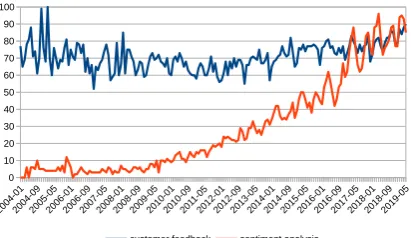
2004-012004-092005-052006-012006-092007-052008-012008-092009-052010-012010-092011-052012-012012-092013-052014-012014-092015-052016-012016-092017-052018-012018-092019-05
authentic material provided online by students as a final assessment of the course in each subject. Each text was manually annotated by two anno-tators: a psychologist and a linguist, who worked accordingly to the general guidelines. In the pilot project we decided to deal with sentiment annota-tion of the whole text. In the sentiment annotaannota-tion we used the same set of tags which is applied in
plWordNet 3.0 emo(Za´sko-Zieli´nska et al.,2015;
Janz et al., 2017) to lexical units: [+m] – strong positive, [+s] – weak positive, [-m] – strong nega-tive, [-s] – weak neganega-tive, [amb] – ambiguous, [0] – neutral.
We used amb tag but we understood it differ-ently. In annotation of lexical units in WordNet with sentiment amb indicated the possibility that units can be positive or negative in various con-texts. Hence, in text sentiment analysis we as-sumed thatambdenotesambiguouspolarity, thus the entire text cannot be clearly described by using neither positive nor negative annotation.
In the annotation we focused primarily on the strategic places in the text. In a customer review these places are the opening and closing sentences, namely the text frame. The beginning consists of the general opinion of the author on the subject of the evaluation and the end includes the author’s recommendation to the recipients. The annota-tors created their first general evaluation based on these two segments. In the body of the review, the authors have only subtly changed these opinions. Regardless of the modification of the main opinion in the text, we did not use the ambtag when the text frame was unambiguously positive. The text frame polarity was influenced not only by lexical content but also nonverbal elements, e.g. emoti-cons or multiplication of punctuation marks.
3.1 An attempt to annotate aspects
The analysis of the content of customer reviews in our pilot project consisted of two stages: the selec-tion of text blocks describing separate aspects and their annotation. Some parts of the text were not of an argumentative nature that could justify the au-thor’s decision to polarise the text. They included: advice (e.g. how to sign up for lectures) or general information on lectures, duration of classes, etc.
The main stage of our project was conducted based on text corpus consisting of consumer re-views (80% of texts) and texts from the corre-sponding domain with high probability of neutral
polarity (20% of texts). We observed that the value of inter-annotator agreement in aspect annotation task was very low, below 15% of Positive Spe-cific Agreement, PSA (Hripcsak and Rothschild,
2005).
3.2 New annotation guidelines
In the main stage of the project we decided to an-notate the sentiment for the whole text (a meta
level) and thesentencelevel. We assumed that this strategy allows to establish the acceptable value of PSA. We followed the rule that the meta an-notation results partially from sentence annota-tions, however the frame polarity is the main fac-tor for the final meta annotation. We have pre-pared the following rules of annotation, regardless of whether the entire text or sentence is annotated:
• SP – strong positive – entirely positive;
• WP – weak positive – generally positive, but there are some negative aspects;
• 0 – neutral;
• WN – weak negative – generally negative, but there are some positive aspects;
• SN – strong negative – entirely negative;
• AMB – ambiguous – there are both positive and negative aspects in the text that are bal-anced in terms of relevance.
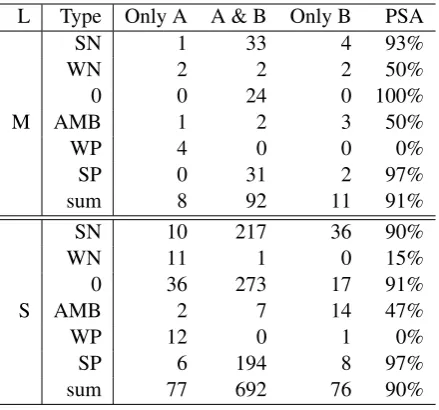
Table 1 shows the value of Positive Specific Agreement (Hripcsak and Rothschild, 2005) ob-tained for a random sample of 111 documents fromMedicinecategory.
4 Multi-level sentiment recognition
We selected three different classifiers for the recognition tasks:
• logistic regression (fastText) providing a baseline for text classification (Joulin et al.,
2017)
• bidirectional long short-term memory recur-rent network in two variants:
– using word vector representations only – using the same vectors extended with
L Type Only A A & B Only B PSA
M
SN 1 33 4 93%
WN 2 2 2 50%
0 0 24 0 100%
AMB 1 2 3 50%
WP 4 0 0 0%
SP 0 31 2 97%
sum 8 92 11 91%
S
SN 10 217 36 90%
WN 11 1 0 15%
0 36 273 17 91%
AMB 2 7 14 47%
WP 12 0 1 0%
SP 6 194 8 97%
sum 77 692 76 90%
Table 1: Annotation agreement between two experts (A and B) at the level (L) of text (meta – M) and sentence (S) for a sample of 111 documents using Positive Specific Agreement metric, PSA (Hripcsak and Rothschild,2005).
• bidirectional encoder representations from transformers (BERT) with addition of se-quence classification layer
We trained logistic regression model using pre-trained vectors for Polish language (Koco´n and Gawor, 2018). This approach is much faster in both training and testing than deep learning classi-fiers (Joulin et al.,2017), however, it has disadvan-tage which comes from not sharing parameters by features and classes, therefore overall result can be highly influenced by keywords with bigger class relativity.
BiLSTM on the other side takes into considera-tion not just words but full text fragment and bas-ing on learnt patterns predicts potential outcome. Texts are divided into tokens and converted to cor-responding word embedding vectors generated by fastText (Bojanowski et al.,2017), in this form it is possible to use it as input for neural network. Dimension of used vectors is equal to 300, there-fore it must be reflected in the input shape. As a loss function for training a categorical crossen-tropy was chosen. Model prepared for the task consists of the following layers:
• Gaussian noise layer with standard devia-tion of 0.01 accepting as input shape up to 128 words with vector matrix for each word of size 300, therefore overall input shape is (128, 300)
• Bidirectional layer with LSTM instances
(consisting of 1,024 hidden units using hy-perbolic tangent activation method) merged with concatenation
• Dropout layer with dropout ratio equal to 0.2
• Dense layer with number of outputs repre-senting number of all possible labels (6 in our task) using normalised exponential function (softmax) activation
BERT was designed to provide pre-trained deep bidirectional representations conditioning left and right context (Devlin et al.,2018), there-fore it achieves best performance on text frag-ments instead of single sentences. It’s ar-chitecture allows to fine-tune these represen-tations by adding one additional output layer which suits needs of specified task. For our task as a pre-trained model BERT-Base, Multilingual Cased6 was selected, which consists of 104 languages and 110M parameters,
and BertForSequenceClassification7
as a BERT classifier extended for multi-class clas-sification.
4.1 Embedding vector extension
Basing on the data accommodated in plWord-Net emo (Za´sko-Zieli´nska et al., 2015) we pre-pared the dictionary for all annotated lexical units and all possible levels of sentiment. Due to the lack of word sense disambiguation method, we grouped the sentiment annotations by lemmas. The final dictionary consists of a set of lemmas with assigned numbers representing the propor-tions of individual sentiment annotapropor-tions, sum-ming up to 1, e.g. for a lemmaakademicki(Eng.
academic) there were 11 annotations: 3 neutral, 4 generally negative, 3 generally positive and 1 en-tirely positive. Therefore arbitrary values for word "akademicki" are:
• entirely positive = 0.0909
• generally positive = 0.2727
• neutral = 0.2727
• generally negative = 0.3636
• entirely negative = 0.0000
6https://github.com/google-research/
bert
7https://github.com/huggingface/
• ambivalent = 0.0000
Using the described dictionary we have pro-posed additional variant of BiLSTM classifier with a word embedding vector extended with the val-ues of sentiment for the lemma of the word from a prepared sentiment dictionary. Lemmas were re-trieved during a preparation of the input data us-ing WCRFT part-of-speech tagger (Radziszewski,
2013). Therefore, in this approach the input word vector dimension was extended with 6 values rep-resenting sentiment of the word. The final dimen-sion of the word embedding increased from 300 to 306.
5 Evaluation
As in article (Koco´n et al.,2019), three variants of evaluation of the sentiment classification methods were prepared. The basic variant is a single do-main in which the classifier is trained, tuned and tested on a set of texts from one domain. The next variant includes an analysis of the ability of the classifier to model the sentiment of the text on a level independent of the domain of the text. For this purpose, we take all available texts except the texts from the selected domain. Then the texts are divided into a training and a validation set. Test-ing of the model takes place on a test set from a selected domain, not taken into account at the stage of preparing the training and validation set. The third test variant allows to examine the clas-sifiers in order to generalise the task of sentiment analysis in all available domains. For this purpose, texts from all domains are treated as one set, which is randomly divided into train, validation and test sets. Summary of the different types of evaluation:
• SD–Single Domain– evaluation sets created using elements from the same domain,
• DO–Domain Out– train/dev sets created us-ing elements from 3 domains, test set from the remaining domain,
• MD–Mixed Domains– evaluation sets ran-domly selected from elements belonging to all domains.
Due to the fact that the data are annotated both at the level of the whole text and at the level of each sentence, asentence ortextmay be anelementin the above list. We useSDT, DOT, andMDTfor
textevaluation types andSDS,DOS, andMDSfor
sentence evaluation types. We use also prefixes of domains (Hotels, Medicine, School, Products) as suffixes for SD* andDO* variants, e.g. SDS-H is a single domain evaluation type performed on sentences withinhotelsdomain, whereas DOT-M is a domain-out evaluation type performed on texts trained on texts outsidemedicinedomain and tested on texts from that domain.
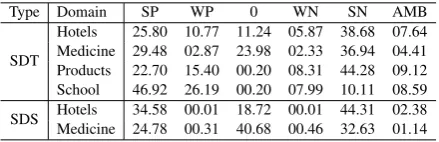
Table2shows the number of texts and sentences annotated by linguists for all evaluation types, with division into the number of elements within training, validation and test sets. Linguists anno-tated a total of 8,450 texts from four domains (ho-tels, medicine, products, school) and 35,789 sen-tences from two domains (hotels, medicine). The distribution of labels within each domain for texts and sentences is presented in Table3. Average an-notated text length in each domain are as follows: 788 characters in hotels, 802 in medicine, 781 in products and 442 in school.
Type Domain Train Dev Test SUM
SDT
Hotels 2534 316 316 3166
Medicine 2650 330 330 3310
Products 790 98 98 986
School 792 98 98 988
DOT
!Hotels 4756 528 - 5284
!Medicine 4635 514 - 5149
!Products 6727 746 - 7473
!School 6725 746 - 7471
MDT All 6771 846 845 8462
SDS Hotels 12434 1554 1553 15541
Medicine 16200 2024 2024 20248
DOS !Hotels 16200 2024 - 18224
!Medicine 12434 1554 - 13988
MDS All 28581 3572 3571 35724
Table 2: The number of texts/sentences for each evaluation type in train/dev/test sets.
Type Domain SP WP 0 WN SN AMB
SDT
Hotels 25.80 10.77 11.24 05.87 38.68 07.64 Medicine 29.48 02.87 23.98 02.33 36.94 04.41 Products 22.70 15.40 00.20 08.31 44.28 09.12 School 46.92 26.19 00.20 07.99 10.11 08.59
SDS Hotels 34.58 00.01 18.72 00.01 44.31 02.38 Medicine 24.78 00.31 40.68 00.46 32.63 01.14
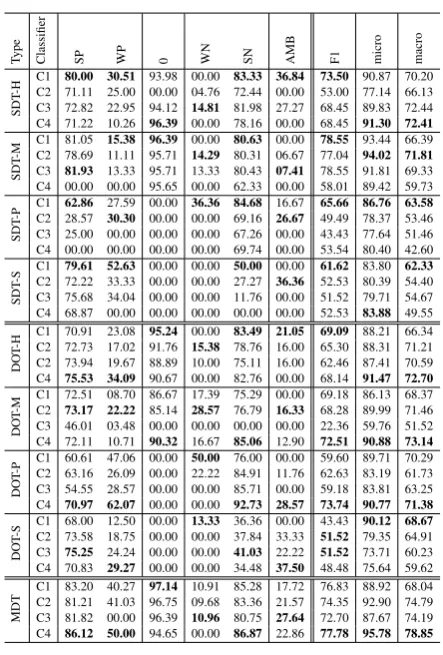
BERT’s performance is below the expectations of this advanced method. Looking at both tables (4
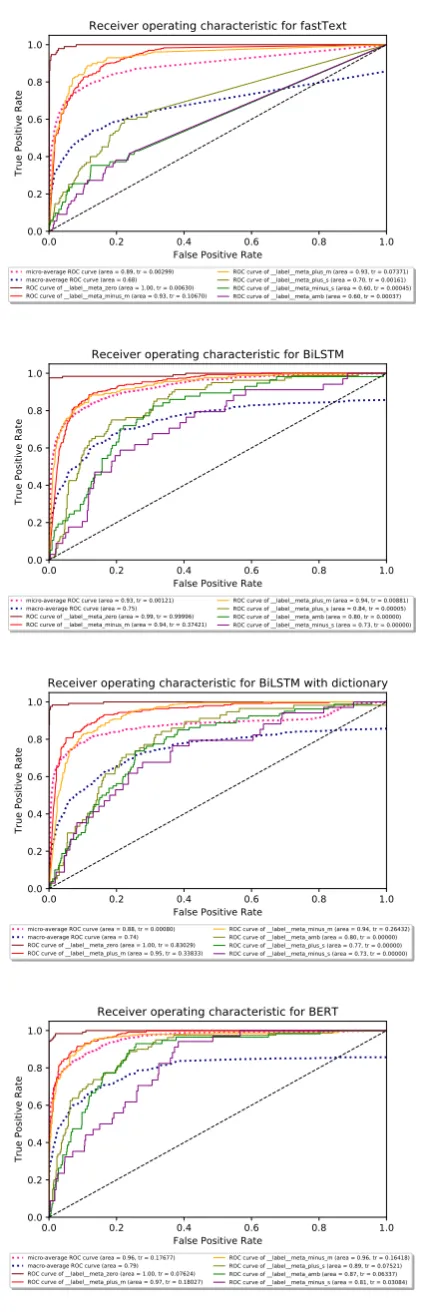
and5), BERT’s results are the best in 19 out of 69 label-specific cases, which is exactly as many as fastText was. BiLSTM outperformed other meth-ods in 31 cases. Adding an external sentiment dictionary helped only in 14 label-specific cases. BERT dominance is observed in DOT and MDT cases, especially when analysing general metric values, where the predominance of the method is visible in 11 out of 15 cases. The advantage is repeated for MDS but not for DOS. MDT case is the most promising in terms of the further use of the recognition method in applications such as brand monitoring or early crisis detection. Fig-ure2shows the ROC curves (Meistrell,1990) for this case. The values of the general F1, micro AUC and macro AUC are the highest for the BERT method (see Table2).
We plan to publish the data created as part of the presented works on an open license soon. We also intend to test the contextualized embedding that we are currently building using the ELMo deep word representations method (Peters et al.,2018), with the use of the large KGR10 corpus presented in work (Koco´n et al.,2019). We also want to train the basic BERT model with the use of KGR10 to investigate whether it will improve the quality of sentiment recognition. It is also very interesting to use the propagation of sentiment annotation in WordNet (Koco´n et al.,2018a,b), to increase the coverage of the sentiment dictionary and to po-tentially improve the recognition quality as well. This objective can be achieved by other complex methods such as OpenAI GPT-2 (Radford et al.,
2019) and domain dictionaries construction meth-ods utilising WordNet (Koco´n and Marci´nczuk,
2016).
Acknowledgements
Co-financed by the Polish Ministry of Educa-tion and Science, CLARIN-PL Project and by the National Centre for Research and Development, Poland, grant no POIR.01.01.01-00-0472/16 –
Sentimenti8.
References
Stefano Baccianella, Andrea Esuli, and Fabrizio Sebas-tiani. 2010. Sentiwordnet 3.0: an enhanced lexical
8http://w3a.pl/projekty/
Maite Taboada, Kimberly Voll, and Julian Brooke. 2008. Extracting sentiment as a function of dis-course structure and topicality. Simon Fraser Uni-veristy School of Computing Science Technical Re-port.
Hiroya Takamura, Takashi Inui, and Manabu Okumura. 2005. Extracting semantic orientations of words us-ing spin model. In Proceedings of the 43rd An-nual Meeting on Association for Computational Lin-guistics. Association for Computational Linguistics, pages 133–140.
Amos Tversky and Daniel Kahneman. 1989. Ratio-nal choice and the framing of decisions. InMultiple Criteria Decision Making and Risk Analysis Using
Microcomputers, Springer, pages 81–126.
Byron C Wallace, Eugene Charniak, et al. 2015. Sparse, contextually informed models for irony de-tection: Exploiting user communities, entities and sentiment. InProceedings of the 53rd Annual Meet-ing of the Association for Computational LMeet-inguistics and the 7th International Joint Conference on
Natu-ral Language Processing (Volume 1: Long Papers).
volume 1, pages 1035–1044.
Fei Wang, Yunfang Wu, and Likun Qiu. 2012. Ex-ploiting discourse relations for sentiment analysis.
Proceedings of COLING 2012: Posterspages 1311–
1320.
Sida Wang and Christopher D Manning. 2012. Base-lines and bigrams: Simple, good sentiment and topic classification. In Proceedings of the 50th annual meeting of the association for computational
lin-guistics: Short papers-volume 2. Association for
Computational Linguistics, pages 90–94.
Theresa Wilson, Janyce Wiebe, and Paul Hoffmann. 2005. Recognizing contextual polarity in phrase-level sentiment analysis. InProceedings of Human Language Technology Conference and Conference on Empirical Methods in Natural Language Pro-cessing.
Monika Za´sko-Zieli´nska, Maciej Piasecki, and Stan Szpakowicz. 2015. A large wordnet-based senti-ment lexicon for polish. In Proceedings of the In-ternational Conference Recent Advances in Natural
Language Processing. pages 721–730.
Peng Zhou, Wei Shi, Jun Tian, Zhenyu Qi, Bingchen Li, Hongwei Hao, and Bo Xu. 2016. Attention-based bidirectional long short-term memory net-works for relation classification. InProceedings of the 54th Annual Meeting of the Association for
Com-putational Linguistics (Volume 2: Short Papers).