A Statistical Model for Measuring Structural Similarity between
Webpages
Zhenisbek Assylbekov, Assulan Nurkas, Inês Russinho Mouga
School of Science and Technology Nazarbayev University
53 Kabanbay batyr ave., Astana, Kazakhstan
{zhassylbekov, anurkas, ines.russinho}@nu.edu.kz
Abstract
This paper presents a statistical model for measuring structural similarity between webpages from bilingual websites. Start-ing from basic assumptions we derive the model and propose an algorithm to esti-mate its parameters in unsupervised man-ner. Statistical approach appears to bene-fit the structural similarity measure: in the task of distinguishing parallel webpages from bilingual websites our language-independent model demonstrates an F-score of 0.94–0.99 which is comparable to the results of language-dependent methods involving content similarity measures.
1 Introduction
A parallel corpus is a collection of text with trans-lations into another language. Such corpora plays an important role in machine translation and multi-lingual language retrieval. Unfortunately, they are not readily available in the necessary quantities: some of them are subject to subscription or license fee and thus are not freely available, while others are domain-specific. However, there is the World Wide Web, which can be considered as one of the largest sources of parallel corpora, since there are many websites which are available in two or more languages. Many approaches have been therefore proposed for trying to exploit the Web as a parallel corpus: STRAND (Resnik and Smith, 2003), PT-Miner (Chen and Nie, 2000), BITS (Ma and Liber-man, 1999), WPDE (Zhang et al., 2006), Bitextor (Esplà-Gomis and Forcada, 2010), ILSP-FC (Pa-pavassiliou et al., 2013), etc. For most of these mining systems, there is a typical strategy for min-ing parallel texts: (1) locate bilmin-ingual websites; (2) identify parallel web pages; (3) extract bitexts. For the step (2) three main strategies can be found in the literature – they exploit:
• similarities in URLs;
• structural similarity of HTML files;
• content-similarity of texts.
Measuring structural similarity of HTML files, which is the “heart of STRAND” architecture (Resnik and Smith, 2003), involves calculating some quantitative features of candidate webpages and then comparing them to manually chosen threshold values or embedding those features into machine learning algorithms. Such approaches do not take into account the intrinsic stochastic na-ture of the mentioned feana-tures, and they require su-pervised learning of the parameters for each given website/language. In this paper we develop a more refined language-independent technique for mea-suring structural similarity between HTML pages, which uses the same amount of information as pre-vious approaches, but is more accurate in distin-guishing parallelism of webpages and can be ap-plied in unsupervised manner.
2 Related Work
Measuring structural similarity between HTML files was first introduced in (Resnik, 1998), where a linearized HTML structure of candidate pairs was used to confirm parallelism of texts. Shi et al. (2006) used a file length ratio, an HTML tag similarity and a sentence alignment score to verify translational equivalence of candidate pages. Zhang et al. (2006) used file length ratio, HTML structure and content translation to traink -nearest-neighbors classifier for parallel pairs ver-ification. Esplà-Gomis and Forcada (2010) used text-language comparison, file size ratio, total text length difference for preliminary filtering and then HTML tag structure and text block length were used for deeper filtering. In (San Vicente and Manterola, 2012) the bitext detection module runs
parallel pair:
A∦:=Pr(w, m, n, l1, l2|∦)
=Pr(w, m, n|l1, l2,∦)Pr(l1, l2|∦) = =Pr(w|m, n, l1, l2,∦)Pr(m, n|l1, l2,∦)×
×Pr(l1, l2|∦) =
={independence assumptions}= =Pr(w|m, n∦)
| {z }
B∦
Pr(m, n|∦)
| {z }
C∦
Pr(l1, l2|∦)
| {z }
D∦
.
(11)
As discussed earlier, under non-parallelism we should assume probability of an alignment token to be removedq∦to be different fromq∥ and thus:
B∦=
( m+n
w )
qw
∦(1−q∦)m+n−w. (12)
Due to independence assumption betweenM and
N (2) under non-parallelism we have:
C∦=Pr(M =m|∦)·Pr(N =n|∦)
≈ {marginal pdf’s do not depend on∦}
≈pˆM(m)·pˆN(n). (13)
And, similarly, from (4) we have
D∦ =Pr(L1 =l1|∦)·Pr(L2 =l2|∦)
≈pˆL1(l1)·pˆL2(l2). (14)
Now, from (11), (12), (13) and (14) we obtain
A∦≈
( m+n
w )
q∦w(1−q∦)m+n−w
×pˆM(m)·pˆN(n)·pˆL1(l1)·pˆL2(l2). (15)
Our modelA∥(w,m,n,l1,l2;q∥,k,b,λ,µ1,2,
σ1,2,a,c,σ) has 11 parameters (q∥,k,b,λ,µ1,2,
σ1,2, a, c, σ), it receives the values of w, m, n,
l1, l2 as input, and outputs the probability to
ob-serve such values underparallelism. The model
A∦(w, m, n, l1, l2;q∦) has one parameter (q∦), it also receives the values ofw, m, n, l1 andl2 as input, and outputs the probability to observe such values undernon-parallelism. For the sake of sim-plicity we will denote
θ∥ = (q∥, k, b, λ, µ1,2, σ1,2, a, c, σ),
p∥ =Pr(∥).
3.3 Parameters Estimation
In order to show how expectation maximization (EM) algorithm (Dempster et al., 1977) can be used to estimate the parameters of our models let us assume that the set of candidate pairs consists of
spairs. Let us introduce the variables (fori= 1, s)
αi =
{
1, if ithpair is parallel 0, otherwise.
Then the likelihood function for our data is given by
L(q∥,∦, k, b, λ, µ1,2, σ1,2, σ, p∥) =
=C
s
∏
i=1
[A∥(xi;θ∥)p∥]αi×
×[A∦(xi;q∦)(1−p∥)]1−αi, (16)
where C = ∏si=1[Pr(xi)−1]is a constant w.r.t. parameters θ, q∦, and p∥. According to Lemma B.1, the likelihood (16) is maximized w.r.t{αi}if
αi =
1, ifA∥(xi;θ∥)p∥ >
> A∦(xi;q∦)(1−p∥),
0, otherwise.
(17)
The formula (17) is basically the decision rule for our task of binary classification of candidate pairs into parallel or non-parallel ones (assuming that we know the parameters ofA∥andA∦). Now the essence of the EM algorithm (Algorithm 1) can be described as follows.
We first initilize parameters on line 1 using the following reasoning:q∥should be less thanq∦due to the comment after (1); N should be approxi-mately equal toM for parallel pairs, therefore we take k = 1 and b = 0 as initial guesses; since we know almost nothing about the components of the Gaussian mixture in (3), we setλ = 0.5 and
µ1,2 = 0, however we can expect that one of the
components should be responsible for larger devi-ations from the mean (i.e. for heavy tails), and thus we setσ2> σ1; we choose initial values fora= 1,
c = 0andσ = √6.8 based on the suggestion in (Gale and Church, 1993), and forp∥ = 2/3based on the experiments in (Resnik and Smith, 2003).
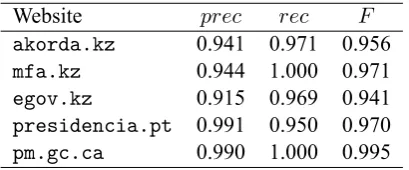
all websites exceptmfa.kz, for which we checked all pairs due to small amount of them). The met-rics used to evaluate our model have been precision (prec), recall (rec), and F-score (F). The results of the experiments are given in Table 2.
Website prec rec F
akorda.kz 0.941 0.971 0.956
mfa.kz 0.944 1.000 0.971
egov.kz 0.915 0.969 0.941
presidencia.pt 0.991 0.950 0.970
pm.gc.ca 0.990 1.000 0.995
Table 2: Results of the experiments
5 Discussion and Future Work
The experiments have shown that statistical mod-eling of misalignments in linearized HTML files allows us to get better results in the task of measur-ing structural similarity between webpages from bilingual websites. The previous approaches for measuring structural similarity were based on find-ing threshold values for the number of misalign-ments (W) or the misalignments ratio (MW+N), or using these characterisics as features in machine learning algorithms. Those approaches either led to high precision but low recall, or required super-vised learning of underlying models, or both. Our approach has good recall and acceptable precision rates; it is language-independent and the param-eters of our model are estimated in unsupervised manner through EM algorithm.
We have noticed that the suggested algorithm demonstrates higher precision for websites, which have good quality of translated texts in general (e.g.presidencia.pt), than for websites, which have worse quality of translation (e.g. egov.kz); but it keeps recall at good level in all cases. This means that the model tries not to throw away parallel pairs, but it sometimes fails to recognize non-parallelism for the websites with substantial amount of medium or low quality of translated texts.
We now address the typical errors made by the model as well as possible directions for the future work. Type II errors (false negatives) are mainly caused by the pairs which have the same (or al-most the same) content in two languages but there is significant difference in HTML-formatting of two pages (e.g. when <p> and </p> tags are used in one version to surround paragraphs, while
the other version uses a sequence of<br/><br/> tags to separate paragraphs). This problem could be handled by an appropriate pre-processing (nor-malizing) of the HTML files before applying the Algorithm 1. Type I errors (false positives) are primarily caused by the pairs which are consis-tent in HTML-formatting but have some differ-ences in content (e.g. when one or few sen-tences/short paragraphs are missing in one ver-sion but are present in the other verver-sion). This problem could be tackled by better alignment of text-chunks and better exploitation of the similar-ity in text lengths if we want to stay in a language-independent framework, or by embedding content-similarity measures, if we decide to switch to language-dependent techniques. In the latter case we could also use morphological segmentation as in (Assylbekov and Nurkas, 2014) for preprocess-ing texts in morphologically rich languages (like Kazakh), in order to improve the existing methods of measuring content-similarity.
Acknowledgments
We would like to thank Dr. Igor Melnykov for the useful discussions of the EM algorithm.
A Goodness-of-fit Tests forϵ
Let r.v.’s W, M, and N be defined as in Sec-tion 2, and letw,m, andndenote values of these r.v.’s. We downloaded candidate pairs from the official website of the President of the Republic of Kazakhstan located athttp://akorda.kzand then from each webpage we removed the boiler-plate, i.e. navigational elements, templates, and advertisements which are not related to the main content4. For each candidate pair we obtained val-ues ofw, m, and nusing a modified version5 of an open-source implementation of STRAND algo-rithm6. The following heuristic rule was used to keep seemingly parallel pairs:
{pages are parallel}≈
{ W
M+N ∈(0,0.2] }
∩
∩ {M ∈[19,200]} ∩ {N ∈[19,200]}. (18) A threshold value of 0.2 forW/(M+N)is rec-ommended by the authors of STRAND. Bound-aries for M andN are selected based on 1st and
4
the scripts as well as the candidate pairs are avail-able at https://svn.code.sf.net/p/apertium/svn/ branches/kaz-eng-corpora/akorda/
5https://github.com/assulan/STRANDAligner
50 100 150 200
50
100
200
M
N
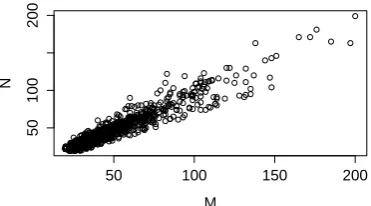
Figure 1: Scatter-plot of{(mi, ni)}for seemingly parallel pairs.
residuals
Frequency
−20 −10 0 10 20
0
40
80
120
Figure 2: Distribution of the residuals{ϵi}
99th percentiles and they are used to remove out-liers. Application of the rule (18) resulted in 1271 seemingly parallel pairs. We stress here that the rule (18)is not used in our paper as the decision rule regarding parallelism of pages. Instead, it al-lows us to quickly identify pages which seem to be parallel and to look at the behavior of theirM andN values. Figure 1 provides a scatter-plot of
{(mi, ni)}1271i=1 for the filtered set of pages and it
shows that the rule (18) supports our assumption on the linear relationship between M and N for parallel pages (2).
Next, we fit a linear regression model N =
kM +b+ϵto the data(mi, ni), and look at the residualsϵi =ni−kmi−b(Figure 2). Outliers among{ϵi}are dropped based on 1stand 99th per-centiles, which resulted in 1245 observations (in-stead of 1271).
Further on we show thatϵcan be modeled us-ing a Gaussian mixture model. A two-component
mixture of Gaussian distributions has a pdf
fGMM(x;λ, µ1, σ1, µ2, σ2) =
= √1
2π (
λ σ1e
−(x−µ1)2
σ21 +1−λ
σ2 e
−(x−µ2)2
σ22
)
(19)
We first find MLEλe, µe1, σe1, µe2, σe2for the param-eters in (19) using EM-algorithm (Dempster et al., 1977), and then test a hypothesis
H0 : fϵ(x) =fGMM(x;µe1, σ1e, µe2, σe2)
H1 : fϵ(x)̸=fGMM(x;µe1, σ1e, µe2, σe2),
using the chi-square goodness-of-fit test. The de-tails are provided in the Table 3, from where we decide not to rejectH0, i.e. there is no evidence that the residuals are not distributed according to (19). In other words, a Gaussian mixture model
does a good job in modelling{ϵi}.
Interval Obs. Freq. Exp. Freq.
(−∞,−19] 5 5.26
(−19,−16] 10 6.92
(−16,−14] 9 8.03
(−14,−12] 8 12.38
..
. ... ...
(12,14] 16 12.97
(14,16] 8 8.62
(16,19] 10 7.55
(19,+∞) 7 5.88
χ2 = 19.023, df = 19, p-value = 0.4554
Table 3: Fitting a Gaussian mixture model to{ϵi}
B Auxiliary Lemmas
Lemma B.1. Let f(α1, . . . , αn) =
∏n
i=1pαiiqi1−αi, where αi ∈ {0,1} and
pi, qi ∈ [0,1], i = 1, n. Then f reaches its
maximum at
αi =
{
1, ifpi > qi
0, otherwise (20)
Proof. The proof is left as an excercise.
Lemma B.2. Let X1, X2, . . . , Xm be indepen-dent binomial random variables with parameters
(n1, q),(n2, q), …,(nm, q)correspondingly. Then
the maximum likelihood estimator forqis
ˆ
q=
∑m
i=1Xi
∑m
i=1ni (21)
References
Zhenisbek Assylbekov and Assulan Nurkas. Ini-tial explorations in kazakh to english statistical machine translation. In The First Italian Con-ference on Computational Linguistics CLiC-it 2014, page 12, 2014.
Jiang Chen and Jian-Yun Nie. Automatic construc-tion of parallel english-chinese corpus for cross-language information retrieval. InProceedings of the sixth conference on Applied natural language processing, pages 21–28. Association for Com-putational Linguistics, 2000.
William G Cochran.Sampling techniques. John Wi-ley & Sons, 2007.
Arthur P Dempster, Nan M Laird, and Donald B Rubin. Maximum likelihood from incomplete data via the em algorithm. Journal of the royal statistical society. Series B (methodological), pages 1–38, 1977.
Miquel Esplà-Gomis and Mikel Forcada. Com-bining content-based and url-based heuristics to harvest aligned bitexts from multilingual sites with bitextor. The Prague Bulletin of Mathemat-ical Linguistics, 93:77–86, 2010.
William A Gale and Kenneth W Church. A pro-gram for aligning sentences in bilingual corpora.
Computational linguistics, 19(1):75–102, 1993.
Peter J Huber. Robust statistics. Springer, 2011.
James Wayne Hunt and MD MacIlroy.An algorithm for differential file comparison. Bell Laboratories, 1976.
Le Liu, Yu Hong, Jun Lu, Jun Lang, Heng Ji, and Jianmin Yao. An iterative link-based method for parallel web page mining. Proceedings of EMNLP, pages 1216–1224, 2014.
Xiaoyi Ma and Mark Liberman. Bits: A method for bilingual text search over the web. InMachine Translation Summit VII, pages 538–542, 1999.
Vassilis Papavassiliou, Prokopis Prokopidis, and Gregor Thurmair. A modular open-source fo-cused crawler for mining monolingual and bilin-gual corpora from the web. InProceedings of the Sixth Workshop on Building and Using Comparable Corpora, pages 43–51, 2013.
Philip Resnik. Parallel strands: A preliminary in-vestigation into mining the web for bilingual text. Springer, 1998.
Philip Resnik and Noah A Smith. The web as a parallel corpus.Computational Linguistics, 29(3): 349–380, 2003.
Inaki San Vicente and Iker Manterola. Paco2: A fully automated tool for gathering parallel cor-pora from the web. InLREC, pages 1–6, 2012.
Lei Shi, Cheng Niu, Ming Zhou, and Jianfeng Gao. A dom tree alignment model for mining parallel data from the web. InProceedings of the 21st Inter-national Conference on Computational Linguistics and the 44th annual meeting of the Association for Computational Linguistics, pages 489–496. Asso-ciation for Computational Linguistics, 2006.