Figure 1: Illustration of the questionnaire flow.
Figure 2: Position of the participants at the time they were doing replication experiments.
Figure 3: Position of the participants at the time of the survey.
Figure 4: Importance of Replication in General.
Figure 6: Results achieved when trying to repli-cate own work.
Figure 7: Participants who tried to replicate some-one elses work.
Figure 8: Results achieved when replicating some-one elses work.
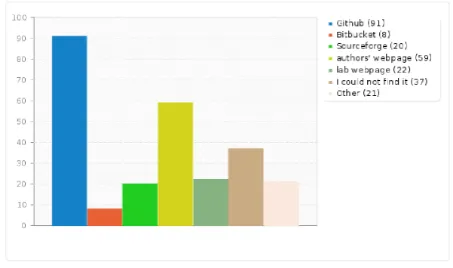
which does not guarantee availability beyond that person maintaining his/her webpage. More than 14% of the answers report that the code could not be found. Data is also primarily published vi-a GitHub or personvi-al webpvi-ages (25% vi-and 25.7% of the answers respectively). 11.1% report that the material used for the experiments could not be found. Parametersfor experiments are primarily found in the respective publications (40.3% of the answers), while 21.9% of the answers state they could be found on GitHub as well. 13.7% report that they could not find parameters at all. Fig-ure9illustrates the absolute numbers concerning the availability of code, while Figure10and Fig-ure11illustrate them for other resources and pa-rameters respectively.
Figure 9: Sources for Accessing the Code for replication.
Figure 10: Sources for Accessing Data and other Resources.
Figure 11: Sources for Accessing Parameters for Replication.
In our survey, 40% of the participants report that they tried to get in touch with the authors (see Figure12), but only in about 30% of the report-ed cases receivreport-ed a helpful answer (164 answers received, as 41 participants gave more than one answer). Approximately 20.1% mention that un-helpful answers were received and almost 23.8% never received any answer. Due to evolution of careers, 13.4% found out that the person had left the lab or the e-mail bounced, resulting in almost 40% of examples where authors were unreachable (see Figure13).
Figure 12: Participants who state that they reached out to original authors.
5 Discussion
The survey results suggest that replicability is perceived as an important issue by a majority of responses (≥ 60%). It is difficult to compute an accurate response rate for the survey, because we do not know the extent of the population com-prised by subscribers to the mailing lists and pro-fessional networks that we reached out to. How-ever, if we approximate the target population us-ing the average participation in a *ACL
confer-Figure 13: Quality of Answers by original authors.
ence (N=1,000), we can estimate the response rate at about 20%. This has previously been described as an “acceptable” response rate for online sur-veys.10 While the responding population includes researchers with a wide range of seniority as well as members of academia and industry, it could be biased by their interest in replication. The result-s, and especially the commentresult-s, indicate that this is most likely not the case as some participants do not see the value in replicating previous results. They state that replicating previous work is only an “exercise” and actually an “overload” on the already busy researchers’ schedule. One commen-t scommen-tacommen-tes commen-thacommen-t“10 year old systems are irrelevant”
and“ML is moving so fast”, which renders repli-cability studies essentially worthless. This could explain why the two largest groups performing replicability studies are on PhD or PostDoc level.
What does this mean for replicability? Re-sponses indicate a variety of views on how repli-cability should be facilitated. One comment s-tates that there is already a culture of sharing and publishing data and code and this should be e-nough. Another participant states that in industrial research publishing data or code is difficult, but suggests that the validity of an approach can be proven by applying the method to other data and in reaching the same general conclusions. Some participants support the idea of giving more visi-bility to replicavisi-bility by making it a prominent top-ic at major conferences and by enforcing reporting guidelines towards reproducibility.
Some participants mention that replicability is crucial to be taken seriously as a scientific field, even stating that the field is “suspect” if replication fails. One participant suggests that “every paper
10
Conference on Computational Linguistics Gothen-burg, Sweden, 22–24 May, 2017, pages 271–276. Association for Computational Linguistics.
Antske Fokkens, Marieke van Erp, Marten Postma, Ted Pedersen, Piek Vossen, and Nuno Freire. 2013. Off-spring from Reproduction Problems: What
Repli-cation Failure Teaches Us. In Proceedings of the
51st Conference of the Association for Computa-tional LinguisticsSofia, Bulgaria 4–9 August 2013, pages 1691–1701.
Tobias Horsmann and Torsten Zesch. 2017. Do LSTMs
really work so well for PoS tagging? – A replication
study. InProceedings of the 2017 Conference on
Empirical Methods in Natural Language
Process-ingCopenhagen, Denmark, September 9–11, 2017,
pages 727–736. Association for Computational Lin-guistics.
Adam Kilgarriff. 1999. 95% Replicability for Manual
Word Sense Tagging. InProceedings of the Ninth
Conference of the European Chapter of the Asso-ciation for Computational Linguistics (EACL-1999)
Bergen, Norway, 8–12 June, 1999. Association for Computational Linguistics.
Edison Marrese-Taylor and Yutaka Matsuo. 2017.
Replication issues in syntax-based aspect extraction
for opinion mining. InProceedings of the
Studen-t Research Workshop aStuden-t Studen-the 15Studen-th Conference of Studen-the European Chapter of the Association for Computa-tional LinguisticsValencia, Spain, April 3–7, 2017, pages 23–32. Association for Computational Lin-guistics.
Margot Mieskes. 2017. A Quantitative Study of Data
in the NLP community. InProceedings of the First
ACL Workshop on Ethics in Natural Language Pro-cessing, pages 1–7, Valencia, Spain. Association for Computational Linguistics.
Andrew Moore and Paul Rayson. 2018. Bringing
repli-cation and reproduction together with generalisabil-ity in NLP: Three reproduction studies for Target
Dependent Sentiment Analysis. InProceedings of
the 27th International Conference on Computation-al Linguistics Santa Fe, New Mexico, USA, Au-gust 20–26, 2018, pages 1132–1144. Association for Computational Linguistics.
Aur´elie N´ev´eol, K. Bretonnel Cohen, Cyril Grouin,
and Aude Robert. 2016. Replicability of Research
in Biomedical Natural Language Processing: a
pi-lot evaluation for a coding task. InProceedings of
the Seventh International Workshop on Health Tex-t Mining and InformaTex-tion Analysis Austin, Texas, November 5, 2016, pages 78–84. Association for Computational Linguistics.
Babatunde Kazeem Olorisade, Pearl Brereton, and Pe-ter Andras. 2017. Reproducibility of studies on text mining for citation screening in systematic reviews:
Evaluation and checklist. Journal of Biomedical
In-formatics, 73:1 – 13.
Ted Pedersen. 2008. Empiricism Is Not a Matter of
Faith.Computational Linguistics, 34(3):465–470.
Zainab Samaan, Lawrence Mbuagbaw, Daisy Kosa, Victoria Borg Debono, Rejane Dillenburg, Shiyuan Zhang, Vincent Fruci, Brittany Dennis, Monica
Ba-wor, and Lehana Thabane. 2013. A systematic
scop-ing review of adherence to reportscop-ing guidelines in
health care literature. Journal of Multidisciplinary
Healthcare, 6:169–88.
Sumithra Velupillai, Hanna Suominen, Maria Liaka-ta, Angus Roberts, Anoop D. Shah, Katherine Mor-ley, David Osborn, Joseph Hayes, Robert Stewart, Johnny Downs, Wendy Chapman, and Rina Dutta.
2018. Using clinical Natural Language Processing
for health outcomes research: Overview and
action-able suggestions for future advances. Journal of
Biomedical Informatics, 88:11 – 19.
Martijn Wieling, Josine Rawee, and Gertjan van No-ord. 2018.Squib: Reproducibility in Computational
Linguistics: Are We Willing to Share?