Improving Chunk-based Semantic Role Labeling with Lexical Features
Wilker Aziz, Miguel Rios and Lucia Specia Research Group in Computational Linguistics
University of Wolverhampton
Stafford Street, Wolverhampton, WV1 1SB, UK {w.aziz, m.rios, l.specia}@wlv.ac.uk
Abstract
We present an approach for Seman-tic Role Labeling (SRL) using Condi-tional Random Fields in a joint identifi-cation/classification step. The approach is based on shallow syntactic information (chunks) and a number of lexicalized fea-tures such as selectional preferences and automatically inferred similar words, ex-tracted using lexical databases and distri-butional similarity metrics. We use se-mantic annotations from the Proposition Bank for training and evaluate the system using CoNLL-2005 test sets. The addi-tional lexical information led to improve-ments of 15% (in-domain evaluation) and 12% (out-of-domain evaluation) on over-all semantic role classification in terms of F-measure. The gains come mostly from a better recall, which suggests that the addi-tion of richer lexical informaaddi-tion can im-prove the coverage of existing SRL mod-els even when very little syntactic knowl-edge is available.
1 Introduction
Identifying the relations that words or groups of words have with verbs in a sentence constitutes an important step for many applications in Natural Language Processing (NLP). This is addressed by the field of Semantic Role Labeling (SRL). SRL has been shown to contribute to many NLP appli-cations, such as Information Extraction, Question Answering and Machine Translation.
Most of the SRL approaches operate via two consecutive steps: i) the identification of the argu-ments of a target predicate and ii) the classification of those arguments (Gildea and Jurafsky, 2002; Pradhan et al., 2004). Alternatively, graph mod-els can rely on the sequential nature of the shallow
semantic parsing and perform both SRL steps si-multaneously (Roth and tau Yih, 2005; Cohn and Blunsom, 2005).
Features for SRL are usually extracted from chunks or constituent parse trees. While parse trees allow a set of very informative path-based, structural features, chunks can provide more re-liable annotations. Hacioglu et al. (2004) pro-pose the use of base phrases as data representation using Support Vector Machines in order to per-form a single argument classification step. Roth and tau Yih (2005) use the same sort of repre-sentation with Conditional Random Fields (CRF) as learning algorithm, motivated by the sequen-tial nature of the task. Cohn and Blunsom (2005) use CRF to perform SRL in a single identifica-tion/classification step based on features from con-stituent trees.
Pradhan et al. (2008) point out the lack of se-mantic features as the bottleneck in argument role classification, a task closely-related to that of word sense disambiguation. Shallow lexical features such as word forms and word lemmas are very sparse. Although named-entity categories have been proposed to alleviate this sparsity problem, they only apply to a fraction of the arguments’ words.
In this paper we propose the addition of other forms of lexical knowledge in order to address this problem. The proposed SRL system tags data in a joint identification/classification step using CRF as the learning algorithm. The data is represented with syntactic base phrases such as in (Hacioglu et al., 2004). Besides the shallow syntactic fea-tures, we add to the CRF model two new sources of lexicalized knowledge as an attempt to over-come data sparsity and the lack of richer syntactic information: i) selectional preferences and ii) au-tomatically inferred similar words. Although our selection preferences are extracted from WordNet in this particular implementation, they could be
extracted from other sources of structured infor-mation such as DBpedia1.
The paper is structured as follows: in Section 2 we give an overview of the related work; in Sec-tion 3 we describe the proposed system; in SecSec-tion 4 we present the results of our experiments. Fi-nally, in Section 5 we present our conclusions and some directions for future work.
2 Related Work
In most previous work, improvements in SRL come from new features used either in the argu-ment identification or in the arguargu-ment classifica-tion step. It is common to train different binary classifiers to perform each of the two steps sepa-rately (Gildea and Jurafsky, 2002; Pradhan et al., 2004). In the first step chunks are identified as po-tential arguments of a given predicate. Xue and Palmer (2004) apply syntax-driven heuristics in order to prune unlikely candidates. In the sec-ond step, the selected arguments are individually labeled with semantic roles. Pradhan et al. (2004) use features such as the role of the preceding argu-ment in order to create a dependency between the classification of different arguments.
Hacioglu et al. (2004) propose a single identi-fication/classification step using SVM by labeling chunks within a window centered in the predicated from left to right. The authors propose to label base phrases instead of constituents in a full parse tree. They also change the data representation of the roles to IOB2 notation which is more adequate to shallow parsing. In the proposed representa-tion, the features of base phrases include those that can be extracted from their head words as well as some chunk oriented features (e.g the distance of the chunk to the predicate).
Cohn and Blunsom (2005) approach induces an undirected random field over a parse tree, which allows the joint identification and classification of all predicate arguments. In that direction, but relying on shallow parsing, Roth and tau Yih (2005) use CRF and Integer Linear Programming to group base phrases into labeled predicate argu-ments.
According to Pradhan et al. (2008) the identifi-cation step relies mostly on syntactic information, whereas the classification needs more semantic knowledge. Semantic knowledge is usually repre-sented by lexicalized features such as wordforms,
1http://dbpedia.org/About
lemmas and named entities. Wordforms and lem-mas make very sparse features; while more gen-eral features such as named-entities gengen-eralize just a fraction of all the nouns that verbs might take as arguments.
To improve argument classification, Zapirain et al. (2010) propose to merge selectional prefer-ences into a state-of-the-art SRL system. They define selectional preference as a similarity score between the predicate, the argument role and the constituent head word. The similarity is computed using different strategies: i) Resnik’s similarity measure (Resnik, 1997) based on WordNet (Miller et al., 1990), and ii) different corpus-based distri-butional similarity metrics, considering both first and second order similarities. They report consis-tent gains on argument classification by combining models based on different similarity metrics.
In this work we propose to add lexical infor-mation in a different fashion. Instead of mea-suring the similarity between the argument head word and the predicate we: i) understand se-lectional preferences as categories, such as the usual named-entities, however covering any sort of noun; ii) provide additional evidence of lexi-cal similarity by expanding the head of any base phrase to its 10-most similar concepts retrieved from a distributional thesaurus.
3 Method
According to Hacioglu et al. (2004) SRL sys-tems can be classified as: word-by-word (W-by-W) classifiers, constituent-by-constituent (C-by-C) classifiers and phrase-by-phrase (P-by-P) clas-sifiers. For example, the approach used in (Cohn and Blunsom, 2005) is a C-by-C classifier.
We used the P-by-P approach, in which words are collapsed into base phrases and features of their head words are used. In order to do so, data was lemmatized and part-of-speech tagged using TreeTagger,2 and shallow parsed (without prepo-sitional attachment) using the OpenNLP toolkit.3 The chunks were labeled using semantic roles in the IOB2 notation, their tokens were collapsed into base phrases and punctuation was discarded. In order to identify the head of a chunk we used a simple right-most heuristic constrained by the to-ken’s POS tag.
Richer lexicalized features were extracted for
2
http://www.ims.uni-stuttgart.de/projekte/corplex/TreeTagger/
head word of the base phrase: i) named-entities, ii) selectional preferences, and iii) similar words. Once the features were extracted, a CRF model was trained using CRF++4.
3.1 Selectional Preferences
We treated selectional preferences (SP) as cate-gories that can be assigned to any noun. In order to extract those selectional preferences we follow two steps.
First, we tag nouns with word senses us-ing WordNet::SenseRelate::AllWords5. Instead of tagging the original input sentences, we remove punctuation and keep only the head of each chunk. As named-entities are not part of WordNet’s lexi-con, we replace them by their categories in order to aid the WSD step. In addition, simple rules are applied to group pronouns under the same NE cat-egories in a normalization step.
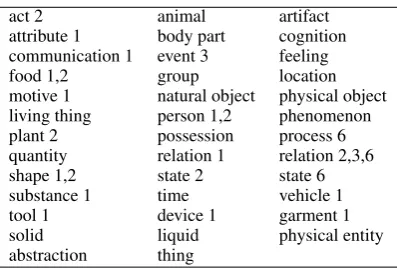
Second, we extract from WordNet the hyper-nym tree related to the sense of each head noun. A word is assigned a selectional preference if its is subsumed by one of the concepts listed in Figure 1. It is worth noticing that a noun may be assigned multiple selectional preferences.
act 2 animal artifact
attribute 1 body part cognition communication 1 event 3 feeling
food 1,2 group location
motive 1 natural object physical object living thing person 1,2 phenomenon plant 2 possession process 6 quantity relation 1 relation 2,3,6
shape 1,2 state 2 state 6
substance 1 time vehicle 1
tool 1 device 1 garment 1
solid liquid physical entity
abstraction thing
Figure 1: Selectional preferences represented by groups of concepts in WordNet. A concept is rep-resented by a word and its sense information
Motivated by VerbNet’s (Kipper et al., ) selec-tional restrictions, we manually selected the 38 categories listed in Figure 1 and mapped them into the WordNet lexicon. We chose general hyper-nyms in order to avoid fine-grained sense distinc-tions, so that the method would be less sensitive to sense-tagging errors.
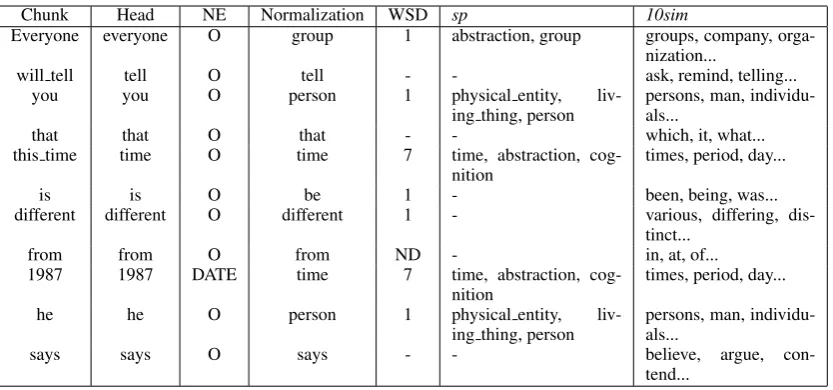
Figure 2 exemplifies the process of assigning selectional preferences to the noun head words of
4
http://crfpp.sourceforge.net/
5http://www.d.umn.edu/ tpederse/senserelate.html
a sentence. We start with the collapsed chunks and their head words; normalization is performed and then selectional preferences such as abstraction,
group,physical entity,living thing,personare as-signed as previously described.
3.2 Most Similar Words
Aiming at producing an SRL system with features that can be easily extracted for different languages and also to provide additional lexical information, we expanded chunks’ heads with similar words. For every head word on its base form, regardless its part-of-speech, we selected the 10-most simi-lar words from Lin’s distributional thesaurus (Lin, 1998). Lin’s thesaurus is an automatically structed resource that maps words to similar con-cepts in terms of a distributional lexical similarity metric. The last column in Figure 2 exemplifies similar words retrieved for some chunks.
3.3 Features
We use the CRF learning algorithm, which con-sists in a framework for building probabilistic models to label sequential data (Lafferty et al., 2001). We extracted the following features:
Head of the Base Phrase: the base phrase’s head word was identified using a right-most heuristic constrained by the POS tag of the can-didates. The head was taken as the right-most word within the chunk whose POS tag was con-sistent with the chunk type (e.g. the right-most noun in a noun phrase, the right-most verb in a verb phrase, etc.). For every base phrase, the word form, lemma and POS tag of the head were se-lected as features. Additionally, named entities were automatically tagged using the OpenNLP and Stanford NER6 systems with one of the fol-lowing categories:person,organization,location,
date, money and percentage. Besides the actual head, the normalized head was also used: named-entities are replaced by their categories and pro-nouns are replaced by their most likely SP (e.g. personal pronouns are replaced by person if sin-gular orgroupif plural).
Chunk or Base Phrase: the tokens and POS tags within every base phrase were collapsed into a surface and a POS span, respectively. The chunk type, its length and its distance to the target predi-cate were also selected as features. For the special case of a verb phrase we added as features its main
Chunk Head NE Normalization WSD sp 10sim
Everyone everyone O group 1 abstraction, group groups, company, orga-nization...
will tell tell O tell - - ask, remind, telling...
you you O person 1 physical entity,
liv-ing thliv-ing, person
persons, man, individu-als...
that that O that - - which, it, what...
this time time O time 7 time, abstraction,
cog-nition
times, period, day...
is is O be 1 - been, being, was...
different different O different 1 - various, differing,
dis-tinct...
from from O from ND - in, at, of...
1987 1987 DATE time 7 time, abstraction,
cog-nition
times, period, day...
he he O person 1 physical entity,
liv-ing thliv-ing, person
persons, man, individu-als...
says says O says - - believe, argue,
con-tend...
Figure 2: Example of feature extraction for the target verbtell
verb, its auxiliary or modal verb, its preceding and following prepositions and a flag to indicate pas-sive voice. The voice was identified using a sim-ple heuristic consisted in checking the occurrence of the verbsto beorto getfollowed by a past par-ticiple form.
Selectional Preferences: as described in 3.1, henceforth referred to assp.
10-most Similar Words: as described in 3.2, henceforth referred to as10sim
3.4 Templates
The CRF++ toolkit allows the definition of tem-plates over the basic feature space, that is, rules that combine multiple features. Templates are ex-panded token-by-token, that is, for every CRF to-ken the original feature set is used to create ad-ditional features. Templates can be based on fea-tures only, referred to asunigram templates, or on the combination of features and predicted labels, referred to asbigram templates.
Unigram templates: we created bigrams and trigrams of individual features. Figure 3 shows an example of how the normalized heads were ex-panded into trigrams, the three right-most columns were generated by template expansion. For ev-ery token we combined different features in pairs (e.g. chunk/lemma, chunk/POS, chunk/NE). Fi-nally, for all the resulting features, including the original ones, we also selected their values in a window of 6 tokens centered in the current token.
Bigram templates: we select the two previ-ously assigned semantic role labels as features of the current chunk.
4 Results
We experimented with different configurations of features in order to understand the impact of their contribution. The baseline model (B) contains all features apart from the selectional preferences and the 10-most similar words, the main contributions of this paper. We added the selectional preferences (B+sp) and the most similar words (B+10sim) sep-arately, and built a final model containing all the features (B+10sim+sp), as described in Section 3. Training was performed using the whole Propo-sition Bank (Palmer et al., 2005) (except Section 23, which is part of the test set). The Proposi-tion Bank adds a layer of predicate-argument in-formation, or semantic role labels, to the syntac-tic annotation of the Penn Treebank. The test set used was CoNLL-2005 (Carreras and M`arquez, 2005), which has predicate-argument information for approximately 2.5K sentences from the Wall Street Journal (WSJ) (in-domain evaluation) and 450 sentences from Brown corpus (out-of-domain evaluation).
Table 1 presents the overall results for the SRL taskon the in-domain test set (WSJ), and Table 2 presents the same analysis on the out-of-domain test set (Brown). They also show CoNLL 2005’s baseline (Carreras and M`arquez, 2005) and a sim-ilar chunk-based SRL (Mitsumori et al., 2005). The figures refer to the weighted average of the performance in correctly classifying target pred-icates (V), their core arguments (A0 to A5) and their modifiers.
Chunk Head (H) Normalized head (NH) Previous H Next H Previous NH/Current NH/Next NH
Everyone Everyone group - tell -/group/tell
will tell tell tell Everyone you group/tell/person
you you person tell that tell/person/that
that that that you time person/that/time
this time time time that is that/time/be
is is be time different time/be/different
different different different is from be/different/from
from from from different 1987 different/from/date
1987 1987 date from he from/date/person
he he person 1987 says date/person/say
says says say he -
person/say/-Figure 3: CRF template expansion
terms of recall as compared to our baseline (B). In isolation, these features result in similar im-provements of approximately 4% in terms of F-measure, whereas together they complement each other yielding about 12% improvement on the out-of-domain dataset. However, disappointingly our system performs worse than that by Mitsumori et al. even though both systems use similar features. In fact, in the out-of-domain task, our system is also outperformed by official baseline.
System Precision Recall F-measure
B 60.04 38.58 46.97
B+10sim 60.15 43.61 50.57
B+sp 61.79 48.11 54.10
B+10sim+sp 65.76 57.35 61.27
CoNLL-baseline 51.13 29.16 37.14
mitsumori 74.15 28.25 71.08
Table 1: In-domain semantic SRL performance
System Precision Recall F-measure
B 38.33 24.34 29.77
B+10sim 44.22 27.27 33.73
B+sp 42.17 27.69 33.43
B+10sim+sp 48.57 37.00 42.00
CoNLL-baseline 62.66 33.07 43.30
mitsumori 63.24 54.20 58.37
Table 2: Out-of-domain SRL performance
One of the reasons for the low performance of our approach may be that we have not yet per-formed feature nor template engineering. Ha-cioglu et al. (2004) report an improvement from 61.02% to 69.49% on their average F-measure based on some feature engineering. Our models could also benefit from having additional forms of syntactic information as features (e.g. flat paths between argument candidates and the target predi-cate). However at this stage of our research we are more concerned about measuring the benefit from adding new lexicalized features over chunk-based SRL approaches with standard features.
Zapirain et al. (2010) evaluate a fairly sim-ple baseline trained using only word lemmas as features as well as their strategies for selectional preferences in isolation. They report an improve-ment on F-measure of 20% (in-domain) and 30% (out-of-domain) over that baseline. They also re-port improvements on accuracy of 1% (in-domain) and 2% (out-of-domain) over a robust state-of-the-art SRL system7. However, their approach was trained using some gold-standard information, as opposed to a more realistic scenario such as ours, where automatic tools are used to produce all the information needed.
Role Precision Recall F-measure
A0 64.12 38.90 48.42
A1 58.59 44.30 50.45
A2 58.32 50.47 54.11
A3 63.21 40.36 49.26
A4 71.74 65.35 68.39
A5 75.00 75.00 75.00
AM-ADV 27.83 7.21 11.45
AM-CAU 25.00 1.32 2.50
AM-DIR 48.89 28.21 35.77
AM-DIS 47.22 11.49 18.48
AM-EXT 87.50 51.85 65.12
AM-LOC 54.84 18.73 27.93
AM-MNR 43.43 15.19 22.51
AM-MOD 95.06 61.60 74.76
AM-NEG 96.55 60.87 74.67
AM-PNC 42.42 12.28 19.05
AM-PRD 100.00 20.00 33.33
AM-REC 0.00 0.00 0.00
AM-TMP 55.53 25.15 34.62
V 98.05 81.31 88.90
Overall 60.04 38.58 46.97
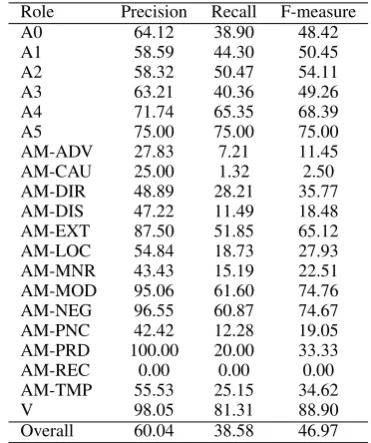
Table 3: B: In-domain semantic role classification
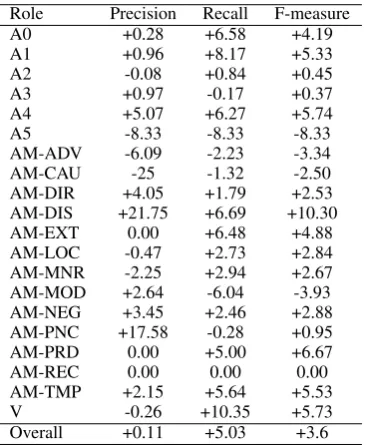
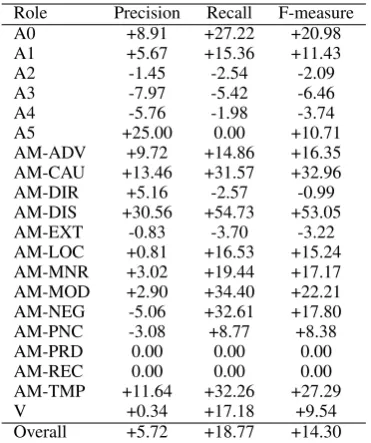
Table 3 shows the performance of our base-line model in detail. Table 4 shows the relative difference in performance for argument classifi-cation between the model improved with the 10-most similar words and the baseline. We can see a considerable gain in recall, particularly for A0 and