Automatic construction of complex features in Conditional Random
Fields for Named Entities Recognition
Michał Marci´nczuk
Institute of Informatics Wrocław University of Technology
Abstract
Conditional Random Fields (CRFs) have been proven to be very useful in many sequence labelling tasks from the field of natural language processing, includ-ing named entity recognition (NER). The advantage of CRFs over other statistical models (like Hidden Markov Models) is that they can utilize a large set of features describing a sequence of observations. On the other hand, CRFs potential function is defined as a linear combination of features, what means, that it cannot model relation-ships between combinations of input fea-tures and output labels. This limitation can be overcome by defining the relationships between atomic features as complex fea-tures before training the CRFs. In the pa-per we present the expa-perimental results of automatic generation of complex features for the named entity recognition task for Polish. A rule-induction algorithm called RIPPER is used to generate a set of rules which are latter transformed into a set of complex features. The extended set of fea-tures is used to train a CRFs model.
1 Background
Named entity recognition (NER) is an information extraction task and its goal is to identify and cate-gorize text fragments which refer to some objects. Objects can be referred to by proper names, defi-nite descriptions and noun phrases (LDC, 2008). From the perspective of information extraction tasks proper names are the most valuable as they identify the objects by their unique (to some ex-tends) name. In this paper we will focus on iden-tification of proper names for Polish.
There exist several tools for named entity
recog-nition for Polish, including Liner21 (Marci´nczuk et al., 2013) and Nerf2 (Savary and Waszczuk, 2012). So far, the existing tools do not solve the problem of named entity once and for all. For a limited set of named entities (first names, last names, names of countries, cities and roads) the results are 70.53% recall with 91.44% precision (Marci´nczuk and Janicki, 2012). Results for a wider range of entities are even lower, i.e. recall of 54% with 93% precision for 56 categories of named entities (Marci´nczuk et al., 2013). Savary and Waszczuk (2012) presented a statistical model which obtained 76% recall with 83% precision for names of people, places, organizations, time ex-pressions and name derivations tested on the Na-tional Corpus of Polish3 (Przepi´orkowski et al., 2012).
The recent works on named entity recognition focus mainly on improving the machine learning-based approaches. One direction is to decompose the task into two stages: named entity bound-ary detection and classification (Marci´nczuk and Koco´n, 2013). The other is identification of new features which will provide better information to identify the named entities (Marci´nczuk and Koco´n, 2013). Another direction is combination of different machine learning methods into a sin-gle classifier (Speck and Ngonga Ngomo, 2014). There is also another tendency which is based on increasing the size of training data by their auto-matic generation from Wikipedia (Al-Rfou et al., 2015). Last but not least direction is improvement of named entity recognition for noisy data, like “tweets” (Piskorski and Ehrmann, 2013; K¨uc¸¨uk et al., 2014).
In our study we will follow another route whose goal is to generate a set of complex features based on an existing set of token features. In Section 2 1Web page:http://nlp.pwr.wroc.pl/liner2. 2Web page:http://zil.ipipan.waw.pl/Nerf. 3Home page:http://nkjp.pl
five features for the adjacent tokens — two pre-ceding tokens, the current token and two follow-ing tokens. A sample of token feature vectors for a single featureorthis presented in Table 3.
n orth orth-2 orth-1 orth-0 orth+1 orth+2
1 Tom NULL NULL Tom lives in
2 lives NULL Tom lives in Paris
3 in Tom lives in Paris NULL
4 Paris lives in Paris NULL NULL Table 3: Token feature vectors for a sample sen-tence and a single featureorth(orthographic form of token)
.
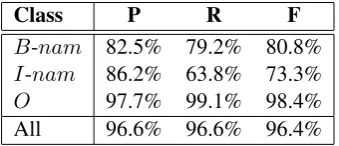
The rule induction process took 2.5 hours on a single 2.4 GHz CPU. The final set of rules con-sists of 29 rules forB-namclass and 24 rules for I-namclass. The accuracy of the rules on the tune part was 96.6%. The detailed results are presented in the Table 4.
Class P R F
B-nam 82.5% 79.2% 80.8% I-nam 86.2% 63.8% 73.3%
O 97.7% 99.1% 98.4%
All 96.6% 96.6% 96.4%
Table 4: Evaluation of the rules on the tune part of the KPWr corpus.
A sample rule generated by JRip is presented on Figure 1. The rule says: the current token starts a named entity (B-nam) if the current to-ken has an upper case letter(has upper case+0 = 1) andthe preceding token does not have only up-per case letters(all upper-1 = 0) and the preced-ing token have only lower case letters (pattern-1 = ALL LOWER) and the following token has an upper case letter(has upper case+1 = 1).
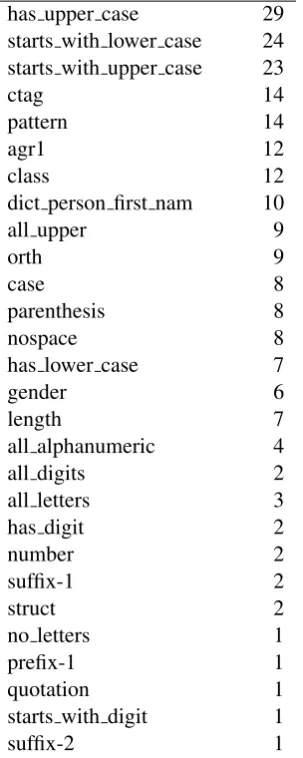
Table 5 contains a list of features which ap-peared in the rules generated by JRip accompanied with the number of rules containing the feature. The most common features wherehas upper case
(29 rules), starts with lower case (24 rules) and
starts with upper case (23 rules). These are or-thographic features which refer to presence of up-per and lower case letters — in Polish upup-per case letters indicate most of named entity. The new features described in Section 3.2 also appeared in the rules —parenthesisandnospaceappeared in 8 rules and quotationin 1 rule. This means that the new features combined with other features are
useful in named entity boundary detection. The set of rules was finally transformed into a set of template features. The transformation con-sists of removing feature values and keeping only feature names. A feature template for the sam-ple rule from Figure 1 is presented on Figure 2. We use CRF++5 implementation of CRFs which generates all possible combinations of feature val-ues for given feature template during the training process. This way CRF++ can explore all combi-nations of feature values (including the one gen-erated by JRip) and evaluate them in the context of sequence labelling task. The final evaluation of the generated complex features is presented in Section 5.
(has_upper_case+0 = 1) and (all_upper-1 = 0)
and (pattern-1 = ALL_LOWER) and (has_upper_case+1 = 1) => iobtag=B-nam
Figure 1: A sample rule generated by JRip on the tune part of KPWr.
has_upper_case:0/all_upper:-1/ pattern:-1/has_upper_case:1
Figure 2: A complex feature converted from the sample rule from Figure 1.
5 Evaluation
We have evaluated three set of features: baseline
(described in Section 3.1),baseline with new fea-tures(described in Section 3.2) andbaseline with complex features(baseline features with new tures and automatically generated complex fea-tures according to the procedure presented in Sec-tion 4).
We decided not to evaluate the set of rules gen-erated by JRip on their own as we did not expect to obtain good results. The performance of the rules on the tune set (set on which the rules were gen-erated) was relatively low and on unseen data it might be even lower.
The evaluation was performed by training CRF-based statistical model using 10-fold cross valida-tion on the train part of the KPWr (see Table 6). 5Web page: http://crfpp.googlecode.com/
Feature Count
has upper case 29
starts with lower case 24 starts with upper case 23
ctag 14
pattern 14
agr1 12
class 12
dict person first nam 10
all upper 9
orth 9
case 8
parenthesis 8
nospace 8
has lower case 7
gender 6
length 7
all alphanumeric 4
all digits 2
all letters 3
has digit 2
number 2
suffix-1 2
struct 2
no letters 1
prefix-1 1
quotation 1
starts with digit 1
suffix-2 1
Table 5: A list of features used to construct the set of rules with a number of rules in which the feature appeared.
We also validate the generality of the feature sets by training the model on the train and tune part of KPWr and testing on the test part of KPWr (see Table 6).
We present results forstrictandpartial match-ing evaluation (Chinchor, 1992). In the strict
matching the boundaries of recognized annota-tions must be exactly the same as in the refer-ence corpus. In the partial matching the recog-nition of annotations presence and its boundaries are evaluated separately. This means that anno-tations which do not exactly match the expected boundaries are treated as partial success.
To check the statistical significance of differ-ence between results we used Student’s t-test with a significance levelα= 0.05(Dietterich, 1998).
Application of the new three features (nospace,
quotation and bracket) improved the F-measure for strict evaluation from 80.30% to 81.13%. The difference is statistically significant forα = 0.05
what means that the additional features are useful for the recognition of named entities boundaries. Further improvement was achieved by extending the feature set with the complex features generated with RIPPER algorithm. The F-measure increased to 82.61% and the difference is also statistically significant.
Similar increase of F-measure was observed for the test part of KPWr. The initial value of F-measure increased from 82.40% for baseline set of features to 84.50% for the baseline set of features extended with complex features.
Evaluation P R F Baseline
Strict 81.92% 78.74% 80.30% Partial 88.11% 84.83% 86.44%
Baseline with new features Strict 82.79% 79.54% 81.13% Partial 88.52% 85.22% 86.84%
Baseline with complex features Strict 84.10% 81.16% 82.61% Partial 89.07% 86.25% 87.64%
Table 6: 10-fold cross validation on the train part of KPWr corpus.
Evaluation P R F Baseline
Strict 84.25% 80.63% 82.40% Partial 89.78% 85.80% 87.74%
Baseline with new features Strict 84.94% 81.72% 83.29% Partial 90.22% 86.75% 88.45%
Baseline with complex features Strict 86.04% 83.02% 84.50% Partial 90.73% 87.63% 89.15%
Table 7: Evaluation on the test part of the KPWr corpus.
6 Conclusions
Agata Savary and Jakub Waszczuk. 2012. Narze¸dzia do anotacji jednostek nazewniczych. In Adam Przepi´orkowski, Mirosław Ba´nko, Rafał L. G´orski, and Barbara Lewandowska-Tomaszczyk, editors, Narodowy Korpus Je¸zyka Polskiego. Wydawnictwo Naukowe PWN. Creative Commons Uznanie Au-torstwa 3.0 Polska.