A Segmentation Matrix Method for Chinese Segmentation Ambiguity Analysis 5
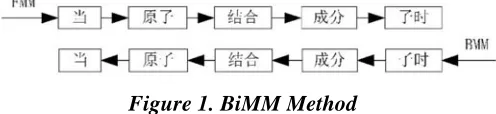
Figure 1. BiMM Method
Omni-segmentation tries to find every segmentation path in a sentence, which can be illustrated by a tree structure as shown in Figure 2. The root represents the start of a sentence. Nodes represent words of a sentence. Each branch implies a possible segmentation path.
Figure 2. Omni-segmentation Method
The Directed Acyclic Graph (DAG) method was proposed by Zhang et al. (2002) as Figure 3 shows. Given a sentence represented as ( denotes Chinese characters),
vertices are used to separate it. Then, is generated.
and are the start and the end vertexes. If a substring ( ) matches a lexicon entry, then a directed edge is added.
The DAG is used to collect possible segmentation paths. According to Zhang et al. (2002), if the 8-shortest paths are collected, this method can receive performance about 99.90% in recall to find correct segmentation paths.
Figure 3. Directed Acyclic Graph
Wang et al. (2004) proposed a Maximum No-cover Ambiguity Graph (MNAG) as Figure 4 shows. Based on the principle of Choosing the Longer Word, MNAG can identify all overlapping ambiguities. This approach can reduce the number of segmentation paths. But identification of the combinational ambiguity is ignored.
6 Yanping Chen et al.
Figure 4. Maximum No-cover Ambiguity Graph
The word lattice method was proposed for Chinese word segmentation (Jiang et al., 2008). It is built by merging the output of outer segmenters. This method is mainly used as a re-ranking strategy. As shown in Figure 5, lattice nodes denote positions between characters. Edges covering subsequences of sentence denote words (Wang et al., 2013).
Figure 5. Word Lattice
There are other approaches proposed for CSA analyses, such as the overlapping ambiguity elimination model (Yao et al., 2012), the word-by-word scanning based maximum matching algorithm (Zhang et al., 2006; Sun et al., 2009), the method based on type theory (Gao et al., 2009) and the coupling degree of double characters method (Wand et al., 2007). These methods mainly focus on the overlapping ambiguity. Problems of combinational ambiguity and the difference between MOAS and OAS are rarely studied. In this paper, we propose a SM method. The detail of SM is discussed in Section 4. In the following, we first introduce definitions and notations used in this paper.
3.
Definitions and Notations
Let to be a segmentation matrix, is an element of with coordinates Row and Column . A sentence is referred as . The length of is supposed to be . We define two sets as:
7
where are the natural numbers. is a partial order set. denotes an employed
lexicon. A closed interval denotes subset of .
represents substring of starting from the th character to the th character. By means of set operations, sentence operations are defined as follows
7
A Segmentation Matrix Method for Chinese Segmentation Ambiguity Analysis 7
Note that all sentence operations are implemented within indexes belonging to the same sentence . Otherwise, these operations are nonsense.
Based on sentence operations, formal definitions about segmentation path, combinational ambiguity, overlapping ambiguity, etc. are defined as follows.
Definition 1: Let to be a partition of , then is a Segmentation Path of , referred to
as or .
In other words, a segmentation path is a partition of . For example, let =“温柔和善 解人意” (gentle and understanding), because is a partition of ,
then is a segmentation path (or , which denotes “温柔/和
/善解人意” (gentle/ and/ understanding). In this paper, (square bracket) represents substring of , and (parentheses) represents a segmentation path.
Definition 2: Let to be a segmentation path, if such that . Then, the segmentation path is in accord with .
In this paper, we assume that all mentioned segmentation paths satisfy this constraint.
Definition 3: Let . If is a
partition of , then has the Combinational Ambiguity (CA), and is a Combinational Ambiguity String (CAS).
For example, let =“温 柔 和 善 解 人 意”, =“善 解 人 意”, and
is a partition of . Because =“善”, ,
=“解”, , =“人 意”, , therefore, has combinational
ambiguity. is a CAS, referred to as .
8 Yanping Chen et al.
combinational ambiguity. Because disambiguation for combinational ambiguity is difficult (Luo et al., 2002). Therefore, to reduce the combinational ambiguity problem, the following combinational ambiguity definition in a narrow sense is proposed.
Definition 4: Let , if such that , then has the Narrow Sense Combinational Ambiguity.
This definition is the same as that proposed by Liang (1984). In this paper, the narrow sense combinational ambiguity is used as our default definition, also referred as combinational ambiguity except where noted.
Definition 5: Let , if and ,
then has the Overlapping Ambiguity (OA). is an Overlapping Ambiguity String (OAS).
If and have overlapping ambiguity, then is an
Overlapping Chain String (OCS) and is Overlapping Chain Length
(OCL), where is the cardinality of .
For example, let =“温 柔 和 善 解 人 意”, =“温 柔 和”, and
. Because , so that has overlapping ambiguity.
is an OAS. is an OCS, and OCL of
is 1.
In this paper, CAS and OAS are collectively referred as Ambiguity String (AS). Prefixes OA, CA and OC are used to indicate properties of (Overlapping Ambiguity, Combinational Ambiguity and Overlapping Chain). For example, means that
is an OAS.
Definition 6: Given and , if , then and are Addable.
If and are addable, then the sum of and
A Segmentation Matrix Method for Chinese Segmentation Ambiguity Analysis 9
(1)
where is the relative complement of in
.
In this field, the Maximum Overlapping Ambiguity String (MOAS) is widely used. It is defined as follows.
Definition 7: In a given sentence , if an is not addable with other OAS in , then this is a Maximum Overlapping Ambiguity String (MOAS).
For example, =“温柔和善解人意” has three OAS: , and
. All of them are addable. The result is . By Eq. (1), an overlapping
chain string of is . For another example, =“逐渐变成暗红色”
has and . and are not addable, then both of
them are MOAS.
Given a set of OAS (referred as ) in a sentence, the set of MOAS (referred to as ) is computed by merging every OAS that are addable. It is computed as follows.
(2)
Because appears on both sides of this equation, it is an iterative process. It will be discussed in Section 4.2.3 that is easy to be implemented, because all elements
in and are ordered.
In ancient Chinese, there are no punctuations between sentences. Currently, symbols such as the period (“。”), question mark (“?”), exclamatory mark (“!”), semicolon (“;”) or comma (“,”) are widely used as sentence boundaries. The problem is that using of the comma is ambiguous. It may function as a sentence boundary or a separation of clauses. Therefore, disambiguation of sentence boundary is required (Xue et al., 2011). Because lots of language characteristics cannot exist while crossing punctuation, e.g., segmentation ambiguity, named entity, etc. (Chen et al., 2015b), Sentence Fragment is used to denote substring of a sentence divided by punctuations.
Definition 8: Sentence fragment is a substring of a sentence that contains no punctuation.
10 Yanping Chen et al.
4.
Segmentation Matrix
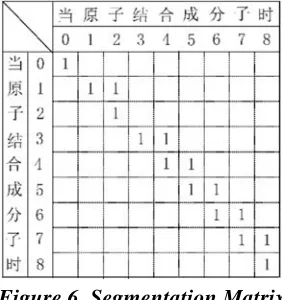
Figure 6 gives an example of SM. Coordinates of SM represent characters of . The element data type of SM is Boolean. means that word . To build SM of a sentence, by scanning a given sentence, when a lexicon entry is matched, the corresponding element is set to 1, otherwise to 0.
Figure 6. Segmentation Matrix
4.1 Ambiguity Identification on SM
Following the definition of the Combinational Ambiguity in a Narrow Sense (See Definition 4), Solution 1 is proposed to identify combinational ambiguity strings.
Solution 1: For , if
, then is a CAS.
For example, in Figure 6, , , ,
, , , then is a CAS. Based on Solution 1,
Algorithm 1 gives the implementation of this solution8.
8
A Segmentation Matrix Method for Chinese Segmentation Ambiguity Analysis 11
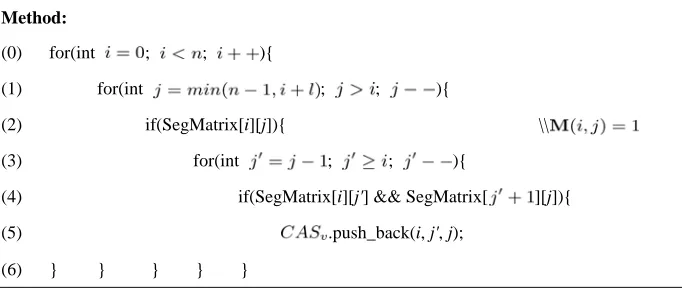
Algorithm 1
CA Identification on SM
Input:
1. SegMatrix[][], SM;
2. , length of the given sentence;
3. , length of the longest lexicon entry;
Output:
Combinational ambiguity strings are stored in the vector ;
Method:
(0) for(int ; ; ){
(1) for(int ; ; ){
(2) if(SegMatrix[i][j]){ \\
(3) for(int ; ; ){
(4) if(SegMatrix[i][j'] && SegMatrix[ ][j]){
(5) .push_back(i, j', j);
(6) } } } } }
As Algorithm 1 shows, three loops are used. Except the outer loop has an index , another two nested loops have cycle indexes less than . Therefore, the complexity of combinational ambiguity identification is . The function in Row (1) is adopted to decrease the search space. If a “break” clause is in the pace after Row (5), the algorithm will return when the combinational ambiguity is identified. Otherwise, as it shows, every combinational ambiguity in the sentence is collected.
Following Definition 3, Solution 2 is proposed to identify the overlapping ambiguity string.
Solution 2: For , if ,
then is an OAS, is the overlapping chain string, and the overlapping chain
length is .
For example, in Figure 6, because ,
, , , and , then is an OAS,
12 Yanping Chen et al.
Algorithm 2
Overlapping Ambiguity Identification on SM
Input:
1. SegMatrix[][], SM;
2. , length of the given sentence;
3. , length of the longest lexicon entry;
Output:
Overlapping ambiguity is stored in vector ;
Method:
(0) for(int ; ; ){
(1) for(int ; && ; ){
(2) if(SegMatrix[i][j]){ \\
(3) for(int ; ; ){
(4) for(int ; ; ){
(5) if(SegMatrix[i'][j'])\{ \\
(6) .push_back(i, j, i', j');
(7) } } } } } }
In Algorithm 2, four loops are used. The outer loop has index . The other three nested loops have cycle index less than . The complexity of overlapping ambiguity identification is . Using Algorithm 2, instead of MOAS, each overlapping ambiguity string is recognized individually. After every OAS is identified, MOAS can be obtained by merging OAS that is addable (See Eq. (2)).
4.2 Segmentation on SM
In this section, we illustrate how Chinese word segmentation algorithms can be implemented on SM. Four lexicon based methods (FMM, BMM, BiMM and Omni-segmentation) are discussed. By mapping string operations into set operations, these processes only implement Boolean operations, which reduces the computing complexity.
4.2.1 FMM
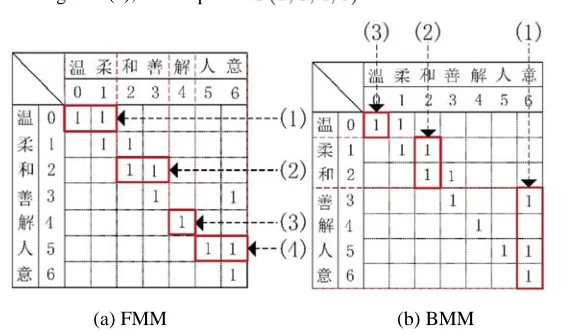
FMM is implemented by scanning each row of SM from right to left. If equals 1, then hold the coordinate as , and scan from the th row again. Iterate this way
A Segmentation Matrix Method for Chinese Segmentation Ambiguity Analysis 13
segmentation path of FMM. Step 1 to 3 give an example of this algorithm. Figure 7(a) shows the visualized process.
Step 1: Scan the th row from Column 6 to Column 0. Hit 1 at , then set 1 as .
Step 2: Scan the th row in the same way, if equals 1, record every .
Step 3: Iterate this way until the column-coordinate equals 6. As shown in Figure 7(a), the output is .
(a) FMM (b) BMM
Figure 7. Maximum Matching Segmentation
4.2.2 BMM
BMM is similar as FMM. The difference is that BMM processes the last column first and scan each column from top to bottom. If equals 1, hold j and restart from th column again until the th column is reached.
For example, in Figure 7(b), first hit 1 at , then hold 6 and scan from the th column again. In Column 2, equals 1, restart from the th column until the column-coordination 0 is met. The output of BMM in this example is .
4.2.3 BiMM on SM
BiMM is implemented by running both FMM and BMM respectively. Two outputs are
compared. Let and to be the
output of FMM and BMM. Comparing and from right to left, if both coordinates9 have the same value, hold this same value and decrease both by 1. Then, compare the new
9
In this place, segmentation path are seen as a vector. The values of
are , , etc. The coordinates of are the position index of this vector. For example,
14 Yanping Chen et al.
coordinates again and always update the held value if both are equal, until the unequal value is met for the first time. Now, the held value is the end of OAS (e.g. in and ). Subtract 1 to the coordinate with larger value. Continue this way, until the equal value is found again (e.g. in and ). At last, it is the start of the OAS. In this example, the OAS is . Iterate this way until both and are traversed.
4.2.4 Omni-segmentation on SM
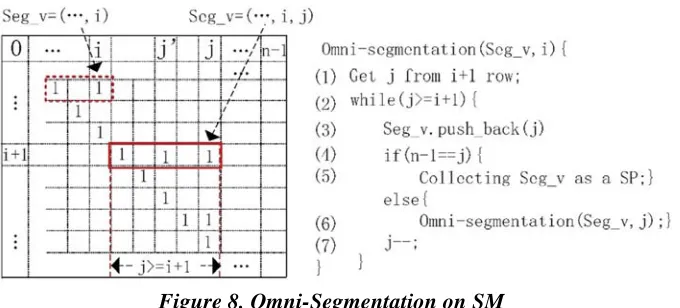
Omni-segmentation tries to find every segmentation path in a given sentence. The number of segmentation paths may explode tremendously. It has the highest computational and space complexity. Based on SM, utilizing segmentation ambiguity information, we can apply Omni-segmentation method on substrings that have the segmentation ambiguity problem, then reducing generated segmentation paths.
For the reason that Omni-segmentation is useful in Chinese NLP, e.g., Chen et al. (2014), Chen et al. (2015a), we give the algorithm that can be implemented on SM. As shown in Figure 8, this algorithm utilizes an iterative method, which can make better use of sentence structure information.
Figure 8. Omni-Segmentation on SM
Suppose that one output of the th iteration is . In the th iteration, the th Row is processed. In Step (1), the largest j with is obtained. In Step (2), add j into segmentation path and judge whether or not j is the end of a sentence. If it equals , then is a segmentation path. If not, iterate this process. For all in Row , recycle from Step (3) Step (7).
A Segmentation Matrix Method for Chinese Segmentation Ambiguity Analysis 15
4.3 Complexity
In order to identify CSA, both Omni-segmentation and BiMM methods try to segment a sentence for finding possible segmentation paths. The lexicon is required to be accessed frequently, and generated segmentation paths must be held for comparison. These processes involve massive string manipulations and string storages, leading to a higher computational and space complexity. In SM, after SM was built, string operations are mapped into set operations. There is no need for SM to implement string operations and access the lexicon. Moreover, SM can make better use of sentence structure information, decreasing the computational complexity. This section discusses the complexity of SM.
Let to be the number of lexicon entry, is the length of a given sentence, is the length of the longest lexicon entry. In a given lexicon, is a constant. The computational and space complexity are given as follows.
4.3.1 Computational Complexity
Searching for an element in a lexicon has computational complexity . Finding every word in a sentence need access lexicon times in the worst case. Therefore, the construction of SM has computational complexity . This is the same as FMM or BMM. Because BiMM implements both FMM and BMM, so BiMM has complexity . Where denotes the complexity to compare the output of FMM and BMM.
In the worst scenario, SM has elements equal 1. In order to identify each overlapping ambiguity, for each , elements of should be scanned.
So identification of the OAS has complexity . Because and
have the similar order, identification of OAS on SM has computational complexity close to BiMM.
4.3.2 Space Complexity
BiMM generates two FMM and BMM output. The space complexity for BiMM is constant. When Omni-segmentation is employed, segmentation path can grow tremendously, therefore, leading to a higher space complexity. In BiMM and Omni-segmentation, generated segmentation paths need to be held for OAS or CAS identification.
16 Yanping Chen et al.
5.
Experiments
Before conducting experiments, we give an example to show the comparison between SM and
BiMM. The sentence is given as “江泽民在北京人民大会堂会见参加全国法院工作会议和
全国法院系统打击经济犯罪先进集体表彰大会代表时要求大家要充分认识打击经济犯罪 工作的艰巨性和长期性”. The outputs of FMM and BMM are listed as follows10:
(0, 1, 2, 3, 5, 7, 9, 11, 12, 14, 16, 18, 20, 22, 23, 25, 27, 29, 31, 33, 35, 37, 39, 41, 43, 45, 46, 48, 50, 51, 53, 55, 57, 59, 61, 62);
(0, 1, 2, 3, 5, 7, 8, 10, 12, 14, 16, 18, 20, 21, 23, 25, 27, 29, 31, 33, 35, 37, 39, 41, 43, 45, 46, 48, 50, 51, 53, 55, 57, 59, 61, 62);
Making use of the BiMM method, 2 MOAS are detected: ,
. However, if SM method is employed, 5 MOAS and 10 OAS are found:
, , , , ,
, , , , , ,
, , , .
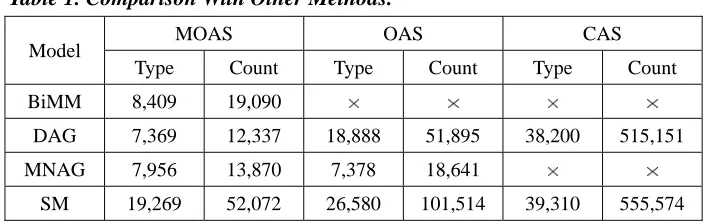
This example shows that BiMM is insufficient for OAS identification. To show more information, based on the Beijing University corpus (PKU corpus) of the Chinese word segmentation Bakeoff training data (Sproat et al., 2003), SM is compared with BiMM, DAG, and MNAG methods, as shown in Table 1.
Table 1. Comparison With Other Methods.
Model MOAS OAS CAS
Type Count Type Count Type Count BiMM 8,409 19,090
DAG 7,369 12,337 18,888 51,895 38,200 515,151 MNAG 7,956 13,870 7,378 18,641
SM 19,269 52,072 26,580 101,514 39,310 555,574
Where, “ ” means that this type of ambiguity cannot be identified by the corresponding method. It can be seen that SM shows better performance. Making use of the SM method, in the rest part of this section, several issues about CSA are discussed.
10
The output may differ when different lexicon is adopted. In this place, we take the Lexicon Common
18 Yanping Chen et al.
and“射门” (Shot) can be combined into an OAS“点射门”. It can be segmented as “点/射门” (Point/ Shot) or “点射/门” (Fixed Fire/ Door). Total OAS Types is produced by merging results in OAS in Overlapping Words and OAS in Adjacent Words. It can be seen as the overlapping ambiguity space.
As shown in Table 1, combinational ambiguities inside words are pervasive, even the Definition 4 is adopted. Except 2,927 words containing only single character, 75.25% words have combinational ambiguity. The Total OAS Types has the same number as OAS in Overlapping Word, so that OAS in Adjacent Words can be seen as a subset of OAS in Overlapping Words.
In the following, we investigate CSA in a large-scale corpus. The corpus contains 52,961 texts involving various literary genres. Because CSA cannot exist across punctuation. Therefore, instead of whole sentences, we take sentence fragments under consideration. After erasing duplicated sentence fragments, there are 0.2 billion sentence fragments remained. The information is shown in Table 3.
Table 3. Information of Corpus.
Corpus Size 8.26 Gigabyte Texts 52,961
Total Characters 2,703,512,684 Total Words 1,902,306,846
Token 69,087 Sentence Fragments 264,748,094
Figure 9 shows the distribution of sentence fragment length in our corpus.
Figure 9. Distribution of Sentence Fragments Length
Almost 99% sentence fragments have length less than 26. Therefore, we set 128 as the size of SM. Longer sentence fragments are removed directly.
A Segmentation Matrix Method for Chinese Segmentation Ambiguity Analysis 19
implemented to extract MOAS, referred as BiMM-MOAS. Table 4 gives information about CAS, OAS, SM-MOAS and BiMM-MOAS.
Table 4. Ambiguity about Corpus.
Ambiguity Type CAS OAS SM-MOAS BiMM-MOAS
Type 39,810 732,873 1,190,606 526,251
Count 579,238,862 40,921,520 32,641,105 23,424,525
Referring to Table 2, nearly all CAS types occurred in our corpus, but only 39.66% OAS types occurred. If the BiMM method is used, there are 91.52% sentence fragments having no overlapping ambiguity. If the SM method is employed, the rate reduces to 88.38%. It means that, by simple method, it is possible to get a massive sentence fragments without overlapping ambiguity for unsupervised methods (Li et al., 2003).
From Table 4, compared SM-MOAS and BiMM-MOAS, it can be seen that the number of SM-MOAS type is doubled. Therefore, only focusing on MOAS produced by BiMM is insufficient to study the CSA problem. In Figure 10, distributions of overlapping chain length about MOAS and OAS are compared.
Figure 10. Distribution of Overlapping Chain Length
It can be seen that the distribution of overlapping chain length in MOAS is more complex, ranging from 1 to 39. However, it is simpler in OAS. There are 99.87% OAS has overlapping chain length equal to 1. This conclusion is useful for disambiguation. It can be modelled as a two-category classification problem.
20 Yanping Chen et al.
(a) CAS (b) OAS
(c) MOAS (d) BiMM MOAS
Figure 11. Distribution of Segmentation Ambiguity
5.2 Influence of Ambiguities on Word Segmentation
Based on FMM and BMM, Sun et al. (1995) analyzed the influence of CSA on Chinese word segmentation. Several conclusions were induced. These analyses mainly based on a corpus containing only 3,680 sentences. The influence of combinational ambiguity on Chinese word segmentation wasn’t studied. In this experiment, the Penn Chinese Treebank corpus12 is used to analyze the influence of CSA on Chinese word segmentation. This corpus is manually segmented, consisting of 2,448 text files, 71,232 sentences, 1,196,329 words and 1,931,381 Hanzi (Chinese character). The segmentation ambiguity information is given in Table 5.
Table 5. Ambiguity about Penn Chinese TreeBank.
Ambiguity Type CAS OAS SM-MOAS BiMM-MOAS
Type 11,672 24,069 17,868 13,5591
Count 61,615 81,694 47,417 18,8275
12
22 Yanping Chen et al.
still be used in this field. In this section, the influence of lexicon size on Chinese word segmentation is studied. We use the PKU testing data. The FMM is used as the default method. This issue was discussed by other researchers (e.g. Sun et al., (2001)), but no quantitative analysis is given. The result is shown in Table 7.
Table 7. Influence of Lexicon Size.
No. Lexicon Entries Precision Recall F1
1 Testing Words 13,148 98.95% 98.62% 98.78%
2 Training Words 55,303 84.34% 90.77% 87.44%
3 (2) + CWCC 85,486 85.32% 90.23% 87.71%
4 (3) + Medium Lexicon 312,065 83.42% 83.16% 83.29%
5 (4) + Maximum Lexicon 554,331 81.23% 80.51% 80.87%
6 (5) + Testing Words 555,475 89.16% 83.49% 86.23%
7 (2) + Testing Words 58,166 97.26% 95.93% 96.59%
In Table 7, five lexicons are employed. Testing Words are words collected from the testing data. Words in Training Words are collected from training data. Performances generated by both are used as the topline and baseline in the Chinese word segmentation Bakeoff competition (Emerson, 2005). CWCC denotes the Lexicon of Common Words in Contemporary Chinese. Medium Lexicon is collected from the Internet, which contains 298,032 words. Maximum Lexicon is generated by merging Medium Lexicon and a Great Dictionary of Chinese with 542,240 lexicon.
A Segmentation Matrix Method for Chinese Segmentation Ambiguity Analysis 23
Table 8. Information about Error.
No. Lexicon Total By OAS By CAS By OOV
1 Testing Words 712 355 357 0
2 Training Words 7,386 752 1,298 5,336
3 (2) + CWCC 7,130 900 1,894 4,336
4 (3) + Medium Lexicon 9,695 1,595 5,433 2,667
5 (4) + Maximum Lexicon 10,954 2,363 5,982 2,609
6 (5) + Testing Words 8,110 2,088 6,022 0
7 (2) + Testing Words 2,045 697 1,348 0
In Table 8, the strategy to count the number of errors is explained as follows. If a segmentation path “A/ BC”, is falsely segmented into “AB/ C” (A, B and C are characters). Then this failure is counted as an OAS error. If a segmentation path “A/ B” is falsely segmented into a word “AB” (combinational ambiguity), it is counted as a CAS error. An OOV error is caused by a word (e.g. “AB”) falsely segmented into small pieces (“A/ B”). Figure 12 compares errors caused by OAS, CAS and OOV.
Figure 12. Influence of Lexicon Size on CSA and OOV
A Segmentation Matrix Method for Chinese Segmentation Ambiguity Analysis 25
CAS extracted from training data. The result shows the performance is increased by OAS disambiguation and CAS disambiguation. Comparing with the CRF model, both show a similar performance.
Based on SM, the segmentation divides word segmentation into three steps. It provides an alternative way to process word segmentation. Making use of SM, each step can be optimized accordingly. However, the result also shows that the disambiguation of OAS and CAS are not independent. Decreasing one of them can influence the other. From Row 2 to Row 5, the CAS is also a challenging task for segmenting Chinese words.
6.
Conclusions
In this paper, a SM method was provided, which represents lexicon information as a matrix. Under the framework of set theory, formal definitions about segmentation path, combinational ambiguity, overlapping ambiguity, etc. are given. By mapping string operations into set operation, SM is effective in CSA identification and also available for Chinese word segmentation. In our experiments, several issues about CSA were explored. For researchers who are interested in our work, the source code of our SM is available at https://github.com/YPench/SMatrix/.
7.
Acknowledges
The research was supported in part by the National Science Foundation of China under Grant Nos. 91118005, 91218301, 91418205.
Reference
Chang, C. & Wei, J. (2008). Identification and disposal of ambiguity based on Omni-Segmentation arithmetic. Computer Engineering and Applications, 15.
Chen, K. & Bai, M. (1998).Unknown word detection for Chinese by a corpus-based learning method. International Journal of Computational Linguistics and Chinese Language Processing, 3(1), 27-44.
Chen, X., Li, L., & Liang, X. (2012). Eliminate Semantic Network Word Segmentation Ambiguity Method Research. Microelectronics & Computer, 3, 045.
Chen, Y., Zheng, Q., & Zhang, W. (2014). Omni-word Feature and Soft Constraint for Chinese Relation Extraction. The Proceedings of ACL'14, 572-581.
Chen, Y., Zheng, Q., & Chen, P. (2015a). Feature assembly method for extracting relations in Chinese. Artificial Intelligence, 228, 179-194.
28 Yanping Chen et al.
Zeng, D., Wei, D., Chau, M., & Wang, F. (2011). Domain-specific Chinese word segmentation using suffix tree and mutual information. Information Systems Frontiers, 13(1), 115-125.
Zeng, X., Wong, D., Chao, L., & Trancoso, I. (2013). Graph-based Semi-Supervised Model for Joint Chinese Word Segmentation and Part-of-Speech Tagging. The Proceeding of ACL '13, 770-779.
Zhang, L. (2004). Maximum entropy modeling toolkit for Python and C++. Natural Language Processing Lab, Northeastern University, China.
Zhang, P., & Li, C. (2006). A new Context-Sensitive ambiguous phrase segmentation Algorithm. Computer Systems & Applications, 5, 013.
Zhang, L., Li, L., He, Z., et al. (2013). Improving Chinese Word Segmentation on Micro-blog Using Rich Punctuations. The Proceeding of ACL '13.
Zhang, H., & Liu, Q. (2002). Model of Chinese Words Rough Segmentation Based on N-Shortest-Paths Method. Journal of Chinese information processing, 5, 000.
Zhang, H., Yu, H., Xiong, D., & Liu, Q. (2003). HHMM-based Chinese lexical analyzer ICTCLAS. The Proceedings of SIGHAN '03, 17, 184-187.