More notably, two systems that facilitate the access and usage of existing processing tools have emerged. GATE (Cunningham et al., 2002) is an environment for building and deploying NLP software and resources that allows integration of a large amount of built-ins in new processing pipelines.
UIMA (Unstructured Information Management Application) (Ferrucci and Lally, 2004) offers the same general functionalities as GATE but once a processing module is integrated in UIMA it can be used in any further chains without any modifications (GATE requires wrappers to be written to allow two or more modules to be connected in a chain). Currently, UIMA is the only industry OASIS standard4 (Ferrucci et al., 2006) for content analytics.
3
NLP System Architecture
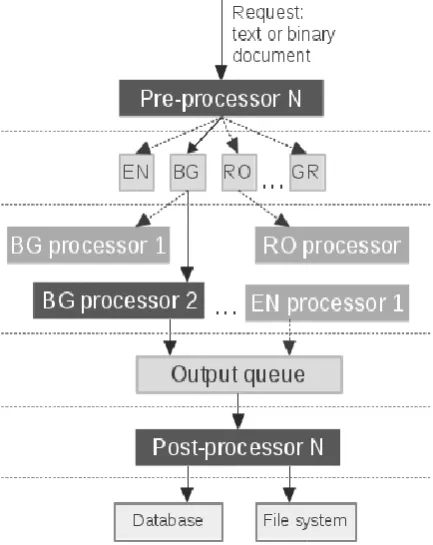
The processing of unstructured text in system is split into three independent subtasks, executed sequentially.
Pre-processing – at this stage the text is extracted from the input source (documents in OpenOffice, PDF, MS Office, HTML, ePub, FB2 and other formats). Details of the implementation of the pre-processing engine are not in the scope of this article.
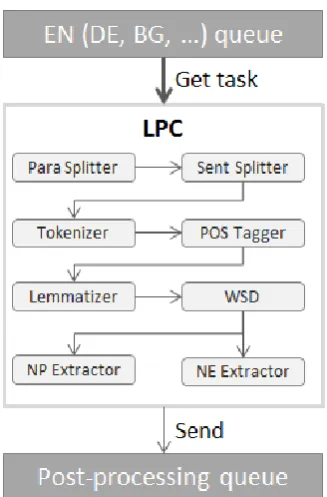
Processing – at this stage the text is annotated by several NLP tools, chained in a sequence. We call the implementation of the processing engine for a specific language a „Language Processing Chain‟ (LPC).
Post-processing – at this stage the annotations are stored in a data store, such as file system, relational or NoSQL database. Details of the implementation of the post-processing engine are not in the scope of this article.
The overall performance of an NLP task depends on the performance of the atomic NLP tools, used in the processing engine and the size of the input text. As the classical request-response chain cannot be used for such tasks because the response time cannot be predicted, we use an asynchronous, message-based, communication channel between the components in the system.
A pre-processing engine detects the mime type of the input source, extracts the text from it, detects the language of the text and sends it to a language-specific queue.
4
http://www.oasis-open.org/committees/uima/
One (of the several) language processing chains checks-out a message, processes it and sends the annotated text to an output queue where a post-processing engine stores the text annotations in a data store.
“Figure 1” depicts the top-level architecture of the NLP components in the system.
Figure 1. Top-level architecture.
4
Language Processing Chain
In order to achieve a basic set of low-level text annotations the following atomic NLP tools have to be executed in sequence (Cristea and Pistol, 2008): Paragraph splitter (splits the raw text in paragraphs) → Sentence splitter (splits each paragraph in sentences) → Tokenizer (splits each sentence into tokens) → POS tagger (marks up each token with its particular part of speech tag) → Lemmatizer (determines the basic form of each token) → Word sense disambiguation
(disambiguates the meaning of each token and assigns a sense to it) → NounPhrase Extractor
(marks up the noun phrases in each sentense) →
NamedEntity Extractor (marks up named entities in the text).
Figure 2. Components of a language processing chain.
The key requirements to our system are the possibility to use heterogeneous NLP tools for different languages, transparent horizontal scalability, and transparent hot-swap of linguistic components. Last but not least is the requirement of a minimal installation footprint.
After evaluating both GATE and UIMA meta-systems, in respect to the above requirements, we based the implementation of the processing engine on the UIMA framework (JAVA version). We wrapped the UIMA base framework with an OSGi shell (OSGi Alliance, 2009), making it available to the rest of the components in the system. The horizontal scalability of the NLP functionalities and the transparent hot-swap of the linguistic components are empowered by a network-distributed architecture based on ActiveMQ5.
5
UIMA Implementation of LPC
A typical UIMA application consists of: a Type System Descriptor, describing the annotations that will be provided by the components of the application; one or more Primitive Analysis Engines, each one providing a wrapper for a NLP tools and adding annotations to the text; an Aggregate Engine, defining the execution sequence of the primitive engines (Gordon et al., 2011).
5
http://activemq.apache.org/
5.1 Type System Descriptor
In order to put the atomic NLP tools in a chain, they need to be interoperable on various levels. The first interoperable level, the compatibility of formats of linguistic information, is supported by a defined scope of required annotations, de-scribed as a UIMA Type System Descriptor.
The uniform representation model, required by the UIMA type system, provides normalized heterogeneous annotations of the component NLP tools. Within our system, it covers properties that are critical for the further processing of annotated data, e.g. lemma, values for attributes such as gender, number and case for tokens necessary to run coreference module to be subsequently used for text summarization, automatic categorization and machine translation.
In order to facilitate the introduction of further levels and types of annotation, a general
markable type has been introduced, carrying subtype and reference to another markable
object. In this way we can test and later include new annotation concepts into the core annotation model.
“Table 1” enlists the annotations which are available in the Type System Descriptor of the system. The parameters of each annotation type, listed in “Parameters” column, extend the standard UIMA annotation set of parameters (begin offset, end offset and covered text).
Annotation type Parameters
Paragraph –
Sentence –
Token POS; MSD (lemma,
gender; number, case); Word sense
Noun Phrase Head, Lemma
Named Entity Type (one of: date, location, money, organization, per-centage, person, time); Normalized value
Markable Type; Reference
Table 1: Summary of the text annotations and their parameters
5.2 UIMA LPC Components
Tool type Based on
Paragraph Splitter Regular expres-sions
Sentence Splitter OpenNLP6
Tokenizer OpenNLP
Lemmarizer RASP7
POS tagger OpenNLP
Word sense dis-ambiguation
C++ LESK
(Banerjee, 2002)8 NP extractor Rules engine NE recognizer OpenNLP
Table 2: Tools, wrapped into UIMA primitive engines, contained in the English LPC.
We have successfully pipelined JAVA-based NLP tools and external C++ tools into a single LPC. A challenge, solved during the integration process, was the different sets of POS tags used by the OpenNLP and RASP tools. We created a rule-based converter between the Penn Treebank and CLAWS tagsets in order to achieve the interoperability of the tools.
5.3 Evaluation
Furthermore, we extended the standard UIMA functionalities to measure the performance of the whole LPC and each individual primitive engine. We based the current evaluations on the processing of a corpus of 27‟085 EU law documents from EUR-Lex9. “Table 3” gives an overview of the contents of the processed corpus.
Number of tokens (N)
Docs Avg
tkns10
C1 N [1,1000) 8‟900 520
C2 N [1000,2500) 4‟863 1‟600 C3 N [2500,7500) 7‟589 4‟600 C4 N [7500,12500) 2‟485 9‟600 C5 N [1250,25000) 2‟082 17‟300 C6 N [25000,50000) 834 34‟800
C7 N ≥ 50000 332 82‟600
Table 3: Distribution by number of tokens of documents in the processed corpus.
6
http://incubator.apache.org/opennlp/
7
http://www.informatics.sussex.ac.uk/research/ groups/nlp/rasp/
8
We managed to achieve 30 time better performance of the C++ version compared to the initial Perl LESK tool.
9
http://eur-lex.europa.eu/
10
Average number of tokens in a document in a class
“Figure 3” depicts the average processing time (in milliseconds) of documents belonging to each of the above categories (C1-C7). The performance of the English LPC is linearly related to the number of tokens in the processed documents.
Figure 3. Average processing time of a document compared to the average number of tokens in documents in categories C1 to C7.
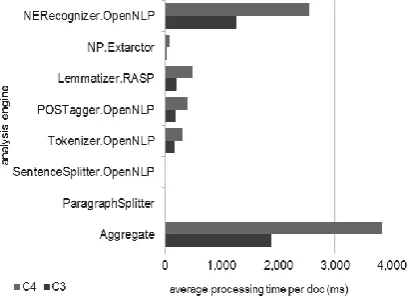
“Figure 4” shows the average processing time (in milliseconds) for each UIMA primitive engine (PE) for documents in categories C3 and C4. The performance of each PE is also linearly related to the number of tokens in the processed documents. The UIMA overhead time, caused by the CAS flow controller, is less than 1% of the total execution time and thus it is not represented at the “Figure 4”.
Figure 4. Average processing time of the primitive engines in the English LPC.
for text and Multi-Modal Analytics, IBM Research Report, RC24122 (W0611-188).
Cristea D., Pistol, I. 2008. Managing Language Resources and Tools using a Hierarchy of Annotation Schemas. In Proceedings of Workshop 'Sustainability of Language Resources and Tools for Natural Language Processing', organized in conjunction with LREC 2008
OSGi Alliance., OSGi Service Platform, 2009 Core Specification, Release 4, Version 4.2.