A VSM-based Statistical Model for the Semantic Relation Interpretation of
Noun-Modifier Pairs
Nitesh Surtani
IIIT Hyderabad
[email protected]
Soma Paul
IIIT Hyderabad
[email protected]
Abstract
The paper addresses the task of automatic in-terpretation of semantic relation in noun com-pounds. The problem has been attempted with both Ontology-based and Statistical ap-proaches, but both approaches having their own limitations. We present a novel VSM-based statistical model which represents each relation with a weighted vector of preposi-tional and verbal paraphrases. The model ranks the paraphrases on their relevance and assigns higher weights to more relevant para-phrases. The performance of the model is compared with the Ontology model and the results are quite encouraging. We finally pro-pose a Hybrid of the two models which com-pares on par with the best performing systems on Nastase and Szpakowicz (2003) dataset.
1 Introduction
There has been an increased interest in discovering the semantics of Noun Compounds (NCs1). There are two reasons that make this task quite essential and interesting in text understanding: (i) their im-plicit nature, for instance the NC ‘monday meet-ing’ is the meeting scheduled on monday (Tem-poral), ‘teacher meeting’ is the meeting organized for teachers (Participant) and‘NLP meeting’is the
meeting to discuss NLP topics(Quality-Topic); and
(ii) their frequent and compounding behavior. NCs are very frequent in english and comprise of 3.9% and 2.6% of all tokens in the Reuters corpus and the British National Corpus (BNC) respectively (Baldwin and Tanaka, 2004). New NCs are very fre-quently constructedeg. website design, internet us-age, orange juiceetc., and sometimes combine with other words to form longer compounds, e.g.,orange juice company, orange juice company homepageetc.
1A noun compound (NC) is a sequence of nouns which act
as a single noun (Downing, 1977),eg. sunday morning
The frequency spectrum of NCs follows a Zipfian distribution (Séaghdha, 2008), where many NC to-kens belong to along tail of low-frequency types. Over half of thetwo-typecompounds in BNC occur just once (Kim and Baldwin, 2006).
The research focusing on the semantic interpreta-tion of NCs has followed two direcinterpreta-tions: (i) Identi-fying the underlying semantic relation (Girju et al., 2005; Tratz and Hovy, 2010); and (ii) Paraphrasing the NC (Nakov, 2008; Butnariu and Veale, 2008; Butnariu et al., 2010). Consider the text:
“Alarge student protestwascarried out during monday evening by various engi-neering collegesto raise funds for research. This London protest saw tremendous par-ticipation by students from 14 colleges, see-ing to which R&D dept. agreed to increase thecollege fundsto 10,000,000 GBP. ”
The sequences marked in bold in the above ex-ample are Noun compounds (NCs). In the above text, some NCs are interpretable via paraphrasing:
protestwascarried out duringevening, where ‘dur-ing’ defines the temporality of the protest. On the other hand, some NCs are not explicit: student protestmeaning that the ‘protest was done by the students’(Agent),London protestmeaning‘protest was held in London’ (Spatial), monday evening
meaning‘evening of monday’ (Part-Of), engineer-ing collegesmeaning the‘colleges that specialize in engineering course’(Purpose),college fundsare the
‘funds allocated for the college’(Beneficiary). The goal of this paper is to discover the underlying se-mantic relation of the NCs via paraphrasing. The knowledge of semantic relation in the above NCs can help in answering questions like:Where was the protest held? Who led the protest? etc. The tasks has applications in many subfields of NLP, including Question Answering (Girju et al., 2006), Knowledge Base acquisition (Hearst, 1998) and others.
a knowledge-intensive ontology and (ii) extracting paraphrases from a large corpus. We discuss two existing WordNet-based ontology models: SemScat 1 (by Moldovan et al. (2004)) and SemScat 2 (by Beamer et al. (2008)), which uses the WordNet’s noun Hypernym (IS-A) hierarchy to find semantic similarity between two Noun-Noun pairs. The main focus (and contribution) of this paper is towards developing a Statistical model which uses Preposi-tional (eg. ‘benefit for consumer’), Verbal (eg. ‘ben-efit involving consumer’) and Verb+Prep (eg. ‘ben-efit received by consumer’) paraphrases of the NC (eg. ‘consumer benefit’) for identifying its relation.
The paper is organized as follows:Section 2 (Re-lated Works)describes previous works on Ontology and Statistical models; Section 3 (Data Analysis and Specification)describes the dataset used for ex-periments,Section 4 (Ontology-Based Model)and
Section 5 (Corpus-Based Model)discusses, exper-iments and provide insights on these two models.
Section 6 (Integrated Model)develops a hybrid of the two models andSection 7concludes the paper.
2 Related Works
Ontology-based Approach: Nastase et al. (2006) explores both WordNet and Roget’s Theasaurus for forming the classification features and find WordNet ontology to be more suitable for the task. Girju et al. (2003), Moldovan et al. (2004) and Beamer et al. (2008) propose Iterative semantic specialization (ISS), SemScat 1 and SemScat 2 modelsrespectively, which utilize WordNet’s Hypernym hierarchy and specialize the synsets from general to specific level.
ISS employs Decision Tree (C4.5) for modelling a singlePart-Wholerelation. SemScat 1andSemScat 2 are designed as multi-class classifiers for mod-elling a set of 35 relations (Moldovan et al., 2004) and 7 relations (Girju et al., 2007) respectively.
Statistical Approach: Nakov and Hearst (2006) suggests that the semantics of noun compounds is best expressible using multiple paraphrases involv-ing verbs and prepositions. For example, bronze statue is a statue that is made of, is composed of, consists of, contains, is of, is, is handcrafted from, is dipped in, looks likebronze. Nastase et al. (2006) makes an assumption that senses of NCs can be de-rived through collocated words learned from large corpus and use a sparse vector of collocated words as features (approx 10,000 features). Their system performs with low accuracy and is outperformed by their WordNet model of sparse Hypernym synset feature vector. Nulty (2007) extracts 28
preposi-tional paraphrases by forming simple‘N2 prep N1’ or ‘N2 prep the Y’templates and querying the web. He shows that the less frequent prepositions achieve higher accuracy than the more frequent ones in clas-sifying the relation. This observation aligns with ours and we employ a TF/IDF (modified) scheme to assign higher weights to such paraphrases. Tur-ney (2006b) introduces aLatent Relational Analy-sis (or LRA)model. The model extracts all possible synonyms for the modifier and the head using a the-saurus and uses a list of 64 joining terms,Jsuch as
‘of’, ‘for’and‘to’to form 128 phrases (i.e. M J H
andH J M). From the set of extracted paraphrases, top few thousands selected paraphrases are used to build an incidence matrix, whose dimensionality is reduced using singular value decomposition (SVD). Nastase et al. (2006), Turney and Littman (2005), Turney (2006a), Turney (2006b) and Nulty (2007) compare their systems on Nastase dataset, where Turney (2006b) outperforms others achieving a ac-curacy of 58% and 54.6% macro-averaged f-score2.
3 Data Specification
We work with two datasets: (i) Nastase and Sz-pakowicz (2003) dataset of noun-modifier pairs (re-ferred as Nastase dataset in the paper); and (ii) Butnariu et al. (2013) SemEval-13 Task 4 gold-paraphrased dataset (referred as SemEval dataset). Nastase dataset uses a two-level taxonomy of 5 coarse-grained and 30 fined-grained relations and comprises of 600 Noun-Modifier pairs consisting of a head noun and a modifier which can either be noun, adjective or adverb. The data is anno-tated withsemantic relationof the NC andPOS tag
andWordNet sensesof the modifier & head. This data has some issues: there are 4 cases of repe-tition and 3 compounds contain multi-word modi-fier (eg.-‘test tube’ baby), which have been pruned out. In the remaining 593 NCs, there are 326 in-stances of noun (55%), 260 inin-stances of adjectives (44%) and 7 instances of adverbs (1%) modifier. The SemEval dataset consists of 355 Noun-Noun compounds which are manually paraphrased by ap-prox. 30 annotators, with a total of 12,471 para-phrases. Each paraphrase is assigned a frequency, which is number of annotators who have marked that paraphrase for the given NC. We have annotated the NCs with semantic relations and modifier & head
WordNet sensesfollowing the guidelines from Nas-tase and Szpakowicz (2003). The experiments on
2Macroaveraged f-score is the overall mean of f-scores of
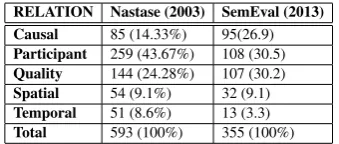
RELATION Nastase (2003) SemEval (2013) Causal 85 (14.33%) 95(26.9)
Participant 259 (43.67%) 108 (30.5)
Quality 144 (24.28%) 107 (30.2)
Spatial 54 (9.1%) 32 (9.1)
Temporal 51 (8.6%) 13 (3.3)
Total 593 (100%) 355 (100%)
Table 1:Distribution of Relations in Datasets
the SemEval dataset of gold paraphrases helps us in harnessing the full potential of the Statistical model which is not possible with Nastase dataset, as the quality of extracted paraphrases is nowhere close to manually annotated paraphrases. On the Nastase dataset, we compare the performance of our Hybrid model with other models evaluated on this dataset.
The ontology and corpus models are designed to handle only Noun-Noun compounds (Beamer et al., 2008; Turney, 2006b). We extend the ontol-ogy model to work with adjective and adverb modi-fiers but such adaptation is not possible for the cor-pus model. The ontology model uses the Noun Hy-pernymy hierarchy, which is extended to adjectives and adverbs by linking them to their correspond-ing noun synsets, through followcorrespond-ing WordNet re-lations: derivationally_related_form, pertainym, at-tributes_toandsimilar_to(eg.electric#a#1 elec-tricity#n#1). The corpus model always yields simi-lar paraphrases with adjective or adverb modifiers, making such paraphrases irrelevant for classifica-tion. Thus, the corpus model works with only 326 Noun-Noun compounds in Nastase dataset.
4 Ontology-Based Approach
We experiment with two WordNet-based models:
SemScat 1 by Moldovan et al. (2004) andSemScat 2by Beamer et al. (2008). The model works on the principle that two NCs having similar concepts in the Hypernym hierarchy encode same relation.
4.1 Model Formulation
Let L be the set of all the hypernym entity types (or synsets). Let the training set of n instances
T = ((x1r1)....(xnrn)), where x1....xn represent
the NCs annotated with semantic relations r1....rn
respectively, where ri ∈ relation set R. The input
xk is represented in terms of modifier and head
fea-tures < fm
i , fjh >, where fim, fjh ∈ L represent
synsets at level i andj in the hypernym hierarchy, combinedly represented asfij. Therefore, the goal
is to model the prediction functionF : (L×L)R. The SemScat models strives to learn general-ized sets of Hypernym synsets, known as Bound-ary, G. For instance - G1 = {entity}andG2 =
{physical−entity, abstract−entity, thing}are two boundaries where G2 is hyponym of G1. The
algorithm starts by creating the most general bound-aryG1={entity}and all the training examples are
mapped to this boundary by forming< Modifier−
Head >featuref11={entity−entity}. Then, the
model computes the probability of each relation r
for every feature formed in this new boundary. Next, the model identifies the most ambiguous feature (the one having the highest entropy) using the weighted entropy measure (Beamer et al., 2008) and special-izes its modifier & head synsets by their hyponyms. The algorithm again computes the statistics on this new boundary and the process is repeated.
Key Differences- SemScat 1 and SemScat 2: The main difference between the two models is the man-ner in which they store their boundary. SemScat1 strives to discover a single optimal boundary G∗, at which all the features map uniquely to a rela-tion. But practically, the boundary G∗ is overspe-cialized and therefore, the model finds a boundary
Gk which generalizes well over the test set by
us-ing a development set. The SemScat 1 terminates the further specialization of the boundary when the performance of the model drops on the develop-ment set (i.e. the model starts to over-specialize). It also uses a Threshold parameter (T) to restricts the over-specialization of the featuresfij, by
treat-ing it as disambiguated if the most probable rela-tion corresponding to featurefij has the probability
greater thanT. On the other hand, the SemScat 2 model keeps track of all the boundaries ranging from the most general to most specific boundary (G∗), G = {G1, ..., G∗} and terminates the training
af-ter discovering the boundaryG∗. Given an unseen instance (with featurefij), SemScat 1 searches for
this feature in the stored boundary Gk, and if the
feature is matched at this boundary, it assigns the most probable relation corresponding to the feature
fij, otherwise the instance is considered as missed
and no relation is assigned; while SemScat 2 starts the search for the feature fij from the most
spe-cific boundaryG∗and moves towards more general boundaries, and assigns the relation corresponding to the most specific feature matched.
4.2 Experiments
Experiment I: Comparison of SemScat 1 and SemScat 2:In this experiment, we compare the per-formance of the two models on the Nastase dataset. We perform k-fold cross-validation to evaluate the performance of the model over the complete dataset. The value ofkis varied as: k=5,7,10,15,30,50,
N −1(Leave-one-out3). The data is divided into training, development and testing set for SemScat 1, while into training and testing set for SemScat2. The development set used in SemScat 1 comprises of 20% data from the training set. The Threshold factor (T) is varied from 0.6 to 0.9 in steps of 0.05.
5 7 10 15 30 50 N−1
20 25 30 35 40 45 50 55
Comparison of SemScat 1 and SemScat 2
Folds
Performance
F−Score(SemScat 1) Accuracy(SemScat 1) F−Score(SemScat 2) Accuracy(SemScat 2)
Figure 1: Performance comparison of SemScat 1 and SemScat 2 on Nastase dataset at varyingkfolds
SemScat 2 outperforms SemScat 1 on each fold achieving the optimal performance at k = N −1 with the 53.46% accuracy (baseline 43.67%) and 48.13% f-score. SemScat 1 performs just above the baseline with accuracy and f-score of 45.02% and 33.70% respectively atk = 50andT = 0.7, classi-fying most of the instances with the majority relation
Participant. We find that the boundaryG∗ is quite specific (ranging fromlevel 6-8on Nastase dataset) while the boundary generally selected by SemScat 1 ranges from level 3-4in the experiments. This re-veals that SemScat 1 fails in achieving the goal of finding its optimal boundary that is the closest ap-proximation of the boundary G∗ and thus, misses out knowledge that would be useful for classifica-tion. The huge performance gap between the model using single boundary and the model storing mul-tiple boundaries motivates us to investigate the au-thenticity of each boundary in attesting the relation.
Experiment II: Performance of Different Bound-ary Levels in SemScat 2: This experiment eval-uates and compares the performance of multiple boundaries stored by the SemScat 2 model. The model is trained on optimal parametersk = N−1 and the accuracy of each level is computed.
3In Leave-one-out, one instance is tested at a time while rest
N−1instances are used for training
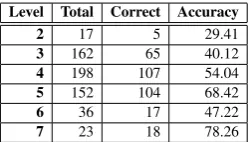
Level Total Correct Accuracy
2 17 5 29.41
3 162 65 40.12
4 198 107 54.04
5 152 104 68.42
6 36 17 47.22
7 23 18 78.26
Table 2:Performance of SemScat 2 at different levels
The results presented in Table 2 show that the con-fidence of the model in assigning the relation im-proves significantly with each level (except forlevel 6). The model performs with accuracy of only 29% at boundarylevel 2which shoots up to 78% atlevel 7. Most of the test instances are mapped at level 4 and 5, achieving accuracy of 54% and 68% re-spectively. This indicates that the NCs are classified accurately when matched with more specific knowl-edge. We capitalize of this useful insight in the Hy-brid model. Further, we observe that the ontology model faces difficulty in disambiguating between certain set of relations, eg. Student Protest(Agent) andStudent Discount(Beneficiary) are represented with very similar concepts in the Hypernym hierar-chy and therefore, the model fails to classify the NCs correctly. On the other hand, the corpus model eas-ily classifies these NCs, since‘protest(led_by, orga-nized_by)students’ clearly points toAgentrelation whereas‘discount (for, given_to)students’suggest that modifier is theBeneficiaryof the action. This complementing behavior of two models establishes the ground for integrating them.
5 Statistical Approach
The statistical model captures the meaning of the NC using Prepositional, Verbal and
Verb+Prepositional paraphrases and uses them to identify the underlying semantic relation. For in-stance,student protest(Participant)is paraphrased as ‘protest (by, of, led_by, involving, started_by)
students’, London protest (Spatial) as ‘protest
(in, at, of, held_at) London’ and evening protest (Temporal) as ‘protest (during, of, held_during ) evening’. In the above examples, the preposi-tion ‘by’ clearly points to Participant relation, ‘in’ and ‘at’ to Spatial relation and ‘during’ to Temporal relation. Similarly, verbal paraphrases ‘involving’ and ‘started_by’ indicate Participant
while paraphrases‘held_at’ and‘held_during’ in-dicateSpatialandTemporalrelations respectively. Prepositions are polysemous in nature and the same preposition can indicate different semantic relation, as also observed by (Srikumar and Roth, 2013),
from cancer’ (Causal-Cause), ‘excerpt from the book’ (Participant-Source), ‘protest from evening’
(Temporal) etc. But the degree of polysemity varies with prepositions, for eg. the preposition ‘of’ in the above 3 NCs maps to 3 different relations but the prepositions ‘by’, ‘at’ and ‘during’ occur specifically withParticipant, Spatial andTemporal
relations respectively. Prepositions that map to a single or fewer relations are more relevant for the task than the ones which frequently occur with different relations and thus, are weighted higher. Furthermore, we observe that the verb+prep paraphrases are quite significant, as such verbs are mostly accompanied with relevant prepositions, for eg. the paraphrase‘Protest held during evening’is plausible but‘Protest held of evening’is not. There-fore, the preposition & verb in such paraphrases are given more relevance using a Strength parameter.
The statistical model represents each NC as a pair of vector of prepositional and verbal paraphrases. With the relation of the NC known (i.e. supervised learning), we transform the NC vectors into Rela-tion Vectors, which represent the complete semantic class with a single pair of prepositional and verbal vector. TheVector Space Model (VSM)withNearest Neighbour classifier employed by the model com-putes the cosine similarity of the test vector with each Relation vector and assigns it the relation with the highest similarity. The next sections describe the two most important modules of this model: Para-phrase Extraction and Vector Formation module.
5.1 Paraphrase Extraction Module
The goal of this system is to take an NC as in-put and provide the set ofprepositional, verbal and verb+prep paraphrases for it. It consists of three submodules: former dealing with extraction while latter two perform cleaning of paraphrases.
Module 1: Paraphrase Extraction:We have relied mainly on the Google N-gram Corpus for extract-ing the paraphrases. Google has publicly released their web data as n-grams, also known as Web-1T corpus (Brants and Franz, 2006). The corpus con-tains 2-, 3-, 4- and 5-grams sequences and returns
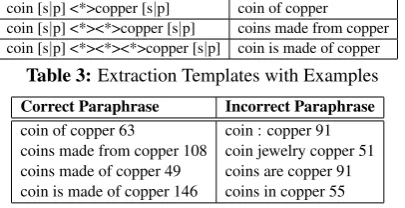
n-gram matches that occur more than 40 times. The templates for extraction with few (correct and incor-rect) selected paraphrases for NCCopper Coinare presented in Table 3 and 4 respectively. Among in-correct paraphrases, the first two are syntactically il-legitimate while the last two are syntactically sound but semantically illegitimate. ‘coins are copper’is part of ‘one cent coins are copper or not’ while
‘coins in copper’is part of‘coins in copperbowl’.
coin [s|p] <*>copper [s|p] coin of copper coin [s|p] <*><*>copper [s|p] coins made from copper coin [s|p] <*><*><*>copper [s|p] coin is made of copper
Table 3:Extraction Templates with Examples
Correct Paraphrase Incorrect Paraphrase
coin of copper 63
coins made from copper 108 coins made of copper 49 coin is made of copper 146
coin : copper 91 coin jewelry copper 51 coins are copper 91 coins in copper 55
Table 4:Paraphrases Extracted from Google N-Gram Module 2: Syntactic Cleaning: To handle the syntactically ill-formed paraphrases, we prepare a set of plausible syntactic templates. The paraphrases for 60 NCs (with total of 5716 paraphrases) are manually marked as incorrect or correct (0 or 1 re-spectively) by two annotators, with high agreement of annotation, since the complexity of the task is
EASY. The correct paraphrases are POS tagged us-ing theCMU ark-tweet POS-tagger(more efficient in tagging 3- & 4-grams than the Stanford POS-tagger) and POS templates are extracted. The data is divided equally into training and testing sets of 30 NCs each. Table 5 shows that the syntactic templates, although learnt from considerably small training data, are exhaustive and achieve good cov-erage of 91.4% on the test set, but low precision of 56.7% as many semantically illegitimate para-phrases are matched by these templates.
Recall Precision F-Score
[Without Constraints] 91.4 56.68 69.97
[With Constraints] 91.4 72.9 81.11
Table 5:Comparison of Syntactic Templatesbeforeand afterapplying Semantic Constraints
Module 3: Semantic Cleaning: The syntactic templates are unable to filter out semantically ille-gitimate paraphrases. Such paraphrases are cleaned by looking at their context, extracted from extended paraphrases:coins in copper<∗><∗>.
Constraint: If the modifier of a given NC is part of a NP chunk having another noun as head, then it is not a legitimate paraphrase. eg: (NP (NNScoins)) (PP (INin) (NP (NNcopper)
(NN bowl)))
into training and testing set with k-fold cross-validation,kvarying as,k= 5,7,10,15,30,50and
N−1.
Model F A Model F A
1: [-R -W -P] 35.23 36.21 4: [+R +W -P] 35.77 38.54
2: [-R +W -P] 36.33 38.18 5: [+R -W +P] 37.97 39.34
3: [+R -W -P] 24.41 35.9 6: [+R +W +P] 38.82 40.72
Table 6:Performance of Models on Prepositional vector
The description of the models with their per-formance on prepositional vector is presented in Table 6. The Model 6 [+R +W +P] (i.e. Model using weighted prior probability Relation vectors) outperforms other models on both preposition and verb vectors. This model achieves an accuracy of 40.72% (baseline 30.55%) and f-score of 38.82% with prepositional vector and (Acc, F) of (34.93%, 35.78%) with verb vector atk =N−1. Therefore, Model 6 is selected for the next two experiments.
Experiment II: Investigating the relevance of Verb+Prep paraphrases: This experiment investigates the relevance of verb+prep paraphrases (e.g. ‘held during’) over preposition and verb paraphrases. We have discussed that these para-phrases are splitted into preposition (i.e. ‘during’) and verb (‘hold’) and contribute to the frequencies of corresponding features in preposition and verb vector, with respective weighting factorsSpandSv,
referred as the Strength parameters. Thus, a higher value of Sp and Sv means greater contribution of
verb+preposition paraphrases in the classification model. The Strength parameters in Experiment I were fixed to Sp = 1andSv = 1but are varied in
this experiment from values1to15.
0 1 2 3 5 7 9 10 12 25
30 35 40 45
Effects of Strength Parameter
Strength Parameter
Performance Accuracy(Prep)
F−Score(Prep) Accuracy(Verb) F−Score(Verb)
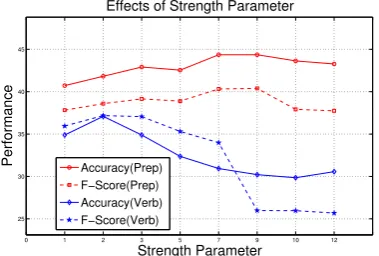
Figure 2: Performance of Preposition and Verb models on varying the Strength parametersSpandSv
The effects of Strength parameter on the prepo-sition and the verb models on SemEval dataset are shown in Figure 2. The performance of preposi-tional model improves drastically (Acc, F) from
(40.72%, 38.82%) to (44.36%, 40.39%) between values 1 to 9 (~4% improvement in accuracy and ~2.5%in f-score) and then drops down. The verb vector achieves best results atSv = 2. This proves
two things: First, verb+prep paraphrases have cru-cial contribution in the model and thus, finding such paraphrases in corpus is important, and secondly, the high value ofSp= 9reveals that prepositions in
verb+prep paraphrases are in fact quite relevant.
Experiment III: Integrating the Preposition and Verb models: In this experiment, we compare the Concatenation model and Best-Selection model for integrating the Prepositional and Verbal models. The experiment is performed on optimal parameters learnt from previous experiments, i.e. Model 6
with Sp = 9 and Sv = 2 at k = N −1. The
Concatenation model concatenates the preposition and the verb feature vectors to form a single vector, with Contribution factorf varying from 0 to 2 in steps of 0.2. The Best-Selection model evaluates the performance of each relation on both the models and given a unseen instance, selects the model which classifies the relation with higherf−score.
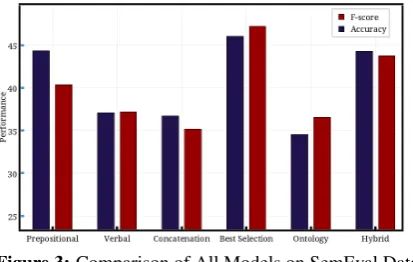
The concatenation of prepositional and verbal fea-tures in the Concatenation model degrades the per-formance at every contribution factorf, achieving the best accuracy of only 36.72% with 35.16% f-score when both vectors are equally weighted at
f = 1, shown in Figure 3. This shows that the significance of preposition features is diluted by the less significant verb features. On the other hand, the performance with Best-Selection model shoots up, which achieves accuracy of 46% with drastic im-provement of∼7in f-score, reaching 47.19%.
5.6 Observations
The Best-Selection model integrating the preposi-tional model and verbal model is selected as the best Statistical model, with optimal parametersSp = 9
andSv = 2at foldk = N −1. It uses Weighted
Relation vector incorporating Prior probability [+R +W +P] for both preposition and verb feature vec-tors. This model achieves 46.04% accuracy (base-line 30.5%) and 47.19% f-score on SemEval dataset and hugely outperforms the ontology model, which performs just above the baseline achieving accuracy of only 34.53% and f-score of 36.56%.
insuffi-Figure 3:Comparison of All Models on SemEval Data
cient and poor quality of paraphrases obtained from the corpus, mainly verb and verb+preposition para-phrases, which are nowhere close to the human an-notated paraphrases. We have selected only those NCs for the experiments for which atleast 3 para-phrases are found. Thus, experiment is performed with 241 NCs (out of 326 Noun-Noun pairs) for which this criteria is satisfied. An interesting prop-erty of the Relation vector is that it maps the lexical terms (i.e. prepositions and verbs) to semantic re-lations, and ranks them in decreasing order of their co-occurence with the relation. Table 7 presents the
fivetop weighted prepositions for each relation. Relation Examples Top-5 Prepositions Causal advertisement agency, cancer death for, with, against, from, on Quality trade statistics, wafer buscuit like, about, as, of, on Spatial garden party, village school towards, near, at, in, around Temporal spring weather, summer meeting during, after, in, at, from Participant army coup, class party by, from, of, in, for Table 7:Top-5 Relevant prepositions for each relation
6 Hybrid Model
The goal of the Hybrid model is to integrate knowl-edge of two very different models: one using the knowledge from a ontology while other deriving it from a corpus. The model employs a Best-Selection strategy which does nothing more than selecting the more suitable model for classification for any given test instance. Therefore, for the model to be effi-cient, it must satisfy two conditions:
a)The constituent models must be complimenting.
b) The model must have a selection criteria that works efficient in different circumstances. We find the two models to be complementing as the statisti-cal model identifies some relations more accurately than ontology model and vice-versa, as discussed in Section 4.2. Further, we find that the performance of ontology model improves with each level of special-ization (in Table 2). This insight is useful in imple-menting the selection criteria. The model computes aPreference Score,P for each model and selects the model with higher score for classifying the unseen
instance. For ontology model, the f-score of each relation,ri at each boundary levelGk is evaluated.
Similarly, thef-scoreof each relation,riis evaluated
for corpus model. Now, given a unseen instance, the following decision is taken:
POnt(r
1)X > PCor(r2), then R∗=r1; else R∗=r2 (5)
where POnt(r1)Gk is the f-score of relation r1 at
boundary levelGk andR∗is the assigned relation.
The Hybrid model on the data of 241 NCs (on which corpus model is evaluated) performs quite well and outperforms the ontology and corpus mod-els by 4.5% and 6.5% respectively, as shown in Table 8. These results are slightly better than the state-of-the-art system tested on this dataset (Tur-ney, 2006b) but are below when compared on com-plete dataset of 593 NCs (out of which 352 NCs use only ontology model). The overall performance on Nastase dataset of 593 NCs achieves 55.31% ac-curacy with 49.47% f-score. On SemEval dataset, the performance of statistical model drops by ~2% when integrated with ontology model, which per-forms poorly on this dataset, as shown in Figure 3.
Relation Ontology(593 NC) (241 NC)Corpus (241 NC)Hybrid (593 NC)Hybrid Quality 45 39.18 49.59 49.59
Temporal 78.26 55.81 75 75
Spatial 29.41 14.81 35.71 35.71
Participant 64.6 65.72 67.78 67.78
Causal 29.09 0 34.78 34.78
Macro-Avg F 49.27 35.11 52.57 52.57
Accuracy 54.35 52.28 58.92 55.31
Table 8:Comparison of Models on Nastase Dataset
7 Conclusion
References
Barbara Rosario and Marti Hearst. 2001. Classify-ing the semantic relations in noun compounds via a domain-specific lexical hierarchy. In Proceedings of the 2001 Conference on Empirical Methods in Natural Language Processing (EMNLP-01).
Brandon Beamer, Alla Rozovskaya and Roxana Girju. 2008. Automatic Semantic Relation Extraction with Multiple Boundary Generation. In AAAI (pp 824-829).
Cristina Butnariu and Tony Veale. 2008. A concept-centered approach to noun-compound interpretation. Proceedings of the 22nd International Conference on Computational Linguistics-Volume 1. Association for Computational Linguistics.
Cristina Butnariu, Su Nam Kim, Preslav Nakov, Diar-muid O Séaghdha, Stan Szpakowicz and Tony Veale. 2010. Semeval-2 task 9: The interpretation of noun compounds using paraphrasing verbs and preposi-tions. In Proceedings of the 5th SIGLEX Workshop on Semantic Evaluation.
Cristina Butnariu, Su Nam Kim, Preslav Nakov, Diar-muid O Séaghdha, Stan Szpakowicz and Tony Veale. 2013. Semeval-13 task 4: Free Paraphrases of Noun Compounds. In Proceedings of the International Workshop on Semantic Evaluation, Atlanta, Georgia. Dan Moldovan, Adriana Badulescu, Marta Tatu, Daniel
Antohe and Roxana Girju. 2004. Models for the Se-mantic Classification of Noun Phrases. In the pro-ceedings of the HLT/NAACL Workshop on Compu-tational Lexical Semantics . Boston, MA.
Diarmuid O Séaghdha. 2008. Learning compound noun semantics. University of Cambridge, Cambridge, UK. Marti Hearst. 1998.Automated discovery of WordNet re-lations. WordNet: an electronic lexical database, 131-151.
Nitesh Surtani, Arpita Batra, Urmi Ghosh and Soma Paul. 2013. IIITH: A Corpus-Driven Co-occurrence Based Probabilistic Model for Noun Compound Paraphras-ing. In Proceedings of the International Workshop on Semantic Evaluation, Atlanta, Georgia.
Olutobi Owoputi, Brendan O Connor, Chris Dyer, Kevin Gimpel, Nathan Schneider and Noah A. Smith 2013. Improved Part-of-Speech Tagging for Online Conver-sational Text with Word Clusters. HLT-NAACL. Pamela Downing. 1977. On the creation and use of
En-glish noun compounds.Language, 53(4): 810-842. Paul Nulty. 2007. Semantic classification of noun
phrases using web counts and learning algorithms. In Proceedings of the ACL 2007 Student Research Work-shop (ACL-07), pages 79-84.
Peter D Turney and Michael L. Littman. 2005. Corpus-based learning of analogies and semantic relations. Machine Learning, 60(1-3):251-278.
Peter D Turney. 2006.Expressing implicit semantic rela-tions without supervision. In Proceedings of the 21st International Conference on Computational Linguis-tics and 44th Annual Meeting of the Association for Computational Linguistics (Coling/ACL-06), Sydney, Australia.
Peter D Turney. 2006. Similarity of semantic relations. Computational Linguistics, 32 (3), 379-416.
Preslav Nakov and and Marti Hearst. 2006.Using verbs to characterize noun-noun relations. Artificial In-telligence: Methodology, Systems, and Applications. Springer Berlin Heidelberg.
Preslav Nakov. 2008. Noun compound interpretation using paraphrasing verbs: Feasibility study. Artifi-cial Intelligence: Methodology, Systems, and Appli-cations. Springer Berlin Heidelberg, 2008. 103-117. Roxana Girju, Adriana Badulescu and Dan Moldovan.
2003. Learning Semantic Constraints for the Auto-matic Discovery of Part-Whole Relations. Proceed-ings of the 2003 Conference of the North American Chapter of the Association for Computational Linguis-tics on Human Language Technology-Volume 1. Asso-ciation for Computational Linguistics.
Roxana Girju, Dan Moldovan, Marta Tatu and Daniel An-tohe. 2005. On the semantics of noun compounds. Computer, Speech and Language 19(4):479-496. Roxana Girju, Adriana Badulescu and Dan Moldovan.
2006. Automatic Discovery of Part-Whole Relations. In Computational Linguistics.
Roxana Girju, Preslav Nakov, Vivi Nastase, Stan Sz-pakowicz, Peter D. Turney, Deniz Yuret. 2007. Semeval-2007 task 04: Classification of semantic re-lations between nominals.. In Proceedings of the 4th International Workshop on Semantic Evaluations (pp. 13-18). Association for Computational Linguistics. Satanjeev Banerjee, Ted Pedersen. 2002. An Adapted
Lesk Algorithm for Word Sense Disambiguation using WordNet - In the Proceedings of the Third Interna-tional Conference on Intelligent Text Processing and Computational Linguistics, pp. 136-145, Mexico City. Su Nam Kim and Timothy Baldwin. 2006. Interpreting semantic relations in noun compounds via verb seman-tics. Proc. ACL-06 Main Conference Poster Session, Sydney, Australia, 491-498.
Stephen Tratz and Eduard Hovy. 2010. A taxonomy, dataset, and classifier for automatic noun compound interpretation. In Proceedings of the 48th Annual Meeting of the Association for Computational Lin-guistics. Association for Computational LinLin-guistics. Thorsten Brants, Alex Franz. 2006.Web 1T 5-gram
Ver-sion1. Linguistic Data Consortium.
right. In Proceedings of ACL-2004 Workshop on Mul-tiword Expressions: Integrating Processing.
Vivek Srikumar and Dan Roth. 2013. Modeling semantic relations expressed by prepositions. Transactions of Association of Computational Linguistics.
Vivi Nastase and Stan Szpakowicz. 2003. Exploring noun-modifier semantic relations. In Fifth Interna-tional Workshop on ComputaInterna-tional Semantics (IWCS-5), pages 285-301, Tilburg, The Netherlands.
Vivi Nastase, Jelber Sayyad Shirabad, Marina Sokolova and Stan Szpakowicz. 2006. Learning noun-modifier semantic relations with corpus-based and Wordnet-based features. In Proceedings of the 21st Na-tional Conference on Artificial Intelligence (AAAI-06), pages 781-787.