Using a Morphological Database to Increase the Accuracy in POS Tagging
Hrafn Loftsson School of Computer Science
Reykjavik University
Sigrún Helgadóttir The Árni Magnússon Institute
for Icelandic Studies
Eiríkur Rögnvaldsson Department of Icelandic
University of Iceland
Abstract
We experiment with extending the dic-tionaries used by three open-source part-of-speech taggers, by using data from a large Icelandic morphological database. We show that the accuracy of the tag-gers can be improved significantly by us-ing the database. The reason is that the unknown word ratio reduces dramatically when adding data from the database to the taggers’ dictionaries. For the best per-forming tagger, the overall tagging accu-racy increases from the base tagging result of 92.73% to 93.32%, when the unknown word ratio decreases from 6.8% to 1.1%. When we add reliable frequency informa-tion to the tag profiles for some of the words originating from the database, we are able to increase the accuracy further to 93.48% – this is equivalent to 10.3% error reduction compared to the base tagger.
1 Introduction
In general, part-of-speech (PoS) taggers can be catagorised into two types. First,data-driven tag-gers, i.e. taggers that are trained on pre-tagged corpora and are both language and tagset indepen-dent, e.g. (Brants, 2000; Toutanova et al., 2003; Shen et al., 2007). Second, linguistic rule-based taggers, which are developed “by hand” using lin-guistic knowledge, with the purpose of tagging a specific language using a particular tagset, e.g. (Karlsson et al., 1995; Loftsson, 2008).
All taggers use a particular tagset T and rely on a dictionaryDcontaining the tag profile (am-biguity class)Tw for each wordw. A tag profile Tw indicates which tags are assignable tow, thus Tw ⊂ T. Essentially, for each wordw, a tagger disambiguates Tw by selecting (or removing all but) one tag from it with regard to context. The
dictionary D is derived by a data-driven tagger during training, and derived or built during devel-opment of a linguistic rule-based tagger.
When tagging new text, PoS taggers frequently encounter words that are not inD, i.e. so-called
unknown words. An unknown worducan be quite problematic for a tagger, because the tag profile foruneeds to be guessed. In most cases, PoS tag-gers therefore contain a special module, called an
unknown word guesser, to generate the tag profile for unknown words. Frequently, the guessing of the tag profile for unknown words is incorrect and therefore the tagging accuracy for these words is considerably lower than the tagging accuracy for known words. To increase the overall tagging ac-curacy of PoS taggers, one might therefore try to refine the underlying unknown word guessers. An-other approach is simply to try to minimise the ra-tio of unknown words by extending the dicra-tionar- dictionar-ies used by the taggers.
In this paper, we use the latter approach. We ex-periment with extending the dictionaries used by three PoS taggers for Icelandic with data from a large morphological database (Bjarnadóttir, 2005). Our logical assumption is that the overall tagg-ing accuracies of the taggers can be increased by this method, but we are also interested in how extended dictionaries affect the accuracy for un-known words and un-known words separately.
The three taggers used in our experiments are: i) the linguistic rule-based taggerIceTagger (Lofts-son, 2008); ii)TriTagger, a re-implementation of the statistical tagger TnT by Brants (2000); and iii) a serial combination of the two (Loftsson et al., 2009).
The morphological database does not contain any frequency information for the tags in the tag profile for each word, but, nevertheless, we show that the tagging accuracy of the taggers can be im-proved significantly by using the database. The reason is that when we add most of the data from
the database to the taggers’ dictionaries the un-known word ratio decreases dramatically, from 6.8% to 1.1%. In that case, the overall tagging accuracy of the best performing tagger, the se-rial combination of IceTagger and TriTagger, in-creases from the base tagging result of 92.73% to 93.32%. When we add reliable frequency in-formation, derived from a corpus, to the tag pro-files for a part of the words originating from the database, we are able to increase the accuracy fur-ther to 93.48% – this is equivalent to 10.3% error reduction compared to the base tagger.
Interestingly, it seems that very few papers ex-ist in the literature regarding extensions of the dictionaries used by PoS taggers. In (Rupnik et al., 2008), a dictionary derived from training is essentially extended by using a backup lexicon extracted from a large corpus (which is differ-ent from the training corpus). In contrast, we use a morphological database to extend a tagger’s dictionary, but use a corpus for deriving frequency information for part of the dictionary entries. In (Tufis et al., 2008), an unknown word u, and its tag profile and lemma obtained by a tagger when tagging new texts, is used by a morphological gen-erator to generate tag profiles for new word forms that are morphologically related tou. The diction-ary is thus extended incrementally, each time new text is tagged. In contrast, since we have access to a large morphological database, we extend a tagger’s dictionary once and for all.
2 The morphological database
At the Árni Magnússon Institute for Icelandic Studies, a comprehensive full form database of modern Icelandic inflections has been developed (Bjarnadóttir, 2005). Its Icelandic abbreviation is BÍN (“Beygingarlýsing íslensks nútímamáls”), and henceforth we use that term. BÍN contains about 280,000 paradigms, with over 5.8 million inflectional forms. The output from the database used in this project contains lemma, word form, word class, and morphological features for com-mon nouns, proper nouns, adjectives, verbs, and adverbs. It is important to note that the database does, however, not contain any frequency infor-mation for the word forms.
A web interface for BÍN is available athttp: //bin.arnastofnun.is, from where a text file in the format used in this project can be down-loaded. Below are 16 lines from the file,
demon-strating entries for the lemma “hestur” ‘horse’:
hestur;6179;kk;alm;hestur;NFET hestur;6179;kk;alm;hesturinn;NFETgr hestur;6179;kk;alm;hest;ÞFET
hestur;6179;kk;alm;hestinn;ÞFETgr hestur;6179;kk;alm;hesti;ÞGFET hestur;6179;kk;alm;hestinum;ÞGFETgr hestur;6179;kk;alm;hests;EFET hestur;6179;kk;alm;hestsins;EFETgr hestur;6179;kk;alm;hestar;NFFT hestur;6179;kk;alm;hestarnir;NFFTgr hestur;6179;kk;alm;hesta;ÞFFT hestur;6179;kk;alm;hestana;ÞFFTgr hestur;6179;kk;alm;hestum;ÞGFFT hestur;6179;kk;alm;hestunum;ÞGFFTgr hestur;6179;kk;alm;hesta;EFFT hestur;6179;kk;alm;hestanna;EFFTgr
The exact meaning of the data in each column is not important for our discussion, but we point out that the lemma is in the first column, gen-der is in third column (“kk”=masculine), the word form is in the fifth column, and the morphologi-cal features case, number and definiteness are in the last column (for example, “NF”=nominative, “ET”=singular, “gr”=definite article).
3 The corpus and the taggers used
The Icelandic Frequency Dictionary (IFD) corpus (Pind et al., 1991) has been used to train and test taggers for Icelandic (Helgadóttir, 2005; Loftsson, 2008; Dredze and Wallenberg, 2008; Loftsson et al., 2009). The corpus contains about 590,000 to-kens, and its underlying tagset about 700 tags, of which 639 tags actually appear in the corpus. The tags are character strings where each character has a particular function. The first character denotes theword class. For each word class there is a pre-defined number of additional characters (at most six), which describe morphological features, like
gender, number and case for nouns; degree and
declension for adjectives; voice, mood and tense
for verbs, etc. To illustrate, consider the word form “hestur” ‘horse’. The corresponding tag is “nken”, denoting noun (n), masculine (k), singular (e), and nominative (n) case.
As mentioned in Section 1, we use one linguis-tic rule-based tagger (IceTagger), one data-driven tagger (TriTagger), and a serial combination of the two in our experiments. Both IceTagger and TriTagger are implemented in Java and are part of the open-source IceNLP toolkit1.
IceTagger is reductionistic in nature, i.e. it re-moves inappropriate tags from the tag profile Tw
1IceNLP is available at http://icenlp.
for a specific word w in a given context. Ice-Tagger first applies local rules for initial disam-biguation and then uses a set of heuristics (global rules) for further disambiguation. The tag profile for each word used by IceTagger is ordered by the frequency of the tags – the first tag listed is the most frequent one and the last tag is the least fre-quent one. If a word is still ambiguous after the application of the heuristics, the default heuris-tic is simply to choose the most frequent tag (the first tag) for the word. An important part of Ice-Tagger is its unknown word guesser, IceMorphy. It guesses the tag profile for unknown words by applying morphological analysis and ending anal-ysis. In addition, IceMorphy can fill in thetag pro-file gaps2in the dictionary for words belonging to certain morphological classes (Loftsson, 2008).
TriTagger is a re-implementation of the well known Hidden Markov Model (HMM) tagger TnT by Brants (2000)3. TriTagger uses a trigram model to find the sequence of tags for words in a sentence which maximises the product of contextual proba-bilities (P(ti|ti−2, ti−1)) and lexical probabilities (P(wi|ti)):
P(t1)P(t2|t1) n
Y
i=3
P(ti|ti−2, ti−1) n
Y
i=1
P(wi|ti)
(1) In the above equation, wi denotes word i in a sentence of lengthn(1 ≤ i ≤ n) andti denotes the tag for wi. The probabilities are derived us-ing maximum likelihood estimation based on the frequencies of tags found during training.
HMM taggers handle unknown words by set-ting tag probabilities according to words’ suffixes. The term suffix is here defined as a final sequence of characters of a word. TnT, and thus TriTag-ger, generate probability distributions for suffixes of various lengths. The distribution for particular suffixes is based on words in the training data that share the same suffix. The reader is referred to (Brants, 2000) for the details of suffix handling.
2
A tag profile gap for a word occurs when a tag is missing from the tag profile. This occurs, for example, if not all pos-sible tags for a given word are encountered during training.
3
The TnT tagger is extremely efficient – both training and testing are very fast. Unfortunately, TnT is closed source which limits its use when changes need to be carried out to its default behaviour. TriTagger is open-source and therefore its functionality can be changed or extended relatively easily. Moreover, our experiments have shown that its tagging accu-racy is almost identical to the accuaccu-racy obtained by TnT. On the other hand, TriTagger has not been optimised for run-time efficiency.
Below, we exemplify the tag profiles stored in the dictionaries for IceTagger and TriTagger for a specific word “konu” ‘woman’:
konu nveþ nveo nvee
konu 122 nveþ 44 nveo 42 nvee 36
The first tag profile is stored in the dictionary for IceTagger. The possible tags are “nveþ”, “nveo”, and “nvee” (denoting noun, feminine, singular, da-tive/accusative/genetive), sorted by decreasing fre-quency. The second tag profile is stored in the dictionary for TriTagger. It contains similar infor-mation, but, additionally, frequency information is attached to both the word itself and each possible tag.
3.1 Base tagging results
We have previously shown (Loftsson et al., 2009) that a significant improvement in tagging accuracy is obtainable by running a serial combination of IceTagger and a HMM tagger (TriTagger). Specif-ically, the best result was obtained by making the HMM perform initial disambiguation only with regard to the word class (the first letter of a tag), then running IceTagger, and finally by making the HMM disambiguate words that IceTagger was not able to fully disambiguate. This tagger is called
HMM+Ice+HMM.
In our current experiments, we use 10-fold cross-validation on the exact same training and test splits of the so-calledcorrected versionof the IFD corpus used by Loftsson et al. (2009). Each test corpus contains about 10% of the tokens from the IFD, while the corresponding training corpus contains about 90% of the tokens. The average unknown word ratio using this data split is about 6.8%.
We use a version of the corrected IFD corpus in which type information for proper nouns (named-entity classification) has been removed, and addi-tionally we only use one tag for numerical con-stants. The reason for these changes is to make the tagset of the corpus comparable to tagsets for other languages. These changes reduce the size of the tagset from about 700 tags to about 600 tags, and the number of tags actually appearing in the IFD reduces from 639 tags to 567.
Tagger Unknown Known All TriTagger 72.98 92.18 90.86 IceTagger 77.02 93.07 91.98 HMM+Ice+HMM 77.47 93.84 92.73
Table 1: Average base tagging accuracy (%). Av-erage ratio of unknown words in testing is 6.8%.
tagging results – in the experiments described in the next section we try to improve on these figures.
4 The experiments
In this section, we describe the setup and results of two experiments. First, we extend the dictionaries used by the three taggers by using data from the morphological database BÍN. Second, we add reli-able frequency information to some of the diction-ary entries (tag profiles).
4.1 Extending the dictionaries
This part of our experiment is in two parts. First, we generate a fileF1 by extracting only lemmata from the database output described in Section 2. F1 contains about 280,000 lemmata. To clarify, only the first line in the example output shown in Section 2 is then included inF1. Second, we drop the lemmata condition and generate a fileF2by se-lecting most of the word forms from the database output4.F2contains about 5.3 million rows.
To generate an extended dictionary for a tagger (classifier)Cusing data fromF1, we perform the following (the same procedure applies when using F2):
1. Derive a dictionary from F1, containing words and their corresponding tag profiles. Symbols denoting morphological features in F1 are mapped to the symbols used in the IFD tagset. We call the resulting dictionary DBIN.
2. CombineDBIN with the dictionary D gen-erated by a tagger C during training (the number of entries inDare about 55,000, on the average). The result is a new dictionary DEXT. If a word exists in bothDandDBIN then only the entry fromDappears inDEXT.
3. Test taggerCusing dictionaryDEXT.
4Because of memory issues with the taggers, we exclude
proper nouns that are names of places.
Tagger Unknown Known All
TriTagger 74.44 91.53 90.63 IceTagger 80.44 92.83 92.18 HMM+Ice+HMM 80.53 93.57 92.89
Table 2: Average tagging accuracy (%) using dic-tionaries extended with lemmata only from BÍN. Average ratio of unknown words in testing is about 5.3%.
The above description holds when generating an extended dictionary for IceTagger, a tagger which does not need frequency information in the tag profile for words. In the case of TriTagger, we sim-ply assume a uniform distribution, i.e. we mark each tag in the tag profileTw for wordwwith the frequency 1. Note that for TriTagger, extending the dictionary only affects the lexical probabilities from Equation 1 – the contextual probabilities re-main unchanged.
Recall (from Section 3) that HMM taggers han-dle unknown words by generating probability dis-tributions for suffixes of various lengths using the words in the training data. We want the generation of these probability distributions to be only depen-dent on the data fromD(from the IFD corpus), but not as well from DBIN. The reason is twofold. First, the IFD corpus is large enough for deriving reliable suffix probability distributions. Second, using all the words from a very large dictionary (like DEXT) to generate the distributions signif-icantly slows down the tagging process. This is-sue demonstrates the importance of having access to open-source software. We simply changed the loading module of TriTagger such that it does not use all dictionary entries for suffix handling. If the loading module finds a special entry in the diction-ary (essentially a specially marked comment) it does not use the succeeding entries for suffix han-dling. We put the special entry intoDEXT after the last entry fromDand thus before the first en-try fromDBIN.
Let us first consider the case of using file F1 for extending the dictionaries, i.e. when only ex-tracting lemmata from the database output. In that case, the resultingDBIN contains about 260,000 entries. Table 2 shows the accuracy of the taggers when using this version of the extended dictionary. Comparing the results from Tables 2 and 1, we note the following:
by about 1.5% (from about 6.8% to about 5.3%).
• The accuracy for known words decreases in the three taggers. The most probable rea-son is that the tag profile for some of the lemmata entries coming fromDBINcontains gaps (see Section 3). This can be attributed to the fact that only a single line from the database output is selected when extracting the lemmata, but in many cases a lemma can have multiple analysis (tags). Note that this decrease in accuracy for known words is con-siderably higher in TriTagger (0.65 age points) than in IceTagger (0.24 percent-age points). This is because the unknown word guesser IceMorphy, used by IceTagger, can fill into the tag profile gaps for certain morphological classes, as mentioned in Sec-tion 3.
• The accuracy for unknown words increases in all the three taggers – the highest gain (3.42 percentage points) is obtained by IceTagger. For the case of IceTagger the reason is that IceMorphy first applies morphological anal-ysis to unknown words (before trying end-ing analysis). For an unknown wordu, Ice-Morphy searches for a morphologically re-lated word (a known word) touin its diction-ary, i.e. a word containing the same stem but a different morphological suffix. The added lemmata entries can thus serve as re-lated words for unknown words and since the morphological analysis module of IceTagger is quite accurate (Loftsson, 2008), the added lemmata entries help to increase the tagging accuracy of unknown words.
• The accuracy for all words increases in both IceTagger and HMM+Ice+HMM, but only by 0.20 and 0.16 percentage points, respectively. Obviously, the decreased accuracy for known words “cut backs” the gain obtained in the ac-curacy for unknown words. TriTagger’s rela-tively large reduction in accuracy for known words is to blame for the reduction in its ac-curacy for all words.
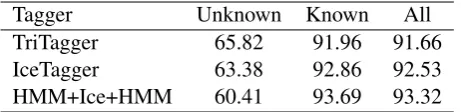
Let us now consider the second case, when us-ing fileF2 for extending the dictionaries. F2 con-tains most of the entries from the database and the resultingDBIN contains about 2.6 million entries.
Tagger Unknown Known All
TriTagger 65.82 91.96 91.66 IceTagger 63.38 92.86 92.53 HMM+Ice+HMM 60.41 93.69 93.32
Table 3: Average tagging accuracy (%) using dic-tionaries extended with most of the data from BÍN. Average ratio of unknown words in testing is 1.1%.
Table 3 shows the accuracy of the taggers when using this large version of the extended dictionary. Comparing the results from Tables 3 and 1, we note the following:
• The average unknown word ratio drops down to 1.1%. Concurrently, the accuracy for un-known words decreases substantially in all the three taggers. This is because the un-known word ratio drops dramatically and only “hard” unknown words remain – mostly proper nouns and foreign words.
• The accuracy for known words decreases in the three taggers by 0.15-0.22 percentage points. This is a lower decrease than when using only lemmata entries from BÍN (see Ta-ble 2) and can be explained by the fact that in this case the added entries from BÍN should not contain tag profile gaps. Why do we then see a slight decrease in accuracy for known words? Recall that BÍN does not contain any frequency information and therefore, for the added dictionary entries, we had to: i) as-sume a uniform distribution of tags in the the tag profile for TriTagger, and ii) assume no specific order for the tags in the tag profile for IceTagger (see the discussion on the or-der of the tags in Section 3). This is the most probable reason for the slight reduction in the tagging accuracy of known words.
• The accuracy for all words increases signifi-cantly in all the three taggers, about 0.4-0.8 percentage points. This result confirms our logical assumption that the tagging accuracy can be increased by extending the dictionar-ies of taggers – even in the absence of reliable frequency information.
4.2 Adding frequency information
sorted. When a word cannot be fully disam-biguated, this enables IceTagger to select the most frequent tag (the first tag) in the tag profile for the word. On the other hand, when frequency in-formation is missing, as is the case for the BÍN data, the first tag of the remaining tags in the tag profile may or may not be the most frequent tag. Thus, when IceTagger applies the defult heuris-tic to choose the first tag that may be an arbitrary choice.
For a HMM tagger, the lack of reliable fre-quency information in a tag profile for a word can also cause problems. This follows directly from Equation 1, i.e. the termP(wi|ti)stands for lexi-cal probabilities which are computed using maxi-mum likelihood estimation from a dictionary con-taining frequency information for each tag in the tag profiles for words.
In order to get reliable frequency informa-tion for the BÍN data, we use a tagged corpus namedMÍM(“Mörkuð íslensk málheild”;http: //mim.hi.is) which is being developed at the Árni Magnússon Institute for Icelandic Studies. The final size of the MÍM corpus will be 25 mil-lion tokens, but the version that we use contains about 17 million tokens.
Recall from Section 4.1 that DBIN denotes a dictionary derived from BÍN. From the MÍM cor-pus, we derive a frequency dictionaryDM IM. We then create a new dictionary DN EW (based on DBIN) in which frequency information for some of its tag profiles comes fromDM IM. Specifically, we use the following procedure:
1. Each word w in DBIN is looked up in DM IM. Ifwis not found inDM IM, thenw and its tag profile is copied toDN EW. Each tag in the tag profile for w is given the fre-quency 1 (i.e. a uniform distribution is as-sumed). Ifwis found inDM IM, proceed to step 2.
2. Order the tags in the tag profile for w in DBIN, according to the frequencies of the tags in the tag profile for win DM IM. If a tagtfor a wordwis found inDM IM but not inDBIN, thent does not become a part of the tag profile forwinDN EW. The reason is that the dictionaryDM IM is derived from a tagged corpus which has not been manually inspected and thus contains tagging errors. In other words, the tag profile from DBIN
Tagger Unknown Known All
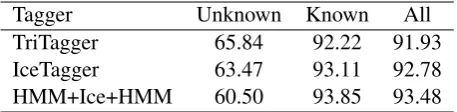
TriTagger 65.84 92.22 91.93 IceTagger 63.47 93.11 92.78 HMM+Ice+HMM 60.50 93.85 93.48
Table 4: Average tagging accuracy (%) using dic-tionaries extended with most of the data from BÍN and with arranged tag profiles for some of the words. Average ratio of unknown words in test-ing is 1.1%.
is considered more reliable than the one in DM IM.
3. Combine the new dictionaryDN EW with the dictionaryDused by a taggerCas explained in step 2 in Section 4.1.
To illustrate, consider the following three tag profiles for the word “skögultennur” ‘buckteeth’:
skögultennur nvfn nvfo skögultennur nvfo nken nvfn skögultennur nvfo nvfn
The first tag profile appears in DBIN. The tags “nvfn” and “nvfo” appear in alphabetic order. The second tag profile appears inDM IM (shown here without the frequency numbers for each tag). The tag profile is sorted in ascending order of fre-quency of the tags. Note that the second tag profile contains the tag “nken” (resulting from a tagging error in MÍM) which does not appear in the first tag profile. When generating the resulting tag pro-file forDN EW – the third line in the illustration above – the tag “nken” does thus not appear.
We used the procedure described above to gen-erate extended dictionaries with frequency infor-mation for TriTagger and sorted tag profiles for IceTagger. Of the 2.6 million tag profiles in DBIN, 250,000 were found inDM IM (i.e. about 10%). This procedure thus “arranged” 250,000 of the tag profiles inDBIN.
an extended dictionary and arranged tag profiles, and the base version of HMM+Ice+HMM (see Ta-ble 1), is 10.3%.
5 Future work
In Section 4.2, we showed that the accuracies of the three taggers can be improved significantly by arranging the tag profiles of the taggers using fre-quency information from the MÍM corpus. We used about 17 million tokens from the corpus, but once it has been extended to its final size of 25 million tokens, we would like to repeat this part of the experiment, thus using more data, to see if the accuracy increases further.
Note that we have only been able to arrange part of the tag profiles (about 10%) in the extended dictionaries by using frequency information from MÍM. In future work, we would also like to ex-periment with arranging the remainder of the tag profiles according to unigram tag frequencies (for example, derived from the IFD corpus), i.e. tag frequenies that are not associated with individual words. We would then be seeking an answer to the question whether assigning unigram tag frequen-cies to the tag profiles of words, for which we do not have reliable frequency information, results in higher tagging accuracy compared to assigning a uniform distribution to the tag profiles (i.e. giving each tag the frequency 1 as we have done).
6 Conclusion
We have experimented with adding data from a large morphological database to the dictionaries used by three open-source PoS taggers for Ice-landic. Our results show that the tagging accuracy improves significantly when extending the dictio-naries, and even further improvement in accuracy can be obtained by adding frequency information to some of the dictionary entries (tag profiles).
Our best performing tagger, a serial combina-tion of a linguistic rule-based tagger and a statisti-cal tagger, obtains a state-of-the-art tagging accu-racy of 93.48% when using extended dictionaries and added frequency information. This is equiva-lent to 10.3% error reduction compared to the best base tagger.
Acknowledgments
The work presented in this paper was partly sup-ported by the Icelandic Research Fund, grant 070025023.
References
K. Bjarnadóttir. 2005. Modern Icelandic Inflec-tions. In H. Holmboe, editor, Nordisk
Sprogte-knologi 2005. Museum Tusculanums Forlag,
Copen-hagen.
T. Brants. 2000. TnT: A statistical part-of-speech tagger. In Proceedings of the 6th Conference on
Applied Natural Language Processing, Seattle, WA,
USA.
M. Dredze and J. Wallenberg. 2008. Icelandic Data Driven Part of Speech Tagging. In Proceedings of the46thAnnual Meeting of the Association for
Com-putational Linguistics: Human Language Technolo-gies, Columbus, OH, USA.
S. Helgadóttir. 2005. Testing Data-Driven Learn-ing Algorithms for PoS TaggLearn-ing of Icelandic. In H. Holmboe, editor, Nordisk Sprogteknologi 2004. Museum Tusculanums Forlag, Copenhagen.
F. Karlsson, A. Voutilainen, J. Heikkilä, and A. Anttila. 1995. Constraint Grammar: A
Language-Independent System for Parsing Unrestricted Text.
Mouton de Gruyter, Berlin, Germany.
H. Loftsson, I. Kramarczyk, S. Helgadóttir, and E. Rögnvaldsson. 2009. Improving the PoS tagg-ing accuracy of Icelandic text. InProceedings of the
17thNordic Conference of Computational
Linguis-tics (NODALIDA-2009), Odense, Denmark.
H. Loftsson. 2008. Tagging Icelandic text: A linguistic rule-based approach. Nordic Journal of Linguistics, 31(1):47–72.
J. Pind, F. Magnússon, and S. Briem. 1991. Íslensk
orðtíðnibók [The Icelandic Frequency Dictionary].
The Institute of Lexicography, University of Iceland, Reykjavik, Iceland.
J. Rupnik, M. Grˇcar, and T. Erjavec. 2008. Improv-ing Morphosyntactic TaggImprov-ing of Slovene Language through Meta-tagging. Informatica, 32(4):437–444.
L. Shen, G. Satta, and A. Joshi. 2007. Guided learn-ing for bidirectional sequence classification. In Pro-ceedings of the45thAnnual Meeting of the Associ-ation for ComputAssoci-ational Linguistics, Prague, Czech Republic.
K. Toutanova, D. Klein, C. D. Manning, and Y. Singer. 2003. Feature-rich part-of-speech tagging with a cyclic dependency network. In Proceedings of
HLT/NAACL 2003, Edmonton, Canada.
D. Tufis, E. Irimia, R. Ion, and A. Ceausu. 2008. Un-supervised Lexical Acquisition for Part of Speech Tagging. In Proceedings of the 6th International
Conference on Language Resources and Evaluation