Extraction of Associative Attributes from Nouns
and Quantitative Expression of Prototype Concept
Maya Ando, Jun Okamoto and Shun Ishizaki
Graduate School of Media and Governance, Keio University 5322 Endo, Fujisawa-shi, Kanagawa, 252-8520, Japan
{maya, juno, ishizaki}@sfc.keio.ac.jp
Abstract
One of the purposes of this research is to formalize similarity among nouns by using attributes associated from the nouns, and then using the similarity, to formalize prototypes of categories. The other purpose is to extract features of nouns by using adjectives or adjective-like words obtained by the association experiments and to formalize importance of the nouns with the words.
We constructed an associative concept dictionary using many kinds of attributes associated from nouns. Similarity among nouns was calculated by using their associated attributes with inner product methods, where the nouns were organized in a hierarchical structure using generalized or specific relations.
This paper discusses similarity between nouns using their attributes. We found that the similarity of nouns located at lower levels has a high score in many cases. Then prototypes are quantitatively formalized among Japanese noun concepts. It uses similarities of part/material concepts, features, and action concepts, and distance values between the noun and its lower-level concepts. Such formalized prototypes are compared with a result of human questionnaire experiments to obtain a good correspondence among them.
1. Introduction
One of the purposes of this research is to formalize prototype concepts of a noun by using attributes associated from the noun. We extracted various attributes from nouns by associative experiments and calculated similarity between the nouns and its lower-level concepts. In this paper we formalized an expression of prototype concepts (Rosch,1975) using the similarities. The prototype concepts were verified quantitatively by comparing them with results of questionnaires asking human subjects about prototype concepts from the nouns. The other purpose is to extract concepts representing features of nouns by adjectives or adjective-like words by the associative experiments and to formalize importance values with them(Ando,1999). Results obtained from the research will be applied to information retrieval systems, flexible question-answering systems, or automatic construction systems for concept dictionaries.
Nouns have various attributes as well as their word senses written in linguistic dictionaries. For example, a concept of fruit has attributes such as “food”, “has-seed”, “has-vitamin c” or “delicious”. One of the ways to obtain such attributes is an associative experiment with humans(Okamoto,2001a).
Large-scale association experiments were done to extract attributes from nouns. Stimulus words were consisting of basic nouns that were selected from textbooks used at Japanese elementary schools. Association was done from stimulus words with 7 tasks, generalized concepts, lower-level concepts, part/material concepts, features, synonyms, action concepts and situation concepts.
Similarity was calculated between nouns by using their associated attributes with inner product methods. The nouns were connected in a hierarchical structure using generalized or specific relations obtained by using results of the association experiments. This paper discusses similarity between nouns using their attributes along the
hierarchical structure as well as the prototype of Japanese noun concepts. We found that the similarity of attributes of nouns located at lower levels has high score in many cases. Using the similarities, prototype of a concept can be formalized in order to find typical concepts among its lower-level concepts. The results have good correspondence with questionnaires with human subjects.
2. Associative Concept Dictionary
G. H. Kent and A. J. Rosanoff reported the large-scale study of associative experiments in 1910(Miller,1991). They read aloud a list of 100 stimulus words to a subject who was instructed to give “the first word that occurs to you other than the stimulus word.” The number of the subjects is 1000 men and women and they have different occupations and level of education. As a result most of the associated words can be classified as instances of just four kinds of connotative semantic relations:1. Super-ordinate, coordinate, and subordinate terms: terms that arrange things in a taxonomic tree
2. Attributive terms: modifying terms that state the values of attributes of things
3. Part –whole relation: terms that name a part of something, or that name the whole of which something is a part
4. Functional terms: terms that designate the ends that things serve – what things normally do or what is normally done with them
5. Prototype of Category
One of words in a category can be a prototype and others have less prototypeness.. Eleanor Rosch discussed in proposing her prototype theory by psychological experiments(Rosch, 1975). For example, a bird has lower level concepts such as pigeons or penguins. Pigeons are more typical than penguins because pigeons can fly but penguins cannot.
5.1. Questionnaire Experiment of Prototype
At first, we thought that the words with low distance values in the associative concept dictionary would be prototypes. After watching the dictionary, we found that this is not the case. To get a perspective of prototypes, we made questionnaire experiments. Requests to the subjects to get prototypes for a concept were “please list up three words just like the given concepts.”Prototypes of categories depend on subject’s situation. For example, robins are familiar in the US and can be typical birds. On the other hand, in Japan robins are not familiar and cannot be a prototype. In the questionnaire experiments, subjects are students at Keio University. The result of our experiments will show prototypes of young Japanese people.
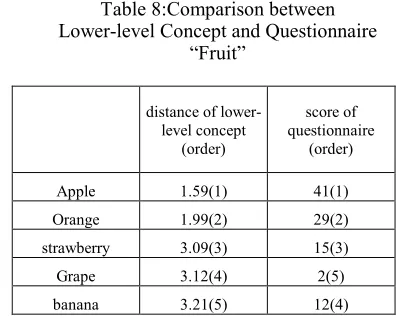
We gave points to the words listed up by the subjects. The point to a word listed at the first position is 3, the second word 2, and the third 1.We arranged the words according to the points by summing up the point with each subject. As a result we find that the questionnaire results differ from that depending on the low distance values of lower-level concepts. In the case of “furniture,” Table 7 shows that the order of lower-level concept differs from the order of questionnaire. In the case of “fruit,” Table 8 shows that the order of lower-level concept and the order of questionnaire are almost same.
We calculated the similarity about part/material concepts, features, and action concepts in associative concept dictionary to extract crucial information to define the prototypes. We found that when a word is typical one, its score of similarity is high. But these kinds of information was not enough to define prototype of a category.
Table 7:Comparison between Lower-level Concept and Questionnaire
“Furniture”
Distance of lower-level concept(order)
score of questionnaire(order)
Chair 1.47(1) 26(2)
chest of drawers 1.62(2) 39(1)
Desk 1.99(3) 17(3)
Table 2.95(4) 7(5)
Bed 3.41(5) 9(4)
Table 8:Comparison between Lower-level Concept and Questionnaire
“Fruit”
distance of lower-level concept
(order)
score of questionnaire
(order)
Apple 1.59(1) 41(1)
Orange 1.99(2) 29(2) strawberry 3.09(3) 15(3)
Grape 3.12(4) 2(5) banana 3.21(5) 12(4)
5.2. Formalization of Prototype of Category
In the last chapter, we discussed inheritance between concepts included in three hierarchical levels. We showed that similarities between highest level concepts and lowest level ones have larger values. In the case of “furniture”, the questionnaire result shows that “bookshelf” is not prototype of “furniture”, but similarity between “furniture” and “bookshelf” has large values.Next, we decided to use distance values of lower-level concepts as well as similarities of part/material concepts, features, and action concepts. We defined prototype P as a linear combination of three similarity values divided by the distance value of the lower level concept. The formalization means that the lower distance values are more important than that of larger values.
P=(αM+βF+γV)/D ,
M: similarity of part/material concept F: similarity of feature
V: similarity of action concept D: distance of lower level concept α , β , γ are linear coefficients
As the first approximation, we simply set the coefficients as 1.0. Then, we arranged words according to the P values.
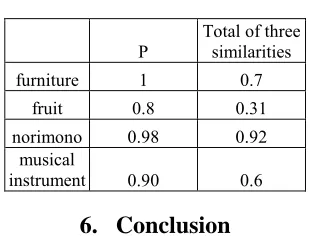
By using spearman’s rank correlation coefficient(Ikeda,1976), it is shown that the order of P and the order in the questionnaire correspond each other. The order of questionnaire and the sum of three similarity are also corresponding.
Table 9:Data of “furniture”
order of
lower-level concept
order of questionn aire
similarity of part/ material
Similarity of feature
similarity of action concept
P (order)
chair 1 2 0.81 0.48 0.49 1.21(2)
chest of
drawers 2 1 0.78 0.73 0.64 1.32(1)
desk 3 3 0.87 0.64 0.52 1.02(3)
table 4 5 0.71 0.63 0.54 0.64(4)
bed 5 4 0.53 0.55 0.31 0.41(5)
sofa 6 6 0.37 0.27 0.44 0.25(9)
bookshelf 7 7 0.76 0.85 0.55 0.45(7)
shelf 8 8 0.82 0.65 0.57 0.40(6)
cupboard 9 9 0.75 0.61 0.58 0.32(9)
Table 10:Rank Correlation Coefficient with questionnaire result
P Total of three similarities
furniture 1 0.7
fruit 0.8 0.31 norimono 0.98 0.92
musical
instrument 0.90 0.6
6. Conclusion
We showed various attributes of nouns can be used to construct an inheritance structure obtained from an associative concept dictionary. Using lower level concepts, part/material concepts, features and action concepts, we can define prototype P. We showed the
higher value of the correlation between questionnaire and the P of prototype to verify the effectiveness of the formalization.
As a future task we need to improve P formalization because all the coefficients are set to 1..0 as the first approximation in this paper. The coefficients are to be calculated aiming at more precise results.
The association experiments will continue because we need to increase subjects and stimulus words to apply the concept dictionary .to QA systems, IR systems or automatic ML systems.
7. References
George A. Miller, 1991. The science of words, chapter 8.
Scientific American Library.
E. Rosch, 1975. Cognitive representations of semantic
categories, Journal of Experimental Psychology
General 104:192-233.
Kai, M. and Matsukawa, T, eds, 1996. Goi shidou no
houhou [Method for Guidance of Vocabulary].
Mitsumura Tosho.
Okamoto, Jun. and Ishizaki, Shun, 2001. Construction of associative concept dictionary with distance information, and comparison with electronic concept dictionary. Journal of Natural Language Processing (in
Japanese), vol.8 No.4:37-54.
Okamoto, Jun. and Ishizaki, Shun, 2001. Associative concept dictionary construction and its comparison with electronic concept dictionary. Pacific association
for computational linguistics 2001.
Ando, Maya. Okamoto, Jun. and Ishizaki, Shun., 2000.
Feature of associated attributes and quantitative
research. Special inter group on language sense
processing engineering.
Ikeda, T, 1976. Toukeiteki houhou 1[Statistical Method 1],