Reducing Segmental Duration Variation by
Local Speech Rate Normalization of Large Spoken Language Resources
Hartmut R. Pfitzinger
Department of Phonetics and Speech Communication University of Munich, Schellingstr. 3, 80799 M¨unchen, GERMANY
Abstract
We developed a time-domain normalization procedure which uses a speech signal and its corresponding speech rate contour as an input, and produces the normalized speech signal. Then we normalized the speech rate of a large spoken language resource of German read speech. We compared the resulting segment durations with the original durations using several three-way ANOVAs with phone type and speaker as independent variables, since we assume that segment duration variation is determined by segment type (intrinsic duration), by the speaker (speech rate, sociolect, ideolect, dialect, speech production variation), and by linguistic effects (context, syllable structure, accent, and stress). One important result of the statistical analysis was, that the influence of the speaker on segment duration variation decreased dramatically (factor 0.54 for vowels, factor 0.29 for consonants) when normalizing speech rate, despite the fact that sociolect, ideolect, and dialect remained almost unchanged. Since the interaction between the independent variables speaker and phone type remained constantly, the hypothesis arises, that this interaction contains most of the speaker-specific information.
1.
Introduction
Estimating phone durations is not only a central concern in information theoretical approaches to the human speech code. It is also a source of definite improvements on spoken language processing methods. Automatic speech segmen-tation gained substantially (St¨ober & Hess, 1998), and au-tomatic speech recognition is expected to gain (Pols, 1999). The estimation of phone durations is also an important problem for automatic speech generation.
The quality of automatically synthesized speech strongly depends on the underlying timing models, which, at the present time, are mostly constructed on speech seg-ment duration measureseg-ments based on large spoken lan-guage resources. Each class of speech segments (e.g. phonemes, sub-phonemic variants, phones) shows a signif-icant amount of duration variation even if the underlying speech corpus reaches saturation regarding segmental du-ration. This means, further enlargement of the speech cor-pus would not further increase the standard deviations of the segmental durations.
The question arises as to whether it is possible to reduce the amount of unexplained duration variation to discover the intrinsic segmental durations. In this paper the influence of speech rate normalization on phone duration variation is investigated experimentally.
Since speech rate is a continuously varying prosodic feature we use a “momentary” or local approach to acoustic speech rate measurements, which was introduced earlier by Pfitzinger (1998; 1999; 2001). It is based on a linear combi-nation of local syllable rate and local phone rate and, in con-trast to just syllable rate or phone rate, it is well-correlated with perceived local speech rate (
) since it repre-sents the linguistic structure of words more accurately. The output of this method is a time-varying speech rate contour.
1.1. Vowel durations and standard deviations
Measurement and analysis of phone durations was a sci-entific topic for many years (Menzerath & de Oleza S. J., 1928). Weitkus (1931, p. 11) estimated an overall mean duration of 161.6 ms on a spoken German corpus compris-ing 7480 phones. He claims that the corpus had an average speaking rate, but in our view his results seem rather large.
Weitkus (1931, p. 20) also estimated mean vowel durations between 88.3 ms for / / and 386.2 ms for / :/.
The standard deviations of German vowel durations re-ported by Tillmann et al. (1990) are roughly between 20– 40 ms depending on the vowel category. The overall mean vowel duration was 88.0 ms. The duration values were es-timated from 5761 vowel realizations of the PhonDatI spo-ken language resource.
The mean duration measurements deviate significantly from vowel data reported by Heid (1998, p. 253) whose measurements are based on 10300 vowel realizations taken from the PhonDatII spoken language resource (see sec-tion 4.). Until now, this was to our knowledge the largest survey on German phone durations. The overall mean vowel duration was 75.6 ms. It is worth mentioning that the standard deviations reported in the studies summarized here are in basic correspondence.
1.2. Duration models
Kohler (1992a) conducted duration measurements on stressed vowels taken from a third of the PhonDatII spo-ken language resource. He found mean durations between 66.9 ms and 168.4 ms depending on the factors last
syl-lable in word, tense, and final.
M¨obius & van Santen (1996) analysed the durations of 16499 consonants and 6991 vowels taken from one speaker, ‘k61’, of the Kiel Corpus of Read Speech (IPDS, 1994). They neither reported measured durations nor standard de-viations but predicted segment durations, which all were significantly larger than the measurements by Heid (1998, p. 249). To predict phone durations, they built a category tree as suggested by Riley (1992, p. 267).
leave providing the actual duration, and finally iv)
stochas-tic models based on neural nets or HMMs.
In the factor tree built by Wang (1997, p. 129) (see also Pols (1999, p. 13)) speech rate as the first of four factors is split into three categories: fast, average, and slow speech. This small number of levels could be a consequence of lim-itations of the underlying corpus size. Wang first consid-ered 11 factors and later restricts himself to four factors (speech rate, stress, syllable location in a word and in a sentence). Even the hugest spoken language resource pro-vides not enough entities in each leave when there are too many nodes in a factor tree.
To increase the number of entities per leave, it is desir-able to eliminate the factor speech rate by normalization of local speech rate changes. For this task a reliable normal-ization procedure is required.
2.
Estimation of local rates
In (Pfitzinger, 1996) we introduced a mathematically sound formula to estimate local rates of speech units (e.g. phones, syllables, words, morphemes):
The distances between subsequent speech unit marks
falling in a window of constant length (e.g. 625 ms) were
accumulated and then divided by their number. The recip-rocal of the quotient is a measure for the local rate of the underlying speech unit:
rate
!
"
"
# %$
#
&!
!
('
were " is the left and " is the right window
bound-ary. Since the left () and the right ()# ) segment most
frequently are covered only partially by the accumulation window, they have to be accumulated proportionately to guarantee a constant window length. This procedure leaves slight discontinuities in the resulting curve of the local rate. A second method which is very time-consuming but re-moves any discontinuities from the resulting curves is de-scribed in brief: The first step is to estimate a new time-domain signal that corresponds to the underlying speech signal. All values of the new signal which fall in a speech unit receive the reciprocal of its duration. The second step is to convolute the signal with a Hanning window of e.g. 625 ms length. The result is a curve representing the local rate of the underlying speech units. It is similar to the result of the first method.
In this paper we applied a third method presented in (Pfitzinger, 2001) which is mathematically equivalent to the second method but as fast as the first method. It is worth mentioning that the application of each of the methods de-scribed above requires to exclude speech pauses because they would produce unrealistically slow rates.
3.
Perceptive Local Speech Rate (PLSR)
There is no homogeneous opinion of what speech rate actu-ally is. Undoubtedly, a high speech rate is characterized by above-average syllable rates and phone rates, but previous research has shown little correlation between local syllable rate and local phone rate (+* ,, see fig. 1) indicating that the information contents of both differ (Pfitzinger, 1996). The existence of words such as banana, showing twice as many phones compared to the syllables, in contrast to the word stretchmarks, having five times more phones than syl-lables, suggests the hypothesis that syllable rate as well as phone rate are involved in speech rate perception.
In earlier studies (Pfitzinger (1998; 1999; 2001)) we conducted a series of four perception experiments to obtain a perceptual reference for local speech rate. On the basis of these results we developed several acoustic models to predict the perceptual judgements. Our results have shown that perceptive local speech rate (PLSR) is predictable by means of an acoustic model with fair accuracy (
). The simplest model we proposed consisted of a linear com-bination of local syllable rate and local phone rate.
Another result was that the linear correlation coefficient
%* -
of the syllable rate with PLSR was not signif-icantly different from the linear correlation coefficient of the phone rate with PLSR. Therefore the term speech rate should not be used if syllable rate or phone rate is meant. The main outcome was that our PLSR prediction models seem to be accurate enough to work with in spoken lan-guage research.
3.1. Evaluation of speech rate estimation
The Evaluation of the accuracy and generalization proper-ties of our PLSR prediction models requires a test corpus containing spoken language data which was unseen during the development process of our models. Since the devel-opment corpus was taken from PhonDatII (see section 4.), we conducted a new perception experiment with 100 stim-uli taken from the VerbMobil spoken language resource (Wahlster, 2000). Hence speakers, speaking style, record-ing equipment, and vocabulary differed.
30 subjects participated in this listening test. The result of this evaluation was that the accuracy on the test corpus was nearly the same as on the training data. This allows us to conclude that our models have good generalization qualities.
3.2. Normalization
How can a local speech rate curve be used to normalize speech rate variation? Stretches of speech with fast local speech rate have to be slowed down to the average speech rate and vice versa. The inverse of the local speech rate curve exactly fulfills this condition, and is the required con-trol input to a conventional time-stretching algorithm en-abling it to exactly even out deviations from the average speech rate.
After such a procedure no single stretch of the resulting speech signal should show a significant deviation from the average speech rate. Since at present our local speech rate estimation method has a mean deviation of ca. 10% there is a small residual speech rate variation in the normalized speech signals. But it is reduced to less than 10% of the original speech rate variation.
3.3. Evaluation of speech rate normalization
4.
The PhonDatII Spoken Language
Resource
This investigation is based on the PhonDatII1spoken
lan-guage resource, which, after 10 years of providing the base for various scientific investigations, is worth of being thor-oughly described in the following sections. The initial aim of setting up the PhonDatII spoken language resource was the development and evaluation of automatic recognition of continuous speech.
4.1. Material
The speech material consists of 200 sentences in the do-main of train inquiry. 100 sentences, the so-called “Er-langen”-sentences, were based on transliteration of real train inquiry dialogues. The other 100 sentences, the so-called “Siemens”-sentences, were theoretically worked out. In (Thon, 1992) all PhonDatII sentences as well as their canonical transcriptions are shown.
4.2. Subjects
5 subjects from Bonn (2 female, 3 male), 5 subjects from Kiel (2 female, 3 male), and 6 subjects from Munich (3 male, 3 male), giving a total of 16 subjects (10 male, 6 fe-male), participated as speakers in the recordings each read-ing aloud all 200 sentences givread-ing a total of 3200 sentences. The age of 11 subjects was between 20 and 30, the age of the other 5 subjects was between 30 and 56. The subjects were native German speakers and their dialect was High German slightly biased by the just-mentioned regions.
4.3. Recordings
The speech data was recorded in the spring 1992 at three departments of phonetics in Germany (Bonn, Kiel, and Mu-nich). The subjects were seated in an anechoic chamber (Munich) or in sound-treated rooms (Bonn, Kiel) and were recorded using a Neumann U-87 professional condenser microphone with cardioid polar pattern, a John Hardy M-1 microphone pre-amplifier, and a Sony PCM-2500 DAT recorder. Finally, speech data was resampled at 16 kHz with 16 bit amplitude resolution.
4.4. Speaking style
The speaking style of most of the subjects was read aloud speech, while some speakers tried to speak as if they were in a familiar environment talking about a subject they chose for themselves. Consequently, the corpus includes a range of speaking styles from fluently read aloud speech to semi-spontaneous speech.
4.5. Phone labels and inventory
64 of the 200 sentences were selected for manual segmen-tation of phones and syllable nuclei. Tab. 3 shows a list of modified SAM-PA symbols being the base for labelling the PhonDatII spoken language resource (Kohler, 1992b). We avoid using the term ‘phonemes’ even though the mod-ified SAM-PA symbol inventory is, regarding its structure and size, not very different from the IPA symbol inventory suggested for German (International Phonetic Association, 1999, p. 86f).
The major difference consists in counting combinations of vowels followed by /6/ as a single ‘segment’ in order to
1PhonDatII was funded by the then German Federal
Min-istry of Research and Technology (BMFT) from 1/1/1991 until 12/31/1992 under contract DLR01IV103.
avoid uncertain segment boundaries (van Dommelen, 1992, p. 201). As you can see in tab. 3 this results in some possi-ble ‘segments’ to have not appeared in the PhonDatII spo-ken language resource ([2:6] as in Geh ¨or (ear), [96] as in
W¨orter (words)) and others to have counts below 50 ([Y6],
[I6], [a6], [E6], and [E:6]).
In this paper we use the term ‘phone’ though it is dan-gerous to call a diphthong like [e:6], as in the German word
sehr (very), a phone because phonologically it consists of
the vowel /e:/ and the consonant /r/ which would be vocal-ized to /6/ in most German dialects. We also say ‘phone types’ when we would like to emphasize the contrast to ’phone tokens’. It should be clear that each spoken real-ization of a phone type is a phone token.
Even though the phone labels include information on insertions, substitutions, and deletions of phones, we had no confidence in the substitutions and therefore we referred to the canonical forms if substitutions occurred. Addition-ally, we corrected all insertions to make certain that they no longer introduce not allowed phone symbols.
Following these considerations, 41 conventional phone types and 13 vowel vocalized-/r/ phone types gave a total
of 54 phone types. The only German phoneme, which did not occur due to the small number of word types, is the voiced post-alveolar fricative [Z] as in the German word
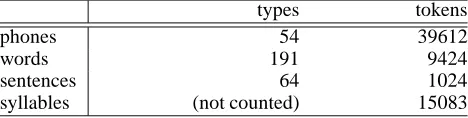
Garage (garage). Finally, we would like to present some
expressive counts:
types tokens
phones 54 39612
words 191 9424
sentences 64 1024
syllables (not counted) 15083
Table 1: Counts of types and tokens in the manually seg-mented part of the PhonDatII spoken language resource.
5.
Evaluation
Our investigation of phone duration variation is based on the PhonDatII spoken language resource described above. The first step was to estimate local phone rate and local syllable rate. Then, on the basis of these data, we evalu-ated and revised the segmentation marks to protect statisti-cal analysis against destructive segmentation errors.
5.1. Local phone rate and local syllable nucleus rate
Applying the local rate estimation procedure introduced in section 2. to manually labelled phones and syllables every 100 ms step through the entire PhonDatII corpus leads to the data shown in fig. 1. Each point in the scatter plot rep-resents the phone rate (ordinate) and the syllable rate (ab-scissa) of a 625 ms frame.
5.2. Evaluation of the segmentation data
0 1 2 3 4 5 6 7 8 9 10 11 12 13 2
4 6 8 10 12 14 16 18 20 22 24 26
G
1
G
2
local syllable rate [syllables/s]
local phone rate [phones/s]
r = 0.599 n = 28497
Figure 1: Scatter plot of the local phone rate based on man-ually segmented phone boundaries versus the local syllable rate based on manually segmented syllable nuclei. Com-pare to (Pfitzinger, 1998, p. 1087).
mean std.dev. min. max. phon duration [ms] 71.9 36.9 11.6 435.9 syllable nucleus distance [ms] 184.5 98.4 28.3 591.8 phone rate [phones/s] 13.90 3.50 2.76 26.45 syllable rate [syllables/s] 5.42 1.45 1.70 13.20
Table 2: Measurements concerning the PhonDatII spoken language resource.
We expect that further evaluation and correction would not change these numbers by more than 0.1% since we eval-uated the corpus several times until none of the values var-ied by more than 0.05%.
While in (Pfitzinger, 1998) roughly 20% of the data was rejected automatically because of glitches in the manual segmentation, we could now incorporate the entire speech data as most of the errors were recovered since 1998. The final speech data base consists of 16 speakers 64 sen-tences 2.78 seconds mean duration
2850 seconds of actual speech. Together with ca. 1000 seconds of silence the total corpus size is 64 minutes.
6.
Experiment
Applying the local speech rate normalization procedure in-troduced in section 3.2. to the entire PhonDatII corpus leads to the data shown in tab. 3. After that we estimated local phone rate and local syllable rate on the speech rate nor-malized corpus. The result is shown in fig. 2.
6.1. Phone durations and standard deviations
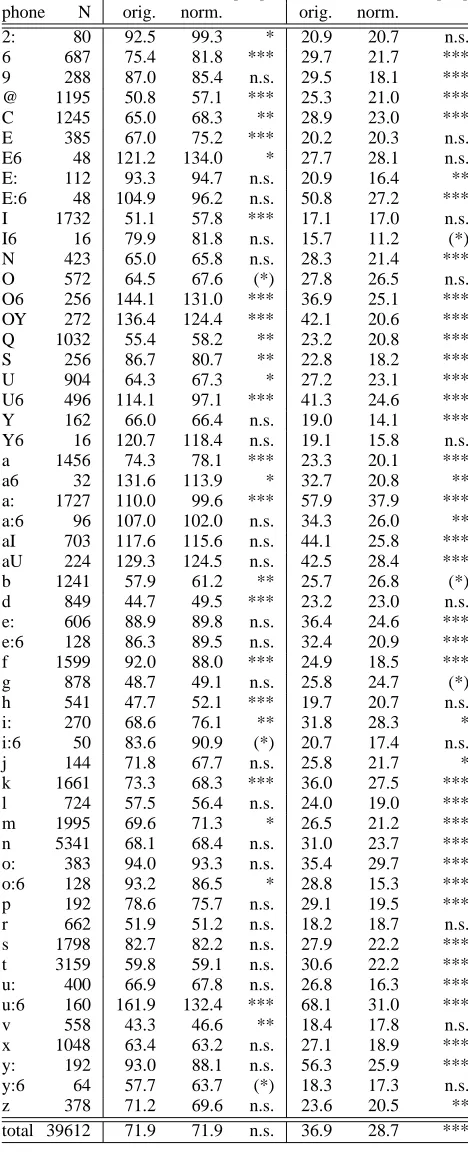
Tab. 3 shows mean durations and standard deviations of all phone types of the PhonDatII spoken language resource. In most of the cases the standard deviation of the phones taken from the speech rate normalized corpus are signif-icantly smaller than the original standard deviations (ex-amined by means of
-test). In three cases (OY, u:6, y:) the standard deviation was reduced by more that half. On the other hand it was never increased significantly by our normalization procedure. In total standard deviation was reduced by approx. 22%.
mean duration [ms] standard deviation [ms] phone N orig. norm. orig. norm.
2: 80 92.5 99.3 * 20.9 20.7 n.s. 6 687 75.4 81.8 *** 29.7 21.7 *** 9 288 87.0 85.4 n.s. 29.5 18.1 *** @ 1195 50.8 57.1 *** 25.3 21.0 *** C 1245 65.0 68.3 ** 28.9 23.0 *** E 385 67.0 75.2 *** 20.2 20.3 n.s. E6 48 121.2 134.0 * 27.7 28.1 n.s. E: 112 93.3 94.7 n.s. 20.9 16.4 ** E:6 48 104.9 96.2 n.s. 50.8 27.2 *** I 1732 51.1 57.8 *** 17.1 17.0 n.s. I6 16 79.9 81.8 n.s. 15.7 11.2 (*) N 423 65.0 65.8 n.s. 28.3 21.4 *** O 572 64.5 67.6 (*) 27.8 26.5 n.s. O6 256 144.1 131.0 *** 36.9 25.1 *** OY 272 136.4 124.4 *** 42.1 20.6 *** Q 1032 55.4 58.2 ** 23.2 20.8 *** S 256 86.7 80.7 ** 22.8 18.2 *** U 904 64.3 67.3 * 27.2 23.1 *** U6 496 114.1 97.1 *** 41.3 24.6 *** Y 162 66.0 66.4 n.s. 19.0 14.1 *** Y6 16 120.7 118.4 n.s. 19.1 15.8 n.s. a 1456 74.3 78.1 *** 23.3 20.1 *** a6 32 131.6 113.9 * 32.7 20.8 ** a: 1727 110.0 99.6 *** 57.9 37.9 *** a:6 96 107.0 102.0 n.s. 34.3 26.0 ** aI 703 117.6 115.6 n.s. 44.1 25.8 *** aU 224 129.3 124.5 n.s. 42.5 28.4 *** b 1241 57.9 61.2 ** 25.7 26.8 (*) d 849 44.7 49.5 *** 23.2 23.0 n.s. e: 606 88.9 89.8 n.s. 36.4 24.6 *** e:6 128 86.3 89.5 n.s. 32.4 20.9 *** f 1599 92.0 88.0 *** 24.9 18.5 *** g 878 48.7 49.1 n.s. 25.8 24.7 (*) h 541 47.7 52.1 *** 19.7 20.7 n.s. i: 270 68.6 76.1 ** 31.8 28.3 * i:6 50 83.6 90.9 (*) 20.7 17.4 n.s. j 144 71.8 67.7 n.s. 25.8 21.7 * k 1661 73.3 68.3 *** 36.0 27.5 *** l 724 57.5 56.4 n.s. 24.0 19.0 *** m 1995 69.6 71.3 * 26.5 21.2 *** n 5341 68.1 68.4 n.s. 31.0 23.7 *** o: 383 94.0 93.3 n.s. 35.4 29.7 *** o:6 128 93.2 86.5 * 28.8 15.3 *** p 192 78.6 75.7 n.s. 29.1 19.5 *** r 662 51.9 51.2 n.s. 18.2 18.7 n.s. s 1798 82.7 82.2 n.s. 27.9 22.2 *** t 3159 59.8 59.1 n.s. 30.6 22.2 *** u: 400 66.9 67.8 n.s. 26.8 16.3 *** u:6 160 161.9 132.4 *** 68.1 31.0 *** v 558 43.3 46.6 ** 18.4 17.8 n.s. x 1048 63.4 63.2 n.s. 27.1 18.9 *** y: 192 93.0 88.1 n.s. 56.3 25.9 *** y:6 64 57.7 63.7 (*) 18.3 17.3 n.s. z 378 71.2 69.6 n.s. 23.6 20.5 ** total 39612 71.9 71.9 n.s. 36.9 28.7 ***
Table 3: Comparing original vs. speech rate normalized mean phone durations and standard deviations.
-test for homogeneity of two samples and-test for inhomogeneous
variances with Welch-correction of the degrees of freedom.
6.2. Normalization does not change ratios
0 1 2 3 4 5 6 7 8 9 10 11 12 13 2
4 6 8 10 12 14 16 18 20 22 24 26
G
1
G
2
normalized local syllable rate [syllables/s]
normalized local phone rate [phones/s]
r = −0.609 n = 28498
Figure 2: Scatter plot of the local phone rate based on man-ually segmented phone boundaries versus the local syllable rate based on manually segmented syllable nuclei (compare with fig 1).
causes the correlation coefficient to only change its sign. This could be due to the fact that speech rate normalization is not able to modify syllable durations and phone dura-tions independently of each other. The local reladura-tionship between syllable rate and phone rate remains nearly un-changed. E.g. a word like stretchmarks, having five times more phones than syllables, remains to have this ratio inde-pendent of the direction and amount of speech rate change.
6.3. Normalization causes duration changes
In fig. 3 a histogram of phone duration changes caused by our speech rate normalization procedure is shown. We plotted a Gaussian curve into the histogram to make clear, where deviations from the normal distribution are. A loga-rithmic scale was chosen because it makes clearer that the obtained distribution skews to the left.
There are more phones than expected from standard dis-tribution, whose duration was reduced by more than half (see the abscissa section below -0.6 in fig. 3). Therefore they must have been from stretches of speech having half of the average speech rate. Examination of these stretches revealed that they mostly appear in utterance-final position. Obviously, our normalization procedure compensates for the pre-final speech rate ritardando.
The phones belonging to the abscissa section above 0.5 in fig. 3 have a smaller than expected number. They mostly appear in utterance-initial position and represent a speech rate accelerando.
6.4. Discussion
It can be assumed that the average speech rate in the Phon-DatII corpus caused the peak in the histogram at ca. 0.15 (fig. 3). Speakers deviate from the average speech rate in both directions according to the communicative rele-vance of the particular speech phrase. Stretches of speech containing mainly function words mostly show an above-average local speech rate while words in sentence focus are produce with a slower speech rate confirming the results of Kohler (1992a).
Excluding pre-final lengthening and utterance-initial
accelerando from the measurements the communicatively
−1.20 −1 −0.8 −0.6 −0.4 −0.2 0 0.2 0.4 0.6 0.8 1 1.2 500
1000 1500 2000 2500 3000
Log change of phone duration [log2(norm./orig.)]
number of phones
Figure 3: Histogram of logarithmic changes of phone dura-tions through speech rate normalization.
motivated speech rate deviations lie in a factor range of 0.7 to 1.4 from the average speech rate. The linguistic mean-ingfulness of our speech rate prosody is obvious.
7.
Statistical analysis of duration variation
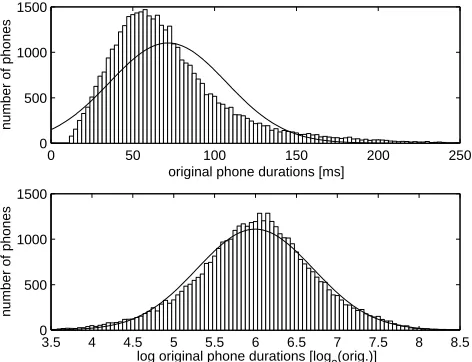
The upper histogram in fig. 4 shows clearly that linear phone durations substantially skew to the right, and there-fore statistical analysis by means of general linear model is not appropriate. With regard to the TIMIT speech database Wang (1997, p. 131) concludes that actual phone duration distribution generally has an asymmetrical shape.Logarithmic phone durations nearly have a Gaussian distribution as shown in the lower histogram in fig. 4. So we apply general linear model statistical analysis to logarithmic duration values in the following sections, al-though other researchers noticed the skew and decided that it should not have an important effect on the results (Camp-bell & Isard, 1991, p. 40).
7.1. Speaker effect and phone type effect
We examined the influence of speaker and phone type on original phone durations by tabulating the 10 vowels with the largest frequency. This procedure leads to 10 factor lev-els for ‘phone-type’. The factor ‘speaker’ had 16 levlev-els giving a total of 160 cells each comprising 31 randomly
0 50 100 150 200 250
0 500 1000 1500
original phone durations [ms]
number of phones
3.5 4 4.5 5 5.5 6 6.5 7 7.5 8 8.5 0
500 1000 1500
log original phone durations [log2(orig.)]
number of phones
7.3. Pre-final lengthening
Earlier estimates of mean phone durations suffered funda-mentally from pre-final lengthening because it was not ob-vious how many phones were lengthened at the end of an utterance due to the pre-final ritardando (Cooper & Danly, 1981). These phones should have been omitted to avoid dis-tortion of means. Our speech rate normalization procedure solves this problem and allows to include phones even if their durations were originally utterance-final and therefore modified by pre-final lengthening.
8.
General Discussion
A table of phones together with their mean durations and standard deviations (e.g. tab. 3) is expressively only if it is reliable. In this paper the reliability of concrete duration values depends on how well the underlying spoken lan-guage resource represents spoken German. 10 years after the record of PhonDatII it is time to summarize and to look forward.
8.1. The future of the PhonDatII spoken language resource
Apparently, producers and users of spoken language re-sources have to accept the question as to whether the term ‘large’ is adequate. Particularly the PhonDatII spoken lan-guage resource comprising only 191 word types seems to be anything but ‘large’ from a superficial view. Undoubt-edly, 39612 manually labelled phone tokens and 15083 syl-lable tokens can only be described as ‘large’. And if they were not used for general investigations on word-level2or phrase-level they remain to be very valuable, especially for phonetic research even in the year 2002 and for years to come.
How can we refine the PhonDatII data base for the fu-ture? The expenditure of manual labelling of the remaining 136 sentences is considered to be excessive regarding the fact that the number of word types/tokens would increase to only 367/34192 even though the number of phone tokens would increase to approx. 143000 and the number of sylla-ble tokens to approx. 54000. Perhaps the manual labelling of a smaller subset of sentences, which was condensed by means of greedy-methods, could effectively raise the value of the data base.
The number of speakers is comparatively small. Ad-ditional recordings of new speakers are certainly possible under the same circumstances and using the same record-ing equipment, which is, even 10 years later, nearly state of the art recording technology. It is even possible to increase the sample rate up to 44.1 kHz since the entire corpus was recorded to DAT tapes. But this would require a lot of work. Taking into consideration this discourse the attempt to refine PhonDatII seems questionable. And another question arises as to whether it is necessary or even helpful to begin these attempts. The comparability of ‘historical’ and future results on the PhonDatII spoken language resource could possibly suffer from the refinement. However, the results of this study, which is based on a corrected and extended version of the PhonDatII, are in correspondence with ear-lier research. Consequently, the actual size of this spoken language resource seems to be sufficient for generalization
2There are exceptions: PhonDatII is also suited for analysing
inter- and intra-speaker variability of e.g. the words Zug (train) vs. Zugverbindung (train connection) since there are 16 speakers each producing 11 and 10 repetitions, respectively.
on the segmental level. No single spoken language resource can meet every researcher’s needs.
9.
Conclusions
Two steps were done making phone duration measure-ments accessible to statistical analysis: i) we normalized the speech rate in the entire underlying spoken language re-source and ii) we used logarithmic durations because they have a probability density function very like that of a nor-mal distribution, whereas distributions of linear durations are generally skewed (see fig. 4). These two procedures per-mitted us to investigate statistically the influence of speaker and phone type on phone duration and of stress on tense vowel duration. The result was that these three factors have highly significant influence.
It remains to repeat this investigation on other spoken language resources, e.g. VerbMobil (Wahlster, 2000). An-other important point in our future research will be to con-struct a model for speaker effects on segment durations.
10.
References
Bartkova, K. and Sorin, C. 1987. A model of segmental duration for speech synthesis in French. Speech
Com-munication, 6(3):245–260.
Campbell, W. N. and Isard, S. D. 1991. Segment durations in a syllable frame. J. of Phonetics, 19:37–47.
Campbell, W. N. 1992. Syllable-based segmental duration. In Bailly, G., Benoˆıt, C., and Sawallis, T. R., eds., Talking
Machines: Theories, Models, and Designs, pp. 211–224.
North-Holland, Amsterdam.
Carlson, R. and Granstr¨om, B. 1986. A search for dura-tional rules in real-speech data base. Phonetica, 43:140– 154.
Chen, M. 1970. Vowel length variation as a function of the voicing of the consonant environment. Phonetica, 22:129–159.
Cooper, W. E. and Danly, M. 1981. Segmental and tem-poral aspects of utterance-final lengthening. Phonetica, 38:106–115.
Heid, S. J. G. G. 1998. Phonetische Variation: Unter-suchungen anhand des PhonDat2-Korpus. Forschungs-berichte (FIPKM) 36, Institut f¨ur Phonetik und Sprach-liche Kommunikation der Universit¨at M¨unchen, pp. 193– 368.
House, A. S. 1961. On vowel duration in English. J. of the
Acoustical Society of America, 33(9):1174–1178.
International Phonetic Association, ed. 1999. Handbook
of the International Phonetic Association. A guide to the use of the International Phonetic Alphabet. Cambridge
University Press, Cambridge.
IPDS. 1994. The Kiel Corpus of Read Speech. CDROM
no. 1. Institut f¨ur Phonetik und digitale
Sprachverarbei-tung der Universit¨at Kiel.
Klatt, D. H. 1973. Interaction between two factors that in-fluence vowel duration. J. of the Acoustical Society of
America, 54:1102–1104.
Klatt, D. H. 1975. Vowel lengthening is syntactically determined in a connected discourse. J. of Phonetics, 3:129–140.
Klatt, D. H. 1976. Linguistic uses of segmental duration in English: Acoustic and perceptual evidence. J. of the
Acoustical Society of America, 59:1209–1221.
Kohler, K. J. 1983. Stress-timing and speech rate in Ger-man. A production model. Arbeitsberichte (AIPUK) 20, Institut f¨ur Phonetik und digitale Sprachverarbeitung der Universit¨at Kiel, pp. 5–53.
Kohler, K. J. 1986a. Invariance and variability in speech timing: from utterance to segment in German. In Perkell, J. S. and Klatt, D. H., eds., Invariance and variability
in speech processes, chapter 13, pp. 268–289. Lawrence
Erlbaum Associates, Hillsdale.
Kohler, K. J. 1986b. Parameters of speech rate perception in German words and sentences: Duration,
move-ment, and
level. Language & Speech, 29:115–139. Kohler, K. J. 1990. Segmental reduction in connected
speech in German: Phonological facts and phonetic ex-planations. In Hardcastle, W. J. and Marchal, A., eds.,
Speech Production and Speech Modelling, vol. 55 of NATO ASI Series D: Behavioural and Social Sciences,
pp. 69–92. Kluwer Academic Publishers, Dordrecht, Boston, London.
Kohler, K. J. 1992a. Dauerstrukturen in der Lesesprache: Erste Untersuchungen am PhonDat-Korpus. Arbeits-berichte (AIPUK) 26, Institut f¨ur Phonetik und digitale Sprachverarbeitung der Universit¨at Kiel, pp. 225–252. Kohler, K. J. 1992b. Sprachverarbeitung im Kieler
PhonDat-Projekt: Phonetische Grundlagen f¨ur ASL-Anwendungen. Arbeitsberichte (AIPUK) 26, Institut f¨ur Phonetik und digitale Sprachverarbeitung der Universit¨at Kiel, pp. 81–95.
Kohler, K. J. 1997. Parametric control of prosodic vari-ables by symbolic input in TTS synthesis. In van Santen, J. P. H., Sproat, R. W., Olive, J. P., and Hirschberg, J., eds., Progress in Speech Synthesis, chapter 37, pp. 459– 475. Springer-Verlag, New York, Berlin, Heidelberg. Lindblom, B. E. F. 1990. Explaining phonetic variation: A
sketch of the H&H theory. In Hardcastle, W. J. and Mar-chal, A., eds., Speech production and speech modelling, no. 55 in Nato ASI series D: Behavioural and social sci-ences, pp. 403–439. Kluwer Academic Publishers, Dor-drecht, Boston, London.
Luce, P. A. and Charles-Luce, J. 1985. Contextual ef-fects on vowel duration, closure duration, and the con-sonant/vowel ratio in speech production. J. of the
Acous-tical Society of America, 78(6):1949–1957.
Menzerath, P. and de Oleza S. J., J. M. 1928. Spanische
Lautdauer. Eine experimentelle Untersuchung. Walter
de Gruyter, Berlin, Leipzig.
M¨obius, B. and van Santen, J. P. H. 1996. Modeling seg-mental duration in German text-to-speech synthesis. In
Proc. of ICSLP ’96, vol. 4, pp. 2395–2398, Philadelphia.
Ohno, S., Fujisaki, H., and Taguchi, H. 1998. Analysis of effects of lexical accent, syntax, and global speech rate upon the local speech rate. In Proc. of ICSLP ’98, vol. 3, pp. 655–658, Sydney; Australia.
Pfitzinger, H. R. 1996. Two approaches to speech rate es-timation. In Proc. of the sixth Australian Int. Conf. on
Speech Science and Technology (SST ’96), pp. 421–426,
Adelaide.
Pfitzinger, H. R. 1998. Local speech rate as a combination of syllable and phone rate. In Proc. of ICSLP ’98, vol. 3, pp. 1087–1090, Sydney; Australia.
Pfitzinger, H. R. 1999. Local speech rate perception in German speech. In Proc. of the XIVth Int. Congress of
Phonetic Sciences, vol. 2, pp. 893–896, San Francisco.
Pfitzinger, H. R. 2001. Phonetische Analyse der
Sprechge-schwindigkeit. Forschungsberichte (FIPKM) 37, Institut f¨ur Phonetik und Sprachliche Kommunikation der Uni-versit¨at M¨unchen, pp. 3–107.
Pols, L. C. W. 1999. Flexible, robust, and efficient human speech processing versus present-day speech technology. In Proc. of the XIVth Int. Congress of Phonetic Sciences, vol. 1, pp. 9–16, San Francisco.
Riley, M. D. 1992. Tree-based modelling of segmental du-rations. In Bailly, G., Benoˆıt, C., and Sawallis, T. R., eds., Talking Machines: Theories, Models, and Designs, pp. 265–273. North-Holland, Amsterdam.
St¨ober, K. and Hess, W. 1998. Additional use of phoneme duration hypotheses in automatic speech segmentation. In Proc. of ICSLP ’98, vol. 4, pp. 1595–1598, Sydney; Australia.
Thon, W. 1992. Struktur eines Datenverarbeitungssys-tems f¨ur das Kieler PhonDat-Projekt: von der Auf-nahme ASL-PhonDat 92 zur Datenanalyse. Arbeits-berichte (AIPUK) 26, Institut f¨ur Phonetik und digitale Sprachverarbeitung der Universit¨at Kiel, pp. 111–173. Tillmann, H. G., Hadersbeck, M., Piroth, H.-G., and Eisen,
B. 1990. Development and experimental use of PHON-WORK: A new phonetic workbench. In Proc. of ICSLP
’90, vol. 2, pp. 1009–1012, Kobe; Japan.
van Dommelen, W. A. 1992. Segmentieren und Etiket-tieren im Kieler PhonDat-Projekt. Arbeitsberichte (AIPUK) 26, Institut f¨ur Phonetik und digitale Sprach-verarbeitung der Universit¨at Kiel, pp. 197–223.
van Santen, J. P. H. and Olive, J. P. 1990. The analy-sis of contextual effects on segment duration. Computer
Speech and Language, 4(4):359–390.
van Santen, J. P. H. 1992a. Contextual effects on vowel duration. Speech Communication, 11(6):513–546. van Santen, J. P. H. 1992b. Deriving text-to-speech
dura-tions from natural speech. In Bailly, G., Benoˆıt, C., and Sawallis, T. R., eds., Talking Machines: Theories,
Mod-els, and Designs, pp. 275–285. North-Holland,
Amster-dam.
van Santen, J. P. H. 1993. Timing in text-to-speech sys-tems. In Proc. of EUROSPEECH ’93, vol. 2, pp. 1397– 1404, Technische Universit¨at Berlin.
van Santen, J. P. H. 1994. Assignment of segmental du-ration in text-to-speech synthesis. Computer Speech and
Language, 8(2):95–128.
van Santen, J. P. H. 1997. Segmental duration and speech timing. In Sagisaka, Y., Campbell, W. N., and Higuchi, N., eds., Computing Prosody. Computational models for
processing spontaneous speech, chapter 15, pp. 225–
249. Springer-Verlag, New York.
van Santen, J. P. H. 1998. Timing. In Sproat, R. W., ed.,
Multilingual text-to-speech synthesis: The Bell Labs ap-proach. Kluwer Academic Publishers, Dordrecht.
Wahlster, W., ed. 2000. Verbmobil: Foundations of Speech-to-Speech Translation. Springer Verlag, Berlin,
Heidelberg, New York.
Wang, X. 1997. Incorporating knowledge on
segmen-tal duration in HMM-based continuous speech recogni-tion, vol. 29 of Studies in Language and Language Use.
IFOTT, Amsterdam.
Weitkus, K. 1931. Experimentelle Untersuchung der
Laut-und Silbendauer im deutschen Satz. Ph.D. thesis,