Developing a Multilingual Telephone Based Information System in African
Languages
JC Roux
*, EC Botha
**, and JA du Preez
*** *Research Unit for Experimental Phonology, University of Stellenbosch Private Bag X1 Stellenbosch 7602, South Africa
Department of Electrical and Electronic Engineering, University of Pretoria Pretoria, South Africa
Department of Electrical and Electronic Engineering, University of Stellenbosch Stellenbosch, South Africa
Abstract
This paper introduces the first project of its kind within the Southern African language engineering context. It focuses on the role of idiosyncratic linguistic and pragmatic features of the different languages concerned and how these features are to be accommodated within (a) the creation of applicable speech corpora and (b) the design of the system at large. An introduction to the multilingual realities of South Africa and its implications for the development of databases is followed by a description of the system and different options that may be implemented in the system.
Introduction
The aims of this presentation are:
(i) to introduce a project which is probably the first of its kind involving the development of African languages at technological level, and
(ii) to highlight some language specific traits which will impact on the gathering of speech corpora, as well as on the design of such an interactive multilingual system.
South Africa has eleven official languages of which nine are indigenous African languages, i.e. isiZulu, isiXhosa, siSwati, isiNdebele, Sesotho, Setswana, Sepedi, TshiVenda and XiTsonga. The other two official languages are Afrikaans (from Dutch origin) and English. Up to this point in time no real measurable developments in the field of language and speech technology (LST) have taken place in this country. In order to stimulate innovative research and development in various fields the Department of Arts, Culture, Science and Technology (DACST) of the national government set up a special fund, the Innovation Fund to support innovative projects. This paper reports on one of the successful projects entitled Promoting the development of the official languages of South Africa through language and speech technology applications. This three year project (working title: African Speech Technology) which commenced in January 2000 has five basic aims:
(i) To develop a prototype multilingual telephone based information system comprising five of the official languages as a demonstration that the indigenous languages of the country may be developed at this level, and that such an application holds tremendous benefits, especially for a country with high illiteracy rates.
(ii) To build sets of re-usable text and speech resources of these languages for subsequent
developments in the field of LST as well as for general academic and linguistic purposes. (iii) To develop a software toolkit which will
facilitate future developments in this field. (iv) To develop expertise in this field within the
South African context.
(v) To create public awareness of the role of LST applications and to involve potential end-users in participating in future research and development programmes.
In Roux (1998:351) several factors were discussed which were seen to inhibit the development of linguistic resources and speech and language technology applications in a developing country such as South Africa. These factors were mainly of an academic as well as of socio-economic and socio-political nature. Despite this state of affairs there seems to be a growing awareness in various circles that language and speech technology applications have a specific role to play in a multilingual society such as South Africa, and the national government is in the process of setting up a national forum for language and information technology development. Apart from government’s involvement in projects of this nature, the newly founded South African Foundation for Language and Speech Technology Development endeavours to create an environment conducive for such developments whilst focusing on support from the private sector as possible end-users of these systems.
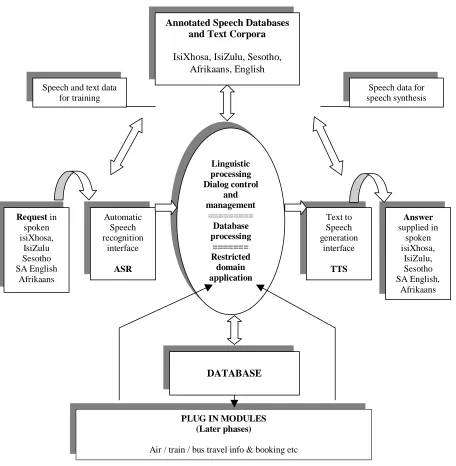
Figure 1: Macro-architecture of an automated multilingual voice based information retrieval and booking system as applicable to the African Speech Technology project.
This classical input-output approach does not represent anything new, however the nature of the languages involved creates a vast number of challenges, especially with regard to particular system design and database construction. These issues will be discussed in more detail in the next sections.
Multilingual Realities in South Africa
There are at least two factors related to multilingual realities in South Africa that influence decisions on the structure of the system to be developed and on the nature of the databases to be acquired.
Home language and language of use
The multilingual complexity of South Africa is clearly reflected in Table 1 which indicates the home language by population group, expressed as a percentage of a total of 40,5 million people. Although these 1996 government statistics (http://www.statsa.gov.za/census96) indicate that the first five largest home languages are respectively, isiZulu (22,9%), isiXhosa (17,9%), Afrikaans (14,4%), Sepedi (9,2%) and English (8,6%), the languages of commerce and industry by and large are English and Afrikaans. There is also a clear tendency among black, coloured and Asian speakers to opt for English in these Automatic
Speech recognition
interface
ASR
Text to Speech generation
interface
TTS Linguistic
processing Dialog control
and management
=========
Database processing
======= Restricted domain application Request in
spoken isiXhosa,
IsiZulu Sesotho SA English
Afrikaans
Answer
supplied in spoken isiXhosa,
IsiZulu, Sesotho SA English,
Afrikaans
PLUG IN MODULES (Later phases)
Air / train / bus travel info & booking etc
Speech data for speech synthesis Speech and text data
for training
DATABASE Annotated Speech Databases
and Text Corpora
African / Black
Coloured Indian / Asian
White Unspecified /Other
Total
Afrikaans 0.7 82.1 1.5 58.5 27.7 14.4
English 0.4 16.4 94.4 39.1 23.2 8.6
IsiNdebele 1.9 0.1 0.0 0.1 0.9 1.5
IsiXhosa 23.1 0.3 0.1 0.1 9.9 17.9
IsiZulu 29.5 0.2 0.2 0.1 16.9 22.9
Sepedi 11.9 0.1 0.0 0.0 5.6 9.2
Sesotho 10.0 0.2 0.0 0.0 4.0 7.7
SiSwati 3.3 0.0 0.0 0.0 1.4 2.5
Setswana 10.6 0.4 0.0 0.0 4.4 8.2
Tshivenda 2.8 0.0 0.0 0.0 1.5 2.2
Xitsonga 5.6 0.0 0.0 0.0 2.8 4.4
Other 0.3 0.2 3.7 2.0 1.7 0.6
Total 100.0 100.0 100.0 100.0 100.0 100.0
Table 1: Home language by population group expressed as percentages excluding those who did not specify their language.
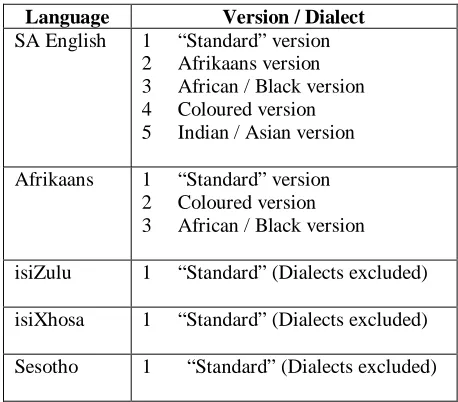
circumstances. From a pragmatic perspective (bearing in mind that a person may prefer not to use a home language for the particular transaction), as well as from an “official” perspective (the government is committed to promote the use of the indigenous languages in as many fields of interaction as possible), it is foreseen that the following databases as listed in Table 2 will need to be developed.
Language Version / Dialect
SA English 1 “Standard” version 2 Afrikaans version 3 African / Black version 4 Coloured version 5 Indian / Asian version
Afrikaans 1 “Standard” version 2 Coloured version 3 African / Black version
isiZulu 1 “Standard” (Dialects excluded)
isiXhosa 1 “Standard” (Dialects excluded)
Sesotho 1 “Standard” (Dialects excluded)
Table 2: Proposed databases
At phonetic level the range of variation is quite large amongst the different languages and language groups. Lanham (1967) identified five distinct varieties of English in South Africa of which SA Black English (BSAE) is one variety. Currently there is a serious debate on whether BSAE is a monolithic entity or whether distinct varieties based on the mother tongue of the speaker may be identified. That is, just as an Afrikaans-English variety may clearly be identified, the question is whether similar varieties such as Zulu-English or Sotho-Zulu-English do in fact exist. Limited experimental studies have shown that for instance, the rhythm of Afrikaans-English is closer to that of English
L1 speakers than that of Tswana-English (cf. Wissing et al., 2000). Similarly Van Rooij and Grijzenhout (2000) have studied certain idiosyncratic voicing phenomena in Zulu-English that distinguishes it from first language varieties of SA English. It is foreseen that in gathering substantial speech databases this project will make a contribution to the BSAE debate. Prinsloo and Botha (1999) investigated the L1 (Afrikaans mother tongue) and L2 (English mother tongue) pronunciation of the three true diphthongs of Afrikaans and found significant differences in formant space. In another study by Brink and Botha (1999), the acoustic properties of L2 (African language mother tongue) pronunciation of English vowels was compared to their L1 counterparts. In this study, empirical acoustic evidence of the linguistically predicted differences were in fact found. The eventual aim with studies of this kind is to apply these acoustical models to improve automatic speech recognition in Afrikaans and English respectively. From a technical point of view it will be necessary to account for the varieties in Table 2 in a systematic way within the system to avoid a breakdown in communication especially at the speech recognition front end.
Code switching and code mixing
Johannesburg may for instance be optionally referred to as Gauteng – from Sotho origin, or Egoli – from Nguni origin. Similarly, Pretoria is known as either Tshwane – from Sotho origin or ePitoli – from Nguni (via English) origin.
These realities need to be addressed in developing the above mentioned databases and prompts will have to be set up accordingly to obtain authentic data. As far as system development is concerned specific attention will be paid to accommodate these aspects.
Speech System Design
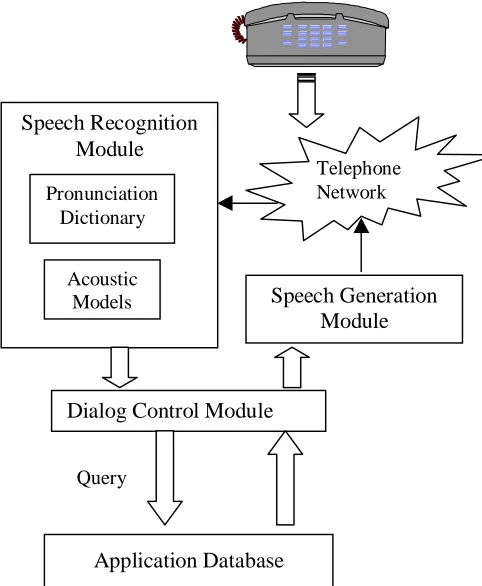
The proposed architecture of our telephone-based information system to be developed is illustrated in Figure 2. One such a system will be developed for each of the five languages concerned.
Figure 2: Voice-driven telephone-based information system architecture.
The core of the system is the speech recognition engine, which contains acoustic models and pronunciation dictionaries of the particular language. The recognizer provides the dialog manager module (DMM) with a hypothesis of the content of an unknown utterance together with a confidence measure. The DMM uses three sources of information to generate an appropriate response in the speech generation module (SGM): the recognition hypothesis, with its confidence measure, a dialog model for the particular application and the response from a query to the application database. The query to the database is generated by the DMM, based on the recognition hypothesis. A concatenative word-based model with a generative grammar is envisioned for the SGM. The recognizer gets its input (the unknown utterance) from the caller over the
telephone network and the response (output from the SGM) is sent to the caller through the same network.
Initial language choice
Initially, on receiving the incoming call, it is necessary to activate the specific language-dependent recogniser as required by the caller. This can be done in various ways.
• The simplest approach, and probably the one which we will give initial preference, is to have a separate telephone number for each language available in the system. This makes the languages available explicit before commencement of the transaction, thereby preventing confusion on the caller's side as whether a specific language is present. To some extent it also circumvents the procedure as to how a language should be activated, thereby allowing the dialogue to more directly proceed to the caller's actual intent. The role of language specific variation should, however, not be ignored. For instance, the English versions used in South Africa vary so widely that a single recogniser for all of them is very likely doomed from the outset. In an attempt to avoid these issues, users can be encouraged to stick to their mother tongue (if it is available). It is however debatable whether one can rely on them doing so. On the other hand, advertising telephone numbers for all of the different variants summarised in Table 2, also is somewhat clumsy. Some further possible difficulties to address are the inevitable wrong-language calls, and the speaker switching wrong-language during the discourse. The detection of these conditions can be based on estimating the reliability of the ASR, or explicit back-ground monitoring using language/variation identification.
• A next approach would be to query the speaker as to his language preference (possibly using a common language such as English) and recognising the response using speech/word recognition technology. This allows a single front-end/number, but also introduces some extra protocol during the initial stages of the conversation. Variation will, of course, again play an important role. It is also possible (or even likely) that the speaker will ignore this protocol and directly continue in his language of preference. This once again calls for detection of this situation.
• The last option is to make the initial system response in a commonly understood language such as English, possibly with the greeting itself in the various languages available. Automatic language/variation identification can then allow the speaker to proceed in the language of his choice. This approach is currently being used in operator-based services in South Africa, an example being telephone number enquiries. Unfortunately this injects a bias towards a specific (common) language and, if the number of languages being accommodated grows to more than two or three, separate language greetings can become clumsy. The previously mentioned problems of language-switching, of course still remains.
Telephone Network
Dialog Control Module
Application Database
Query
Speech Generation Module Speech Recognition
Module
Pronunciation Dictionary
Conclusion
Developing this system obviously poses a number of challenges, especially if it is taken into account that there is no real history on similar types of developments within the context of the African languages. It is challenging enough to develop a monolingual system in this fashion and we have no illusions on the magnitude of this venture. Fortunately, however, any “late starter” has the benefit of previous experiences of colleagues in the field in general. It is believed that this project will not only introduce African languages in a meaningful way to this exciting field, but that it will also make some contribution towards the “African Renaissance.”
References
Brink, J.D. & Botha, E.C. (1999). Towards an acoustic comparison of first and second language South African English. In Proceedings of the Tenth South African Workshop on Pattern Recognition (paper #0009). PRASA, Stellenbosch, South Africa.
Damper, R.Y., Marchand, M.A. & Gustafson, K. (1999). Evaluating the pronunciation component of text-to-speech systems for English: a performance comparison of different approaches. Computer Speech and Language, 13 (2): 155-176.
Dogil, G, Mayer, J & Roux, JC. (1998). Syllables and unencoded speech: Clicks and their accompaniments in Xhosa. In J Rennison & K Kuhnhämmer (Eds.) PHONOLOGICA 96: Syllables?! (pp. 49-60). The Hague: Holland Academic Graphics.
Donovan, R. & Woodland, P. (1999). A hidden Markov-model-based trainable speech synthesizer. Computer Speech and Language, 13 (3): 223-241. Lanham, L.W. (1967). The pronunciation of South
African English. Cape Town: A.A. Balkema.
Moulines, E. and Charpentier, F. (1990). Pitch-synchronous waveform processing using diphones. Speech Communication, 9:453-468.
Moulines, E. and Sagisaka, Y. (1995). Voice cenversion: State of the art and perspectives (guest eds.). Speech Communication, 16 (2).
Parthasarathy, S and Coker, C. (1992). Automatic estimation of articulatory parameters. Computer Speech and Language, 6:36-75.
Roux, JC (1998). SASPEECH: Establishing speech resources for the indigenous languages of South Africa. In A Rubio et al (Eds.), Proceedings of the First International Conference on Language Resources and Evaluation. Granada, Spain. European Language Resources Association – ELRA. Vol 1, 343-350.
Prinsloo, C.P. & Botha, E.C. (1999). Towards modelling the acoustic differences between the diphthongs of Afrikaans and English L1 and L2 speech. In Proceedings of IEEE Africon, Vol 1 (pp. 207-210). Cape Town, South Africa.
Purnell, D.W. & Botha, E.C. (1998). Automatic phone segmentation and labelling of Xhosa data. In Proceedings of the Tenth South African Workshop on Pattern Recognition (pp 23-28). PRASA, Stellenbosch, South Africa.
Van Rooij, B & Grijzenhout, J (2000). Voicing Phenomena in Zulu-English. In Proceedings of Workshop on Black South African English,
International Conference on Linguistics in South Africa (pp. 81-90). Cape Town.
Wissing, D, Gustafson, K, & Coetzee, A (2000). Temporal organisation in some varieties of South African English: Syllable compression effects in different types of foot structures. In Proceedings of Workshop on Black South African English, International Conference on Linguistics in South Africa (pp. 59-69). Cape Town.