A Framework for Cross-Document Annotation
David Day, Alan Goldschen, John Henderson
The MITRE Corporation
202 Burlington Road, Bedford, MA 01730, USA http://www.mitre.org/technology/nlp
{day,alang,jhndrsn}@mitre.org
Abstract
We introduce a cross-document annotation toolset that serves as a corpus-wide knowledge base for linguistic annotations. This imple-mented system is designed to address the unique cognitive demands placed on human annotators who must relate information that is expressed across document boundaries.
1.
Introduction
We are interested in building and evaluating systems that extract information about individuals and events from different textual sources. By operating over multiple docu-ments, multiple facts about individuals can accrue to a sin-gle representation of that individual (or event), enabling a more complete description of the entity, and supporting ev-idential reasoning. In addition, maintaining records about the source of each piece of contributing information can provide a mechanism to cluster documents using domain-specific semantic relationships.
However, most of the linguistic phenomena that are rou-tinely annotated in the corpus-based computational linguis-tics community have a relatively small locus of occurrence, almost always limited by the scope of the document it-self. Within the sub-community that concentrates on in-formation extraction, the layers of annotation range from the lexeme (segmentation, morphological analysis, part-of-speech tagging), to simple short phrases (”named entity” tagging, ”nominal entity” tagging, and similar tasks), sen-tences and their syntactic sub-structure, coreference rela-tionships among phrases, and, at the upper extreme, ”en-tity” and ”event” tagging within the scope of a single docu-ment (herein docudocu-ment-level). In the latter case, the entities and events can be derived from linguistic cues occurring virtually anywhere within the document. It should not be surprising, then, that current tools are poorly suited to han-dle the challenges of cross-document annotation.
The same arguments for the utility of document-level information extraction apply equally strongly in the cross-document case: we want to build systems that can reliably extract unique pieces of information from a text stream, in-dependent of how that information is stated within the text stream. By operating over multiple documents, more facts about individuals and events can accrue to a single rep-resentation of that individual or event. In addition, there are distinct motivations for maintaining information about which specific documents information has appeared in:
• Such information provides a mechanism to thread doc-uments, potentially at a finer granularity than simply by topic.
• Documents can be sorted and organized by the seman-tics of the extracted information, e.g., the temporal
or-dering of events, or other logical relationships among individuals or events (e.g., those that happened at the same location, etc.).
• Changes of authors’ hypotheses and points of view can be better tracked across both time and source.
• Multiple sources can be compared and combined to increase or decrease support for extracted information, either relative to the language processing capabilities, or relative to models of the domain.
2.
The Annotation Problem
Consider the following four selections of text, which we will assume derive from distinct documents (for example, from stories in different electronic news wire sources on different days).
1 . . .US Ambassador Bill Richardson traveled to France today to begin the negotiations he requested with. . .
2 . . .U.S. negotiator Richardson is not expected to dis-cuss European Union trade concerns on his trip to meet President Chirac. . .
3 . . .American farmers like B. J. Richardson are enthusi-astic about the new hybrid seeds, in spite of European concerns about their potential for. . .
4 . . .the president of France remains concerned about American agri-business and its willingness to. . .
Figure 1: Example text from four different documents.
In considering the problem of tracking identical people across their mentions in different news stories, we might represent the person entities mentioned in the documents as shown in Figure 2.
Person-1 Names Bill Richardson 1 Richardson 2 Titles US Ambassador 1 Descriptors U.S. negotiator 2
he 1
Person-2 Names Chirac 2 Titles President 2 Descriptors president of France 4 Person-3 Names B. J. Richardson 3 Descriptors American farmer[s] 3
Figure 2: One way of depicting the information captured from four different example articles.
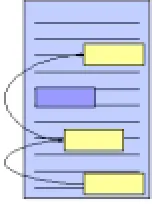
the Sixth Message Understanding Conferences evaluation (muc, 1995) of coreference used SGML annotations that used pair-wise links between annotated spans of text, as shown in Figure 3. This style of annotation can be depicted graphically as in Figure 4. The logical treatment of these pair-wise links is that a set of mutually coreferring expres-sions is represented by the transitive closure of all the con-stituent pair-wise links. Thus, while there are actually many different SGML element identifiers that may appear in any chain of coreferring expressions, one can view the annota-tions in one chain as identifying the individual menannota-tions as a member of a particular equivalence class.
. . .<COREF ID="1">Bank Austria AG,
<COREF ID="2" REF="1">Austria’s largest bank,</COREF></COREF> said <COREF ID="32">a covert,<COREF
ID="3"> 500-million schilling</COREF> deposit</COREF>. . .
Figure 3: MUC-style coreference annotation.1
Figure 4: A graphical depiction of the coreference arcs that are annotated following the MUC6 annotation standards.
In practice, however, as one moves into the prob-lem of identifying coreferring expressions across document boundaries, identifying coreferring pairs of text spans is un-tenable from the perspective of the human annotator. Con-sider the case in which an annotator working on annotating the 1 000-th document in a collection desires to coalesce
1The annotations have been simplified by removing
informa-tion indicating both the type of coreference relainforma-tionship (IDENT, PART OF) and an indication of the head or MIN (minimum per-mitted) constituents of a particular phrase.
a mention of Joe Smith (a very common name) with the previously annotated portion of the document collection. First, the annotator must find another annotated document containing a mention that could be this person. Then, if uncertainty remains, the annotator must determine if it is the same person by inspecting that document. Eventually, a mention of the correct underlying entity is found and the current mention is annotated with the corresponding equiv-alence class identifier.
The annotation problem is thus revealed: using this model, the annotator must repeatedly search the previously annotated documents, or keep discriminating information in mind to determine which mentions should be attributed to which underlying entity. This places an unreasonable burden on the annotator, and would severely hinder the abil-ity to distribute the annotation task among different anno-tators.
3.
Solution Framework
A framework that departs from traditional linguistic an-notation is adopted to address this problem. The goal is to enable the annotator to accurately and rapidly find pre-viously annotated candidate mentions and facilitate inspec-tion of those meninspec-tions in context.
Standoff annotation in a database, together with a schema providing descriptions of searchable keys, provides a mechanism for finding candidate mentions. The annota-tor can query the database more precisely than using text scanning tools on large document collections. The anno-tator cannot be expected to predict which descriptions will be useful as keys for later search, however. Therefore, each mention in the database must have an associated pointer into its location in the document collection to enable view-ing the mention in its context. An information retrieval open query mechanism using cosine distance in the vec-tor space model should be utilized if specialized queries fail. Finally, text retrieval tools of the most primitive type, involving queries composed of string matching predicates can be used as a method of last resort.
3.1. From Links to Free Standing Entities
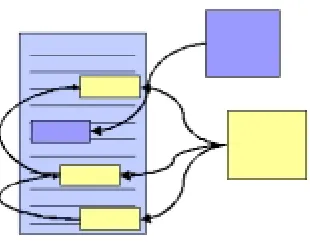
Coreference as a linguistic phenomena is grounded not in the referring expressions on which coreference chains are constructed, but in the “entities” that are being referred to in the minds of the participating language users. So while it is relevant to represent and evaluate the ground expressions which give rise to coreference, a rich model of coreference can benefit from directly modeling the entities themselves. Thus, the next step for annotating and evaluating corefer-ence is to explicitly capture the entities to which the core-ferring expressions are recore-ferring (as depicted in the transi-tion from Figure 4 to Figure 5).
Figure 5: Entity-centric model of coreference annotation.
Figure 6: Entity repository for capturing entities and their references across a document corpus.
repository. The repository serves to present a unified, “coa-lesced” view of the entities which are defined and referred to in a multiplicity of ways.
4.
Cross-Document Annotation Toolset
We have developed a set of tools that allow users to annotate a broad class of cross-document information us-ing this approach. A sus-ingle entity repository, implemented as a network service, maintains the corpus-level informa-tion being tracked. Individual documents within the corpus are annotated with pointers to the entity repository, and the repository, in turn, maintains references to all of the docu-ments (and locations within docudocu-ments) where information was individually annotated.A range of annotation types can be supported through the specialized interfaces of the document annotation appli-cation, the Alembic Workbench (Day et al., 1997), whose results are stored either as SGML tags embedded within the source documents themselves or else as stand-off XML annotations using the emerging ATLAS annotation frame-work (Bird et al., 2000). For our current research we we are interested in annotating document collections with infor-mation about coreferring expressions that describe people, places, organizations, and simple relations among these en-tities (such as who works for whom, where an organization is located, etc.).
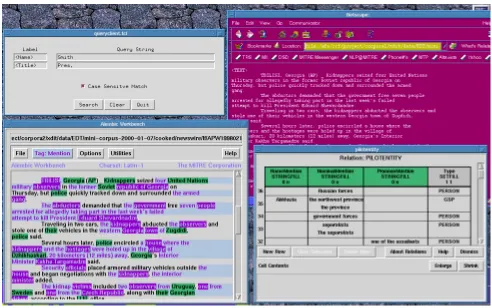
From the user’s point of view, there are three
major components: (1) the document-level annotation application; (2) the cross-document entity repository query/browser application; and (3) a general purpose docu-ment browser. A depiction of how these eledocu-ments might appear on a screen are shown in Figure 7. In this view the document-level annotation application actually consists of two elements of the Alembic Workbench—a text viewer and an entity viewer. In the lower left corner is a view of the source document text, with various text spans annotated and displayed with user-defined colors. In the lower right of the screen is the Alembic Workbench “relations” editor. This interface enables users to define attribute/value struc-tures that can be associated with spans of text, as well as with other types of values (including user-entered strings, selections from pre-defined lists of values, and pointers to other entities of specified types, either in this or a different relation table).
In the upper left corner of the screen is the query in-terface to the cross-document repository. This inin-terface is the front end of an application that runs on the client ma-chine and sends user queries to the entity repository server somewhere on the network (using network protocols). The results of a query (those entities that match the query con-straints) are returned and displayed in a different pop-up screen (not shown here). These returned values are in the form of whatever entities the server has been configured to store. (Entity structures are defined via an XML DTD, and data can be saved and restored via XML files.) The query and result interface components are in the process of being incorporated directly into the Alembic Workbench applica-tion to enhance their interoperability.
The goal of the users’ interactions with the repository query facility is to explore the database in search of en-tities that are most likely coreferential with an document-level entity being annotated. When annotating a portion of text within the document, the user can signal that it should be added to the repository. All document-level annota-tions, whether unique or destined to be bound together with other entries in the repository, are added to the repository as atomic entries. Collapsing entries in the repository (for example, those that are deemed to be coreferential) into an equivalence class is a separate operation that does not de-stroy the initial atomic entry, but merely associates one or more entries in a way that is supported by the query and display mechanisms. In this way subsequent processing of the repository is free to associate and disassociate entries from one another without losing track of the separate point-ers into the source documents from which this information was extracted.
The repository itself supports four major operations:
Add Inserts new entities into the repository server,
includ-ing possible substructure. For example, person en-tities might consist of names, titles, and descriptive phrases). Each entry in the repository always includes bookkeeping information, such as the original docu-ment and location within the docudocu-ment from which a piece of information was derived.
Query Finds entries in the repository that satisfy various
Figure 7: An example layout of the component tools that can be used to annotate coreferring expressions across documents. (See text for further description.)
Merge Performs a reversible unification of two entries,
en-abling them to be viewed by repository clients as if they were a single entity (e.g., during queries, etc.).
Split Separates previously merged entities.
The contents of the server are accessible from a multi-threaded XML database application whose internal knowl-edge representation (a Document Object Model) can be modified by re-defining the controlling DTD. We currently have defined a DTD that supports two kinds of entities: per-sons and organizations, both of which incorporate a small number of internal fields (including names, titles, and de-scriptors). Document-level annotations can be added di-rectly to the entity repository via the repository browser client, which performs both an atomic update as well as a search of the repository for entities of matching type that contain similar strings. When the repository entries are not sufficiently informative to disambiguate among competing entities, the tool can bring up a general purpose document browser to display the section of a document from which any particular repository entry was derived. This informa-tion is maintained in each atomic entry in the repository.
What the user sees of the repository is a local client, in-tegrated with the document-level annotation client. When the result of an annotation is to be added to the entity repos-itory, the repository client performs both an atomic update as well as a search of the repository for similarly typed en-tities that contain similar strings. This supports the next activity, namely determining which of the existing entries may be coreferential (or otherwise related) with this newly
annotated data.
It will often happen, especially with entities with few mentions and/or few “features” that the human annotator will need to refer to the original documents in which one or another of the repository entities were derived. All of the results from a query maintain their links back to the source documents from which they were derived, so the user may click on the appropriate returned entity to view the references to this entity in the context of the source doc-ument. In this case we are simply using a World Wide Web browser to retrieve and display these original source docu-ments (shown in the upper right of the Figure 7).
5.
Evaluation
There are three distinct ways in which one might want to evaluate cross-document information extraction. The different techniques stress different concepts, and are ab-stract. There are also parameters on the coreference evalu-ation task which must be set for instantievalu-ation (including a description of markables and categories into which mark-ables will be sorted), but those will not be discussed here.
Equivalence class identity, as exemplified in the