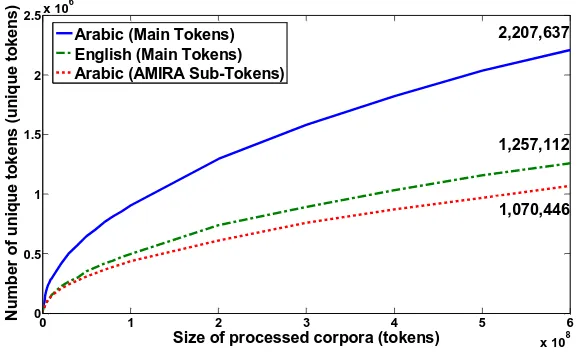
(words with the same writing form). However, Arab readers normally differentiate between homographs by the context of the script.
Moreover, Arabic is a morphologically complex language. An Arabic word may be constructed out of a stem plus affixes and clitics. Furthermore, some parts of the stem may be deleted or modified when appending a clitic to it according to specific orthographical rules. As a final point, different orthographic conventions exist across the Arab world (Buckwalter, 2004a). As a result of omitting diacritics, complex morphology and peculiar orthographical rules, processing Arabic text is a difficult task whether performed using statistical or rule-based methods.
1.2
Clitics in Arabic
A clitic is a linguistic unit that is pronounced and written like an affix but it is grammatically independent. Linguistically speaking, if one can parse an Arabic linguistic unit attached to a stem it should be considered as a clitic. This covers most of the clitics except the definite article (ـﻟا) (Al) (the). It is worth to mention that the transliteration used in this work is based on (Buckwalter, 2004b). In the worst case, there could be four concatenated proclitics and three enclitics attached to stems like (ﻞطﺎﺒﻟﺎﺒﻓأ) (> f b Al bATl) (? then by the false) (then by the false?) and (ﮫﯿﻨﺘﺒھو) (whb
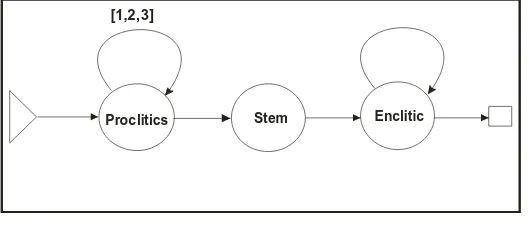
t ny h) (gave you me it) (you gave it to me) respectively. Figure 1 shows a model for constructing
main tokens in Arabic, where the number over the link represents the possible number of iterations keeping in mind the rules of ordering clitics. In Arabic an enclitic may immediately come after a proclitic as in (ﺎﮭﺑ) (b ha) (by it) (by it).
Proclitics Stem Enclitic
[1,2,3]
Figure 1: A model for constructing tokens in Arabic.
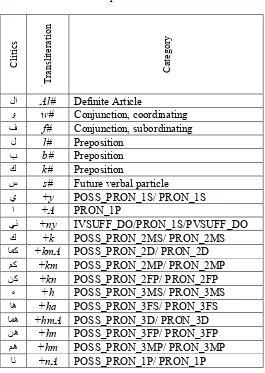
Proclitics and enclitics processed in this work are listed in Table 1, where enclitics are marked by “+” at the beginning and proclitics are marked by “#” at the end. All the clitics mentioned in Table 1 are extracted from (Maamouri et al. 2007) except the definite article. Besides these clitics, there are some other clitics that are rarely used in the MSA like the preposition (ﻢﺴﻘﻟاءﺎﺗ)
(t) (by) (swear by) used as in ( ﺎﺗ) (tAllAh) (by Allah) (swear by Allah) and the interrogative
particle (أ) (>) used as in (؟ﺔﺳرﺪﻤﻠﻟ ﺖﺒھذأ) (> *hb t) (? went you to school) (did you go to
school?). In addition, some complex structures are hardly ever used in the MSA like the token
(؟ﺎﮭﯿﻧﻮﻄﻌﺘﺳَ وَ أ) (>wstETwnyhA) (? and will give you me it) (and will you give it to me?).
2
Tokenization
The early step of processing any text is to divide the text into proper linguistic units (Manning, 1999). The resulting unit is called token and the process is called tokenization. The naive scheme of tokenization is to divide the text between white spaces or punctuation marks into tokens. In Arabic, this could produce a grammatically complete sentence like (ﺎﮭﻧﻮﺒﺘﻜﯿﺳو) (wsyktbwnhA) (and
will write they it) (and they will write it).
measure of 99.2%. AMIRA 2.0 has two models for tokenization one of them is much faster but slightly less accurate than the other.
3
Preparing the Data
The corpora used in this work come from English Gigaword (Graff et al., 2007) and Arabic Gigaword (Graff, 2007). They are collections of text data extracted from newswire archives of English and Arabic news sources that have been gathered over several years by the Linguistic Data Consortium (LDC) at the University of Pennsylvania. Text data in the Arabic Gigaword were collected from four newspapers and two press agencies. Text collected from press agencies was typed with less concern since it will be edited before publishing. The Arabic Gigaword corpus contains almost two million documents with nearly 600 million words, while the English Gigaword contains more than seven million documents with three billion words. To be consistent, only 600 million words are randomly extracted from English documents.
A common problem in the Arabic corpus is the omission of white spaces between main tokens that end with graphically non-connecting characters as in (اﺮﯿﺸﻣﺔﯾوﻮﻨﻟاﺔﺤﻠﺳﻻارﺎﺸﺘﻧاﺔﺤﻓﺎﻜﻣو) (and combating the spread of nuclear weapons pointing) which is a phrase of five connected words. Other problems in this corpus are the inconsistence use of punctuation marks, the presence of odd control characters and existence of many spelling errors. Simple preprocessing has been applied to overcome straight forward problems like splitting the above linked sentence.
4
Statistical Results
Running AMIRA 2.0 to tokenize such a huge corpus is a time consuming task. Therefore, the fast tokenization option was used. Nevertheless, it took about 300 hours of processing on a quad processor PC. The first step after tokenizing the Arabic text was counting every extracted clitic. In addition, frequency of clitics was calculated from a much smaller but manually tokenized corpus which is the LDC’s Arabic Treebank part 3 (Maamouri et al., 2007).
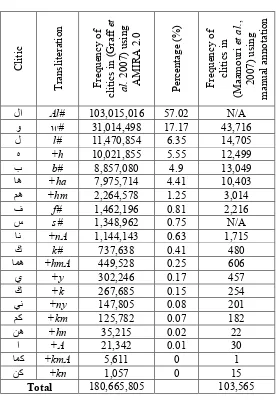
Table 2 shows the frequency and percentage of every clitics appeared in the tokenized text ordered in a descending manner in addition to the frequency of clitics appeared in the LDC’s Arabic Treebank. Since the definite article and the future verbal particle were not found in the LDC’s Arabic Treebank, it is worthless to calculate the overall percentage in the manual case. In general, the frequency of clitics in manual and automatic cases are proportional except the cases of the clitics ( k#) and (+kn). This could be due to the use of the slightly less accurate fast version of AMIRA 2.0. However, false proclitics consisting of the letter (ا) (A) and every other character in the alphabet frequently appeared in the automatically tokenized text using AMIRA 2.0. Among them only the definite article (ـﻟا) (Al) is correct. Table 3 shows a list of some false clitics generated from the tokenization process. It is important to mention that the false clitic (ا) (A#) is different than the interrogative particle (أ) (>#).
References
Alotaiby, F., I. Alkharashi and S. Foda. 2009. Processing large Arabic text corpora: Preliminary analysis and results. Proceedings of the Second International Conference on Arabic
Language Resources and Tools, Cairo, Egypt, pp. 78-82.
Attia, M. 2007. Arabic tokenization system. Proceedings of the 2007 Workshop on
Computational Approaches To Semitic Languages: Common Issues and Resources, Prague,
Czech Republic. Association for Computational Linguistics, pp. 65-72.
Buckwalter, T. 2004a. Issues in Arabic Orthography and Morphology Analysis. Proceedings of
the Workshop on Computational Approaches to Arabic Script-based Languages, Geneva,
Switzerland.
Buckwalter, T. 2004b. Buckwalter Arabic Morphological Analyzer Version 2.0, Linguistic Data Consortium (LDC) catalogue number LDC2004L02, ISBN 1-58563-324-0, Philadelphia. Diab, M. 2009. Second generation AMIRA tools for Arabic processing: Fast and robust
tokenization, POS tagging, and phrase chunking. Proceedings of the Second International
Conference on Arabic Language Resources and Tools, Cairo, Egypt, pp. 285-288.
Diab, M., K. Hacioglu and D. Jurafsky. 2004. Automatic tagging of Arabic text: From raw text to base phrase chunks. 5th Meeting of the North American Chapter of the Association for
Computational Linguistics/Human Language Technologies Conference (HLT-NAACL04),
Boston, MA.
Graff, D. 2007. Arabic Gigaword Third Edition. Linguistic Data Consortium. Philadelphia, USA.
Graff, D., J. Kong, K. Chen and K. Maeda. 2007. English Gigaword Third Edition. Linguistic Data Consortium. Philadelphia, USA.
Habash, N., O. Rambow and R. Roth. 2009. MADA+TOKAN: A toolkit for Arabic tokenization, diacritization, morphological disambiguation, POS tagging, stemming and lemmatization.
Proceedings of the Second International Conference on Arabic Language Resources and
Tools, Cairo, Egypt, pp. 102-109.
Maamouri, M., A. Bies, S. Kulick, F. Gaddeche, and W. Mekki. 2007. Arabic Treebank: Part
3(a) v. 2.6. Linguistic Data Consortium. Philadelphia, USA, Catalog ID: LDC2007E65.