Sentiment Classification in Resource-Scarce Languages
by using Label Propagation
Yong Rena
, Nobuhiro Kajib
, Naoki Yoshinagab
, Masashi Toyodab
, and Masaru Kitsuregawab a
Graduate School of Information Science and Technology, University of Tokyo, Japan [email protected]
b
Institute of Industrial Science, University of Tokyo, Japan
{kaji,ynaga,toyoda,kitsure}@tkl.iis.u-tokyo.ac.jp
Abstract. With the advent of consumer generated media (e.g., Amazon reviews, Twitter, etc.), sentiment classification becomes a heated topic. Previous work heavily relies on a large amount of linguistic resources, which are difficult to obtain in resource-scarce languages. To overcome this problem, we investigate the usefulness of label propagation, which is a graph-based semi-supervised learning method. Extensive experimental evaluation on three real datasets demonstrated that label propagation performs more stable than support vector machines (SVMs) and transductive support vector machines (TSVMs) in a document-level sentiment classification task for resource-scarce languages (Chinese in our case).
Keywords: sentiment classification, label propagation, semi-supervised learning
1 Introduction
Over the last decade, document-level sentiment classification has attracted much attention from NLP researchers; its potential applications include opinion summarization and opinion mining (Pang and Lee, 2008). Most of the existing methods locate sentiment classification as a supervised classification problem and train a reliable classifier from a large amount of labeled data (Panget al., 2002; Mullen and Collier, 2004; Matsumotoet al., 2005; Gamon, 2005). The main disadvantage of such supervised approaches is that it is quite expensive in both time and labor to annotate a large amount of training data.
Unfortunately, in some languages such as Chinese and Hindi, a sufficient amount of training data is not always available. Sentiment classification becomes a quite challenging problem for such resource-scarce languages. While some studies have tackled this problem (Wan, 2009; Dasgupta and Ng, 2009), they still require substantial human efforts or specific linguistic resources that are only available in particular languages as we will see later in Section 2. We therefore want to develop a low-cost, general method that can be readily applicable to sentiment classification in any languages.
In this paper, we explore the use of label propagation (LP) (Zhu and Ghahramani, 2002) in building a document-level sentiment classifier under a minimally-supervised setting, where we have only a small number of labeled reviews other than the target reviews that we want to classify. Having a similarity graph whose vertices are labeled or unlabeled instances (reviews, here) and edges represent the similarity between the vertices, LP infers the label (sentiment polarity) of unlabeled (target) reviews based on labeled reviews that are similar to the target reviews. The key in applying LP to document-level sentiment classification is therefore in the way to represent reviews on the graph and to define the similarity between the them. We thus investigate the impact of the review representation and the similarity measure on the classification performance.
The main contributions of our work are summarized as follows:
• We evaluate LP on document-level sentiment classification in a resource-scarce language. Our method can be applied to any languages in which a small number of labeled reviews are available.
• We run LP with different review representations1(content words, phrases, and adjectives), and various similarity measures (dice coefficient, overlap coefficient, Jaccard, cosine simi-larity) (Manning and Sch¨utze, 1999). We thereby reveal their impact on the classification performance.
• We compare our method with support vector machines (Vapnik, 1995) and transductive sup-port vector machines (Joachims, 1999), and demonstrate the stability of the classification performance of our method in this task.
The rest of this paper is organized as follows: Section 2 introduces related work, Section 3 explains LP algorithm in detail. Section 4 evaluates our method. Section 5 concludes this study and discusses future direction.
2 Related Work
Several researchers attempted to solve a sentiment classification task in languages without abun-dant training instances (Dasgupta and Ng, 2009; Wan, 2009; Yanyan Zhao and Liu, 2010). In what follows, we briefly introduce those studies.
Dasgupta and Ng (2009) used transductive SVM (Joachims, 1999) to exploit unlabeled reviews in a document-level sentiment classification task. Basically their work is divided into three steps: firstly they perform spectral clustering to identify unambiguous reviews from unlabeled reviews. Second, they employ active learning to label the remaining ambiguous reviews. Third, they use the resulting labeled reviews and the remaining unlabeled reviews to train a transductive SVM classifier. Unlike our method, this study assumes manual intervention in the active learning step.
Wan (2009) employed co-training (Blum and Mitchell, 1998) to exploit labled reviews for a resource-rich language (English) in a document-level sentiment classification task in Chinese. Co-training assumes two independent classifiers that solve the target task, and use the output of one classifier to train the other classifier. With the help of machine translation, they could train two document-level sentiment classifiers in Chinese and English alternately. Their method can be applied to only resource-scarce languages that have a machine translation system between the target resource-scarce languages and a resource-rich language (e.g, English) and the classification performance could be heavily affected by the translation quality.
Yanyan Zhao and Liu (2010) adopted a graph-based propagation approach called Potts model (Wu, 1982) to solve a sentence-level sentiment classification task. Similar to label propagation we used in this study, Potts model uses the relationship among instances, and each instance arrives a probability state through the process of propagation until the whole graph stabilizes. We should mention that the motivation of their study is not to obtain high classification performance in a minimally-supervised setting but to make use of intra- and inter-document evidences in sentence-level sentiment classification. The usefulness of a graph-based semi-supervised algorithm in a minimally-supervised setting remains to be investigated.
3 Proposed Method
3.1 Method Overview
We adopt label propagation (Zhu and Ghahramani, 2002), which is a graph-based semi-supervised learning method, to solve a document-level sentiment classification task. Label propagation owns a
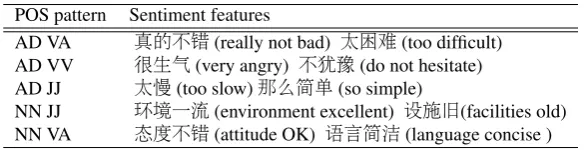
Table 1:POS patterns and example sentiment features that match them
POS pattern Sentiment features
AD VA dddd(really not bad) ddd(too difficult)
AD VV ddd(very angry) ddd(do not hesitate)
AD JJ dd(too slow)dddd(so simple)
NN JJ dddd(environment excellent) ddd(facilities old)
NN VA dddd(attitude OK) dddd(language concise )
Table 2:Reviews and their sentiment phrases
Reviews Sentimental features extracted
dddddddddddd dd dd ddd
The room is very small and cold. Unsatisfying! Very small, very cold, Unsatisfying
dddddddddddd dddd dd
Service attitude is OK. The food is very good. Attitude is OK, very good
lot of advantages including convergence and a well defined objective function. It has been success-fully employed in several NLP tasks, such as sentiment lexicon induction (Rao and Ravichandran, 2009) and word sense disambiguation (Niuet al., 2005). To the best of our knowledge, there is no previous work that uses this algorithm in document-level sentiment classification where there are only a few amount of training data available.
Our method is divided into three steps:
Step 1: We extract from each reviewsentiment features, which are words/phrases with sentiment polarity, and then represent the review with a vector of extracted sentiment features ( senti-ment feature vectors).
Step 2: We construct a similarity graph by regarding the reviews (sentiment feature vectors) as vertices. The edge (weight) between two vertices (reviews) represents a degree of similarity between their sentiment polarity.
Step 3: Having a few vertices labeled as seeds, each vertex iteratively propagates its label to its neighboring vertices according to their similarity; seeds (initially labeled vertices) thereby behave like sources that push out labels to unlabeled vertices.
In the following sections, we explain each step in detail.
3.2 Step1: Extract Sentiment Feature
Feature selection plays an important role in label propagation, since the similarity score (label consistency) is directly affected by the design of feature vector. We therefore try the following three different ways to obtain the feature vector. Prior to extraction, Stanford Chinese Word Seg-menter2and Stanford Log-linear Part-Of-Speech Tagger3are used to pre-process each review. In
what follows, AD, VV, VA, JJ and NN refer to adverb, verb, predicative adjective, adjective and noun, respectively.
content words: We extract content words with the exception of words with pronoun (PN), mea-sure word (M), cardinal number (CD), proper noun (NR), which do not convey sentiment. phrases: We extract phrases that are likely to express sentiment by using manually-tailored POS
patterns. Table 1 lists five POS patterns that we used to extract phrases, along with cor-responding phrases extracted by them. These POS patters motivates from an intuition that 2http://nlp.stanford.edu/software/segmenter.shtml
Table 3:Similarity measure methods
Name Computing formula
Dice 2|A∩B|
|A|+|B|
Jaccard Index |A∩B|
|A∪B|
Overlap |A∩B|
|min(A,B)|
Cosine (tf-idf) A·B
|A||B|
Cosine (binary) √|A∩B|
(|A|×|B|)
they are common indicators to identify sentiment expressed in reviews. Note that negation is tagged as AD. Turney (2002) used similar feature extracting strategy.
adjective: We extract only adjective words with POS tag VA and JJ.
Table 2 lists two examples of sentiment features extracted from reviews in the dataset we used in our experiment. They are positive and negative reviews in hotel domains, respectively.
3.3 Step 2: Build Similarity Graph
We try several similarity measures to define the similarity between the feature vectors extracted from reviews in Step 1. We assume that the more similar the sentiment polarity of two reviews is, the higher the similarity score between them is. Table 3 lists similarity measures we have used, where A and B are two reviews represented as feature vectors.
Then we construct a similarity graph from both labeled reviews (seeds) and unlabeled target reviews to be classified. In this study, when the similarity score between two reviews is above 0, we create an edge between two vertices corresponding to the two reviews in the graph, and the edge weight is computed by the similarity score. We should note that this graph construction procedure is performed in a totally parameter-free fashion. We do not require precious labeled data (as development set) to tune hyper-parameters as other (semi-)supervised methods do.
3.4 Step 3: Learning on Similarity Graph
Having the similarity graph obtained in step 2, label propagation (LP) (Zhu and Ghahramani, 2002) iteratively propagates a label from the labeled instances to their neighbors. LP can assign labels to the vertices that are connected to labeled vertices on the graph. In other words, if the graph is well-connected, we need a few labeled data to provide a label to a large amount of unlabeled data.
The similarity graph G={V, E, W} consists of verticesV, edges E, and an n×n weighted similarity matrix W = [wij], where n = |V|. The edge weightwij is calculated by similarity
score between reviewiand reviewj. When similarity scorewijbetweenxiandxjis larger, they
are more likely to have the same label.
Mathematically speaking, LP aims to minimize the following objective function (Rao and Ravichandran, 2009), where lis the number of labeled data, u is the number of unlabeled da-ta, andyiis a binary label that takes 1 if the vertex is positive and 0 if the vertex is negative.
l+u
∑
i,j=1
wij(f(xi)−f(xj))2subject tof(xi) =yifori= 1,2, . . . , l (1)
The solution to this problem satisfies the following stationary conditions:
f(xi) =yi, i= 1...l f(xj) =
∑l+u
k=1wjkf(xk)
∑l+u k=1wjk
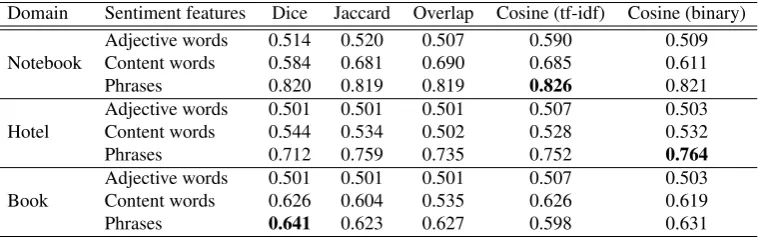
Table 4:Classification performance with label propagation
Domain Sentiment features Dice Jaccard Overlap Cosine (tf-idf) Cosine (binary)
Notebook Adjective wordsContent words 0.5140.584 0.5200.681 0.5070.690 0.5900.685 0.5090.611
Phrases 0.820 0.819 0.819 0.826 0.821
Hotel Adjective wordsContent words 0.5010.544 0.5010.534 0.5010.502 0.5070.528 0.5030.532
Phrases 0.712 0.759 0.735 0.752 0.764
Book Adjective wordsContent words 0.5010.626 0.5010.604 0.5010.535 0.5070.626 0.5030.619
Phrases 0.641 0.623 0.627 0.598 0.631
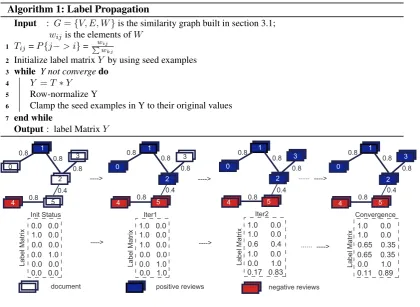
The process of the algorithm is exemplified in Figure 14. Each rectangle stands for one vertex
(review). The weight value is the similarity score computed by using similarity measures intro-duced in Table 3 in Step 1. Here we define blue vertices as positive reviews and red ones as negative reviews.
Algorithms 1 process this graph as follows: Firstly, vertex 1 and vertex 4 are initialized as positive seed and negative seed, respectively. The corresponding label matrix Y is also shown. Then after the the first iteration (Iter1), label from vertex 1 is propagated to vertex 0 and vertex 2. Similar behavior happens between vertex 4 and vertex 5. After the second iteration (Iter2), positive label is also propagated to vertex 3 from vertex 2. Although vertex 2 could also receive negative label from vertex 5, in the corresponding label matrixY, we could find positive value (Y[2,0]) is larger than negative value (Y[2,1]). Vertex 2 is still be categorized as positive review according to the classifying criteria we mentioned before. Finally the state of label matrix Y is stabilized (Convergence). The classifying process ends.
4 Evaluation and Discussion
We firstly investigate the performance of sentiment classification using different sentiment features and various similarity measures to define edges in the LP’s similarity graph. We then compare LP with representative supervised and semi-supervised algorithms in terms of classification perfor-mance when we change the number of labeled reviews.
4.1 Data Set
The dataset we used is ChnSentiCorp5. It consists of reviews from three different domains:
note-book, hotel, and book. The sentiment polarity of each review has been manually labeled. In each domain, we randomly selected 300 reviews as test dataset. The ratio between positive and negative reviews in the test data is 1:1, so that random baseline achieves accuracy of 0.5. We divided the remaining reviews into two parts: labeled seeds and unlabeled data. The number of labeled seeds is varied from 10 to 300 to control the amount of supervision.
In order to decrease the effect of seed selection, we conduct a ten-rounds experiment for the same number of labeled seeds. In each round, different labeled seeds are used. We report the average classification accuracy as a final result.
4.2 Sentiment Feature and Similarity Graph Selection
In this section we present classification results of our method when using different sentiment features and similarity graphs. The number of labeled seeds is fixed to 300. The classification results are summarized in Table 4. We have marked the best results using bold characteristics.
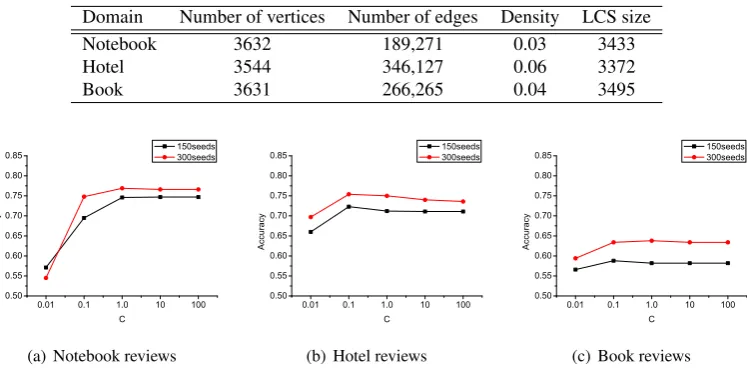
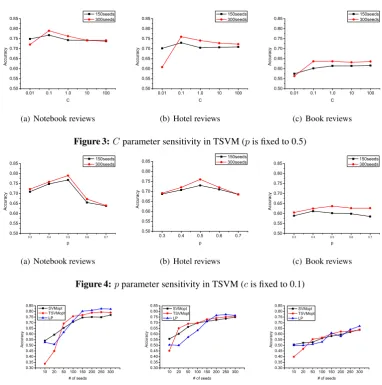
4.3.2 Performance Comparison The comparison of classification performance is shown in Figure 5; the vertical axis indicates the accuracy, while the horizontal axis indicates the number of labeled seeds. The performance of LP is comparable with SVM and TSVM with optimal hyper-parameter setting (referred to as SVMopt and TSVMopt int Figure 5) and even outperforms them when an appropriate number of seeds are provided. We should note that label propagation is a parameter-free method. It performed reasonably well across all the three domains without tuning hyper-parameters.
We could find that, with the increase of labeled instances, the performance of all of three methods were improved. For SVM and TSVM, the increase of labeled instances means more labeled data are available, so the classifiers perform better. On the other hand, for label propagation when more seeds take part in the label propagating process, unlabeled vertices could get more reliable sources so that LP could become more confident to decide the label one specific vertex belongs to.
Finally, all the three methods do not perform well in book domain. Because in book reviews people would discuss various aspects including the story, the writing style of author, the figures in the book and even the publisher. Sometimes the sentiment those aspects are not consistent. Turney (2002) reported similar findings on movie reviews.
5 Conclusion and Future Work
In this paper we explore the use of label propagation (LP) for a document-level sentiment classi-fication task in resource-scarce languages. We exhaustively investigate the performance of label propagation in this task while varying the way to build the task similarity graph. We found the similarity graph built on phrases is an excellent choice for label propagation for this task. And based on phrases, conine (binary) could be used to measure the sentimental similarity well.
We compared our method with supervised learning and semi-supervised learning methods on real Chinese reviews classification in three domains. Experimental results demonstrated that la-bel propagation showed a competitive performance against SVM or Transductive SVM with best hyper-parameter settings. Considering the difficulty of tuning hyper-parameters in a resource-scarce setting, the stable performance of parameter-free label propagation is promising.
We plan to further improve the performance of LP in sentiment classification especially when we only have a small number of labeled seeds. We will exploit the idea of restricting the label propagating steps when the available labeled data is quite small. Besides, according the work (Ve-likovichet al., 2010) label propagation suffers a problem when there are dense subgraphs in the similarity graph. Because in label propagation a vertex with multiple paths to a seed will be influ-enced by all these path, when the label information comes into a dense subgraphs a reinforcement effect will happen. We plan to adopt the idea of damping factor used in PageRank (Brin and Page, 1998) to solve the problem. Finally, we will also explore sentiment feature extracting approaches and different similarity graphs combining methods.
References
Blum, Avrim and Tom Mitchell. 1998. Combining labeled and unlabeled data with co-training. InProceedings of the eleventh annual conference on Computational learning theory, COLT’ 98, pp. 92–100. ACM.
Brin, Sergey and Lawrence Page. 1998. The Anatomy of a Large-Scale Hypertextual Web Search Engine.Computer Networks and ISDN Systems, 30(1-7), 107–117, April.
the 47th Annual Meeting of the ACL and the 4th International Joint Conference on Natural Language Processing of the AFNLP: Volume 2 - Volume 2, ACL ’09, pp. 701–709.
Gamon, Michael. 2005. Sentiment classification on customer feedback data: noisy data, large feature vectors, and the role of linguistic analysis. InIn COLING, pp. 841–847.
Joachims, Thorsten. 1999. Transductive inference for text classification using support vector machines. pp. 200–209. Morgan Kaufmann.
Manning, Christopher D. and Hinrich Sch¨utze. 1999. Foundations of statistical natural language processing. MIT Press.
Matsumoto, Shotaro, Hiroya Takamura, and Manabu Okumura. 2005. Sentiment classification using word sub-sequences and dependency sub-trees. InPAKDD’05, pp. 301–311.
Mullen, Tony and Nigel Collier. 2004. Sentiment analysis using support vector machines with diverse information sources. InIn Proceedings of Conference on Empirical Methods in Natural Language Processing.
Niu, Zheng-Yu, Dong-Hong Ji, and Chew Lim Tan. 2005. Word sense disambiguation using label propagation based semi-supervised learning. InProceedings of the 43rd Annual Meeting on Association for Computational Linguistics, ACL ’05, pp. 395–402.
Pang, Bo and Lillian Lee. 2008. Opinion mining and sentiment analysis. Found. Trends Inf. Retr., 2, 1–135, January.
Pang, Bo, Lillian Lee, and Shivakumar Vaithyanathan. 2002. Thumbs up? sentiment classification using machine learning techniques. InEMNLP ’02: Proceedings of the ACL-02 conference on Empirical methods in natural language processing, pp. 79–86. Association for Computational Linguistics.
Rao, Delip and Deepak Ravichandran. 2009. Semi-supervised polarity lexicon induction. In Pro-ceedings of the 12th Conference of the European Chapter of the Association for Computational Linguistics, EACL ’09, pp. 675–682.
Turney, Peter D. 2002. Thumbs up or thumbs down?: semantic orientation applied to unsuper-vised classification of reviews. InProceedings of the 40th Annual Meeting on Association for Computational Linguistics, ACL ’02, pp. 417–424.
Vapnik, Vladimir N. 1995. The nature of statistical learning theory. Springer-Verlag New York, Inc.
Velikovich, Leonid, Sasha Blair-Goldensohn, Kerry Hannan, and Ryan McDonald. 2010. The vi-ability of web-derived polarity lexicons. InHuman Language Technologies: The 2010 Annual Conference of the North American Chapter of the Association for Computational Linguistics, HLT ’10, pp. 777–785.
Wan, Xiaojun. 2009. Co-training for cross-lingual sentiment classification. In Proceedings of the Joint Conference of the 47th Annual Meeting of the ACL and the 4th International Joint Conference on Natural Language Processing of the AFNLP: Volume 1 - Volume 1, ACL ’09, pp. 235–243.
Wu, F. Y. 1982. The potts model. Rev. Mod. Phys., 54(1), 235–268, Jan.
Yanyan Zhao, Bing Qin and Ting Liu. 2010. Integrating intra- and inter-document evidences for improving sentence sentiment classification.ACTA AUTOMATICA SINICA, 36(10), 1417– 1425.