LPath
+: A First-Order Complete Language
for Linguistic Tree Query
Catherine Lai and Steven Bird
Department of Computer Science and Software Engineering University of Melbourne, Victoria 3010, AUSTRALIA Department of Linguistics and Linguistic Data Consortium
University of Pennsylvania, Philadelphia PA 19104, USA [email protected],[email protected]
Abstract
Annotated linguistic databases are widely used in linguistic research and in language technology development. These annotations are typically hierarchical, and represent the nested structure of syntactic and prosodic constituents. Recently, the LPath language has been proposed as a convenient path-based language for querying linguistic trees. We establish the formal expressiveness of LPath relative to the XPath family of languages. We also extend LPath to permit simple clo-sures, resulting in a first-order complete language which we believe is sufficiently expressive for the majority of linguistic tree query needs.
1. Introduction
In recent years, a great variety of linguistic query languages have been proposed, most of them specialised for linguistic trees (Lai and Bird, 2004), and applied to corpora such as the Penn Treebank (Marcus et al., 1993). Despite this considerable effort, relatively little is known about the formal expressiveness of these languages, or the computational resources required to process them as the size of the data grows. One reason for this is that much of the work in this area has taken place in isolation from well-understood database query languages such as SQL and XPath (Clark and DeRose, 1999).
Recently, the LPath language has been proposed as a convenient path-based language for querying linguistic trees (Bird et al., 2006). It augments the navigational axes of XPath with three additional tree operators, and it can be translation into SQL for efficient execution. In this paper we investigate the expressiveness of LPath with respect to Core XPath and to a first-order complete language called Conditional XPath. We also extend LPath to permit simple closures, and argue that this new language supports all the navigational and closure requirements of linguistic tree query.
This paper is organised as follows. Section 2 reviews LPath, XPath, and Conditional XPath, and Section 3 examines the LPath operators to see which of them can be expressed in XPath or Conditional XPath. Section 4 presents an extended language, Conditional LPath, or LPath+
S2
VP4
NP6
PP11
NP7 NP13
NP3 V5 Det8 Adj9 N10 Prep12 Det14 N15 N17
lex: lex: lex: lex: lex: lex: lex: lex: lex:
I saw the old man with a dog today
Figure 1: Tree Representation
2. Background: LPath and XPath
2.1. LPath
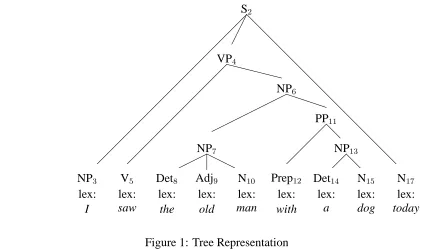
LPath was developed to be expressive enough for linguistic query but also to take advantage of relational database technology. As the name suggests, LPath is an extension of XPath. Bird et al. (2006) present three linguistically motivated syntactic additions. These are the immediate following axis (and its converse), tree edge alignment, and a scoping operator. They also present an efficient interpreter for LPath which converts LPath expressions into equivalent SQL expressions over annotation graphs (Bird and Liberman, 2001). Here are a selection of examples intended to illustrate the syntax and interpretation of LPath queries. When applied to the tree in Figure 1 they return the specified node sets.
1. //S[//_[@lex=saw]{S2}
Find a sentence containing the word saw. 2. //V->NP{NP6, NP7}
Find noun phrases that are immediately following a verb. 3. //VP/V-->N{N10, N15, N17}
Find nouns that follow a verb which is a child of a verb phrase. 4. //VP{/V-->N}{N10, N15}
Within a verb phrase, find nouns that follow a verb which is a child of the given verb phrase.
5. //VP{/NP$}{NP6}
Find noun phrases which are the rightmost child of a verb phrase. 6. //VP{//NP$}{NP6, NP13}
Find noun phrases which are rightmost descendants of a verb phrase. 7. //VP[{//ˆV->NP->PP$}]{VP4}
locpath := abspath | abspath ’{’ locpath ’}’ | locpath ’|’ locpath
abspath := | locstep abspath
locstep := axis test | axis test ’[’fexpr’]’
fexpr := locpath | fexpr ’and’ fexpr | fexpr ’or’ fexpr | ’not’ fexpr | ’(’ fexpr ’)’
axis := ’\’ | ’\\’ | ’\\*’ | ’.’ | ’/’ | ’//’ | ’//*’ ’->’ | ’<-’ | ’-->’ | ’<--’ |
’=>’ | ’<=’ | ’==>’ | ’<==’ test := p | _ | ’ˆ’p | p’$’
Figure 2: LPath Syntax (pis a node label; attribute syntax is omitted)
\ parent / child
\\ ancestor // descendant
\\* ancestor or self //* descendant or self
-> immediate following <- immediate preceding --> following <-- preceding
=> immediate following sibling <= immediate preceding sibling ==> following sibling <== preceding sibling
. self
Figure 3: LPath Axes and their Interpretation
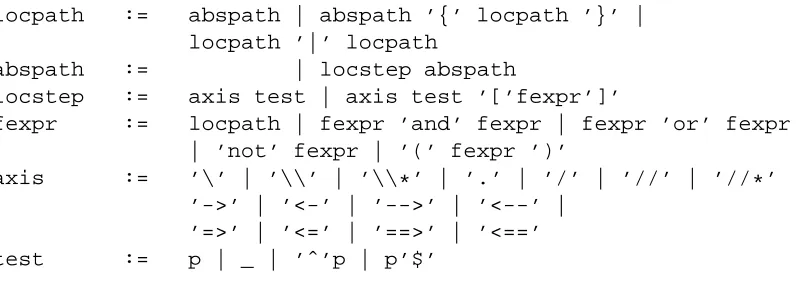
The syntax of LPath is described in Figure 2. Figure 3 gives the translation of abbreviated axes. We briefly review the syntax of LPath here, and refer the reader to (Bird et al., 2006) for full details.
Scoping: The scoping operator is denoted by pairs of braces, {}. These braces represent queries constrained to a particular subtree rooted by the context node immediately before the opening brace. The location path inside the scoping braces is evaluated as if this subtree were the whole of the input. This allows us to write queries restricted to a particular constituent.
Alignment. Left and right tree edge alignment, ˆ and $ respectively, together with the scoping operator allow us to constrain a node to be leftmost (rightmost) edge in a constituent. For example, the following query returns sentences (S labelled nodes) that begin with a noun phrase and end with a verb phrase://S{[//ˆNP-->VP$]}.
Horizontal axes. The immediate following axis, ->, is the natural one-step version of the following axis,-->. We can consider this axis as taking a step to constituents immediately right of the current context node. LPath also includes an immediate following sibling relation.
locpath := locstep | /locpath | locpath ’/’ locpath | locpath ’|’ locpath
locstep := axis::test | axis::test[fexpr]...[fexpr] fexpr := locpath | fexpr ’and’ fexpr |
fexpr ’or’ fexpr | ’not’ fexpr | ’(’ fexpr ’)’ axis := ancestor | ancestor_or_self | parent | child |
descendant | descendant_or_self | self | following | preceding |
following_sibling | preceding_sibling |
test := p | _
Figure 4: Syntax of Core XPath
Notation. The following sections take an incremental approach to investigating the
expres-siveness of Core XPath and LPath extensions. This involves several languages constructed and related by restrictions on closures and the LPath operators defined above. Subscripts and superscripts denote the addition of a particular operator. X+
{} denotes Conditional XPath
extended with the scoping operator (but not->or its converse). X->{}$ represents Core XPath
with->, =>and their converses, scoping and edge alignment, that is, LPath orL. L+
denotes LPath extended with the conditional axis.
2.2. XPath and Conditional XPath
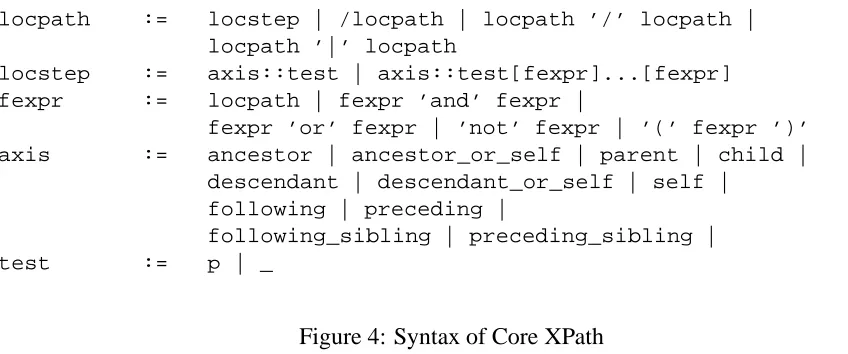
Marx (2004) presents a family of XPath languages that extend the navigational functionality of XPath 1.0. Core XPath (X) was originally presented by Gottlob et al. (2003). This language can be seen as XPath 1.0 stripped of non-navigational components such as attributes and namespaces. The syntax ofX is shown in Figure 4.
Conditional XPath (X+
) extends X primarily by adding a conditional axis. This expresses conditional paths where every node in that path satisfies a particular condition represented as a filter expression.X+
replaces the definition ofaxisin Figure 4 as follows: axis := primaxis | ’[’ fexpr ’]’ primaxis |
primaxis ’[’ fexpr ’]’ | axis ’*’ primaxis := self | child | parent |
immediate_following_sibling | immediate_preceding_sibling
Primary axes (primaxis) represent the smallest steps that can be taken in each direc-tion from nodes in a tree. Note, X does not include the one-step sibling axis immediate following sibling or its converse. However, it does include its transitive closures, following sibling. In fact, the transitive closures of each primary axis are included in X so we will use these axis names for non-conditional closures. For example, child* is equivalent to descendant_or_self. We also define axis+ as the non-reflexive transitive closure of an axis as/axis::_/(axis)*. Again, we will denotechild+asdescendant.
X+
\\ // // //
NP
VP
N
PP −−>
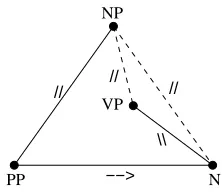
Figure 5: Scoping induced cycles:NP{//PP-->N\\VP}
restricted to particular types of constituents and their contents. In order to express scoping we need expressions that have some way of remembering the subtree they should be in. However, path-based, variable-free languages like X+
have no explicit memory and so can only do this implicitly.
3. The Relationship between LPath, XPath and Conditional XPath
How does the expressiveness of LPath, L, compare with that of X and X+
, existing well-understood languages? Perhaps LPath is just a syntactic variant of one of them, in which case we could build an interpreter to convertLexpressions toX orX+
expressions. We take up this question in the next two subsections.
3.1. LPath Operators and Core XPath
To begin, it is easy to see that edge alignment can be expressed in X. We note the following equivalences:ˆA≡A[not <-- _ ]andA$≡A[not --> _ ].
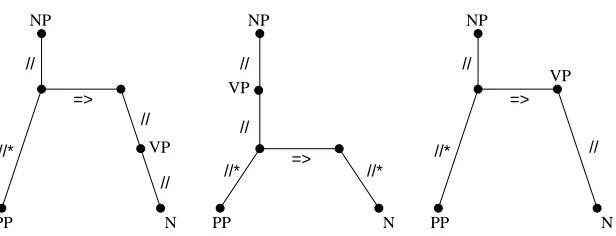
The scoping operator can be thought of as the assertion that a dominance relation between the scoping node and those appearing within the scoping braces. This is illustrated in Figure 5. Here, the queryNP{//PP-->NP\\VP}is drawn as a cyclic graph where edges are labelled with the axes relating pairs of nodes. The scoping constraint corresponds to the extra dashed edges.
The difficulty implementing the scoping operator in path-based languages such asX is that they have no memory of previous steps. In general, it is not possible to return to a particular node unless every node in the tree is uniquely labelled. This is clearly not the case for linguistic trees. In order to to transform a ‘scoped’ expression into a X expression we need to convert cyclic queries into a disjunction of acyclic ones. An algorithm that does exactly this for the positive fragment ofX has been presented by Gottlob et al. (2004). PositiveX is the set ofX
expressions that do not include negation in filter expressions. However, note that positive X
cannot express the edge alignment operators.
Lemma 1. The scoping operator adds no expressiveness to PositiveX.
VP
VP NP
PP NP
V PP
NP V
VP
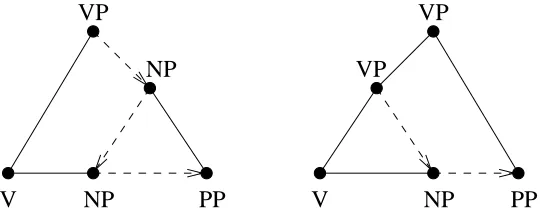
Figure 7: Scoping and immediate following. Dashed lines indicate the path of the query.
Lemma 4. Lis strictly more expressive thanX->.
Proof. The additional axes express sequential relations and so do not giveX->any more ability
to express queries of the form //B/A{//A[not (\\_[not .A])]}. Thus, the scoping operator is not expressible inX->.
In fact, the interaction of L operators results in queries that require other closures that are inexpressible in X. First, consider the interaction of the scoping and edge alignment operators. As noted previously, this allows us to express subtree edge alignment. The query //S{[//ˆNP-->VP$]}is equivalent to constraining theNP(VP) to be a leftmost (rightmost) descendant of theS. This requires us to be able to state that every node on the/-path between theSandNPhas no left sibling. This is just the conditional axis, which is inexpressible inX.
Second, consider the scoping operator and the immediate following axis. This axis allows the current context node to move outside of the scoped subtree. This is demonstrated in Figure 7. Consider a situation where we wish to find verb phrases (VP) containing a noun phrase (NP) immediately followed by a prepositional phrase (PP). That is//VP{//NP->PP}. From the point of view of the NP node, there is no way to tell if an immediate following PP is dominated by the same VP originally being tested. If order to constrain -> to be within a subtree, we need to phrase this constraint using other axes. (Note that the following axis, -->, can be alternatively defined as:-->t[F]≡\\*_==>_//*t[F].)
Now, the only chance that we may leave the scope is if the ‘ancestor’ part of the expression takes us above the scoping node. As long as we constrain how far up the ancestor is chosen, we are assured of staying within the scope. The cycle-removing algorithm of Gottlob et al. (2004) enumerates the possible positions such an ancestor can take.
Although -> has a similar form to its closure --> it requires further constraints that are inexpressible inX. Specifically, we need to to be able to identify ancestors that are rightmost and descendants that are leftmost. This is much the same as subtree edge alignment. As in the previous example, these constraints cannot be expressed inX. Importantly, this means that the only way we can represent the immediate following relation is with the primitive. Without some sort of memory device there is no way to force this primitive to stay within a scope. In a first-order formulas such a memory device would come in the form of extra variables.
Putting all this together gives a clear picture of the expressiveness is required to implement
syntax is much more intuitive and more closely aligned to actual descriptions of structure in the linguistics literature (Palm, 1999). However, there is still a price to pay for choosing this path-based variable-free approach over the variables and predicates of classical first-order logic. The major advantage of the classical approach of fsq is that variables can be used to identify specific nodes throughout a query. The scoping operator accounts for cases where there is a need to identify the root of a particular subtree, the scoping node, at every step in a path expression. However, althoughL+
is first-order complete, it is not always clear how a first-order formula can be converted into a (variable-free)L+
expression.
First-order completeness tells us that the following query is expressible: Find the first com-mon ancestor of noun phrases immediately followed by a verb phrase. This can be expressed as follows:
ϕ(x) =∃y∃zdescendant(x, y)∧descendant(x, z)∧NP(y)∧VP(z)
∧following(y, z)∧ ¬∃z′(following(x, z′)∧following(z′, y))
∧ ¬∃w(descendant(w, y)∧descendant(w, z)).
However, even with the immediate following axis and the scoping operator it is not very obvious how this can be expressed inL+
. Note that the following query is incorrect,
//_[{//NP->VP} and not(//_{//NP->VP})].
This is because each NP(orVP) may refer to completely different nodes. We can express this query by using theX+
definition of the immediate following relation rather than the primitive ->axis.
//_[/_[(NP or (/_[not(=>_)])*/NP[not(=>_)) and => (VP or (/_[not(<=_)])*/VP[not(<=_)])]
However, this is a very different approach to representing this sort of query than suggested by the first-order formula above. These problems are inherent to path-based, variable-free languages.
As an example of how sequential closures are expressed consider the following query: Find words consisting of consonant-vowel-consonant sequences.1 Let words, consonants and vowels be represented by the labels W, C, and V respectively. We can express this query in L+
as follows://W{[/ˆC(->C)*(->V)+(->C)+_$]}
Here, the->axis allows us to capture the case where the consonants and vowels may not all be at the same depth. Moreover, the scoping operator provides a convenient way of specifying subtree edge alignment. This allows us to specify completely what a node dominates.
We can express more hierarchical closures too, for example, to findNPnodes that conform to the simple grammar fragment,NP→Adj NP;NP→Nas: //NP[({/ˆAdj=>NP$})*/N] The addition of the immediate following and immediate following sibling axes completes the set ofX axes for navigating trees. InL+
, each axis has a corresponding one-step axis. The
L+
axis set accounts for both hierarchical, sequential and sibling orderings on unranked ordered trees. As such, there do not appear to be any such (unconditional) relations lacking in theL+ axis set. Thus,L+
5. Conclusion
LPath was proposed as a new query language which augmented the navigational axes of XPath with three additional tree operators. The analysis of LPath operators shows that they are more than just syntactic sugar. In fact, LPath takes up a new rung on the expressiveness hierarchy strictly between Core and Conditional XPath. Conditional LPath, LPath extended with the conditional axis, has the same expressiveness as Conditional XPath. This provides evidence that the closures required for linguistic query can be restricted to conditional paths, and supports the argument that first-order logic provides enough expressiveness for our linguistic tree query needs.
6. Acknowledgements
This research has been supported by an Australian Postgraduate Award (Lai) and by the US National Science Foundation project 0317826 Querying Linguistic Databases (Bird). We are grateful to Marcus Kracht and Maarten Marx for helpful discussions of this work. A substan-tially expanded version of this work may be found in the first author’s masters thesis (Lai, 2005).
References
Bird, S., Chen, Y., Davidson, S. B., Lee, H., and Zheng, Y. (2006). Designing and evaluating an XPath dialect for linguistic queries. In 22nd International Conference on Data Engineering.
Bird, S. and Liberman, M. (2001). A formal framework for linguistic annotation. Speech
Communication, 33:23–60.
Cassidy, S. (2002). XQuery as an annotation query language: a use case analysis. In Proceedings of
LREC 2002, Las Palmas, Spain, May.
Clark, J. and DeRose, S. (1999). XML Path language (XPath). W3C. http://www.w3.org/TR/xpath.
Gottlob, G., Koch, C., and Pichler, R. (2003). The complexity of XPath query evaluation. In
Proceedings of the Twenty-Second ACM SIGACT-SIGMOD-SIGART Symposium on Principles of Database Systems, PODS, pages 179–190, San Diego, CA, USA. ACM.
Gottlob, G., Koch, C., and Schulz, K. U. (2004). Conjunctive queries over trees. In Proceedings of the
Twenty-third ACM SIGACT-SIGMOD-SIGART Symposium on Principles of Database System, pages
189–200, Paris, France. ACM.
Kepser, S. (2003). Finite structure query: A tool for querying syntactically annotated corpora. In EACL
2003: The 10th Conference of the European Chapter of the Association for Computational Linguistics, pages 179–186.
Lai, C. (2005). A formal framework for linguistic tree query. Master’s thesis, Department of Computer Science and Software Engineering, University of Melbourne.
Marcus, M. P., Santorini, B., and Marcinkiewicz, M. A. (1993). Building a large annotated corpus of English: The Penn Treebank. Computational Linguistics, 19(2):313–30.
http://www.cis.upenn.edu/˜treebank/home.html.
Marx, M. (2004). XPath with conditional axis relations. In Advances in Database Technology - EDBT
2004, 9th International Conference on Extending Database Technology, Proceedings, volume 2992
of Lecture Notes in Computer Science, pages 477–494, Heraklion, Crete, Greece. Springer.
Marx, M. (2005). First order paths in ordered trees. In Eiter, T. and Libkin, L., editors, Database
Theory - ICDT 2005, 10th International Conference, Edinburgh, UK, January 5-7, 2005, Proceedings, volume 3363 of Lecture Notes in Computer Science, pages 114–128. Springer.
Marx, M. and de Rijke, M. (2004). Semantic characterization of navigational XPath. In Proceedings of
TDM’04 Workshop on XML Databases and Information Retrieval, Twente, The Netherlands.
Palm, A. (1999). Propositional tense logic for trees. In Proceedings of the Sixth Meeting on