Body-Worn Camera Activations:
1
Demographic, Attitudinal, and Job Function Predictors
2 3 4 5
IAN ADAMS 6
Department of Political Science, University of Utah 8
9
SHARON MASTRACCI 10
Department of Political Science, University of Utah 12
13
SCOTT MOURTGOS 14
Department of Political Science, University of Utah 16
17
Abstract
18
What drives an individual police officer to activate his body-worn camera (BWC)? 19
Some evidence suggests officer attitudes and resistance to the technology 20
contributes to the equivocal results in studies testing for BWCs effect on use-of-21
force, complaints, and other outcomes of interest. Leveraging a novel survey and 22
administrative dataset, we investigate the predictors of BWC activation among 23
police officers in a single agency. With a test of three nested models, we find job 24
function covariates offer robust predictive power of how often an officer activates 25
her or his BWC. Neither demographic nor attitudinal measures significantly predict 26
BWC activations, except for a negative relationship with how officers perceive 27
BWC impacts on professional discretion. The study furnishes empirical support for 28
understanding officers as Principled Agents: job function, guided by administrative 29
policy is the most explanatory and parsimonious, while models of attitudes and 30
demographics fail to improve upon the job function model. 31
Keywords: Body-Worn Cameras, Police, Activation, Attitudes, Principled Agents 32
33
2
.
INTRODUCTION
34
Body-worn cameras (BWCs) are a workplace surveillance technology that have become 35
part of the new normal of US policing and are quickly becoming standard kit for police forces 36
across the world. While there is little reliable reportage on exactly how many police departments 37
have adopted BWCs, an industry report suggests up to % of major police agencies in the 38
United States have either already implemented BWCs or were planning to within the year 39
(Lafayette Group, , p. ii). Previous work has laid out the political and social reasons behind 40
the rapid adoption of BWCs (Wasserman, ; White, ). The rush to implement BWCs was 41
initiated in a low-evidence environment, which at the time was comprised of the ‘Rialto study’ 42
(Ariel, Farrar, & Sutherland, ). The Rialto study provided late- evidence for a substantial 43
reduction in use-of-force and complaints for shifts of officers equipped with BWCs, otherwise 44
there was little scientific evidence upon which to rely (Lum, Koper, Merola, Scherer, & Reioux, 45
; White, ). Implementation has continued apace, despite the well-known history of 46
technology failing to deliver the proposed benefits in the policing context, and having “ 47
unintended consequences for police officers, their organizations, and citizens” (Lum, Stoltz, 48
Koper, & Scherer, , p. ). In the absence of evidence, policymakers, police executives, 49
researchers, and other stakeholders relied upon a theoretical base of deterrence which 50
commingled lawful use-of-force with its bloody cousin, police brutality. 51
A review of the relevant research literature follows, in which the equivocal BWC 52
research results are appraised. One reason for the uneven empirical record may be due to a 53
mismatch between the theoretical ground and the outcomes measured. Most BWC research takes 54
deterrence theory as its taproot, which predicts officers will be less likely to engage in 55
illegitimate and unlawful force the more likely those acts are to be discovered. BWCs, then, act 56
as a measure of surety that police brutality will be discovered. However, illegitimate, unlawful, 57
and brutal force incidents are challenging to measure (Hickman, Piquero, & Garner, ), and 58
moreover are not the outcomes measured in BWC literature, which due to feasibility constraints 59
are limited to counting instances of nonlethal force more generally. Still, the mismatch between 60
lawful use-of-force and deterrence theory has not precluded optimism that as “the degree of 61
deterrence increases, officers are less likely to use force” (Ariel, Sutherland, Henstock, Young, & 62
Sosinski, , p. ). 63
The inability for ‘gold standard’ experimental techniques to establish convincing, 64
consistent effects for BWCs may be due to mismeasurement, but alternative explanations exist. 65
One recent article argues that research designs that randomize individual officers rather than 66
shifts have led to spillover effects which violate the Stable Unit Treatment Value Assumption 67
(Ariel, Sutherland, & Sherman, ), while Lum and her colleagues ( ) wonder if the 68
infrequency of excessive force, combined with varying agency-level factors are responsible. 69
Moreover, given the penetration of BWCs into U.S. policing, researching the effect of BWCs 70
will continue to become more difficult as adequate research sites where the technology has not 71
already been used become rarer. Within those constraints, establishing how officers use BWCs, 72
and what predicts that use, becomes more salient. For the present research, the probative 73
force/no-force condition is less salient than investigating what predicts how often an officer uses 74
a BWC. 75
Even if the cameras are capable of substantively altering officer bad behavior, if officers 76
3 communities, then the harmful behavior will not be deterred. On the other hand, if officers are 78
good stewards of their profession and willingly engage with the demands for BWCs from their 79
employers and citizens, then we should rely on a theoretical base more akin to the “Principled 80
Agents” proposed by John Dilulio Jr. ( ). In such a case, job function – the actual work of an 81
officer, guided by agency policy, assignment, and oversight – and not individual characteristics 82
of officers including their attitudes about BWCs, should provide a more reliable theoretical base 83
for future BWC research. 84
This study tests Principled Agent theory in the context of BWCs, by revealing whether 85
demographic descriptors, job function, or an individual officer’s attitudes towards the cameras 86
better predict how often the camera is activated. The study proceeds as follows. First, a review of 87
the two dominant themes in BWC research – the effects of the technology on police use-of-force 88
and officer perceptions of the cameras – are reviewed. Taken together, both themes suggest the 89
need for a theoretical and empirical base to understand how and why police officers activate 90
BWCs. Next, three hypotheses are offered to test the main reasons why officers activate their 91
BWCs: demographic, job function, and officer attitudes and beliefs towards the technology. In 92
the third section, the study’s methods are reviewed, followed by a demonstration of the results. 93
Following the results is a discussion of the implications of the findings, as well as limitations for 94
interpreting and applying the results in other contexts. The paper closes with a conclusion and 95
calls for additional research to challenge and extend the findings reported here. 96
.
Literature Review
97The research momentum around BWCs lagged behind their adoption in US policing, but 98
the body of evidence has grown substantially in the last several years. Studies have increased 99
fourteenfold (Lum et al., ) since the first review of the evidence by leading BWC researcher 100
Michael D. White (White, ). The dominant theme of research in this area has been 101
investigating the proposed benefits from the cameras on policing, particularly a reduction in 102
police use-of-force and a reduction in complaints. The growth in studies has not coalesced into 103
straightforward answers, however, and overall the “anticipated effects from BWCs have been 104
overestimated” (Lum et al., , p. ). 105
The research record since the most impactful study, known as the Rialto Study (Ariel et 106
al., ), has resulted in equivocal support for the contention that the cameras will dramatically 107
change use-of-force by police officers. While four works have shown statistically significant 108
reduction in use-of-force by police officers wearing the cameras (Braga, Sousa, Coldren Jr, & 109
Rodriguez, ; Henstock & Ariel, ; Jennings, Fridell, Lynch, Jetelina, & Reingle Gonzalez, 110
; Jennings, Lynch, & Fridell, ), none of the studies have established a magnitude of 111
effect similar to the ones found in Rialto. Contrasting those three reports are the eight since the 112
Rialto Study which have not found a reduction in use-of-force (Ariel et al., b; Braga, Barao, 113
McDevitt, & Zimmerman, ; Headley, Guerette, & Shariati, ; Peterson, Yu, La Vigne, & 114
Lawrence, ; Stratton, Clissold, & Tuson, ; Toronto Police Service, ; White, Gaub, & 115
Todak, ; Yokum, Ravishankar, & Coppock, ). 116
In at least one large field experiment (Ariel et al., b) the researchers find that not 117
only is there no reduction in police use-of-force, but assaults on officers rose %. This counter-118
intuitive finding has been revisited in a later piece by the same lead author (Ariel, Sutherland, 119
4 for understanding why BWCs might increase assaults on police. The lead author of the study has 121
also recently expanded the BWC field by testing how the cameras effect assaults on non-policing 122
railway personnel (Ariel, Newton, et al., ), and find the BWC-equipped employees had a 123
% reduction in the odds of being assaulted compared to non-BWC-equipped employees. 124
In sum the studies investigating the impact of BWCs on police use-of-force do not 125
produce clear answers. The theoretical basis for expecting a change is rooted in theories of 126
deterrence. Deterrence theory is centuries old (Beccaria, ), and forms the basis for mainline 127
body-worn camera research. Simply put, deterrence theory expects to alter police use-of-force 128
with the expectation that officers will rationally respond to camera surveillance by following the 129
rules when they believe they are being observed, and that detection of rule-breaking is likely 130
(Nagin, ). Proponents contend the cameras act to ensure that the probability of apprehension 131
for officers using illegitimate force is high, thus “deterring” them from such unlawful acts. As 132
“the degree of deterrence increases, officers are less likely to use force” (Ariel, Sutherland, 133
Henstock, Young, & Sosinski, , p. ). 134
This theoretical stance is problematic at the conceptual and operational level – police 135
officers do not consider lawful use-of-force – the variable actually measured in the experimental 136
studies – to be an illegitimate behavior, and therefore are not likely to be deterred from it. To be 137
sure, there may be a deterrent effect on illegitimate and excessive force, but that is not what is 138
being measured by body-camera researchers, and may explain why the most extensive 139
experimental study of body-camera outcomes to date – the Washington DC study – did not 140
detect a single statistically significant effect on any outcome, including use-of-force. The null 141
finding prompted the authors to advise “we should recalibrate our expectations” (Yokum, 142
Ravishankar, & Coppock, , p. ) regarding body-worn cameras. 143
. . Police Attitudes Towards BWCs
144
Studies of officer perceptions and attidudes form the second largest sub-theme in the 145
BWC literature. Lum and co-authors ( ) identify at least thirty-two separate studies that 146
investigate officer attitudes towards BWCs, a significant increase from the thirteen studies 147
identified in an earlier report by many of the same scholars (Lum et al., ), or the two 148
identified in the earliest review of BWC evidence (White, ). 149
The officer attitude literature consistently finds that as officers grow more experienced 150
with the technology, their perceptions generally become more positive, despite early reports 151
revealing skepticism and some negativity. This temporal effect has been noted across both early 152
and recent studies and across a variety of policing contexts (Ellis, Jenkins, & Smith, ; 153
Fouche, ; Gaub, Choate, Todak, Katz, & White, ; Grossmith et al., ; Jennings, 154
Fridell, & Lynch, ; Smykla, Crow, Crichlow, & Snyder, ; White, Todak, & Gaub, ), 155
and the consensus indicates a durable, portable effect. 156
The increasing acceptance of BWCs may be due to officers finding them to be useful 157
tools in public complaint and internal affairs investigations (Fouche, ; Goetschel & Peha, 158
; Owens & Finn, ; Pelfrey Jr & Keener, ). Other job-related benefits of BWC 159
footage have been identified as well, including aiding evidence collection (Gaub, Todak, & 160
White, ; Katz, Choate, Ready, & Nuño, ; White et al., ), and improving job 161
5 reviewed above, officers’ negative perceptions are tested in the current study for their impact on 163
BWC activations. 164
Contrary to the general findings of positive attitudes towards BWCs, some reports find 165
negative or neutral perceptions as well. Perceptions linked to the burden of additional time 166
related to BWCs and technical difficulties were reported in an early study (Katz et al., ), 167
though the quick advance of BWC hardware and software development may have blunted these 168
concerns. The most credible reasoning advanced for officers’ negative attitudes is that BWCs 169
curb/curtail officer discretion or make them more hesitant to use force, even when justified to do 170
so (Gaub et al., ; McLean, Wolfe, Chrusciel, & Kaminski, ; Stratton et al., ). This 171
phenomenon has been documented in an experimental study and dubbed the “over-deterrent” 172
effect (Ariel, Sutherland, Henstock, et al., ). 173
Young and Ready ( ) find evidence that variance in behavior between officers is 174
responsible for . % of the variation in BWC activation. The authors contend that officers’ 175
individual preferences for BWCs are mediated by departmental policy on activations. Further, 176
officers who volunteered to wear BWCs were significantly more likely to activate their cameras 177
over the study period compared to officers who were mandated to participate in the treatment 178
group by their agency. In other words, despite their individual preferences for the technology, 179
agency policy was the better predictor of BWC activation. In this way, Young and Ready provide 180
the first limited support in the BWC literature for understanding police officers as Principled 181
Agents (Dilulio Jr, ) rather than shirkers intent on subverting agency policy and community 182
expectations, which motivates the core research question investigated in this study. 183
A recent line of research has tied officer attitudes towards BWCs to organizational 184
factors. Adams and Mastracci ( ) show evidence that officers’ levels of perceived 185
organizational support (Rhoades & Eisenberger, ) mediates increased burnout observed 186
among officers equipped with BWCs. Relatedly, officer perceptions of organizational justice 187
have been tied to their attitudes towards BWCs (Kyle & White, ; Tankebe & Ariel, ), 188
though two other studies (Huff, Katz, & Webb, ; Lawshe, Burruss, Giblin, & Schafer, ) 189
quickly followed and found no link. Given the conflicting findings, this study tests the predictive 190
power of demographics, job function, and officer attitudes towards BWCs on activations. 191
. . BWC Activations – A Measure of Discretion
192
Police work “entails a tension between the exercise of discretion by officers on the street 193
and the control of that discretion by police organizations” (Engel & Worden, , p. ). The 194
choice to activate a BWC, or not, is the directly measurable ability of an officer’s discretion – 195
whether they either comply with or confound agency BWC implementation. Merely wearing a 196
BWC does not implement a BWC – the camera must record at appropriate times, and in order to 197
record an officer must manually activate the camera. The importance of discretion, and its 198
appropriate use, has been noted not only in the general public management literature (Dilulio Jr, 199
; Lipsky, ; S. W. Maynard-Moody, Musheno, & Musheno, ; Tummers & Bekkers, 200
), but in policing specific contexts as well (Epp, Maynard-Moody, & Haider-Markel, ). 201
Police officers are often recognized as having among the highest levels of discretion due to the 202
unstructured, often chaotic problems facing them, and understanding police officer exercise of 203
discretion has been a long-standing concern of researchers (Davis, ; Engel & Worden, ; 204
6 Discretion is at the core of the professional police identity (Crank, ; Sklansky, ; 206
Skolnick, ), and professional identity is a core component of officer performance and well-207
being (Schaible, ). Officers are protective of their professional discretion as Bayley ( , p. 208
) notes in his somewhat light-hearted comparison of the institutions of policing and the 209
academy: “The discretion given professors is very great, and like police officers, they bitterly 210
resent any attempt to supervise them.” Despite its importance to both the institution of policing 211
and the members of the policing profession, discretion is often viewed negatively, as a 212
confounding tendency to undermine agency policy (Tummers & Bekkers, ) or specified 213
research design (Ariel et al., a). When misused, officer discretion can become a legalistic 214
excuse to perpetuate social inequities, so “while street-level worker judgment is necessary and 215
ever-present, it is fundamentally illegitimate unless operating within specific, juridical bounds” 216
(S. Maynard-Moody & Musheno, , p. S ). 217
. . BWC Activations: A Principal-Agent Problem, or Principled Agents?
218
Two competing views of discretion in BWC activation emerge. In the first, situated 219
within the principal-agent problem literature (Miller, ), officers are likely to choose to 220
activate a BWC according to their desires and attitudes rather than acting as required by their 221
‘principals,’ the agency and the community. The principal-agent problem, then, arises when 222
public employees act “not as public-spirited souls but as self-seeking slugs who are disposed to 223
shirk, subvert, and steal whenever and wherever they can get away with it” (Dilulio Jr, , p. 224
). At the extreme of this view, officers will subvert the intended benefit of BWCs through 225
their control of the cameras’ activation, specifically (Kerrison, Cobbina, & Bender, , p. ) 226
“their ability to turn [the BWC] off or position a partner to block the view finder frame.” Even in 227
the absence of motivation to hide outright criminal behavior, in the principal-agent problem 228
view, officers with cynical attitudes towards BWCs because of perceptions that camera footage 229
will be used against them, or negatively impact their professional practices and discretion (Katz 230
et al., ) may opt to activate the cameras less, as (Newell & Greidanus, , p. ) “officer 231
perceptions and interpretations of the technology may impact how they use it.” 232
Representing the principal-agent problem view, some studies have raised questions about 233
both the intended and unintended effects of BWCs through the lens of activations. In the first 234
(Ariel et al., b), a multisite, multinational experimental study found that officers equipped 235
with BWCs had % higher odds of being assaulted compared to officers without the cameras, 236
while also not reducing police use-of-force. The authors contend the unexpected findings in that 237
study could be the result of several factors, but focus in on protocol compliance violations. In 238
seven of the ten study sites, breakdowns with study protocol were observed. In a follow-up study 239
to try and explain the paradoxical rise in assaults on officers while police use-of-force remained 240
unchanged, the authors identify several types of non-compliance (Ariel, Sutherland, Henstock, et 241
al., ). Within three of the sites “departments gave officers the discretion to use BWCs how 242
and when they deemed fit during treatment condition” (Ariel et al., , p. ). The authors 243
assert this granting of discretion in BWC activation confounded the expected results of decreased 244
use-of-force. 245
The second view of discretion in the BWC context can be situated with the ‘Principled 246
Agent’ theory advanced by John D. Dilulio ( ). Dilulio argued that principal-agent theory is 247
7 subverting their principals' wishes and guidance. What principal-agent theory lacks, argues 249
Dilulio (p. ), is sufficient explanatory power to help us understand what motivates public 250
employees to “perform thankless tasks, go above and beyond the call of duty, and make virtual 251
gifts of their labor even when the rewards for behaving that way are highly uncertain at best.” 252
Following Dilulio’s work ( ), research has consistently found weak or non-existent links 253
between officer attitudes and behavioral outcomes. Arrest decisions are not predicted by job 254
satisfaction (Smith & Klein, ), nor DUI arrests by attitudes about enforcement (Mastrofski, 255
Ritti, & Snipes, ; Meyers, Heeren, & Hingson, ). Officer attitudes towards domestic 256
violence are not strongly linked to domestic violence arrests (Stith, ), and officer attitude 257
fails to predict coercive behavior by officers (Terrill & Mastrofski, ). Engel and Worden 258
( ) directly investigate the link between officer attitude and behavior and find no link, 259
concluding that agency policy and supervision is predictive of officers’ problem-solving. 260
Young and Ready ( ) directly investigate the effects of agency policy and officer 261
discretion on BWC activation and provide at least some evidence for the Principled Agent view. 262
The authors’ find that despite individual officer attitudes towards BWCs, activations of the 263
cameras are predicted and guided by agency policy rather than their attitudes and desires. In the 264
study both compulsory and volunteer officers in the treatment group (with BWCs) had similar 265
activation rates at the beginning of the study, which was guided by an agency directive 266
mandating BWC recordings with the following language (Young & Ready, , p. ): “when 267
practical, officers will make every effort to activate the on-officer body camera when responding 268
to a call or have any contact with the public.” 269
We follow Young and Ready ( ) and apply the theory of the Principled Agent to 270
explain variations in BWC activations. Dilulio ( , p. ) defined Principled Agents as 271
“workers who do not shirk, subvert, or steal on the job even when the pecuniary and other 272
tangible incentives to refrain from these behaviors are weak or nonexistent.” Deterrence theory 273
predicts decreased use of force in the presence of BWCs, yet research fails to produce evidence 274
of this effect. Perhaps a different explanation is in order. Perhaps officers are using BWCs just as 275
they should, according to department policy as is consistent with Maynard-Moody and Musheno 276
( , p. S ) who find police officers to be “far from rogue agents” and instead “are, in most 277
instances, conservers of institutional norms.” We, therefore, anticipate BWC activation to be 278
based on officer job function, in line with the expectations of Principled Agent theory, and not 279
their demographic characteristics or individual attitudes towards the technology. 280
. . Hypotheses
281
There is a growing need for theoretical grounding in the BWC literature, as the empirical 282
literature has provided equivocal support for the initial optimism that the technology would 283
result in impactful reductions to police use-of-force, and “BWCs have not produced dramatic 284
changes in police behavior” (Lum et al., , p. ). Dominant voices in the BWC literature 285
(Ariel et al., a, p. ) have centered the unexpected results in some conditions on officer 286
discretion, arguing “it is precisely the issue of discretion where we believe that the effect of 287
BWCs can vary.” To that end, this study aims to test the three likely classes of covariates 288
identified in the broader policing literature as well as previous BWC studies. 289
Relatively little specific guidance is offered by previous research on BWC activation. 290
8 policing literature all three have been connected to important outcomes related to this work, 292
including use-of-force (Fridell & Lim, ; Paoline III & Terrill, ; Sklansky, ; 293
Skolnick, ). Provoked by that literature but lacking a theoretical expectation for the direction 294
of effect from demographic variance, the following baseline hypothesis (and minimal model for 295
nesting) is constructed: 296
Hypothesis One: BWC activations will be significantly related to officer 297
demographics (age, sex, and professional experience). 298
Previous study of BWC activation among officers found preliminary support for the 299
importance of an agency’s administrative policy in guiding both compulsory and volunteer 300
officers in their use of the cameras (Young & Ready, ). These policies distinguish between 301
the types of situations in which a BWC recording is expected, and it is assumed that those 302
situations are encountered at varying rates according to an officer’s job function and job-related 303
activities. A second hypothesis logically follows, then, that variations in officers’ BWC 304
activations are primarily due to job functions and activities: 305
Hypothesis Two: Police officers who are involved in more calls, make more arrests, 306
and are involved in more use-of-force incidents will activate their BWCs more 307
often than officers with less activity in those areas. 308
Finally, the importance and influence of street-level discretion in public service (S. W. 309
Maynard-Moody et al., ), and how that discretion can be influenced by the individual’s own 310
beliefs, bias, and perception, is well established in the context of policing (Epp et al., ). 311
Although perception and attitude research represents the second largest subset of BWC research 312
(Lum et al., , ), in relation to BWC activation there is relatively limited guidance offered 313
(Ariel, Sutherland, Henstock, et al., ; Lawshe et al., ; Young & Ready, ). While we 314
are led to believe there will be an effect, the direction of the effect is not known. Expanding that 315
literature to understand if individual attitudes overcome the strength of administrative policy – 316
whether officers act as Principled Agents of their agency and community (Dilulio Jr, ) or as 317
principal-agent problems – the following hypothesis is tested: 318
Hypothesis Three: Police officers with negative attitudes towards body-worn 319
cameras will activate their cameras less often compared to officers with positive 320
attitudes. 321
.
Methods
322. . Data
323
The current study is one part of a more extensive survey focused on law enforcement 324
employee attitudes, emotional labor, and wellness. Participating agencies were contacted in late 325
Spring , and following initial approval from the chief executive of each agency, we worked 326
with a command staff representative from each of the three final participating agencies to 327
develop supplemental questions specific to the agency and its interests, which were added to the 328
core survey. The final survey was distributed simultaneously to all employees of all three 329
agencies. For this study, a single participating agency was selected for its widespread, 330
9 force, BWC activation, and other variables of interest alongside the information collected via 332
employee survey. Survey questions which were potentially inter-related, such as BWC attitudes 333
and perceived organizational support, were randomized between respondents to lessen the risk of 334
response order bias (Israel & Taylor, ). 335
After removal of non-valid emails, double-entries, and “bounce backs,” a total of 336
unique, anonymous URL links were emailed to both sworn and civilian employees on July , 337
. Three reminder emails were sent over one month, and a substantial number of new 338
responses were received following each wave. Once the survey closed on August , , a total 339
of responses had been collected, and new responses were no longer received. For data 340
analysis, responses with less than % of the survey completed were dropped from the dataset 341
for excessive missingness. In the end, we evaluate a total of responses, equal to a % 342
response rate. Of the survey observations, are sworn law enforcement officers, and 343
are equipped with a BWC, forming the final sample for this study. 344
Following the completion of the thirty-day survey period, data related to BWC activation 345
and related job function correlates were compiled. This type of data is already collected by the 346
study agency, including use-of-force, arrest, and dispatched call information. One advantage to 347
this study design is it allows for a definitive comparison of the model correlates and the outcome 348
of interest (BWC activation count) in the same discrete time window of days. Study 349
participants were not made aware of the intent to combine survey data with agency level 350
reporting on activations, use-of-force, or other job function predictors, allowing the study to limit 351
the risk of participant bias towards research results. 352
. . Respondents
353
Study participants are police officers, all of whom are assigned a BWC, in a single 354
police agency located in the US regional West. The department is a municipal police department 355
of a capital city and serves a population of approximately , residents (U.S. Census 356
Bureau, ). The agency has implemented body-worn cameras (BWCs) across their front-line 357
policing personnel for what they deem are “first responder roles,” such as patrol, motor and bike 358
officers, SWAT personnel, gang and accident investigators. The agency was the first in the state 359
to invest significantly in the technology, deploying the first BWCs across the agency by 360
October , well in advance of the national trend towards BWC adoption. 361
The respondent pool is majority white ( %) and male ( %). The average respondent is 362
approximately years old and has just over years of law enforcement experience. The 363
respondent pool generally reflects the demographic descriptions of police officer population in 364
the state they work, although slightly fewer respondents report a white racial identity than would 365
be expected. The respondent pool also reports a slightly higher education level on average, with 366
. % reporting having attained a bachelor’s degree and another . % with a master’s degree 367
or higher. Approximately ten percent of respondents report less than a year experience wearing a 368
BWC, while % report having more than three years of experience with the technology. A 369
listing of descriptive statistics for the study can be found in Table below. Univariate 370
distributions and missingness data by variable are reported in the appendix. 371
10
Table . Descriptive Statistics 374
Variable n Mean Std. Dev. Min Max
Dependent Variable
ln(BWC Activations) . . .
Demographic Controls
Female . .
White . .
Age . .
Education . .
Years LEO Experience . .
How Long Worn BWC . .
Rank
Officer Sergeant Lieutenant
Job Function Measures
Use-of-Force Count . .
Total Primary Calls . .
Arrests . .
Front-line Officer . .
BWC Attitude Measures
BWCs Modify Professional Discretion
. .
BWCs are Positive . .
Perceived
Organizational Support
. . .
BWC Helpful in
Complaints . .
Public Does not Understand Policing
. .
BWC Leads to Using
Less Force . .
375
. . Measurement
376
Table One above gives the descriptive statistics for all measures reported in the study. 377
11 distribution of activations among officers forms a count between zero and (x̄ = . , σ = 379
. ). Approximately % of the sample had ten or fewer activations during the study period, 380
and . % had no activations. Because of the highly skewed distribution in the raw count, a 381
natural log of the raw count plus one (to account for null counts) is used (x̄ = . , σ = . ). 382
Demographic measures are all reported untransformed and can be interpreted directly. 383
Education level is collapsed to an ordinal measure (x̄ = . , σ = . ) where a high school degree 384
is equal to , associate’s degree at , bachelor’s degree at , and graduate degree at . The 385
majority of officers self-report a white racial identity, and a dummy construction for White is 386
reported, although like education level, racial identity is not modeled in the regression tables for 387
lack of theoretical expectation for affecting BWC activation. Some scholars have suggested 388
veteran officers hold differing views regarding BWCs compared to their junior colleagues 389
(Jennings et al., ), and so years of law enforcement experience is reported. Similarly, 390
previous studies expect that as officers become more familiar with BWCs, their attitudes towards 391
the cameras will become more positive. If it is true that an officer with positive attitudes towards 392
BWCs are more likely to use the camera (Young & Ready, ), and that attitudes improve with 393
time (Gaub et al., ), then we would expect officers with more BWC experience to have more 394
BWC activations. This temporal effect is operationalized with a five-point scale which asks an 395
officer how long they have worn a BWC: ( ) less than six months, ( ) up to a year ( ) up to two 396
years ( ) up to three years, and ( ) over three years. Numerous empirical studies have noted 397
differences in use-of-force between male and female officers, we report and control for sex with 398
a dichotomous indicator variable for female officers. A breakdown of officer rank is also 399
provided, with . % of participants holding the rank of officer. 400
Job function measures include use-of-force, which is modeled as a count variable 401
between zero and three. The limited range and high skewness of the use-of-force count are in line 402
with research establishing any use-of-force as a rare occurrence (Alpert & Dunham, ). The 403
of-force measure is heavily skewed towards zero, with . % of respondents having no use-404
of-force incidents during the study period. The count combines physical use-of-force incidents 405
from across the spectrum, including oleo capsicum spray (OC), Taser deployments, hard strikes 406
(hands and feet), and firearm pointing (handgun and firearm). There were no firearm uses or 407
deadly force incidents by officers of the agency during the study period. Total primary calls 408
documents how many calls an officer is recorded as the primary, documenting officer for, and 409
includes both dispatched and proactive incidents. A minority of police calls result in either 410
physical or citation arrest, though due to agency data limitation only physical arrests are 411
collected as another measure of job activity. While arrests during the study period range up to , 412
. % of respondents had zero arrests, and among those who had any arrests the average was 413
. (σ = . ). While rank is seen as a demographic measure, it is not a good measure of an 414
officer’s job function. Officers with frontline, patrol, and street-investigation assignments are 415
expected to activate their BWCs more often than those with more administrative or office-416
centered assignments, a difference controlled for with the dichotomous dummy measure “front-417
line assignment.” Moderate correlation between some job function predictors was noted, but 418
regression diagnostics (see results below) did not indicate the correlation resulted in impairing 419
multicollinearity. 420
Officer attitude measures are all reported using a seven-point Likert-like scale – strongly 421
disagree ( ) to strongly agree ( ), with the neutral point of representing “neither agree nor 422
12 summed construct of seven items with high internal consistency (α = 0.959). The measure of an 424
officer’s positive perceptions of BWCs (‘BWCs are Positive’) is a summed construct of eight 425
items with high internal consistency (α= . ). In both summed constructs the underlying items 426
also use the seven-point Likert scale reported above. Figures for variable correlations, data 427
missingness, and univariate distributions, along with a listing of the individual items comprising 428
summed constructs, are all included in the study appendix. 429
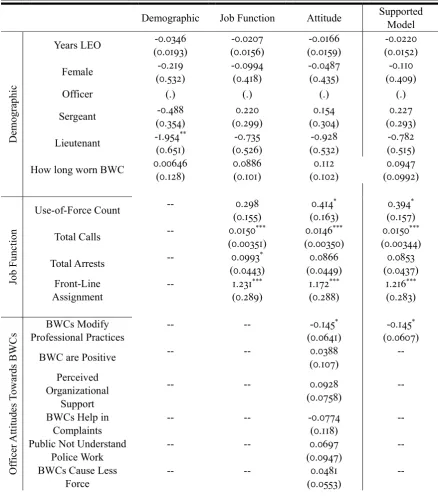
Table . Nested Model Results of Log-Linear Regressions on BWC Activations 430
Demographic Job Function Attitude Supported
Model
Demogra
phic
Years LEO - .
( . ) - . ( . ) - . ( . ) - . ( . )
Female - .
( . ) - . ( . ) - . ( . ) - . ( . )
Officer (.) (.) (.) (.)
Sergeant - .
( . ) . ( . ) . ( . ) . ( . )
Lieutenant - . **
( . ) - . ( . ) - . ( . ) - . ( . )
How long worn BWC .
( . ) . ( . ) . ( . ) . ( . ) Job Func tion
Use-of-Force Count -- .
( . )
. *
( . )
. *
( . )
Total Calls -- . ***
( . )
. ***
( . )
. ***
( . )
Total Arrests -- . *
( . ) . ( . ) . ( . ) Front-Line Assignment -- . *** ( . ) . *** ( . ) . *** ( . ) Of fic er A tti tu de s To war ds B W C
s Professional Practices BWCs Modify -- -- - .
*
( . )
- . *
( . )
BWC are Positive -- -- .
( . ) -- Perceived Organizational Support -- -- . ( . ) --
BWCs Help in Complaints
-- -- - .
( . )
--
Public Not Understand Police Work
-- -- .
( . )
--
BWCs Cause Less Force
-- -- .
( . )
13
Constant . ***
( . )
. **
( . )
. ( . )
. ***
( . ) Observations
Adjusted R . . . .
AIC . . . .
BIC . . . .
LR chi diff -- . *** . . *
Standard errors in parentheses; *p < . , **p < . , ***p < . 431
.
Results
432The results of the log-linear regressions for three nested models are presented above in 433
Table , along with a fourth ‘Supported model’ which was inferentially constructed post-hoc and 434
is provided not as a test of hypotheses, but for reader information and research guidance. The 435
results of the nested model support the importance of agency policy on BWC activations in 436
leveraging the use of the technology, even in the face of some officers’ negative personal 437
perceptions and preferences regarding it. The findings reported below both confirm results from 438
previous research on BWC activations (Young & Ready, ), as well as depart from and build 439
upon it. 440
Results do not support hypothesis one, which predicted that individual demographic 441
characteristics will significantly predict BWC activation. Years of experience, sex, and rank are 442
all non-significant at the p < . level, except for officers with command rank (lieutenant or 443
higher), who are significantly less likely to activate their BWC. Officers of command rank 444
represent a rather small portion of police officers overall, with only six in the sample studied 445
here. Surprisingly, when other factors are held constant, the length of time an officer has worn a 446
BWC is not significantly related (p= . ) to how often they activate the camera, contrasting 447
with previous attitude research suggesting a temporal effect on underlying officer attitudes 448
towards BWCs. While this study is not measuring a temporal change in attitude, we expected 449
that experience with BWCs to influence activations positively. The impact of experience with 450
BWCs reported here are in the positive direction but is very small and non-significant. Overall 451
the demographic model of BWC activations explains only . of the variance observed. 452
Robust support is found for hypothesis two, which predicts job function covariates will 453
be significantly related to BWC activation. Regarding the individual predictors only partial 454
support is found, with arrest count, number of assigned calls, and whether an officer is in a front-455
line assignment all significantly and positively related to BWC activations. While use-of-force is 456
only marginally significant in this model (p= . ), given it is in the hypothesized positive 457
direction it is included in the final supported model and attains reliable significance (p= . ). A 458
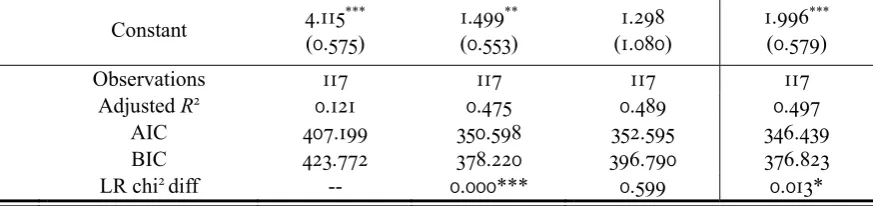
likelihood ratio test statistic (p<=. ) indicates the job function model provides adequate 459
explanatory power for its increase in complexity and should be accepted over the nested 460
demographic model. 461
Hypothesis three posits that individual officer attitudes regarding BWCs would have a 462
significant effect on BWC activations. Minimal support is found for the effect of officers’ 463
attitudes towards BWCs, as significance is only observed for an officer’s endorsement that 464
14 used to construct the summed “BWC approval” measure is included in the appendix, but the 466
measure fails to significantly affect BWC activations, nor does an officer’s perception of the 467
camera’s ability to reduce use-of-force or assist them when a member of the public complains 468
about them. Similarly, neither an officer’s perception of organizational support, nor their belief 469
that BWCs will depict policing situations the public will not understand, influence their BWC 470
activations. A likelihood ratio test statistic of p<=. indicates the officer attitudes model does 471
not provide sufficient explanatory power over the nested job function model, and therefore 472
should not be accepted. 473
The fourth model (‘Supported’) reported in Table is a construction of the job function 474
model along with the sole attitude measure (BWC modifies professional practice) which attained 475
significance in the officer attitude model. Both the AIC and BIC indicators show the supported 476
model performs best, and a likelihood ratio test of the job function model nested within the 477
supported model (p<= . ) indicates the discretion attitude measure adequately improves the 478
job function model and should be accepted. As shown, the model attains enough of a gain in 479
explanatory power, while keeping complexity at a relative minimum, to warrant future research 480
effort to replicate. 481
As previously noted in the measures section, some moderate correlation was noted, 482
particularly among the job function predictors. The highest correlation noted was between the 483
officer rank and line officer conditions ( . ), still well below the generally accepted problematic 484
cutoff of . (Berry, Berry, Feldman, & Stanley Feldman, ). All findings were robust to 485
adding or dropping predictor variables with moderate correlation. Post-estimation diagnostics 486
show all models are free from impairing multicollinearity, with mean variance inflation factors 487
(VIF) scores well below the standard cutoff: Model ( . ); Model ( . ); Model ( . ); 488
Model ( . ). 489
.
Discussion
490This study investigated the impact of three classes of predictors on police officers’ 491
activations of body-worn cameras: Individual demographic characteristics, individual attitudes 492
towards BWCs, and job function indicators. We find job function to explain variations on BWC 493
activation, which implies that officers are Principled Agents (Dilulio Jr, ) of their agencies 494
and communities. This finding is in line with the vast majority of literature which investigates 495
the link between officer attitudes and behavior and finds that “officers’ behavior is only weakly 496
related, if at all, to their occupational attitudes” (Engel & Worden, , p. ). 497
Regardless of an officer’s attitudes towards BWCs, or their demographic characteristics, 498
this study finds little evidence of an impact of those correlates on how the cameras are used. This 499
finding supports Dilulio’s reckoning that ‘front-line’ public service workers (see also Lipsky, 500
) are far more constrained by agency policy and leadership than they are motivated by self-501
interest, because “there is more self-sacrifice, and less self-interest, than rational choice theory 502
allows.” 503
The top-line finding of this study is that job function correlates strongly predict BWC 504
activation, with the model explaining nearly half of the variation found among officers. This top-505
line finding successfully links empirical findings from previous work showing the impact of 506
15 and colleagues ( , p. ) that the equivocal empirical results from experimental tests of BWCs 508
on police use-of-force might arise at least partly from “variation in agency policies regarding 509
how the devices should be used.” Variation in BWC activation should be expected across 510
differing policing contexts because there is variation in the policies employed in those contexts, 511
not because of differences in individual officer perception of the technology itself. 512
We operationalize professional discretion with a survey question which asks for an 513
officer to disagree or agree with the statement “Wearing a body camera pressures me to modify 514
certain professional practices I have had in the past.” Previous scholars have revealed that 515
negative attitudes about BWCs stem from officer concerns about the suppressive effects of 516
BWCs on their exercise of professional discretion (Gaub et al., , ; Headley et al., ; 517
White et al., ). The findings here support those previous findings, as this perception is the 518
only one tied significantly to BWC activation. 519
.
Limitations and Future Research
520Variations in policy and use of BWCs are expected at the departmental, state, and 521
international levels, and as policies regarding BWCs are still evolving across policing contexts 522
the findings of this study must be contextualized in its limitations. First, like any cross-sectional 523
design, the study is vulnerable to both missingness and confounding effects. While the study has 524
a healthy response rate of %, it is possible officers who chose not to respond to the survey 525
have a non-random reason for not responding which might relate to BWC activations and could 526
bias the reported results. Relatedly, while both the job function model and the supported model 527
report adjusted r-squared statistics of close to . , a confounding unmeasured variable cannot be 528
discounted from any cross-sectional study, and caution in interpreting the results outside of the 529
study context is warranted. 530
In line with the broad research questions provoked by Young and Ready’s longitudinal 531
findings ( ), this study provides empirical evidence that factors outside personal attitudes 532
provide the most explanatory power for understanding how often an officer activates their BWC. 533
However, that policy direction relies on good agency policy. The agency where this study is 534
located has a BWC policy with a strong bias towards recording interactions between officers and 535
the public. In the context of BWC studies, the policy would be considered a “mandatory 536
activation” one, as opposed to a “discretionary activation” policy (see both Ariel, Sutherland, et 537
al., ; Young & Ready, ). Since the study agency implemented BWCs, command staff 538
estimate there have been less than five sustained allegations that an officer did not activate their 539
BWC when they should have. With that in mind, porting the findings of these studies to agencies 540
with a more discretionary policy, or significantly higher activation non-compliance, is not 541
recommended until further research can establish replicability in that setting. 542
A third limitation of this study is in the operationalization of the dependent variable. It is 543
theoretically possible, though technically infeasible, to establish a ratio rather than a count 544
variable to measure BWC activation. In this theoretical counter-factual, researchers could 545
establish a denominator of how often a BWC ought to have been activated and establish a 546
measure against how often the camera was actually activated. In practice, however, this is a 547
fundamentally implausible goal, as establishing the numerator is reasonably uncomplicated while 548
identifying and then measuring the denominator is infeasible for a number of reasons. Problems 549
16 (Schlaud, Brenner, Hoopmann, & Schwartz, , fig. , p. S) and criminological research 551
(Tregle, Nix, & Alpert, ). 552
In the specific case of BWC activation, the first challenge to the denominator is the 553
nature of police work itself. Officers work in chaotic, fluid environments, and while policy can 554
control for many of the contextual decisions – activate when force is expected to be used, during 555
arrests, but not in hospitals or when interviewing the victim of sexual assault (Adams & 556
Mastracci, ) – there is no policy possible which can predict all situations all the time. This 557
reality may at least partly explain that the sole officer perception to attain significance in the 558
results is the impact of BWCs on professional discretion. 559
Any policy which grants any discretion to officers in BWC activation neatly confounds 560
researcher intent to measure how often a camera should have been activated. While maybe such 561
a count could be established by a researcher for a single officer in a single shift during a ride-562
along, post-hoc quantitative analysis does not allow for even establishing the most basic 563
definition for such a denominator. The second, sharper edge lurking below the surface of the 564
iceberg is that policy change in BWCs is relatively constant at this time, and best-practices even 565
within a single agency can shift unexpectedly in response to local events. Such an event did take 566
place before this study and resulted in additional discretionary language being added to the 567
agency’s BWC activation policy. A final problem is attempting to generalize best activation 568
policy across agencies, which is unrealistic and ignores the underlying structural reasons for the 569
balkanization of U.S. policing. Agencies are ideally responsive to their communities, each of 570
which has particular considerations, desires, and demands for their police forces generally, and 571
BWC policy specifically. 572
Given these denominator problems, this study forgoes its measure and instead constructs 573
a series of models that attempt to capture the intended benefits of an accurate denominator 574
through inference. The benefits of an accurate denominator should not be forgone, and through 575
accurate measures of the number of calls, involvement in use-of-force situations, the number of 576
arrests, experience level, and job assignment an adequate proxy of the environmental variables 577
likely to influence how often a BWC ought to have been activated is established. Still, the mix of 578
proxy measures is not the idealized measure itself, and places limits on interpreting the findings 579
reported here. 580
Future research should be done in larger and multi-site settings to increase the number of 581
observations and test the replicability of the relatively simple model presented here. With over 582
, agencies with policing powers in the United States alone, the mix of job function and 583
limited perception impacts on BWC activations could likely shift in different contexts. Similarly, 584
comparative international studies are suggested and warranted, especially given the importance 585
of culture on organizations (Hofstede, ; Hofstede, Hofstede, & Minkov, ; Mastracci & 586
Adams, ) in shaping individual employee perception (Yang et al., ) and behavior 587
(Triandis, ). 588
.
Conclusion
589The results reported here support straight-forward reasoning for why officers activate, or 590
do not activate, their BWCs. Neither underlying demographic characteristics nor variation in 591
17 officers use the BWCs because agency policy requires them to do so while handling calls,
593
making arrests, and (rarely) using force. When it comes to BWC activations, officers act as 594
principled agents, not principal-agent problems. This study joins a long line of research which 595
has found weak or absent links between officer attitude and behavior (Engel & Worden, ; 596
Mastrofski et al., ; Meyers et al., ; Smith & Klein, ; Terrill & Mastrofski, ). 597
While there continue to be no easy answers to explain the mixed results from BWC 598
research, our findings should contribute to the literature by providing preliminary evidence that 599
the failure to capture the intended benefits of the cameras does not fall on the shoulders of 600
individual officers. That is not to say that the institution of policing will not be responsible, but 601
that is a question left to future research. As noted in other works (Epp et al., ; S. Maynard-602
Moody & Musheno, ), the impacts of officer discretion are nuanced. While individual officer 603
behavior is better explained by agency policy and legalistic guidance than by individual attitude 604
and bias, the policies themselves can perpetuate inequity, and the juridical bounds may grant so 605
much latitude that they “take on the nature of a farce” (S. Maynard-Moody & Musheno, , p. 606
S ). It is contingent upon the still developing guidance for best-practices related to the 607
deployment and use of BWCs to provide proper guidance to the officers tasked with 608
implementing the cameras. The evidence presented in this study suggests, at least, that officers 609
will implement such policy as Principled Agents. 610
18
.
References
613
Adams, I., & Mastracci, S. ( ). Visibility is a Trap: The Ethics of Police Body-Worn 614
Cameras and Control. Administrative Theory & Praxis, 39( ), – . 615
https://doi.org/ . / . .
616
Adams, I., & Mastracci, S. ( ). Police Body-Worn Cameras: Effects on Officers’ 617
Burnout and Perceived Organizational Support. Police Quarterly, . 618
https://doi.org/ . / 619
Alpert, G. P., & Dunham, R. G. ( ). Understanding police use of force: Officers,
620
suspects, and reciprocity. Cambridge University Press. 621
Ariel, B., Farrar, W. A., & Sutherland, A. ( ). The effect of police body-worn cameras 622
on use of force and citizens’ complaints against the police: A randomized controlled trial. Journal
623
of Quantitative Criminology, 31( ), – . 624
Ariel, B., Newton, M., McEwan, L., Ashbridge, G. A., Weinborn, C., & Brants, H. S. 625
( ). Reducing Assaults Against Staff Using Body-Worn Cameras (BWCs) in Railway 626
Stations. Criminal Justice Review, . 627
Ariel, B., Sutherland, A., Henstock, D., Young, J., Drover, P., Sykes, J., … Henderson, R. 628
( a). Report: increases in police use of force in the presence of body-worn cameras are driven 629
by officer discretion: a protocol-based subgroup analysis of ten randomized experiments. Journal
630
of Experimental Criminology, 12( ), – . 631
Ariel, B., Sutherland, A., Henstock, D., Young, J., Drover, P., Sykes, J., … Henderson, R. 632
( b). Wearing body cameras increases assaults against officers and does not reduce police use 633
of force: Results from a global multi-site experiment. European Journal of Criminology, 13( ), 634
– . 635
Ariel, B., Sutherland, A., Henstock, D., Young, J., Drover, P., Sykes, J., … Henderson, R. 636
( ). Paradoxical effects of self-awareness of being observed: testing the effect of police body-637
worn cameras on assaults and aggression against officers. Journal of Experimental Criminology, 638
14( ), – . 639
Ariel, B., Sutherland, A., Henstock, D., Young, J., & Sosinski, G. ( ). The deterrence 640
spectrum: Explaining why police body-worn cameras ‘work’or ‘backfire’in aggressive police– 641
public encounters. Policing: A Journal of Policy and Practice, 12( ), – . 642
Ariel, B., Sutherland, A., & Sherman, L. W. ( ). Preventing treatment spillover 643
contamination in criminological field experiments: the case of body-worn police cameras. 644
Journal of Experimental Criminology, – . 645
Bayley, D. H. ( ). Et tu brute: are police agencies managed better or worse than 646
universities? Police Practice and Research, 12( ), – . 647
Beccaria, C. ( ). On crimes and punishments. 648
Berry, W. D., Berry, W. D., Feldman, S., & Stanley Feldman, D. ( ). Multiple
649
19 Braga, A. A., Barao, L., McDevitt, J., & Zimmerman, G. ( ). The Impact of
Body-651
Worn Cameras on Complaints Against Officers and Officer Use of Force Incident Reports:
652
Preliminary Evaluation Findings. Unpublished Manuscript, Boston, MA. 653
Braga, A. A., Sousa, W. H., Coldren Jr, J. R., & Rodriguez, D. ( ). The Effects of 654
Body-Worn Cameras on Police Activity and Police-Citizen Encounters: A Randomized 655
Controlled Trial. Journal of Criminal Law and Criminology, 108( ), . 656
Crank, J. P. ( ). Understanding police culture. Routledge. 657
Davis, K. C. ( ). Police discretion. West Publishing Company. 658
Dilulio Jr, J. D. ( ). Principled agents: The cultural bases of behavior in a federal 659
government bureaucracy. Journal of Public Administration Research and Theory, 4( ), – . 660
Ellis, T., Jenkins, C., & Smith, P. ( ). Evaluation of the introduction of personal issue 661
body worn video cameras (Operation Hyperion) on the Isle of Wight: Final report to Hampshire 662
Constabulary. 663
Engel, R. S., & Worden, R. E. ( ). POLICE OFFICERS’ATTITUDES, BEHAVIOR, 664
AND SUPERVISORY INFLUENCES: AN ANALYSIS OF PROBLEM SOLVING. 665
Criminology, 41( ), – . 666
Epp, C. R., Maynard-Moody, S., & Haider-Markel, D. P. ( ). Pulled over: How police
667
stops define race and citizenship. University of Chicago Press. 668
Fouche, A. ( ). Officer attitudes on deployment of body-worn cameras in the 669
University of Georgia Police Department Patrol Division. Campus Law Enforcement Journal, 670
44( ), – . 671
Fridell, L., & Lim, H. ( ). Assessing the racial aspects of police force using the 672
implicit-and counter-bias perspectives. Journal of Criminal Justice, 44, – . 673
Gaub, J. E., Choate, D. E., Todak, N., Katz, C. M., & White, M. D. ( ). Officer 674
perceptions of body-worn cameras before and after deployment: A study of three departments. 675
Police Quarterly, 19( ), – . 676
Gaub, J. E., Todak, N., & White, M. D. ( ). One Size Doesn’t Fit All: The 677
Deployment of Police Body-Worn Cameras to Specialty Units. International Criminal Justice
678
Review, .
679
Goetschel, M., & Peha, J. M. ( ). Police perceptions of body-worn cameras. American
680
Journal of Criminal Justice, 42( ), – . 681
Goldstein, H. ( ). Police discretion: The ideal versus the real. Public Administration
682
Review, – . 683
Gramagila, J. A., & Phillips, S. W. ( ). Police Officers’ Perceptions of Body-Worn 684
Cameras in Buffalo and Rochester. American Journal of Criminal Justice, – . 685
Grossmith, L., Owens, C., Finn, W., Mann, D., Davies, T., & Baika, L. ( ). Police, 686
camera, evidence: London’s cluster randomised controlled trial of Body Worn Video. London,
687
20 Headley, A. M., Guerette, R. T., & Shariati, A. ( ). A field experiment of the impact of 689
body-worn cameras (BWCs) on police officer behavior and perceptions. Journal of Criminal
690
Justice, 53, – . 691
Henstock, D., & Ariel, B. ( ). Testing the effects of police body-worn cameras on use 692
of force during arrests: A randomised controlled trial in a large British police force. European
693
Journal of Criminology, 14( ), – . 694
Hickman, M. J., Piquero, A. R., & Garner, J. H. ( ). Toward a national estimate of 695
police use of nonlethal force. Criminology & Public Policy, 7( ), – . 696
Hofstede, G. ( ). Culture’s consequences: International differences in work-related
697
values (Vol. ). sage. 698
Hofstede, G., Hofstede, G. J., & Minkov, M. ( ). Cultures and organizations:
699
Software of the Mind ( rd ed.). New York: McGraw-Hill. 700
Huff, J., Katz, C. M., & Webb, V. J. ( ). Understanding police officer resistance to 701
body-worn cameras. Policing: An International Journal, 41( ), – . 702
Israel, G. D., & Taylor, C. L. ( ). Can response order bias evaluations? Evaluation and
703
Program Planning, 13( ), – . 704
Jennings, W. G., Fridell, L. A., & Lynch, M. D. ( ). Cops and cameras: Officer 705
perceptions of the use of body-worn cameras in law enforcement. Journal of Criminal Justice, 706
42( ), – . 707
Jennings, W. G., Fridell, L. A., Lynch, M., Jetelina, K. K., & Reingle Gonzalez, J. M. 708
( ). A quasi-experimental evaluation of the effects of police body-worn cameras (BWCs) on 709
response-to-resistance in a large metropolitan police department. Deviant Behavior, 38( ), – 710
. 711
Jennings, W. G., Lynch, M. D., & Fridell, L. A. ( ). Evaluating the impact of police 712
officer body-worn cameras (BWCs) on response-to-resistance and serious external complaints: 713
Evidence from the Orlando police department (OPD) experience utilizing a randomized 714
controlled experiment. Journal of Criminal Justice, 43( ), – . 715
Katz, C. M., Choate, D. E., Ready, J. R., & Nuño, L. ( ). Evaluating the impact of 716
officer worn body cameras in the Phoenix police department. Phoenix, AZ: Center for Violence
717
Prevention & Community Safety, Arizona State University. 718
Kerrison, E. M., Cobbina, J., & Bender, K. ( ). Stop-gaps, lip service, and the 719
perceived futility of body-worn police officer cameras in Baltimore City. Journal of Ethnic &
720
Cultural Diversity in Social Work, – . 721
Kyle, M. J., & White, D. R. ( ). The impact of law enforcement officer perceptions of 722
organizational justice on their attitudes regarding body-worn cameras. Journal of Crime and
723
Justice, 40( ), – . 724
Lafayette Group. ( ). Major Cities Chiefs and Major County Sheriffs Survey of
725
21 County Sheriffs Associations) (pp. – ). Retrieved from
727
https://assets.bwbx.io/documents/users/iqjWHBFdfxIU/rvnT.EAJQwK /v 728
Lawshe, N. L., Burruss, G. W., Giblin, M. J., & Schafer, J. A. ( ). Behind the lens: 729
police attitudes toward body-worn cameras and organizational justice. Journal of Crime and
730
Justice, – . 731
Lipsky, M. ( ). Street-level bureaucracy, 30th ann. Ed.: dilemmas of the individual in
732
public service. Russell Sage Foundation. 733
Lum, C. M., Koper, C. S., Merola, L. M., Scherer, A., & Reioux, A. ( ). Existing and
734
ongoing body worn camera research: Knowledge gaps and opportunities (pp. – ). George 735
Mason University. Retrieved from http://cebcp.org/wp-736
content/technology/BodyWornCameraResearch.pdf 737
Lum, C. M., Stoltz, M., Koper, C. S., & Scherer, J. A. ( ). Research on Body-Worn 738
Cameras: What We Know, What We Need to Know. Criminology and Public Policy, 18( ), – . 739
Mastracci, S., & Adams, I. ( ). Is Emotional Labor Easier in Collectivist or 740
Individualist Cultures? An East–West Comparison: Public Personnel Management. 741
https://doi.org/ . / 742
Mastrofski, S. D. ( ). Controlling street-level police discretion. The Annals of the
743
American Academy of Political and Social Science, 593( ), – . 744
Mastrofski, S. D., Ritti, R. R., & Snipes, J. B. ( ). Expectancy theory and police 745
productivity in DUI enforcement. Law and Society Review, – . 746
Maynard-Moody, S., & Musheno, M. ( ). Social equities and inequities in practice: 747
Street-Level workers as agents and pragmatists. Public Administration Review, 72(s ), S –S . 748
Maynard-Moody, S. W., Musheno, M., & Musheno, M. C. ( ). Cops, teachers,
749
counselors: Stories from the front lines of public service. University of Michigan Press. 750
McLean, K., Wolfe, S. E., Chrusciel, M. M., & Kaminski, R. J. ( ). Body-Worn
751
Cameras in South Carolina: Law Enforcement Executives’ Views Concerning Use, Policies, and
752
Outcomes (pp. – ). Colombia: University of South Carolina. Retrieved from 753
https://sc.edu/study/colleges_schools/artsandsciences/criminology_and_criminal_justice/docume 754
nts/ _census_report.pdf 755
Meyers, A. R., Heeren, T., & Hingson, R. ( ). Discretionary leniency in police 756
enforcement of laws against drinking and driving: Two examples from the state of Maine, USA. 757
Journal of Criminal Justice, 17( ), – . 758
Miller, G. J. ( ). The political evolution of principal-agent models. Annu. Rev. Polit.
759
Sci., 8, – . 760
Nagin, D. S. ( ). Deterrence: A review of the evidence by a criminologist for 761
economists. Annu. Rev. Econ., 5( ), – . 762
Newell, B., & Greidanus, R. ( ). Officer Discretion and the Choice to Record: Officer 763