110
International Journal in Management and Social Science http://ijmr.net.in, Email: [email protected]A COMPARATIVE STUDY OF CUSTOMER PERCEPTION TOWARDS BANKING SERVICES
Dr. Abdul Khalique Talukder Acting Principal Public College of Commerce
Burma Camp Road Dimapur : Nagaland (India)
Abstract - In banking sector, the whole range of activity and generation of income swivels around the customer. The quality of service is crucial to both the customers and the banks. As banks provide identical services, in order to survive the competitions, they have to identify the customers’ needs and expectations and not only deliver quality services but should constantly improve on them. The purpose of this paper is to determine the customer’s perception toward the banking services with a sample size of 500 customers taken from selected branches of commercial banks from Dimapur and Kohima districts of Nagaland. The overall service quality and customer satisfaction of commercial banks is being done by comparing the Means of all dimensions’ Mean Consideration and Mean Experience covering all the items. The finding of the study clearly shows that different educational status groups and different occupation groups of customers have different perception toward the banking services. It also shows that all the educational status groups as well as occupation groups of customers experience less than what they expect in the overall service quality of commercial banks. It is, therefore, suggested that banks, keeping in view the perception level of different categories of customers, take necessary initiatives to understand the needs and expectations of all categories of customers and fulfill the same in a better way.
111
International Journal in Management and Social Science http://ijmr.net.in, Email: [email protected]1.
INTRODUCTIONMarketing is a core element of management philosophy and key to its success lies in focusing more and more on the customers. The success of a firm depends upon the efficiency of its customer‟s service. Thus, the main challenge before the marketers is to identify what would appeal and convince the customers and ensure that customers‟ need, wants, & demands are fulfilled. Today customers look out value for money; therefore marketers are trying to enhance the concept of value through unique delivery methods. They have realized that product, service characteristics, customers‟ aspirations & perceptions and the availability of competing alternatives can be used to enhance customer satisfaction.
Banking is a catalyst and life of modern trade and commerce. It is an integral part of all the business. Today the banking industry is facing a rapidly changing market, new technologies, economic uncertainties, fierce competition, and more demanding customers which lead to an unprecedented set of challenges. In the era of globalization and liberalization, economic reform has become imperative to remain in the main stream of global economy. The banking sector being the backbone of the economy can not maintain the status quo. Again, with the advancement of information technology and communication system, the whole world has been reduced to a global village. At present customers are well aware of the service level available around the world and thus expects the best from his bank. Commercial banks operating in India have been facing tremendous challenges as also opportunities in the new millennium. After nationalization, tremendous changes have been taking place in the banking system. Increasing domestic and international competition and fast changing technologies have led to growing pressure on banks to think in terms of increasing the effectiveness in such ways that should be beneficial to them. Success of the banking organization depends upon the efficiency of its customer‟s service. Under these circumstances, banks are faced with pronged challenges to retain the existing customers and to create new customers. However, success rate depends on the innovative strategies adopted by the banks including the better customer services and adequate fulfillment of customers‟ expectations. To keep pace with the changing environment, commercial banks have not only been adopting technology and innovative strategies at a faster rate but have also been offering numerous services and embracing many new features in their services.
2.
SERVICE QUALITY AND CUSTOMER SATISFACTION112
International Journal in Management and Social Science http://ijmr.net.in, Email: [email protected] According to Oliver et al. (1992) “Customer satisfaction (CS) is a consumer‟s post-purchase evaluation and affective response to the overall product or service experience”. Rust and Oliver (1994) states that, “CS is a summary of cognitive and affective reaction to a service incident (or sometime to a long-term service relationship). Satisfaction (or dissatisfaction) results from experiencing a SQ encounter and comparing that encounter with what was expected”. According to Ghost & Gnanadhas (2011) the CS is the collective opinion on various aspects in commercial banks. CS is derived from the customer‟s attitude towards various variables related to banks. According to Philip Kotler (2007) “CS is a person‟s feeling of pleasure or disappointment resulting from comparing a product perceived performance in relations to his or her expectations”. However, CS is an ambiguous and abstract concept because the actual manifestation of the state of satisfaction varies from person to person and service to service. The state of satisfaction depends on a number of factors which consolidate as psychological, economic and physical factors.In the modern customer centric competitive arena, satisfaction and quality prove to be key factors reciprocally interrelated in a causal, cyclical relationship. Satisfaction and quality have evolved along parallel tracks (Lilijander, 1995). Quality works as an antecedent of CS (Ruyter and Bloemer, 1995). Brahmbhatt & Panelia (2008) pointed out that SQ is at the root of CS. As banks provide identical services, it is the delivery of quality service according to customers‟ expectations, will matter most in meeting the challenges of competition. Any bank that wants to compete in this global industry must offer services that create CS. CS lies in banks‟ ability to deliver better quality products and convenient solutions to the customers.
3.
SERVICE QUALITY DIMENSIONS113
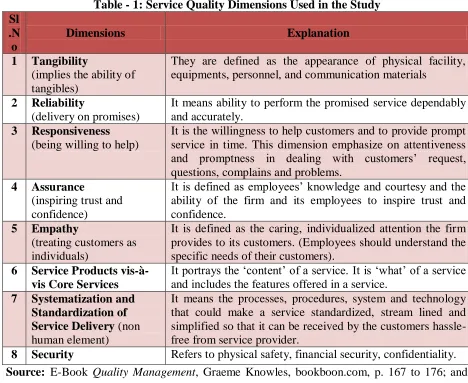
International Journal in Management and Social Science http://ijmr.net.in, Email: [email protected]Table - 1: Service Quality Dimensions Used in the Study
Source: E-Book Quality Management, Graeme Knowles, bookboon.com, p. 167 to 176; and various research Papers.
4.
REVIEW OF LITERATUREService quality is a concept that has aroused considerable interest and debate in the research literature because of the difficulties in both defining it and measuring it with no overall consensus emerging on either. Customer satisfaction is an important theoretical as well as practical issue for marketers and consumer researchers. It may be considered as essence of success in the present highly competitive scenario. A number of studies are available on service quality and customer satisfaction both in India and abroad. Here an attempt has been made to present a view of some of the literature available in the area of customer services in banks in particular.
Sl .N o
Dimensions Explanation
1 Tangibility
(implies the ability of tangibles)
They are defined as the appearance of physical facility, equipments, personnel, and communication materials
2 Reliability
(delivery on promises)
It means ability to perform the promised service dependably and accurately.
3 Responsiveness
(being willing to help)
It is the willingness to help customers and to provide prompt service in time. This dimension emphasize on attentiveness and promptness in dealing with customers‟ request, questions, complains and problems.
4 Assurance
(inspiring trust and confidence)
It is defined as employees‟ knowledge and courtesy and the ability of the firm and its employees to inspire trust and confidence.
5 Empathy
(treating customers as individuals)
It is defined as the caring, individualized attention the firm provides to its customers. (Employees should understand the specific needs of their customers).
6 Service Products vis-à-vis Core Services
It portrays the „content‟ of a service. It is „what‟ of a service and includes the features offered in a service.
7 Systematization and Standardization of Service Delivery (non human element)
It means the processes, procedures, system and technology that could make a service standardized, stream lined and simplified so that it can be received by the customers hassle-free from service provider.
114
International Journal in Management and Social Science http://ijmr.net.in, Email: [email protected] Shanka (2012) confirmed the theory of literatures regarding the relationship between the SQ and CS and indicated that there is a positive correlation between the dimensions of SQ and CS. The results also showed that offering quality service have positive impact on overall CS. The research proved that empathy and responsiveness plays the most important role in CS level followed by tangibility, assurance, and reliability. The research findings also indicated that offering high quality service increases CS, which in turn leads to high level of customer commitment and loyalty. Dash and Mahapatra (2006) observed that the customers‟ requirements must be translated and quantified into measurable targets. This provides an easy way to monitor improvements, and deciding upon the attributes that need to be concentrated on in order to improve customer satisfaction. Pushpaganthan (2006) finds that as regards facilities and amenities in public sector banks, the customers‟ expectations are not fulfilled when compared to foreign banks and private sector banks. The study reveals the dissatisfaction of customers with the behavior of bank staff in their dealings with customers in public sector banks and private sector banks. Huei-Chen (2007) found that personal risk, privacy risk and performance risk embodies the customer perception on quality of online services. Jham and Khan (2008) inferred that the satisfaction of customers with the services of Indian banks is linked with the performance of banks. Nukpezah and Nyumuyo (2009) established that the competitive pricing as well as company image contribute to customer satisfaction and that service quality along a number of pathways drives customer loyalty and profitability. Ghost & Gnanadhas (2011) concludes that there is a close link between the customer's perception on the service quality factors and the customer satisfaction. But the impacts of service quality factor on customer satisfaction among the customer are not unique; it depends upon the demographic profile of the customers. Haq and Muhammad (2012) found that CS varies from person to person. Malli (2011) concluded that each aspect of SQ leading to CS is influenced by one or the other demographic factors which results into varied CS for all category banks. Fozia (2013) found that different occupation group of customers have different perception toward the e-banking services. The results points out that demographic factors impact significantly internet banking behavior, specifically, occupation and age. The paper suggests that an understanding about the customer‟s perception regarding the e-banking services will help the bankers to understand the customers‟ need in a better way. Kumbhar (2011) pointed out there is a significant difference in the customers‟ perception in internet banking services provided by the public and private sector banks; private sector banks are providing better SQ of internet banking than the public sector banks.115
International Journal in Management and Social Science http://ijmr.net.in, Email: [email protected] positive relationship but it has no significant effect on customer satisfaction. Reliability has negative relationship but it has no significant effect on customer satisfaction. Tangibles have positive relationship and have significant impact on customer satisfaction. Empathy has positive relationship but it has no significant effect on customer satisfaction. Responsiveness has positive relationship but no significant impact on customer satisfaction. Haidar & Islam (2011) found that tangible is the most important factor in determining the service quality of private commercial banks followed by reliability, empathy, accessibility, and assurance. However, these factors or dimensions vary across gender, age, education level, and occupation. Santhiyavalli (2011) indicated that among 5 dimensions of SQ, Reliability, Responsiveness, Empathy, and Tangibility are the major factors responsible for CS among the customers of State Bank of India. Rao and Lakew, (2011) revealed that Reliability and Assurance dimensions of SQ scored the highest ratings while the Tangibles dimension got the lowest score. The study also found that there is a strong dissimilarity in SQ perceptions between customers of private sector and public sector banks. Selvakumar (2015) found that assurance has the most significant impact on CS towards banking services and responsiveness has the least significant impact on CS towards banks. Khafafa & Shafii (2013) found that responsiveness was the strongest indicator of CS using the dimensions of perceived quality, followed by reliability, empathy, and assurance.5.
SIGNIFICANCE OF THE STUDY116
International Journal in Management and Social Science http://ijmr.net.in, Email: [email protected]6.
OBJECTIVES OF THE STUDYThe study aims to make education level-wise, and occupation-wise comparison of customers‟ overall service quality consideration of commercial banks and their satisfaction with the quality of services provided.
7.
GEOGRAPHICAL COVERAGE OF THE STUDYThe study is confined to two districts of Nagaland, viz. Dimapur and Kohima. Dimapur district has a geographical area of 927 Sq.km with a population of 378811 persons accounting for 19% of the total population of the state (2011 census). Dimapur town is the main commercial centre of the state. Kohima district has a total geographical area of 1595 Sq.km with a population 267,998 persons accounting for 14% of the total population (as per 2011census). Kohima town is the districts headquarter as well as state capital. Banking net-work in the state is not as large and wide as it is in other parts of the country. The records, however, indicate that there is a steady growth in the functioning of this sector in the state. Most of the banks and their branches in the state are concentrated in these two districts. All the 28 banks operating in the state have branches in Dimapur, and 18 banks have branches in Kohima. Out of 175 bank branches in the state, 100 (57.14%) branches are found in these two districts alone. Again, out of these 100 branches, 26 are of SBI, 35 are of other nationalized commercial banks, 23 are of private commercial banks and remaining 16 are of co-operative bank and rural bank. Dimapur is the major commercial centre with highest number of bank branches followed by Kohima and have maximum users of banking services.
8.
MATERIALS AND METHODSThe study focused on service quality and customer satisfaction using some identified variables. For the purpose of this study, the survey was conducted amongst the customers of commercial banks in two districts of Nagaland, viz. Dimapur and Kohima. A total of 11 banks were selected for the study, taking 7 from public sector and 4 from private sector in approximate proportion to the total number of branches of each bank as well as each district, using convenience sampling. While selecting the sample respondents, convenient as well as quota sampling were used. A total of 500 respondents (account holders) were considered for the study which was divided in proportion to the number of accounts in each bank branch.
117
International Journal in Management and Social Science http://ijmr.net.in, Email: [email protected] To measure the consideration level of service quality by the customers and also the experience of satisfaction level of the customers, 5 point scale has been used. When responding to a questionnaire item, respondents specified their level of consideration as well as experience from the specific services catered by the bank. In other words, to elicit the level of consideration, the respondents were required to choose their agreement or disagreement for quality assessment of various factors for each item into a five pre-defined level scale --„strongly agree‟, „agree‟, „indifferent‟, „disagree‟, and „strongly disagree‟. Similarly, to elicit the level of experience, they were required to choose correct alternatives for each item vis-à-vis statement. The alternatives were „strongly satisfied‟, „satisfied‟, „indifferent‟, „dissatisfied‟ and „strongly dissatisfied‟. The answers of the respondents were solely based on the respondents‟ experience and personal opinion, without any influence. The data collected were analyzed with relevant statistical tools and techniques, using SPSS software.9.
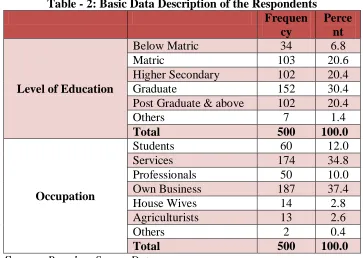
RESULTS AND DISCUSSIONThe basic data description of the respondents is presented in Table 2.
Table - 2: Basic Data Description of the Respondents Frequen
cy
Perce nt
Level of Education
Below Matric 34 6.8
Matric 103 20.6
Higher Secondary 102 20.4
Graduate 152 30.4
Post Graduate & above 102 20.4
Others 7 1.4
Total 500 100.0
Occupation
Students 60 12.0
Services 174 34.8
Professionals 50 10.0
Own Business 187 37.4
House Wives 14 2.8
Agriculturists 13 2.6
Others 2 0.4
Total 500 100.0
Source: Based on Survey Data
Level of education-wise comparison shows majority of the respondents are graduate (30.4 %), followed by matriculate (20.6 %), higher secondary passed (20.4 %), post graduate (20.4 %), below matric (6.8%), and others (1.4%). Occupation-wise comparison of respondents shows, „own business‟ category has the highest number (37.4 %), followed by „services‟ (34.8 %), „students‟ (12%), „professional‟ (10%), house wives (2.8%), agriculturists (2.6%), and others (0.4%).
118
International Journal in Management and Social Science http://ijmr.net.in, Email: [email protected]Figure – 1: Level of Education-wise Service Quality Variation
Source: Based on Survey Data
From the figure 1, it is found that in respect of overall service quality, the Consideration level of „post graduate and above‟ group of customers is highest followed by „graduate‟, „others‟, „matriculate‟, „higher secondary‟, and the lowest is of „below matriculate‟; also, the overall Experience level of „post graduate and above‟ group of customers is highest followed by „graduate‟, „matriculate‟, „others‟, „higher secondary‟, and the lowest is of „below matriculate‟. On the whole all the educational status groups of customers experiences less than what they consider in the overall service quality.
Figure – 2: Occupation-wise Service Quality Variation
Source: Based on Survey Data 0.0
50.0 100.0 150.0 200.0 250.0 300.0
Mean of Below Matric
Mean of Matric
Mean of Higher Secondary
Mean of Graduate
Mean of Post Graduate and Above
Mean of Others
268.7 277.3 274.0 281.2 283.2 277.4
229.5 237.3 233.3 238.5 240.0 233.7
Level of Education-wise Service Quality Variation
Level of Consideration Level of Experience
0.0 100.0 200.0
300.0 274.2246.0290.7 286.2 294.3 275.1 286.5 277.5
239.1 233.1 230.4 232.5 230.3
181.5 Occupation-wise Service Quality Variation
119
International Journal in Management and Social Science http://ijmr.net.in, Email: [email protected] From the figure 2, it is found that in respect of overall service quality, the Consideration level of „own business owners‟ group of customers is highest followed by „service holders‟, „agriculturists‟, „professionals‟, „others‟, „housewives‟, and the lowest is of „students‟; whereas, the overall Experience level of „students‟ group of customers is highest followed by „service holders‟, „professionals‟, „housewives‟, „own business owners‟, „agriculturist‟, and the lowest is of „others‟. On the whole all the occupation groups of customers experiences less than what they consider in the overall service quality.10.
CONCLUSION AND SUGGESTIONSIt is found that, on the whole, all the educational status groups as well as occupation groups of customers experienced less than what they expected in the overall service quality. It is, therefore, suggested that commercial banks, take necessary initiatives to improve on all the dimensions of service quality and fulfill the expectations of the customers of all educational status groups as well as occupation groups.
11.
LIMITATIONS120
International Journal in Management and Social Science http://ijmr.net.in, Email: [email protected]REFERENCES
1. Alabar, T. Timothy (2012), “Electronic Banking Services and Customer Satisfaction in the Nigerian Banking Industry”, International Journal of Business And Management Tomorrow Vol. 2 No. 3.
2. Dash, M.K and Mahaptra, D.M.(2006), “Measuring Customer Satisfaction in the Banking
Industry”, International Journal of Bank Marketing,
http://www.indianmba.com/Faculty_Column/FC328/fc328.html
3. Fozia (2013), “A Comparative Study of Customer Perception toward E-Banking Services Provided by selected Private & Public Sector Bank in India”, International Journal of Scientific and Research Publication, Vol. 3, Issue 9, September, 2013.
4. Geography of Nagaland". Retrieved 1 November 2014.
5. Ghost, S.H.G. & Gnanadhas, M. E. (2011), “Impact of service quality in commercial
banks on the customers satisfaction: an empirical study”, International Journal of
Multidisciplinary Research Vol.1 Issue 6, October 2011, ISSN 2231 5780, p. 23.
6. Graeme Knowles, E-Book Quality Management, bookboon.com, p. 167 to 176.
7. Gronroos, C.A (1984), “Service Model and Its Marketing Implications”, European Journal of Marketing, 18(4), pp. 36-44.
8. Haidar, M. I & Islam, M.S. (2011), “Determination of Service Quality Factors of Private Commercial Banks in Bangladesh”, ASA University Review, Vol. 5 No. 2, July– December, 2011.
9. Haq, Waqar ul and Muhammad Bakhtiar, (2012) , “Customer Satisfaction: A Comparison of Public and Private Banks of Pakistan”, IOSR Journal of Business Management, ISSN 2278 – 487X, Vol. 1, Issue 5 (July – August 2012), pp. 01-05.
10. Huei-Chen, H (2007) „A study of factors affecting the success of private label brands in Chinese e-markets‟, Journal of Technology management in China, Vol.2, No.1, pp.38-53.
11. ISO 10002 (2004), Quality Management – Customer satisfaction – Guidelines for Complaints Handling in Organizations.
121
International Journal in Management and Social Science http://ijmr.net.in, Email: [email protected] 13. Jham,V and Khan, K.M. (2008), “Customers Satisfaction in the Indian Banking Sector: AStudy”, IIMB Management Review, (March).
14. Khafafa, AJ and Shafii, Z (2013), “Measuring the Perceived Service Quality and Customer Satisfaction in Islamic Bank Windows in Libya Based on Structural Equation Modeling (SEM)” Afro Asian Studies , Vol. 2, Issues 1 & 2, Spring and Fall 2013, 56-71.
15. Kotler, P. (2007), “Principles of Marketing”, Pearson Education, 4th Edition, New Delhi.
16. Kumbhar, Vijay (2011), “Service Quality Perception and Customers’’ Satisfaction in Internet Banking Service: A Case Study of Public and Private Sector Banks”, Cyber Literature: The International Online Journal, Vol. 4, Issue 2,Dec. 2011, ISSN 0972-0901 MPRA Paper No. 36959, Posted 26/02/2012. (http:// www.englishcyberliterature.net
17. Lenka, U, Suar, D and Mohapatra, P.K.J. (2009), “Service Quality, Customer Satisfaction, and Customer Loyalty in Indian Commercial Banks”, Journal of Entrepreneurship March, 18 (1 ): 47-64.
18. Lilijander, V., (1995), “A Comparison Standards in perceived Service Quality”, publication of the Swedish School of Economics and Business Administration, Helsinki, finland, No. 63.
19. Malli, Reena, R (2011), “A Comparative Study on Marketing of Banking Products and Customer Services and Satisfaction Level in Gujarat”, Dept. of Business Studies, Saurashtra, pp. 47 - 53.
20. Munusamy, J., Chelliah, S. and Mun, H.W.( 2010), “Service Quality Delivery and Its Impact on Customer Satisfaction in the Banking Sector in Malaysia”, International Journal of Innovation, Management and Technology, Vol. 1, No. 4, October 2010 ISSN: 2010-0248, pp. 399.
21. Nukpezah, Daniel and Nyumuyo, C. (2009), “What Drives Customer Loyalty and Profitability? Analysis of Perspectives of Retail Customers in Ghana’s Banking Industry”, ATM/SektionenforManagement,p-78eb2944e0ac1256608004f0535/79b759
c3a9f30570c12576780059c7a0?OpenDocument.
122
International Journal in Management and Social Science http://ijmr.net.in, Email: [email protected]23. Oliver, R.L., Oliva, T.A., and MacMillan, I.C., (1992), “A Catastrophe Model for
Developing Service Satisfaction Strategies”, Journal of Marketing, 56(3), p. 83-95.
24. Ongori, M.H (2013), “Self-Service Technology and Customer Satisfaction in Commercial Banks in Kenya”, MBA Research Project, School of Business, University of Nairobi, pp. 1, 5-7.
25. Parasuraman A., Zeithaml V A and Berry L L (1988), "SERVQUAL: A Multiple Item Scale for Measuring Customer Perceptions of Service Quality," Journal of Retailing, 64, spring, 12-40.
26. Pushpangathan (2006), A Study on the Quality of Customer Service in Public Sector Banks, Finance India, Vol.XX, No.11, March 18, 2006.
27. Qadeer, Sara (2013), “Service Quality & Customer Satisfaction – A Case Study in Banking Sector”, International Journal of Scientific and Research Publications, Vol. 3, Issue 9, (November) (www.ijsrp.org.
28. Rao. K. Rama. Mohana and Lakew. Tekeste Berhanu (2011), “Service Quality Perceptions of Customers: A Study of The Customers‟ of Public Sector and Private Sector Commercial Banks in India”, International Journal of Research in Commerce & Management, Volume No. 2 (2011), Issue No. 11 (November).
29. Rust, R.T. and Oliver, R.L. (1994), “Service Quality: Insights and Managerial Implication from the Frontier, Service Quality: New Directions in Theory and Practice”, 1-19.
30. Ruyter, K D and Bloemer, J (1995), "Integrating Service Quality and Satisfaction: Paying in the Neck, or Marketing Opportunity?" Journal of Consumer Satisfaction, Dissatisfaction and Complaining Behavior, Vol. 8, pp. 44-52
31. Santhiyavalli, G. (2011), “Customer’s perception of service quality of State Bank of India - A Factor Analysis”, IJMBS Vol. 1, Issue 3, September 2011.
32. SBI, Regional Business Office, Dimapur and Branches of other banks in Dimapur and Kohima.
123
International Journal in Management and Social Science http://ijmr.net.in, Email: [email protected] 34. Selvakumar, J.J. (2015), “Impact of Service Quality on Customer Satisfaction in PublicSector and Private Sector Banks”, SMS Journal of Entrepreneurship & Innovation, Vol. VIII, No.1, March, 2015 to August, 2015.
35. Shanka, M.S. (2012), “Bank Service Quality, Customer Satisfaction and Loyalty in
Ethiopian Banking Sector”, Journal of Business Administration and Management
Sciences Research, Vol. 1(1), pp. 001-009, Dec, 2012.