A Study on Job satisfaction among Software Employees
Dr.V. Subathra
Principal, AIMAN College of Arts & Science for Women, Trichy &
V.Prinitha
Ph.D Research Scholar, Bharathidasan University AIMAN College of Arts & Science for Women,
K.Sathanur ,Trichy
Abstract
Job satisfaction in regard to one’s feeling or state of mind regarding nature of their work. Job can be influenced by variety of factors like quality of one’s relationship with their supervisor, quality of physical environment in which they work, degree of fulfillment in their work etc. Positive attitude towards job are equivalent to job satisfaction where as negative attitude towards job has been defined variously from time to time. In short job satisfaction in person’s attitude towards job.
In this context, the present study seeks to examine the relationship between family status and job satisfaction among Software Employees. Analysis revealed that employees working in respective area mostly belong to the age group of 26-35 and most of them are married. Female employees working in the respective area are approximately half of the working male and most of them are Post graduates. The next objective of the researcher is to find out the relationship between family status and Job satisfaction and the chi square value showed that the association is not statistically significant.
Introduction
Human life has become very complex and completed in now-a-days. In modern society the needs and requirements of the people are ever increasing and ever changing. Creating job satisfaction begins by first providing a positive work environment. Basically employee’s satisfaction is a measure of how happy workers are with their job and working environment.
Job satisfaction in regard to one’s feeling or state of mind regarding nature of their work. Job can be influenced by variety of factors like quality of one’s relationship with their supervisor, quality of physical environment in which they work, degree of fulfillment in their work etc. Positive attitude towards job are equivalent to job satisfaction where as negative attitude towards job has been defined variously from time to time. In short job satisfaction in person’s attitude towards job.
Job satisfaction can be defined as an individual’s total feeling about their job and the attitudes they have towards various aspects or facets of their job, as well as an attitude and perception that could consequently influence the degree of fit between the individual and the organization (Ivancevich & Matteson 2002; Spector 1997).
Job Satisfaction among Software Professionals
Employee satisfaction is a key to the success of IT industries that relies on a variety of organizational and psycho economic factors every software company wants to compete in this globalize world market. So the company is forcing the employees work more with new technologies with lesser expenses and investments. This may lead the employees to get dissatisfaction of job. There is a strong need to address the various issues concerning job satisfaction of employees of IT sector which contributes significantly to India’s GDP .Generally employee job satisfaction has been a problem in many organizations for several decades Chen (2008) evaluates job satisfaction among information system professionals through examining two broad elements: achievement motivations (perseverance, competition, and difficulty control) and job characteristics (task identity, professionalism, feedback, and autonomy). Chen’s conclusion signifies that job satisfaction increases as job characterized by more feedback, professionalism and autonomy while factors of achievement motivation do not change personnel satisfaction. Diala and Nemani (2011), however, when attempt to answer the question of “what are the factors influence IT professional's perceptions of job satisfaction”, find autonomy in work, motivation, and the potential for advancement as factors with direct impact on general satisfaction.
Literature Overview
Kamal and Sengupta (2008) conducted a study on job satisfaction among Bank officers, stated that overall job satisfaction in case of officers was not very high and they concluded that with the change of satisfaction determinants, level of job satisfaction also varies. It was also observed that as a person ages, job satisfaction shows an increasing trend. With age, spiritualism of the person increases, but alternatives for change decreases. Younger employees have more energy, more expectations and more options, and hence have lesser satisfaction with the job. Overall the job satisfaction of bank officers though was not very high but still satisfactory
Methodology
The present study seeks to examine the Level of Job satisfaction among Software employees. The research design of the present study is descriptive The sample size of the study consists of 50 Software Professionals working in 3 different IT Companies in Chennai. The sample includes Programmers, Developers, Implementers and Project Managers The sampling technique used in this study is convenience sampling. The researcher circulates the questionnaire personally to the employees for collecting data. The researcher used a standardized scale developed by Amar Singh and T. R. Sharma (2012) for collecting the data. The schedule form comprised of two parts, The first part of the questionnaire contained the questions related to the personal profile and the second part consists of measuring the level of Job satisfaction among Software Employees.
Table-1 Distribution of Respondents by Socio economic data(n=50)
Variable
Total No. of
respondents Per cent
Age (In years)
Below 25 16 32
26-35 22 44
36-45 & above 12 24
Gender Male 34 68
Female 16 32
Domicile Rural 16 32
Urban 34 68
Marital Status Married 27 54
Unmarried 23 46
Type of Family Joint Family 15 30
Nuclear Family 35 70
Educational Qualification
Undergraduate 27 54
Postgraduate 22 44
Research degree 1 2
Monthly Income (In rupees)
Below 20,000 12 24
20,000-50,000 11 22
50,000-1,00,000 16 32
1,00,000-2,00,000 10 20
2,00,000 above 1 2
Years of Experience
less than 5 7 14
6-10 22 44
11-15 6 12
16-20 10 20
20 above 5 10
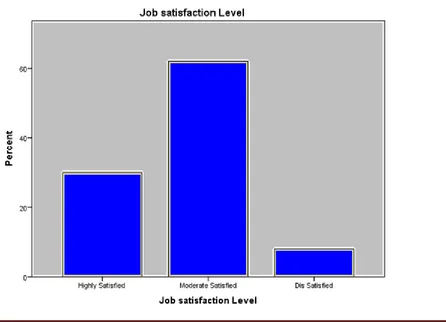
Table-2 Distribution of the respondents by Job Satisfaction Level Job Satisfaction level No. of respondents Per cent
Low job satisfaction 23 46
Moderate job satisfaction 17 34
High job satisfaction 10 20
Total 50 100
Source: Primary data
According to the e table 1 reveals that the majorities 44% of the respondents belong to the age group of 26-35 years, and 32% of the respondents belong to the age group below 25,and only 24% of the respondents belong to 36-45 years. 64%of the respondents are male and rest 32% is female. It indicates working males are greater than working Females in the selected area.
As far as educational back ground of the respondents is concerned, 54% are Graduates, 44% are Post graduate, and the rest 2% are Research degree.54%of the respondents are Married and the rest 46%are unmarried or single. Majority 32%of the respondents draw Salary range is Rs. 50000- Rs.100000, whereas only 2%of the respondents draw above Rs.200000.
Total work experience of most 44% of the respondents was up to 6-10years and only 10% of the respondents have the work experience above 20 years. Maximum of 70% of the respondents live in nuclear family and 30% of the respondents live in Joint Family and 68% of the respondents are from urban area.
Table 2 reveals that among the total respondents, 46% of the respondents belongs to Lower level and 34% of the respondents belong to Middle Level job and only 20% of the respondents are in Higher Level Job.
Source: Primary data
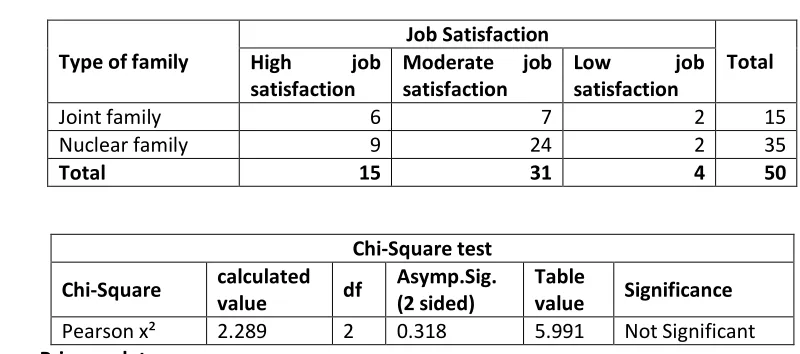
Table-3 Association between Respondents Type of Family and Job Satisfaction
Type of family
Job Satisfaction
Total High job
satisfaction
Moderate job satisfaction
Low job
satisfaction
Joint family 6 7 2 15
Nuclear family 9 24 2 35
Total 15 31 4 50
Chi-Square test
Chi-Square calculated value df
Asymp.Sig. (2 sided)
Table
value Significance Pearson x² 2.289 2 0.318 5.991 Not Significant Source: Primary data
The table 3 indicates that 40.0% of the respondents who live in joint family have high Job satisfaction and 68.6% of the respondents who live in Nuclear family have Moderate Job satisfaction, whereas 13.3% of the respondents who live in joint family have Dissatisfied in Job. The chi squire value shows that the association is not statistically significant. Thus there is no association between Family Status and Job satisfaction(P>0.05)
Findings and Discussion
Statistics in Table I, describes the personal characteristics of the respondent employees i.e. age of the employees, gender, marital status, educational qualification and Family status of the employees respectively. From these findings researcher describes that employees working in respective area mostly belongs to the age group of 26-35 and most of them are married. Female employees working in the respective area are approximately half of the working male and most of them are graduates. The next objective of the researcher is to find out the relationship between family status and Job satisfaction and the chi square value showed that the association is not statistically significant.
Reference:
Chen, L. (2008). Job satisfaction among information system (IS) personnel. Computers in Human Behavior. Vol.24, pp.105–118.
Diala, I., and Nemani, R. (2011). Job Satisfaction: Key Factors Influencing Information Technology (IT) Professionals in Washington DC. Int. J. Comp. Tech. Appl. Vol.2(4), pp. 827-838.
Ivancevich, J. & Matteson, M. (2002). Organizational Behaviour and Management (6th edition). New York: McGraw-Hill.
Kamal, R., & Sengupta, D. (2008). A Study of Job Satisfaction of Bank Officers. Prajnan. 37(3), 229-245.
Spector, P. 1997. Job satisfaction. Application, assessment, causes and consequences. Thousand Oaks, CA: Sage.
Sarminah S. (2006). The contribution of demographic variables: Job characteristics and job satisfaction on turnover intentions. Journal of International Management Studies, Vol.1, No. 1.