Application Research on Target Cost Management Method of Lean Supply Chain of Construction Engineering Project
Siming YU11,Cheng CAI2,*, Jinyong CHEN3and Qiangyi LI4 1 School of Business, Hubei University, Wuhan, Hubei, China
2 School of Economics and Management, Wuhan University, Wuhan, Hubei, China 3 School of Business, Hubei University, Wuhan, Hubei, China
4 School of Economics and Management, Wuhan University, Wuhan, Hubei, China * Correspondence:[email protected]
Abstract: The lean supply chain of construction engineering projects is to achieve the maximum satisfaction of the owners' needs in order to effectively achieve the goal of supply chain management. This paper explores an effective method of lean supply chain cost management for construction engineering projects with target cost management, so that each participating unit on the supply chain node can fully utilizes its core competencies to minimize internal consumption and waste, and achieve the optimal overall efficiency of the supply chain. According to the requirements of the goal planning theory of the construction project company, establish a lean supply chain cost planning system for the construction project, realize the basic model of the lean supply chain cost management of the construction project, and set the target cost from the lean project of the construction project. The technical decomposition is established by the process of cost decomposition and cost pressure transmission and sub-target cost planning.
Keywords: construction engineering, lean supply chain, target cost management
1. Introduction
The lean supply chain of construction projects is to meet the requirements of supply chain management andt the needs of the owners. The supply chain cost management should be analyzed from the height of strategy, and an effective method for cost management of lean supply chain of construction projects should make the supply chain nodes give full play to its core capabilities, and minimize internal consumption and waste, and achieve the optimal overall efficiency of the supply chain.
Formal analysis, Qiangyi LI; Software, Cheng CAI; Supervision, Jinyong CHEN; Writing – original draft, Siming YU.
Objective cost method and activity-based costing method are modern cost control theories that are generated and developed in the context of modern society. Target costing and activity-based costing are two aspects of cost, not two separate methods. A new direction of cost management development is that enterprises combine the two with their own actual situation to adapt to the new competitive environment and obtain a competitive advantage. Introduce the idea of operation management in the process of lean supply chain cost management of construction projects, and carry on refined operation cost management. At the same time, combined with target cost management, it can deepen the target cost management to the level of refined operation, and through scientific operations cost calculation, we can try to make the supply chain cost control within the target cost plan, ensure the realization of project target cost management; and to be responsible for the various tasks in the project construction process according to the requirements of operation management And the center of control, the cost control is deeply implemented on each operation, with the operation as the core and the cost-based basis to achieve the goal of continuously reducing costs.
Although both the activity-based costing method and the target costing method are cost control methods that are consistent with supply chain management, the two cost control methods have different focuses: if the activity-based costing method and the target costing method are combined, the cost-management management is combined with target cost management to be performed, the target cost management is deepened to the operational level, and make the supply chain cost control within the target cost range, which can provide an optimal cost control method. Based on the above characteristics, the integration of target cost management and activity cost management is a new breakthrough in the research on lean supply chain cost management methods for construction projects.
2. Framework Construction of Lean Supply Chain Target Cost Management for
Construction Projects.
The construction project supply chain begins with the construction project owner's conception, site selection and feasibility study, through lean exploration, lean design, lean construction, lean procurement, lean logistics and lean services and so on various units provide products or services, ended by the final consumption of the owner. The owner is generally
a target price of construction project. The competitiveness and profitability of the construction project supply chain in the market are the key factor in determining the survival and development of the project management company. Therefore, the project management company's construction of the supply chain cost control model must focus on the "construction market", find the overall target cost of the project supply chain in the construction market demand, and effectively decompose the target cost of the construction project.
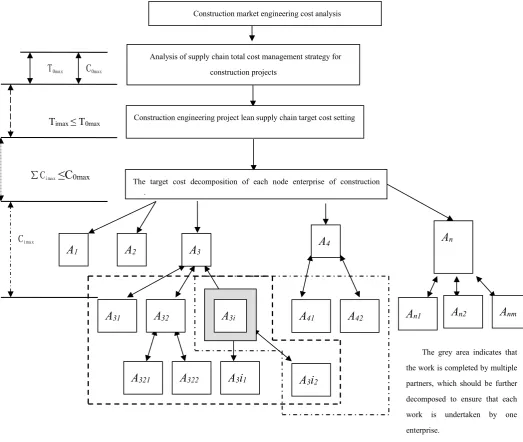
2.1 The assumptions of lean supply chain target cost framework
Cimax
∑Cimax
≤C
0maxTimax≤ T0max T0max C0max
The grey area indicates that the work is completed by multiple partners, which should be further decomposed to ensure that each work is undertaken by one enterprise.
A
n1A
n2A
nmA
nConstruction engineering project lean supply chain target cost setting
The target cost decomposition of each node enterprise of construction project
A
321A
322A
32A
31A
3i
1A
3i
2A
3iA
41A
42A
33
A
44
Analysis of supply chain total cost management strategy for construction projects
A
11
A
22
A1-survey units, A2-design unit, A3-construction unit, A4-supply unit……
An-property management unit A31-bidding A32-procurement...A3i-construction
Figure 1. Construction project lean supply chain target cost composition diagram
其中:
Ai is the construction task on the supply chain(i=1.2.3.….n)
Aij is the next sub-task of task i(i =1.2.3.….n,j =1.2.3.….n),
Aijk is the task next to the ‘i’th subtask(i =1.2.3.….n,i =1.2.3.….n,k =1.2.3.….n)
T0maxis time objective constraint;Timax is the longest working time of each task obtained by
decomposition;
C0maxis the maximum target cost value set;Cimax is the maximum possible target cost value
for decomposition of all subtasks.
2.2 Analysis of lean supply chain target cost planning system for construction projects
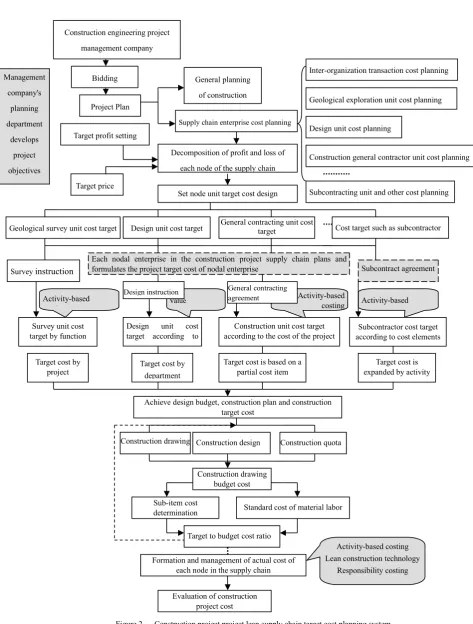
Figure 2 Construction project project lean supply chain target cost planning system Management company's planning department develops project objectives
Construction drawing Construction design Construction quota
Construction drawing budget cost
Sub-item cost determination
Target to budget cost ratio
Standard cost of material labor
Evaluation of construction project cost
Formation and management of actual cost of each node in the supply chain
Activity-based costing Lean construction technology
Responsibility costing Construction engineering project
management company
Bidding General planning of construction Project Plan
Target profit setting
Supply chain enterprise cost planning
Decomposition of profit and loss of each node of the supply chain
Target price
Set node unit target cost design
Design unit cost target
Geological survey unit cost target General contracting unit costtarget Cost target such as subcontractor Design unit cost planning
Geological exploration unit cost planning
Construction general contractor unit cost planning
Subcontracting unit and other cost planning Inter-organization transaction cost planning
Surveyinstruction Subcontract agreement
Design unit cost target according to function
Value Activity-basedcosting Activity-based costing Construction unit cost target
according to the cost of the project according to cost elementsSubcontractor cost target
Target cost by department
Target cost is based on a
partial cost item expanded by activityTarget cost is
Achieve design budget, construction plan and construction target cost
Survey unit cost target by function
Target cost by project Activity-based costing
Each nodal enterprise in the construction project supply chain plans and formulates the project target cost of nodal enterprise
In this target cost planning system, cost planning runs throughout the entire process of building product such as planning, design and construction etc. The target cost indicators layers of decomposition to the planning, design, supply, construction and management of each department, and the cost of every employee to undertake a certain indicators. Construction engineering project lean supply chain target cost management has achieved cost control of all staff and the whole process.
The project company first determines the target price and target profit rate of the project according to the bidding situation of the construction project. The planning department determines the target cost of the construction project; at the same time, the geological exploration unit, the design unit, the construction general contractor, the subcontractor and other supply chain participants plan their own cost and target price for the bidding situation of the construction project formulate and determine the design scheme to meet the target cost through the analysis of profit and loss indicators. After the target cost and design scheme are determined, each node enterprise in the chain will successively expand the cost of the construction project according to the function and cost elements, and use the value analysis technology and activity-based cost method to analyze its cost and calculate the project budget, planned cost and construction cost. The financial and budget departments of each node in the chain compare the target cost with the estimated cost. If the budget, planning and construction costs reach the target cost, the design department cooperates with the cost management department to draw the construction drawing directly according to the preliminary design drawing and work out the construction organization and design. If the estimated cost does not reach the target cost, as shown by the dotted line, on the basis of further value analysis, the cost design department draws the construction drawing and prepares the construction organization design. The budget department prepares the construction budget according to the construction drawing and construction organization design, and the budget and cost are compared by the finance and budget departments. If the target cost is not achieved, return to the design design phase and restart the design work; if the target cost is achieved, evaluate the target cost achievement.
Based on the analysis of the total cost management strategy of the supply chain of the construction project, the project management company determines the supply of the construction project by analyzing the construction market demand, combining the strategic combination of the overall optimization of the lean supply chain of the construction project and the actual situation of the lean supply chain operations, determine the construction project supply chain management concepts, including the construction of the project market positioning, basic functions, characteristics, quality requirements, life cycle, market demand, etc. Market analysis is the starting point of cost control. Market analysis should deal with the overall planning and concept design of construction projects to help optimize structural cost drivers and provide a good foundation for supply chain cost management of construction projects.
3.1 Lean supply chain target cost setting
The target cost is the cost target value that must be achieved in order to realize the effective operation of the construction project supply chain and ensure the realization of the target profit. It is to determine the life cycle cost of the project to be developed, and is the expected goal of all employees in the supply chain. The construction project project lean supply chain target cost is also an important measure for effective cost comparison analysis. By comparing the actual cost of each link with the target cost, revealing the difference between actual cost and target cost, analyzing and overcoming the causes of the difference, thus realizing the construction project. Optimization of project lean supply chain cost control.
(1) Target cost planning process
NO Competitive target
cost
Target contracted
project volume The revenue target Target profit
Competiti ve strategy
Engineering design CAD
Owner value analysis
Design sub-division cost targets Total project target cost-- TC
Pressure transmission Adjustment
Subcontractor target cost planning
Supplier target cost planning Select each enterprise project
operation chain
Activity cost simulation Forecast total project cost
Optimize the project chain of each
enterprise project Job analysis
Modified design scheme
Yes Estimated costtarget cost
Approved project design
Determine the cost and total cost of the project
Yes
Upstream target cost planning Construction market
survey owners demand analysis
End
Start
Figure 3
Construction project lean supply chain target cost planning flow chart
project to achieve the target cost. It is also necessary to continue the operational control before the project is scrapped to avoid the actual cost deviating from the target cost. Therefore, the entire project engineering project lean supply chain target cost management framework through the whole process, all-round, all personnel cost control, so that the final cost of the project meets the requirements of the owners and participants to achieve the strategic objectives of lean management of construction projects
(2) Formation of target cost
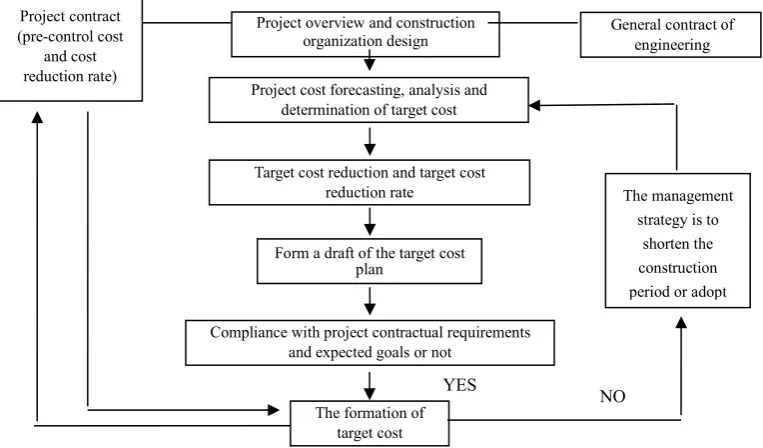
The formation process of the lean cost of the construction project lean cost is also the forecasting, analysis, determination and dynamic management process of the planned cost, as shown in Figure 4.
(3) Calculation of target cost
Lean supply chain target cost of construction engineering projects is the product of cost forecasting and target management method. It is the starting point of target cost planning activity. The goal is to determine the allowable cost of construction project, and the target value is the maximum allowable value under the total cost of lean supply chain. The traditional target cost management theory holds that there are absolute benefits in the quality, cost and construction period of the project, that is, there are absolute contradictions between the three elements of the economic activities of construction. The improvement of project quality will definitely lead to an
YES
General contract of engineering
是 Project overview and construction
organization design Project contract
(pre-control cost and cost reduction rate)
否 The management
strategy is to shorten the construction period or adopt
new materials and new processes
The formation of target cost Form a draft of the target cost
plan
Compliance with project contractual requirements and expected goals or not
Target cost reduction and target cost reduction rate
Project cost forecasting, analysis and determination of target cost
Figure 4.Formation process of target cost
increase in the project target cost. To shorten the project period, it must rely on a large amount of inventory materials to ensure that the target cost management is simply to balance the target cost and service level of the project to a certain extent. However, in the lean supply chain system of construction projects, it is compatible to improve project quality, shorten the construction period, improve service and reduce costs. Through the strategic alliance of partners, the market risk is balanced to the control of integration cost and opportunity cost in the entire supply chain, cooperative operation, so that the absolute benefits can be transformed into a relatively, controllable benefit relationship. Construction projects allow the cost to be determined by the target cost and desired target profit determined by market demand. The formula is expressed as follows:
Target cost = target price - target profit
Target cost = target price × (1- target profit margin)
The purpose of target profit margin determination is to ensure the completion of all participating companies' long-term profit plans. Project management can set the project target profit rate based on factors such as enterprise competitiveness, enterprise market share, construction project technical content, construction specification level and other factors based on its own experience. Since the construction budget quota of China is compiled according to the average level of construction enterprises, in order to facilitate the operation, the profit rate in the quota issued by the state can be directly determined as the target profit, or a small adjustment can be made on this basis.
According to the whole life cycle of the construction project, the need to pay attention to the construction market demand situation, the time T0max and the quality Q requirements, the target
constraints and the feasible target cost of the construction project are set. 3.2 Lean supply chain target cost decomposition and cost pressure transfer (1) Target cost decomposition
procurement, lean logistics and lean service. Goal, sub-goal. Target cost decomposition mainly adopts the form of distribution to various technical objects, which is to expand financial costs according to technical elements, and mobilize geological prospectors, project designers, subcontractors, material suppliers, machinery manufacturers, bidding and supervision units, and service organizations. Such as the enthusiasm of each node in the supply chain, the activities to reduce costs spontaneously, and truly reduce the overall target cost of the set supply chain. This phase is also the central stage of the target cost planning process, called the “central implementation cycle”. From the perspective of strategic cost management, cost information is introduced into the technical information source, and the overall target cost management information source of the supply chain is fundamentally changed. The overall target cost breakdown of an effective supply chain helps to rationally allocate the supply chain's tasks and lay the foundation for the next phase of cost targets.
The cost decomposition of the supply chain of the construction project can be combined with the principle of job decomposition and particle size decomposition, which can reasonably decompose the target cost, and help to clarify the cost control responsibility of the supply chain node enterprises and evaluate the performance of each node in the supply chain.
The principle of job decomposition: the principle of job decomposition requires analyzing the operation chain according to the supply chain business process to decompose the target cost into multi-level sub-cost targets. The target tree is a good method for target cost decomposition. It mainly uses value chain analysis to determine the basic operational activities of the supply chain. Then, it analyzes the basic operations of these basic operations, and uses the value chain upstream method to decompose according to a single flow direction. The job unit is merged to obtain a job chain composed of a job process, and the target cost value is decomposed into a multi-level sub-job target cost value by top-down according to the supply chain historical operation cost data or the job cost data of the benchmark operation flow. Form a multi-layered cost target tree.
The combination of the above two decomposition principles can not only decompose the target cost according to a reasonable decomposition method, but also help to clarify the cost control responsibility of the supply chain node enterprise and evaluate the performance of each node enterprise in the supply chain. The total target cost of the supply chain is directly decomposed according to the operation chain to form a tree hierarchy with two relationships of and/or. The total target cost is the root of the tree, and the sub-target cost forms the leaves of the tree structure.
(2) Target cost integration, establish a homogeneous operation cost library
In order to better improve the scale efficiency of each node of the construction project and reduce the duplication of labor, after the establishment of the supply chain, the main operations must be divided into operation centers, and the small operations before and after the construction and production process should be absorbed. The degree of relevance of the work is scientifically and effectively combined, and the merger of the operations must meet certain conditions. The so-called job consolidation means that the cost of two or more jobs corresponds to the workload and add up to form a new job. In the process of consolidation, the cost of product sharing does not change, that is, the cost of the operation after the merger. The cost of the method calculation should be equal to the cost calculated by the activity-based costing method before the merger. Also, the motivations for participating in the combined operation are generally the same. The prerequisite for job consolidation is that the drivers are the same and the cost sharing is unchanged.
3.3 Lean supply chain target cost target cost plan reached
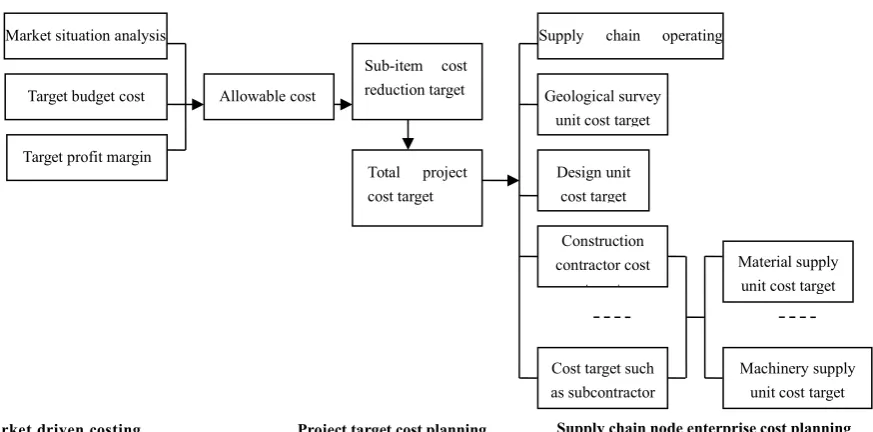
The goal cost achievement is the process of realizing the sub-cost goal of the target cost tree from the bottom up on the basis of the target cost decomposition. In order to determine the cost targets of each node of the construction project supply chain, this step is often referred to as the target cost planning of each node. The target cost planning at each sub-level conveys the target cost pressure at the project level to the project designer, geological prospector, material supplier, machinery manufacturer, subcontractor, etc., so that each node enterprise finds its own cost reduction. Measures to jointly bear the cost pressure and achieve the expected cost targets.
Supply chain node enterprise cost planning
Market situation analysis
Target budget cost
Target profit margin
Sub-item cost reduction target Allowable cost
Total project cost target
Supply chain operating costs
Geological survey unit cost target
Construction contractor cost
target
Cost target such as subcontractor
Machinery supply unit cost target Material supply
unit cost target
Market driven costing Project target cost planning
Design unit cost target
As can be seen from Figure 4, in order to support this cost management system, all participants, including owners, designers, suppliers, contractors, subcontractors, and other project participants, need to work together. The final result of the target cost planning based on lean construction determines the cost target of a participating node unit, and decomposes the target according to the components of the cost project, thereby constructing the construction project management company, the project general contracting company or large-scale construction. The core enterprises are connected with the suppliers, so that the target cost planning of the construction project can be effectively integrated with the value chain, fully integrating the resource advantages of the cooperative enterprise, and it has important and far-reaching significance for the construction industry to win in the competition.
To this end, we need to do the following work[7]:
First, the owner, the main contractor and the supplier should be involved in the early stage of project implementation. This is important for the formulation of the target cost and the design of the design plan, which can reduce the cost variation and improve the cost controllability in the later stage;
Second, the owners, designers, general contractors and professional subcontractors and suppliers jointly form a cross-functional team, working together on joint cost reduction activities, and transferring cost pressures along the entire value stream to the entire value chain. All organizations;
The third is to increase the transparency of information, especially the transparency of cost information, which can enhance the trust between the participants and contribute to the achievement of cost targets;
The fourth is to establish a long-term stable, mutual trust and close partnership, as well as a risk-sharing and benefit-sharing cooperation mechanism. When problems arise, they will not cause greater losses and wastes due to mutual promotion.
Fifth, through training or other means, all project participants should pay attention to cost management, actively participate in cost management, find out factors and characteristics related to soil cost from their own work, take the initiative to strengthen cooperation and cooperation, and reduce costs by improving the quality of work.
4. Design of the allocation model of the target cost and workload of lean supply
chain in construction projects.
In construction engineering project planning, survey, design, construction and maintenance and other construction activities, all need to consume a variety of resources, incurred the corresponding costs and expenses, and expect to obtain the maximum benefit. Therefore, when designing the target cost of lean supply chain, this paper mainly takes the workload or construction area of construction projects undertaken by each participating nodal enterprise in the supply chain as the base for decomposition, and confirms the target cost and expected target profit that each enterprise should bear. Such as building unit of organization design and construction of the production process, should with engineering drawings design and engineering construction drawing as the basic guide, to carry out the raw material procurement, logistics, transportation, inventory in the supply chain management, and other activities, ultimately reflected on the basis of the construction or other work area, with minimum cost into the core guiding ideology for supply chain design.
In order to minimizing the cost of construction engineering project and the profit maximization, construction engineering project management company or large construction project general contracting company needs of each child to the cost of the forehead and coalition units to deal comprehensively with the amount of work, using multi-objective linear programming technology, build a model of the distribution of the cost and effort.
CPi: the total target cost of the supply chain (i = 1, 2... n), there are N node enterprises in the
supply chain, namely n sub-alliances; (i is the number of nodes in the supply chain; j is the subordinate participating unit of each node of the supply chain)
Li: the total profit distribution of each node in the supply chain;
Xi: The lower cost proportion of each node in the supply chain;
Cij: unit cost of the internal node enterprise of the sub-confederation, rij: cost reduction rate;
Lij: unit profit of the internal node enterprise of the sub-library, Lij= Cij*Pij
S: building area or workload indicator;
Sij: the contracted area or other workload indicator obtained by the j-th unit in the i-th
sub-dynamic alliance;
Sij': the maximum workload that can be undertaken by the j-th unit in the i-th sub-dynamic
alliance under existing equipment, machinery, time and technology;
Then: the steps to establish the allocation model of the target cost and workload of the construction project are as follows:
(1) Total cost of construction project target = target total budget cost - target profit
(2) Target cost of each node in the lean supply chain. According to the investment estimation table made in the feasibility study stage of the project, calculate the lower cost proportion xjof
each alliance in each link, and the target cost of each alliance node. Ci= CLxi(i = 1, 2... n), There
are n nodes in the supply chain, that is, there are n sub-allies.
The balance relationship between the cost of a node's enterprise and the total cost of the supply chain:
That is, the cost of a node enterprise = the resources consumed by the upstream enterprise to perform the operation + the profit retained by the node
(3) Sub-union internal member units (j) costs and profits. Using the actual average unit cost Cij' and the planned cost reduction rate rijof each member in the previous period, the unit cost of
the member can be obtained: Cij= Cij'(1- rij)(i=1,2,...,nj), i There are njunits in the alliance, and the
unit profit of this unit is Lij= Cij*Pij. Among them, pijis the cost profit rate.
The profit of a node enterprise = the pricing of the next node payment - the price of the node to pay the previous node - the resource cost consumed by the operation of the node
That is to say, the supply chain cost does not include the management of the expenses of each node enterprise. The total cost of the supply chain is the operating cost of each node enterprise and the retained profit between the nodes. It is actually equal to the total project cost of the project that the owner ultimately pays. Specifically, there are the following: planning cost, bidding cost, survey cost, design cost, construction and construction cost, training cost, storage cost, management information system maintenance cost, distribution cost, retained profit between nodes, etc.
(4) Workload allocation plan for members of the sub-mineral. The construction area of the project is S, Sijis the construction area or other workload indicator obtained by the j-th unit in the
i-th sub-dynamic alliance, and Sij' is the unit under the existing equipment, machinery, time and
technology. Maximum workload. The model is as follows:
The maximization model of the total profit distribution of each node in the supply chain is:
ij ij ij n 1 i ij ij i n 1 i ij
i
C
P
S
C
(
1
-
r
)
P
S
maxL
(i=1,2,…,n j=1,2,…,m) (4-1)
The target cost minimization model is:
ij ij n 1 i ' ij ij n 1 i ij
pi
C
S
C
(
1
-
r
)
S
minC
(4-2)
0
S
)
S
S,
(
min
S
S
S
,
C
C
C
C
S
S
S
:
st
ij ij ij ij 1 m 1 i j i n 1 i ij ij n 1 i ij
(4-3)
It can be solved conveniently by using multi-objective linear programming.
cost control as the core, realizes target cost as the purpose, and takes into account pre-event, in-process and post-event control.
5. Conclusion
Target costing is one of the main tools of supply chain cost management. Many researchers have studied the application of target cost system in manufacturing, but there is little research on lean supply chain management of construction projects. Therefore, the research based on the study of the basic model of lean supply chain cost control for construction projects is particularly important. Based on the analysis of the strategic cost management ideas embodied in the target cost planning, this paper establishes the basic model construction principles and assumptions for the lean supply chain cost control of construction projects. According to the requirements of the goal planning theory of the construction project company, establish a lean supply chain cost planning system for the construction project, realize the basic model of the lean supply chain cost management of the construction project, and set the target cost from the lean project of the construction project. The technical decomposition is established by the process of cost decomposition and cost pressure transmission and sub-target cost planning.
Firstly, the relationship between the target cost and the workload of the construction project is established. The technology of multi-objective linear programming is studied. A cost and workload allocation model is established for the cost of each sub-fund and the workload obtained by each unit within the alliance. For the construction project, the core node construction enterprise of the lean supply chain provides the method of effectively decomposing the target cost according to the workload, and finally provides the optimal supply chain design implementation algorithm.
Secondly, through the cost and benefit analysis of lean supply chain of construction engineering projects, the expenditure of lean supply chain target cost of construction engineering projects is measured, and the amount of cost incurred during and after construction projects is controlled.
cost. Because the target cost is constrained throughout the supply chain, we must use the idea of operation management to penetrate the supply chain. At the operational level, comprehensively and in-depth analysis of all aspects of the supply chain, formulating key operating points from the perspective of cost optimization, improving operations, reorganizing operational processes, optimizing the entire operation chain and value chain, and achieving target cost management based on supply chain strategy .
References
[1] Joseph Sarkis, A strategic decision framework for green supply chain management[J].Journal of Cleaner Production. 2003,11:397-409.
[2] Shank J K,Strategic Cost Management:New Wine,or Just New Bottles?[J].Journal
of Management Accounting Research,1989,4(1):47-65
[3] Tanaka, T.Target Costing at Toyato[J].Journal of Cost Management,1993,7:4-7. [4] Munday,M,Accounting Cost Data Disclosure and Buyer-Supplier Partnerships:A
Research Note[J].Journal of Management Accounting Research,1992,3:245-250
[5] Dekker,H.C,van Goor,A.R. , Supply Chain Management and Management
Accounting:A Case Study of Activity-Based Costing[J].International Journal of Logistics Research and Applications,2000,3(1):41-52
[6] Cullen,J.,Berry,A.J.,Seal,W.,Dunlop,A.,Ahmed,M.,Marson,J , Inter firm Supply
Chains The Contribution of Management Accounting[J].Management Accounting(UK),1999,7:30-32.
[7] LaLonde,B.J.,Pohlen,T.L,Issues in Supply Chain Costing[J].International Journal
of Logistics Management,1996,7(1):1-12
[8] Peter BB,Turney and Bruce Anderson Accounting for Continuous. Improvement
Research[J].Sloan Management Review,1989,12:37-47
[9] Monden Y,Lee J,How a Japanese Auto Maker Reduces Costs[J].Management
Accounting Research,l993,8:22-26
[10] Shank J K,Strategic Cost Management:New Wine,or Just New Bottles?[J].Journal
of Management Accounting Research,1989,4(1):47-65
[12] Chen Y. C.,Fang S. C.,Wen U. P. Pricing Policies for Substitutable
Products in a Supply Chain with Internet and Traditional Channels[J]. European Journal of Operational Research,2013,224( 3) : 542-551
[13] [Wang J.,Shin H. The Impact of Contracts and Competition on Upstream
Innovation in a Supply Chain[J].Production & Operations Management,2015,24( 1) :
134-146
[14] Taylor T. A. Sale Timing in a Supply Chain: When to Sell to the Retailer[J].
Manufacturing & Service Operations Management,2006,8( 1) : 23-42
[15] Kaya M., zalp zer.Quality Risk in Outsourcing: Noncontractible Product
Quality and Private Quality Cost Information[J].Naval Research Logistics,2009,56( 7) :
669-685
[16] Ghosh D.,Shah J. Supply Chain Analysis under Green Sensitive Consumer
Demand and Cost Sharing Contrac[J]. International Journal of Production Economics,2015,
164: 319-329
[17] Zhang M.,Guo H.,Huo B.,et al.Linking Supply Chain Quality Integration
with Mass Customization and Product Modularity[J].International Journal of Production
Economics,2019,207: 227-235
[18] Taylor T. A. Supply Chain Coordination under Channel Rebates with Sales
Effort Effects[J]. Management Science,2002,48( 8) :992-1007
[19] Giovanni P. D. Quality Improvement vs.Advertising Support which Strategy
Works Better for a Manufacturer[J]. European Journal of Operational Research,2011,