IJEDR1501065
International Journal of Engineering Development and Research (www.ijedr.org)351
Experimental Analysis and Optimization of Process
Parameter in WEDM for Aluminum-6082
1
Anup B. Patel,
2Mr. Krunal Shah,
3Mr. Divyang Pandya
1ME, 2Asst. Prof,3Asst. Prof
1,2Department of Mechanical Engineering, Venus international college of engg. and tech., Gandhinagar,India .3Department of Mechanical Engineering,LDRP-ITR, Gandhinagar, Gujarat,, India., Gandhinagar,India
________________________________________________________________________________________________________ Abstract - Wire Electro-Discharge Machining (EDM) is a metal-working process whereby material is removed from a conductive work piece by electrical erosion. Wire EDM while not a new process, has rapidly become a key component in the manufacture of injection moulds, and metal stamping dies. Surface roughness and Material Removal Rate. This paper reviews the research carried out for the alloy 6082 of Aluminium material. The research carried out here includes material removal rate and surface roughness of the same material. Input process parameters that are taken into consideration are wire speed & wire tension. The effect of input parameters on performance parameters such as material removal rate and surface roughness was experimentally noted and optimization of parameters is done with the help of RNS.
Keyword - MRR, Surface roughness, DOE, Full factorial, RNS
________________________________________________________________________________________________________
I.INTRODUCTION
Wire electrical discharge machining (WEDM) is an indispensable machining technique for producing complicated cut-outs through difficult to machine metals without using high cost grinding or expensive formed tools. Wire-cutting EDM is commonly used when low residual stresses are desired, because it does not require high cutting forces for removal of material. It can machine anything that is electrically conductive regardless of the hardness, from relatively common materials such as tool steel, aluminum, copper, and graphite, to exotic space-age alloys including has alloy, wasp alloy, Inconel, titanium, carbide, polycrystalline diamond compacts and conductive ceramics. Parts that have complex geometry and tolerances don‟t require you to rely on different skill levels or multiple equipment. Most work pieces come off the machine as a finished part, without the need for secondary operations.
II. LITERATURE REVIEW
Atul Kumar, Dr. D. K. Singh [1] represents variation of cutting performance with pulse on time, pulse off time, open voltage, feed rate override, wire feed, servo voltage, wire tension and flushing pressure which were experimentally investigated in wire electric discharge machining (WEDM) process. Brass wire with 0.25mm diameter and Skd 61 alloy steel with 10mm thickness were used as tool and work materials in the experiments. The cutting performance outputs considered in this study were material removal rate (MRR) and surface roughness. Experimentation has been completed by using Taguchi‟s L18 orthogonal array under different conditions of parameters. A 0.25 mm diameter brass wire used in this experiment as a cutting tool and Skd 61 alloy steel plate of 100mm x 80mm x 10mm size. Analysis of the results leads to conclude that factors at level A2B1C1D2E2F3G2 and H2 can be set for maximization of MRR. Similarly, it is recommended to use the factors at levels such as A1B1C1D3E1F3G2 and H1 for minimization of surface roughness, where A1,A2 are 5µsec and 10µsec pulse on time respectively, B1 is 22µsec pulse off time, C1 is 5V open voltage, D2,D3 are 20mm/min and 30mm/min feed rate respectively, E1, E2 are 5mm/sec and 10mm/sec wire feed respectively, F3 is 75V servo voltage, G2 is 10N wire tension, H1,H2 are 3kg/cm2 and 5kg/cm2 flushing pressure respectively. Kuriachen Basil, Dr. Josephkunju Paul, Dr. JeojuM.Issac [2] investigates the effect of voltage, dielectric pressure, pulse on-time and pulse off-time on spark gap of Ti6AL4V alloy. It has been found that pulse on time and pulse off time have the more impact on the spark gap. The minimum spark gap was obtained as 0.040407mm. The WEDM experiments were conducted in Electronic ultracut S1 machine using 0.25 mm brass wire as the tool electrode. „Pulse on time‟, „pulse off time‟, „voltage‟ and „dielectric pressure‟ are the four WEDM parameters that were selected for investigations. In this experimental study two level full factorial experiment is adopted because this gives all possible combinations of machine parameters. It can be noticed from that corresponding to minimum value of pulse off time the spark gap decreases with increase in dielectric pressure, whereas the spark gap increases with increase in dielectric pressure corresponding to maximum value of pulse off time. For high value of pulse off time, spark gap increases with increase in pulse on time. When the pulse off time is maximum and the pulse on time increase from 20 μsec to 25 μsec, spark gap also increases. To achieve minimum spark gap, the pulse on time, pulse off time, voltage and dielectric pressure should be set at 20 μsec, 50 μsec, 30 V and 15 kg/cm2 respectively.Analysis of the result leads to the conclusion that factors at level A3, B3, C1, D3 gives maximum MRR. Although factors C factor is not show significant effect on material removal rate and surface finish. Factor C is having least significance effect for improving MRR. Similarly, it is recommended to use the factors at level A3, B3, C1, D2 for minimization of SR. Factors C and D have least contribution for minimization of SR, where A3 is 105V applied voltage, B3 is 5µsec pulse width, C is pulse interval and C1 is 20µsec pulse interval, D2,D3 are 500rpm and 750 rpm respectively.
IJEDR1501065
International Journal of Engineering Development and Research (www.ijedr.org)352
material removal rate are graphically tabulated. The best combination of machining parameter viz. machine feed rate (4 mm/min), wire speed (8 m/min), wire tension (1.4kg) and voltage (60V) were identified. The selection of parameters depends on the requirements based on a better surface roughness or a maximum material removal rate. Hence an appropriate combination of variables can be selected accordingly. Furthermore, this combination can contributes to increase production rates perceptibly by reducing machining time. The outcome of this study will help in improving the quality of Titanium Ti-6Al-4V products as well as minimizing the machining cost to realize the economic potential to the fullest.Mustafa I˙lhanGo¨kler, Alp MithatOzano¨zgu [6] aims to select the most suitable cutting and offset parameter combination for the wire electrical discharge machining process in order to get the desired surface roughness value for the machined work pieces. A series of experiments have been performed on 1040 steel material of thicknesses 30, 60 and 80 mm, and on 2379 and 2738 steel materials of thicknesses 30 and 60 mm. The test specimens have been cut by using different cutting and offset parameter combinations of the “Sodick Mark XI A500 EDW” wire electrical discharge machine. The related tables and charts have been prepared for 1040, 2379, 2738 steel materials. The tables and charts can be practically used for WEDM parameter selection for the desired work piece surface roughness.
Aniza Alias, Bulan Abdullah, NorlianaMohd Abbas [7] evaluates the influence of three different machine rates which are 2 mm/min, 4 mm/min and 6 mm/min with constant current (6A) with WEDM of Titanium Ti-6Al-4V. The effects of different process parameters on the kerf width, material removal rate and surface roughness are also discussed. The best combination of machining parameter viz. machine feed rate (4 mm/min), wire speed (8 m/min), wire tension (1.4kg) and voltage (60V) were identified. The paper highlights the importance of process parameters and different machining conditions on kerf width, MRR, surface roughness (Ra) and surface topography. The machine feed rate increases, the kerf width decreases. By increasing machine feed rate, the MRR will increases simultaneously. Smoother surface can be obtained with low setting of machine feed rate.
PujariSrinivasaRao, KoonaRamji, BeelaSatyanarayana [8] studied Wire-cut electric discharge machining of Aluminum-24345. Experimentation has been done by using Taguchi‟s L18 (21x37) orthogonal array under different conditions of parameters. The response of surface roughness is considered for improving the machining efficiency. Optimal combinations of parameters were obtained by this method. The confirmation experiment shows, the significant improvement in surface finish (1.03μm) was obtained with this method. Multiple linear regression model have been developed relating the process parameters and machining performance and a high correlation coefficient (r2 = 0.97) indicates the suitability of the proposed model in predicting surface roughness. The study shows that with the minimum number of experiments the stated problem can be solved when compared to full factorial design. All the experiments were conducted on Ultra Cut 843/ ULTRA CUT f2 CNC Wire-cut EDM machine. The size of the work piece considered for experimentation on the wire-cut EDM is 25 mm x 20 mm x 10 mm. Increasing the discharge energy generally increases surface irregularities due to much more melting and re-solidification of materials. Hence, it is found that SR tends to decrease significantly with decrease in IP and TON. Here, the minimum SR is obtained at low IP (10 A) and low TON (105 μsec). The parameters wire tension and spark gap voltage are observed as significant parameters in obtaining better surface finish. The increase of voltage means that the electric field becomes stronger and the spark discharge takes place more easily under the same gap and a coarse surface is always obtained.
SauravDatta, SibaSankarMahapatra [9] experimented with six process parameters: discharge current, pulse duration, pulse frequency, wire speed, wire tension and dielectric flow rate; to be varied in three different levels. Data related to the process responses viz. material removal rate (MRR), roughness value of the worked surface and kerf have been measured for each of the experimental runs; which correspond to randomly chosen different combinations of factor setting. These data have been utilized to fit a quadratic mathematical model (Response Surface Model) for each of the responses, which can be represented as a function of the aforesaid six process parameters. Predicted data have been utilized for identification of the parametric influence in the form of graphical representation for showing influence of the parameters on selected responses. Predicted data given by the models (as per Taguchi‟s L27 (3*6) Orthogonal Array (OA) design) have been used in search of an optimal parametric combination to achieve desired yield of the process: maximum MRR, good surface finish and dimensional accuracy of the product. Grey relational analysis has been adopted to convert this multi-objective criterion into an equivalent single objective function. The work piece, a block of D2 tool steel with 200 mm × 25 mm ×10 mm size, has been cut 100 mm length with 10 mm depth along the longer length.
S Sivakiran, C. Bhaskar Reddy, C. Eswarareddy [10] evaluated the influence of various machining parameters Pulse on, Pulse off, Bed speed and Current on metal removal Rate (MRR). The relationship between control parameters and Output parameter (MRR) is developed by means of linear regression. Taguchi‟s L16 (4*4) Orthogonal Array (OA) /designs have been used on EN-31 tool steel to achieve maximum metal removal rate. The experiments were performed on CONCORD DK7720C four axis CNC Wire-cut electrical discharge machining (WEDM). The results obtained are analysed using S/N Ratios, Response table and Response Graphs with the help of Minitab software. The better Parameter setting is Pulse on 24μsec, pulse off 6 μsec, Bed speed 35 μm/s and Current to obtain maximum metal removal rate. Regression analysis is used to predict the MRR with 6.77% error. With the help of Regression equation the predicted values of MRR is estimated.
III. EXPERIMENTAL SETUP
IJEDR1501065
International Journal of Engineering Development and Research (www.ijedr.org)353
Fig3.1 Ratnapakhi CNC Wire EDM-5530Specification Description
Worktable Size Mm 340 X 560
XY Table Traverse Mm 250 X 320
Max Z Height Mm 300
Max Work Piece Weight Kg 200
Max Taper Cutting Angle ±3 /100mm
Higher Degree Optional. Yes
Dielectric Capacity Tap Water + Coolant Oil (40:1lit.) Tap Water + Multipass Paste (40:1kg.)
Tank Capacity 55 Liters
Filter Magnetic Separator
Minimum Input Command 0.001 Mm
Minimum Increment 0.001 Mm
Interpolation Function Linear And Circular. S Simultaneous Controlled Axes X, Y, U, V
R Resolution For X, Y, U, V 0.001 Mm
Data Input CD, US B Pen Drive
Input Power Supply 3phase, 415VAC, 50Hz
Wire Diameter 0.2 To 0.25 Mm (Brass)
Table3.1Specification of Ratnaparkhi CNC Wire EDM-5530
Selecting Aluminium Alloy 6082 Tool as Work piece
Aluminum alloy 6082 is a medium strength alloy with excellent corrosion resistance. It has the highest strength of the 6000 series alloys. Alloy 6082 is known as a structural alloy. In plate form, 6082 is the alloy most commonly used for machining. As a relatively new alloy, the higher strength of 6082 has seen it replace 6061 in many applications. The addition of a large amount of manganese controls the grain structure which in turn results in a stronger alloy. It is difficult to produce thin walled, complicated extrusion shapes in alloy 6082. The extruded surface finish is not as smooth as other similar strength alloys in the 6000 series. In the T6 and T651 temper, alloy 6082 machines well and produce tight coils of swarf when chip breakers are used.
Design of work-piece
Design of work-piece in solid work
IJEDR1501065
International Journal of Engineering Development and Research (www.ijedr.org)354
Fig 3.2 solid work design of plateThrough this dissertation, effect of varying parameter as Wire Tension (Kg), Wire Speed(m/min), Pulse Width and Wire Material were used to analyse for MRR, Surface roughness of Aluminium 6082 Tool.
Input Parameters Output Parameters
Wire Tension ( Kg) Material Removal Rate (mm/min) Wire Speed (m/min) Surface Roughness (µm)
Pulse Width (µsec) Kerf Width (mm) Wire Material
Table3.2 Input and output parameters
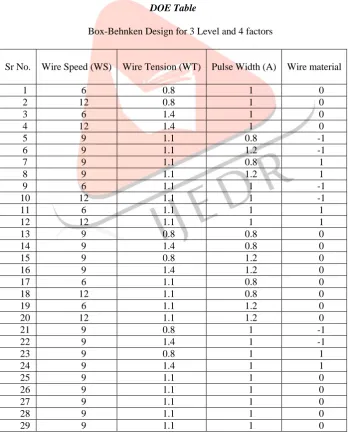
I have selected the design of experiment as Response Surface Methodology (Box Behnken method for DOE) and optimize the WEDM process parameters for effective machining using different wire materials.
Experimental work was carried out at R.K. Industries, Yamuna estate, CTM, Ahmedabad. DOE Table
Box-Behnken Design for 3 Level and 4 factors
Sr No. Wire Speed (WS) Wire Tension (WT) Pulse Width (A) Wire material
1 6 0.8 1 0
2 12 0.8 1 0
3 6 1.4 1 0
4 12 1.4 1 0
5 9 1.1 0.8 -1
6 9 1.1 1.2 -1
7 9 1.1 0.8 1
8 9 1.1 1.2 1
9 6 1.1 1 -1
10 12 1.1 1 -1
11 6 1.1 1 1
12 12 1.1 1 1
13 9 0.8 0.8 0
14 9 1.4 0.8 0
15 9 0.8 1.2 0
16 9 1.4 1.2 0
17 6 1.1 0.8 0
18 12 1.1 0.8 0
19 6 1.1 1.2 0
20 12 1.1 1.2 0
21 9 0.8 1 -1
22 9 1.4 1 -1
23 9 0.8 1 1
24 9 1.4 1 1
25 9 1.1 1 0
26 9 1.1 1 0
27 9 1.1 1 0
28 9 1.1 1 0
IJEDR1501065
International Journal of Engineering Development and Research (www.ijedr.org)355
IV.CONCLUSION
In all the wires higher pulse width removes the material quickly with high cut speeds.
Pulse width is the key factor as any changes in its value affects all the output factors.
Surface Roughness is affected by the combination of wire tension and pulse width, with both having maximum values highest is the roughness and with both having minimum value minimum is the roughness.
Kerf width is largely affect by pulse width in all the three wires.
With the increase in pulse width, soft brass wires doest break which helps for continuous cutting as breakage of wire may lead to wire marks, increase cutting time and also increase the surface roughness.REFERENCES
[1] Atul Kumar and Dr. D. K. Singh. Performance Analysis of Wire Electric Discharge Machining (W-EDM). International Journal of Engineering Research & Technology (IJERT) Vol. 1 Issue 4, June – 2012, ISSN: 2278-0181.
[2] Kuriachen Basil, Dr.Josephkunju Paul, Dr.JeojuM.Issac. Spark Gap Optimization of WEDM Process on Ti6Al4V. ISSN: 2319-5967, ISO 9001:2008 Certified. International Journal of Engineering Science and Innovative Technology (IJESIT). Volume 2, Issue 1, January 2013.
[3] Jaganathan P., Naveen kumar T., Dr.R.Sivasubramanian. Machining parameters optimization of WEDM process using Taguchi method. International Journal of Scientific and Research Publications, Volume 2, Issue 12, December 2012. ISSN 2250-3153.
[4] Aniza Alias, Bulan Abdullah, NorlianaMohd Abbas. WEDM: INFLUENCE OF MACHINE FEED RATE IN MACHINING TITANIUM Ti-6Al-4V USING BRASS WIRE AND CONSTANT CURRENT (4A). International Symposium on Robotics and Intelligent Sensors 2012 (IRIS 2012).
[5] K. Kanlayasiri, S. Boonmung. An investigation on effects of wire-EDM machining parameters on surface roughness of newly developed DC53 die steel. Journal of Materials Processing Technology 187–188 (2007) 26–29.
[6] Mustafa I˙lhanGo¨kler, Alp MithatOzano¨zgu. Experimental investigation of effects of cutting parameters on surface roughness in the WEDM process. International Journal of Machine Tools & Manufacture 40 (2000) 1831–1848.
[7] Aniza Alias, Bulan Abdullah, NorlianaMohd Abbas. WEDM: INFLUENCE OF MACHINE FEED RATE IN WEDM OF TITANIUM Ti-6Al-4V WITH CONSTANT CURRENT (6A) USING BRASS WIRE. International Symposium on Robotics and Intelligent Sensors 2012 (IRIS 2012).
[8] PujariSrinivasaRao, KoonaRamji, BeelaSatyanarayana. EFFECT OF WEDM CONDITIONS ON SURFACE ROUGHNESS:A PRAPMETRIC OPTIMISATION USING TAGUCHI METHOD. IJAEST, Vol No. 6, Issue No. 1, 041 – 048.
[9] SauravDatta, SibaSankarMahapatra. Modeling, simulation and parametric optimization of wire EDM process using response surface methodology coupled with grey-Taguchi technique. International Journal of Engineering, Science and Technology. Vol. 2, No. 5, 2010, pp. 162-183.
[10] S Sivakiran, C. Bhaskar Reddy, C. Eswarareddy. Effect Of Process Parameters On MRR In Wire Electrical Discharge Machining Of EN31 Steel. International Journal of Engineering Research and Applications (IJERA) Vol. 2, Issue 6, November- December 2012, pp.1221-1226. ISSN: 2248-9622.
[11] S.SivanagaMalleswaraRao, Ch.V.S. ParameswaraRao. Parametric Evaluation for Machining Die-Steel with WEDM. International Journal of Scientific and Research Publications, Volume 3, Issue 4, April 2013. ISSN 2250-3153
[12] G.Rajyalakshmi, Dr.P.VenkataRamaiah. Simulation, Modelling and Optimization of Process parameters of Wire EDM using Taguchi –Grey Relational Analysis. G. Rajyalakshmi et al. / IJAIR, ISSN: 2278-7844.
[13] Anish Kumar, Vinod Kumar, Jatinder Kumar. Prediction of Surface Roughness in Wire Electric Discharge Machining (WEDM) Process based on Response Surface Methodology. International Journal of Engineering and Technology Volume 2 No. 4, April, 2012. ISSN 2049-3444.
[14] U. Esme, A. Sagbas and F. Kahraman. PREDICTION OF SURFACE ROUGHNESS IN WIRE ELECTRICAL DISCHARGE MACHINING USING DESIGN OF EXPERIMENTS AND NEURAL NETWORKS. Iranian Journal of Science & Technology, Transaction B, Engineering, Vol. 33, No. B3, pp 231-240.
[15] C. Bhaskar Reddy, V. Diwakar Reddy, C. Eswara Reddy. EXPERIMENTAL INVESTIGATIONS ON MRR AND SURFACE ROUGHNESS OF EN 19 & SS 420 STEELS IN WIRE-EDM USING TAGUCHI METHOD. C. Bhaskar Reddy et al. / International Journal of Engineering Science and Technology (IJEST)
[16] http://shodhganga.inflibnet.ac.in/bitstream/10603/9876/6/06_chapter%201.pdf [17] Production Technology by R.K Jain, Pg. 350-351
[18] Production Technology by P.C Sharma, Pg. 565-572