IJEDR1501014
International Journal of Engineering Development and Research (www.ijedr.org)65
Minimization of Interference Using Different
Equalization Techniques
1Yogeshwari Y Ujalmbkar,2Sayad Shoaib Anwar 1Student of Master of Engineering,2Assistant Professor 1,2
Department of Electronics and Tele Communication MGM‟s College of Engineering Nanded, India
________________________________________________________________________________________________________ Abstract - During past few years, demand for higher data rates is increasing day by day. The main problems in higher data rates are inter symbol interference and inter channel interference. To mitigate these challenges, different equalization techniques are used. Among all multiplexing techniques Orthogonal Frequency Division Multiplexing (OFDM) is proved to be best for achieving higher data rates.
This paper discusses different equalization techniques such as LS algorithm, MMSE algorithm by using OFDM for minimization of interference. The simulation results show that LS estimator gives better performance and lower complexity.
Index Terms - MMSE, LS, OFDM, minimization of interference.
________________________________________________________________________________________________________
I.INTRODUCTION
In wireless transmission the output is not the same signal transmitted but the combination of reflected, diffracted and scattered copies of the transmitted signal. This happens due to the interference while travelling. Another problem is fading. Fading is present where there are multipath components. Multipath components arrive at receiver at slightly different times. If movement in system occurs then there is phase difference between received components which leads to frequency shift. These multiple received copies form constructive or destructive interference to the signal. It creates standing wave pattern which shows rapid signal strength changes, frequency shifts or echoes. Orthogonal Frequency Division Multiplexing(OFDM) is most commonly employed inwireless communication systems because ofthe high data rate of transmission, high bandwidth efficiency. Though it has ability to combat against multipath delays it also suffers from fading. To minimize this interference different equalization techniques are used such as LS algorithm, MMSE algorithm etc. When the modulated symbol time isof the same order as that of channel delay spread, it leads to Inter-symbol interference (ISI). ISI is a major problem of any wireless communicationsystems. It can cause an irreducible error whichdegrades the system performance significantly. To mitigate ISI, equalization is performed on receiver side. Equalization isa filtering approach which minimizes the error between actualoutput and desired output by continuous updating its filtercoefficients. It is generally used to combat ISI due to channelas well as due to transmitter and receiver filters. LS, MMSE algorithms are implemented in this paper.
The rest of the paper is organized as follows. In section II,system model used in this paper is discussed. Insection III, various equalizer algorithms are shown along withtheir implementation issues. The simulation parameters andresults are presented in section IV, and paper is concluded insection V.
II.SYSTEMMODEL
The transceiver structure of MT x MR MIMO OFDM system is shown in Fig. 1. Where, MT and MR are the number of transmitting and receiving antennas. Initially, the input bits are randomly generated. These input bits are mapped into data symbols by using different modulation techniques such as Binary Phase Shift Keying (BPSK), Quadrature Phase Shift Keying (QPSK), Quadrature Amplitude Modulation (QAM). Afterwards, serial to parallel converter (SPC) is used to convert the incoming serial stream into number of parallel substreams.
Number of parallel sub-streams will depend upon number of transmitting antennas ie. MT. The number of parallel streams are passed through IFFT block which converts the streams into time domain. After that cyclic prefix is inserted to minimize the interference. Again this parallel data is converted into serial data stream. The data symbols are transmitted simultaneously from MT transmitting antennas and then passed through MIMO channel. Channel used in this paper is Rayleigh selective frequency fading channel. While passing through these channels Additive White Gaussian Noise (AWGN) gets added and the signal is contaminated with distortions like ISI and Inter- carrier interference (ICI). The information is received through MR receiving antennas, which will serve as input to equalizer. At receiver side performed actions are exactly opposite to that performed at transmitter side to get the original signal as output.
Consider the transmission sequence as X1 X2, ..., Xn• In normal transmission, X1 will be transmitted in first time slot, X2 in second time slot and Xnin nth time slot.
Consider two antennas on both sides, then we can group the data symbols into group of two. In the first time slot, X1 and X2 is transmitted from the first and second antenna. In the second time slot, X3 and X4 is transmitted from the first and second antenna respectively. Thus, the received signals at receiver 1 and 2 can be expressed as
IJEDR1501014
International Journal of Engineering Development and Research (www.ijedr.org)66
Y2 =h21 x1 +h22 x2 +n2 (2)Where, n1and n2 is additive white Gaussian noise
(AWGN) with zero mean and unit variance at receiver 1 and 2. h11, h12 are channel impulse response (CIR) coefficients between receiver 1 and transmitter 1 and 2. Similariy, h21 and h 22 are CIR coefficients between receiver 2 and transmitter 1and 2. After combining
equation ( 1)and (2) the new equation is expressed as
∑ (3)
Where, Yjis received signal at receiver antenna j. Xi and Ni are symbol vector and noise vector for MT transmitting antennas. hj,iis channel response between transmit antenna i and receive antenna j. It can be expressed as
( ) ∑ ( ) ( )
(4)
Where, α is complex path gains which can be modeled by Gaussian variables. L is the number of multipath between transmitter antenna i and receiver antenna j.
Equation (3) can also be expressed in matrix form as,
Y =HX+N (5)
At the receiver, several replicas of the same signal may add up constructively or destructively which leads to multipath fading channels. These Multi-path fading channels are characterized by delay spread in time domain.
The channel models used in this paper are Rayleigh
Selective frequency channels. It means that we considered multi path channels without any single domiant path. The behavior of H is continuously varying due to a combination of inadequate antenna spacing and/or inadequate scattering which leads to spatial fading correlation. In the presence of an Line of Sight (LOS) component between transmitter and receiver, the MIMO channel may be modeled as the sum of a fixed component and a fading component.
H=√
Ĥ+√ (6)
Where, √
Ĥ is LOS component and
√
is fading component of channel.
Here, k is Rician k-factor of the channel and it is nothing but the ratio of the power in the LOS component of the channel to the power in fading component. k is always greater than or equal to 0.When k=0, it means we have pure Rayleigh fading channel. In general, real-world MIMO channels will exhibit some combination of Ricean fading and spatial fading correlation.
III. Equalization
ISI still exists due to multipath propagation channels, although CP is included. ISI caused by multipath within time dispersive channels will results into an irreducible error floor at the receiver. It severely affects the system performance when modulation symbol time is of the same order as that of channel delay spread. To mitigate this ISI equalization is incorporated on receiver side. Equalizer can be categorized as time and frequency domain equalizer depending on the domain in which it is applied. They can also be categorized as linear and non-linear depending upon usage of their output. Equalizers used in this paper are linear equalizers such as Least Square (LS), Minimum mean square error (MMSE).
Symbol
mapping
S/p
IFFT CP
Insertion
P/S
Symbol de-mapping
Linear combining
FFT CP
Removal
S/P
Channel
+
EqualizerBinary Data
AWGN W(n) O/P
Data
IJEDR1501014
International Journal of Engineering Development and Research (www.ijedr.org)67
Least Square Equalizer
The Least Squares Error (LSE) estimation method can be used to estimate the system h[m] by minimizing the squared error between estimation and detection.
In matrix form, it can be written as
y = XH (7)
So the error „e‟ can be defined as Error=Expected o/p- Actual o/p
e = y”-y (8)
Where y” is the expected output.
Now, the squared error (S) can be defined as S = | e |2 S = ( y”- y )2
S = ( y”- y )*( y”- y )t (9) Where, superscript „t‟ stands for complex transpose of a matrix.
S = ( y”- Xh )*( y”- Xh )t
(10)
This equation can be minimized by taking its derivative w.r.t „h‟ and equating it equal to zero. The final equation is given by:
h” = ( XtX )-1Xt y (11) which can be written as
h” = X-1 y hls = X-1y
This equation can be implemented on SISO as well as MIMO systems.
Minimum Mean Square Error (MMSE) Equalizer
The MMSE estimator minimizes the mean-square error. If „X‟ is transmitted over a channel „h‟ such that
y = X h (12)
Error is given as
e = y” – y (13)
Where, y” is expected output.
Mean Square Error = mean{( y”- y )^2}
=E {( y”- y )^2} (14)
Where, „E‟ is operator for expected value
Concept of expected value and correlation can be used to derive the equations for finding the channel response. Rgg - auto covariance matrix of „g‟
RYY- auto covariance matrix of „Y‟
RgY - cross covariance matrix of „g‟ and „Y‟
The estimated channel Hmmse can be found out by the equation
Hmmse = F * ( RgY * RYY-1 * Y) (15) Where, F is a noise matrix
Rgy = Rgg * F' * X'
RYY = X * F * Rgg * F' *X'+ (variance of noise * Identity Matrix)
The equation can be used for both SISO as well as MIMO systems.
IV. Simulation Results
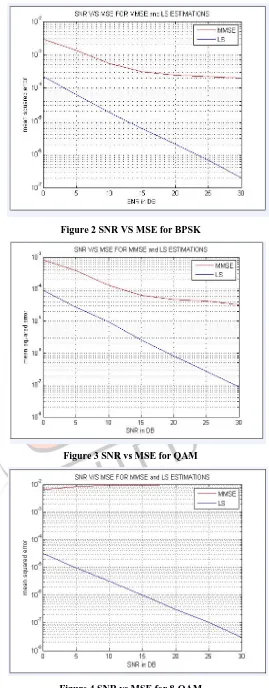
In this section, the simulation results are shown in terms of mean square error with respect to variation in SNR for 2x2 MIMO systems. Results are plotted using BPSK, QAM and 8-QAM and compared for MMSE and LS equalization algorithms.
IJEDR1501014
International Journal of Engineering Development and Research (www.ijedr.org)68
Figure 2 SNR VS MSE for BPSK
Figure 3 SNR vs MSE for QAM
IJEDR1501014
International Journal of Engineering Development and Research (www.ijedr.org)69
Table 1 Comparison of Mean Square Error for Various Modulation Techniques Considering LS and MMSE Algorithms
BPSK QAM 8 QAM
SNR (DB)
LS MMSE LS MMSE LS MMSE
00 10-3.9 10-2.8 10-4 10-3 10-4.8 10-2.1
10 10-4.9 10-3.6 10-5 10-4 10-5.8 10-2
20 10-5.9 10-3.8 10-4 10-4.5 10-6.8 10-2
30 10-6.9 10-3.9 10-7 10-4.9 10-7.8 10-2
V. CONCLUSION
In this paper, ISI due to multipath fading is effectively mitigated using LS and MMSE algorithms. These techniques are based on pilot aided block type training symbols. Mean square error analysis is done using these equalizers in Rayleigh selective frequency fading channel. LS equalizer has shown better results than MMSE equalizer.
In future, these algorithms can be implemented using different tap vectors to improve the results. Variation in modulation technique like QAM, 8 QAM and 16 QAM can also be implemented for improved results.
REFERENCES
[1] Bhasker Gupta and DavinderS.Saini, “BER Performance Improvement in MIMO Systems Using Various Equalization Techniques”, IEEE 2nd
International Conference on Parallel, Distributed and GridComputing, 2012.
[2] K. Elangovan, “Comparative study on the Channel Estimation for OFDM system using LMS, NLMS and RLS Algorithms”, in Proceedings of the International Conference on Pattern Recognition, Informatics and Medical Engineering, March 21-23, 2012.
[3] T. C. Hewavithana, and D. M. Brookes, “Blind Adaptive Channel Equalization for OFDM Using the Cyclic Prefix Data”, 2004.
[4] Sajjad Ahmed Ghauri, SherazAlam, M. FarhanSohail, Asad Ali, FaizanSaleem “Implementation of OFDM and Channel Estimation using LS and MMSE Estimators”,International Journal of Computer and Electronics Research,Vol.2, No. 1, February 2013.
[5] NavdeepBansal, Sukhjeet Singh, Pardeep Kumar Jindal, “Channel Estimation Algorithms in OFDM, A Review”, International Journal of Application or Innovation in Engineering & Management (IJAIEM), Vol. 2, Issue 6, June 2013. [6] Liu Kewen, XingKe, “Research of MMSE and LS channel estimation in OFDM systems”, IEEE 2nd International
Conference on Information Science and Engineering, Dec. 2010
[7] Deepa T., Rajaguru S., Kumar R., “Performance analysis of SIMO and MIMO system with equalization” ,IEEE International Conference on Communication and Signal Processing, April. 2013.
[8] Mydhili S. K., Rajeshwari A., “Equalization techniques in MIMO systems - An analysis”, IEEE International Conference on Communication and Signal Processing, April. 2014.
[9] ZhechengAn, Jun Wang, Su Huang, “MMSE-based equalization and ICI mitigation scheme for OFDM system over doubly selective channels”, IEEE International Symposium on Broadband Multimedia Systems and Broadcasting (BMSB), June 2014.