University of South Carolina
Scholar Commons
Theses and Dissertations
6-30-2016
Bayesian Semiparametric Quantile Regression for
Clustered Data
Xin Tong
University of South Carolina
Follow this and additional works at:https://scholarcommons.sc.edu/etd
Part of theOther Public Health Commons
This Open Access Dissertation is brought to you by Scholar Commons. It has been accepted for inclusion in Theses and Dissertations by an authorized administrator of Scholar Commons. For more information, please [email protected].
Recommended Citation
Tong, X.(2016).Bayesian Semiparametric Quantile Regression for Clustered Data.(Doctoral dissertation). Retrieved from
Bayesian Semiparametric Quantile Regression for Clustered Data
by
Xin Tong
Bachelor of Science Nanjing University 2007
Master of Science in Public Health University of South Carolina 2011
Submitted in Partial Fulfillment of the Requirements
for the Degree of Doctor of Philosophy in
Biostatistics
The Norman J. Arnold School of Public Health
University of South Carolina
2016
Accepted by:
Bo Cai, Major Professor
Marco Geraci, Committee Member
Alexander McLain, Committee Member
Lianming Wang, Committee Member
c
Copyright by Xin Tong, 2016
Acknowledgments
I would like to express my deep and sincere gratitude to everyone who supported and
helped me over the past few years. They have made my graduate study possible.
First and foremost, I would like to thank my advisor Bo Cai for his insightful
guidance, endless patience and invaluable advice throughout my doctoral study. This
thesis would not be possible without his constant support and inspiration make my
doctoral research productive and stimulating.
I am especially thankful to my committee members, Dr. Marco Geraci, Dr. Alex
McLain and Dr. Lianming Wang for joining my committee. I greatly appreciate
constructive feedback they have provided. I have learned a lot about the concept and
modeling methodology of quantile regression for longitudinal data by talking with
Dr. Geraci. I am very grateful to Dr. Wang for advising me with his expertise on
interval-censored data. I would like to express my gratitude to Dr. McLain for his
perpetual encouragement along the way.
The faculty of this department are very resourceful and have provided me with
a tremendous graduate education. Further thanks go to Dr. James Hussey, Dr.
Robert Moran, Dr. Jiajia Zhang for their enlightenment, which has provided me a
solid foundation to progress upon my graduate study. I also would like to thank Dr.
Suzanne McDermott for offering me a research assistantship during my PhD study.
Most of all, I thank my parents, Lianfang Tong, Yahui Wang and my husband,
Abstract
Traditional frequentist quantile regression makes few assumptions on the form of
the error distribution and thus is able to accommodate non-normal errors. However,
inference on the quantile regression models could be challenging for the unknown error
distribution, though asymptotic or resampling methods were developed. Bayesian
literature on quantile regression with random effects is relatively limited. The quantile
regression approach proposed in this dissertation is founded on Bayesian probabilistic
modeling for the underlying unknown distributions. By adopting the error density
with a nonparametric scale mixture models, we developed Bayesian semiparametric
models to make an inference on any quantile of interest and to allow for flexible shapes
of the error densities.
In this dissertation, we aimed to develop Bayesian semiparametric quantile
re-gressions for both longitudinal data and clustered interval-censored data. We first
proposed a semiparametric quantile mixed effect regression for clustered data, which
relaxed normality assumption for both random effects and the error term. We then
developed a semiparametric accelerated failure time quantile regression for the
clus-tered interval-censored data. Both of the methods allow for estimates for the subgroup
specific parameters and the detection of heterogeneity in the random effects
popu-lation under nonparametric settings. Markov chain Monte Carlo (MCMC) methods
provide computationally feasible implementations of Bayesian inference and learning.
However, the speed of convergence can be challenging for highly complex and
non-conjugate models. Specifically, Gibbs sampling algorithm that employs the addition
Sev-eral variations of the proposed model were considered and compared via the deviance
information criterion. The performance of the proposed methods was evaluated by
extensive simulation studies, and examples using data from Orthodontic clinics and
Table of Contents
Acknowledgments . . . iii
Abstract . . . iv
List of Tables . . . viii
List of Figures . . . x
Introduction . . . 1
Chapter 1 Background of Quantile Regression for Longitu-dinal Data . . . 4
1.1 Mixed Models with Heterogeneity in Random Effects . . . 4
1.2 Quantile Regression . . . 6
1.3 Quantile Regression for Longitudinal Data . . . 12
1.4 Bayesian Nonparametric Modeling for Quantile Regression . . . 14
Chapter 2 A Bayesian Nonparametric Quantile Regression for Repeated Measures with a Flexible Error Distri-bution . . . 21
2.1 Model Setup . . . 22
2.2 Prior Specification . . . 23
2.3 Posterior Computation . . . 24
2.5 Orthodontic Growth Data . . . 47
Chapter 3 Clustered Interval-Censored Data and Regression Methods . . . 56
3.1 Interval-Censored Data . . . 57
3.2 Regression Analysis for Interval-Censored Data . . . 59
3.3 Accelerated Failure Time Model with Random Effects . . . 64
Chapter 4 Bayesian Quantile Analysis of Clustered Interval-Censored Data . . . 67
4.1 Quantile AFT Model for Clustered Interval-Censored Data . . . 67
4.2 Nonparametric Quantile AFT model . . . 69
4.3 Posterior Computation . . . 71
4.4 Simulation Study . . . 77
4.5 Analysis of Lymphatic Filariasis Data . . . 82
Chapter 5 Concluding Remarks . . . 93
Bibliography . . . 95
Appendix A Posterior Sampling under Nonparametric error distributions . . . 103
A.1 Sampling from posterior distribution for σri . . . 103
A.2 Sampling from posterior distributions for β . . . 104
List of Tables
Table 1.1 Coefficients estimates for quantile regression and linear
regres-sion for the birth weight example . . . 10
Table 2.1 Simulation study scenarios . . . 31
Table 2.2 Simulation Results for Scenario (1) . . . 34
Table 2.3 Geweke’s Statistics for Markov Chains of the Proposed Model in Scenario (1) . . . 35
Table 2.4 Simulation Results for Scenario (3) . . . 37
Table 2.5 Simulation Results for Scenario (5) . . . 38
Table 2.6 Simulation Results for Scenario (6) . . . 39
Table 2.7 Simulation Results for Scenario (14) . . . 40
Table 2.8 Simulation Results for Scenario (16) . . . 41
Table 2.9 Simulation Results for Scenario (19) . . . 42
Table 2.10 Simulation Results for Scenario (23) . . . 43
Table 2.11 Summaries and coverage probabilities of 95% intervals: compar-ing Reich’s marginal random effects model and the proposed method 45 Table 2.12 Simulation Results (a), (b), (c) . . . 48
Table 2.13 Coefficient estimates for Orthodontic data set at τ = 0.1, . . . ,0.9 . 52 Table 2.14 Quantile coefficient β0(τ = 0.5): fixed effect and random effect . . 52
Table 4.2 Geweke’s convergence diagnostic for MCMC chains of the QAFT
with Normal mixture errors . . . 83
Table 4.3 Geweke’s convergence diagnostic for MCMC chains of the
BN-QAFT with ALD errors . . . 83
Table 4.4 Geweke’s convergence diagnostic for MCMC chains of the
BN-QAFT with Normal Mixture errors . . . 84
Table 4.5 Geweke’s convergence diagnostic for MCMC chains of the
BN-QAFT with Normal mixture errors . . . 85
Table 4.6 Simulation Results for two models with ALD errors . . . 88
Table 4.7 Simulation Results for two models with Normal Mixture errors . . 89
Table 4.8 Geweke’s convergence diagnostic for MCMC chains of the model
parameters in the lymphatic filariasis data . . . 92
Table 4.9 Estimates of parameters in the lymphatic filariasis data . . . 92
Table A.1 Determination of precision parameters by DIC at quantile level 0.1 107
Table A.2 Determination of precision parameters by DIC at quantile level
List of Figures
Figure 1.1 Estimated parameters by quantile level . . . 10
Figure 1.2 Estimated parameter smoking by quantile level . . . 11
Figure 2.1 Using auxiliary parameters to represent conditional prior dis-tribution for a new observation. . . 28
Figure 2.2 Trace plot at quantile level 0.5 in Scenario (1) . . . 35
Figure 2.3 Trace plots of Proposed method at quantiles: 0.1, 0.5, 0.9 . . . 44
Figure 2.4 Errors of Proposed method at quantiles: 0.1, 0.5, 0.9 . . . 44
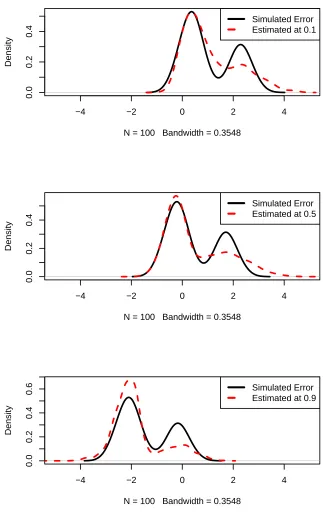
Figure 2.5 Errors comparison of Proposed method at quantiles: 0.1, 0.5, 0.9 . 46 Figure 2.6 Errors in Scenario (c) . . . 49
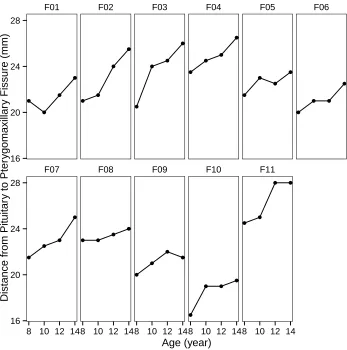
Figure 2.7 Plots of Distance against Age for each female . . . 50
Figure 2.8 Relationship between Distance and Age for each female in one plot 50 Figure 2.9 Regression quantiles for distance and 95% confidence intervals (shaded area). Least squares estimates (dashed lines) and 95% confidence intervals (dotted lines) are reported. . . 53
Figure 2.10 LQMM: Regression quantiles for distance and 95% confidence intervals (shaded area). Least squares estimates (dashed lines) and 95% confidence intervals (dotted lines) are reported. . . 53
Figure 2.11 Trace plot for each quantile level . . . 54
Figure 2.12 Error plot for each quantile level . . . 55
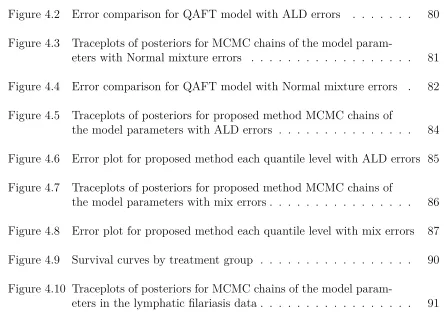
Figure 4.2 Error comparison for QAFT model with ALD errors . . . 80
Figure 4.3 Traceplots of posteriors for MCMC chains of the model
param-eters with Normal mixture errors . . . 81
Figure 4.4 Error comparison for QAFT model with Normal mixture errors . 82
Figure 4.5 Traceplots of posteriors for proposed method MCMC chains of
the model parameters with ALD errors . . . 84
Figure 4.6 Error plot for proposed method each quantile level with ALD errors 85
Figure 4.7 Traceplots of posteriors for proposed method MCMC chains of
the model parameters with mix errors . . . 86
Figure 4.8 Error plot for proposed method each quantile level with mix errors 87
Figure 4.9 Survival curves by treatment group . . . 90
Figure 4.10 Traceplots of posteriors for MCMC chains of the model
Introduction
Linear mixed models are frequently used to describe longitudinal and repeated
mea-surements data where random effects serve to model the between-individual
correla-tion structure. One of the basic model assumpcorrela-tions of mixed model is the normality
of the random effects, which is chosen mainly for computational convenience.
How-ever, the normality assumption is typically made for the sake of convenience, rather
than from some theoretical justification, and might be inappropriate in some
situa-tions. Another troublesome fact, as noted by [Burr and Doss, 2005], is that random
effects, unlike error terms, cannot be checked (there are no residuals). Thus we are
totally dependent on this uncheckable model assumption. It is of potential interest to
model the error nonparametrically while accounting for the correlation of observations
within the same subject. Extensive work have been done on a more flexible,
possi-bly nonparametric distribution for random effects in both frequentist and Bayesian
methods, such as Dirichlet Process (DP) prior to model random effects [Bush and
MacEachern, 1996, Kleinman and Ibrahim, 1998b].
Most linear mixed models also assume that random errors are normally distributed
with constant variances. However, in some applications, the covariates may have
dif-ferent impacts at difdif-ferent locations of the response distribution. For instance, in a
birth weight study, Abrevaya and Dahl [2008] found that gender of the baby and the
mother’s prenatal-care visits have different effects at the lower and upper quantiles of
the infant birth weight distribution. In such scenarios, modeling the mean is limiting
and thus cannot accommodate population heterogeneity. Quantile regression extends
outcome variable, by allowing the tail quantiles of the conditional distribution of the
response variable as functions of a set of covariates [Koenker and Bassett Jr, 1978].
By focusing on the conditional quantiles, quantile regression offers an alternative
an-alytic tool that can automatically capture the heterogeneity in covariate effects at
different quantiles of the response distribution without modeling the
heteroscedas-ticity. Quantile regression is free from the distributional assumptions and robust to
the presence of outliers and therefore quantile regression is appropriate with skewed
distributions.
The dissertation is organized as follows. We begin with an introduction of mixed
models, quantile regression and quantile regression for longitudinal data in chapter 1.
The use of asymmetric Laplace distribution (ALD) for the error distribution provides
a natural way to deal with the Bayesian quantile regression [Yu and Moyeed, 2001],
but lacks flexibility in error distribution. [Kottas and Krnjanić, 2009] proposed an
approach to inference for nonparametric quantile regression founded on probabilistic
modeling for the underlying unknown (random) distributions. The flexibility of such
inference under nonparametric prior models is attractive and can be incorporated
into mixed models for longitudinal data. Chapter 2 presents a Bayesian
semipara-metric approach to random effects model using Dirichlet process mixtures for the error
distribution. Two simulation results are presented and indicate that the presented
approach works well for practical situations. In chapter 3, we provide an overview
of interval-censored data and two common regression models, proportional hazard
model and accelerated failure time model, and discuss some existing approaches for
regression analysis of clustered interval-censored failure time data. We are interested
to explore a flexible quantile regression framework for analysing time-to-event data
that are randomly interval-censored in chapter 4. Quantile regression models the
conditional quantiles of the survival time directly and allows the covariates to have
cap-ture important population heterogeneity [Koenker, 2005]. We adopt an accelerated
failure time model with random effects to analyze clustered interval-censored data in
the nonparametric quantile regression framework. A nonparametric Dirichlet process
prior random effects component has been used to provide flexible distributional forms
to the random effects. In addition, a Bayesian quantile regression model for clustered
interval-censored data with parametric error distribution is also constructed for
com-parison. Lastly, chapter 5 provides some discussion and offer some recommendations
on how to proceed in this Bayesian nonparametric quantile regression with random
Chapter 1
Background of Quantile Regression for
Longitudinal Data
Inference of quantile analysis has received increasing attention in recent years.
Quan-tile regression seeks to model each quanQuan-tile of the response distribution, whether
separately or jointly, conditional upon covariates. It extends regression for the mean
to the analysis of the entire conditional distribution of the outcome variable.
Regres-sion quantiles are robust against the influence of outliers [Huber, 1981], and in many
regression examples, we might expect a different structural relationship for the higher
(or lower) responses than the average responses. In such applications, mean (or
me-dian) regression approaches would likely overlook important features that could be
uncovered by a more general quantile regression analysis.
The construction of infant and adolescent growth charts provides a motivating
application of applying quantile regression to longitudinal data [Wei et al., 2006].
It is of importance to construct reference growth charts that accurately represent
the conditional quantiles of the growth distribution without unduly constraining the
estimation process by unverifiable distributional assumptions.
1.1 Mixed Models with Heterogeneity in Random Effects
Longitudinal data are characterized by repeated measurements on the same subject
over time, as may be collected in clinical trials, panel research, epidemiological
where covariate effects are modeled parametrically and with-in subject correlations
are modeled using random effects [Laird and Ware, 1982]. Letyij denote the response
for ith subject and jth repeated measurements, the random effects model for yij is
given by
yij =Xijβ+Zijbi+ij, i= 1, . . . , n, j= 1, . . . , ni, (1.1)
where the subscript i would index individual subjects, and the subscript j would
index the ni distinct measurements made on the ith subject. yij is the outcome
for the jth measure on the ith subject, Xij is a 1× p vector of fixed covariates;
β is a p×1 parameter vector of regression coefficients, β = (β1, . . . , βp)T, referred
to as fixed effects in the models; Zij is typically a subset of Xij, 1× q vector of
covariates for the q ×1 vector of random effects bi with q ≤ p, bi = (bi1, . . . , biq)T
is assumed to be normally distributed as Nq(0,D). Here D is a q ×q
positive-definite covariance matrix. ij is usually assumed to be independent and normally
distributed as Nni(0, σ2I). The random effects component Zijbi can be considered
as the deviation from the population mean Xijβ. bi is a vector of individual specific
regression coefficients, which is assumed to be independently distributed from the
error terms i. Marginalizing the random effects bi, we have
yij|β, D, σ2 ∼N(Xijβ, ZijDZijT +σ2I) (1.2)
Inference for regression parameters can be done by generalized least squares,
maxi-mum likelihood methods or empirical Bayesian method.
The dominant paradigm in the random effects literature has been a Gaussian
structure in which covariates exert a pure location shift effect on the response
vari-able. McCulloch and Neuhaus [2011] argued that misspecifying the shape of a random
effects distribution does not matter as long as the assumed distributions are not quite
far from non-normality, not as extreme as a two-point, discrete distribution,
of heterogeneity associated with the covariates under less stringent distributional
as-sumptions, while still accounting for individual specific effects. Frequentist inference
regarding fixed effects should not be much affected asymptotically by changing the
distribution of the random effects since the first two moments of the marginal
distri-bution of the response variable do not depend on the normality of the distridistri-bution
of the random effects. In equation 1.2, the individual regression coefficients simply
result in a complex covariance structure. On the other hand, bayesian inference for
fixed effects will depend on (y, σ2, D), and this dependence will be sensitive to the
distributional form ascribed to the bi [Kleinman and Ibrahim, 1998b]. Verbeke and
Lesaffre [1996] shows that random effects may be badly estimated under normal error
while the true error distribution is not normally distributed, and the current methods
for inspecting the appropriateness of the model assumptions are not sound. A more
flexible and robust approach to solve the Gaussian restricted random effect
distribu-tion problem is to use a nonparametric distribudistribu-tion, such as Dirichlet process which
will be discussed in section 1.3.1. Such model has the potential to capture more types
of variability in those effects with the possible end result of more precise estimates of
the fixed effects.
1.2 Quantile Regression
Quantile regression has been used as an attractive analytic technique to examine
many situations including risk management, portfolio optimization and asset pricing
in econometrics. The use of quantile regressions is versatile with many advantages.
It allows us to study the impact of predictors on different quantiles of the response
distribution, and thus provides a complete picture of the relationship between the
re-sponse variable and the predictors. The entire conditional distribution of the
depen-dent variable can be characterised by using different values of τ. Median regression
heteroscedasticity. Quantiles are invariant to monotonic transformations and are not
sensitive to outlier observations on the dependent variable. Finally, when the error
term is non-normal, quantile regression estimators may be more efficient than least
squares estimators since estimation and inference are distribution-free.
Basics of Quantile Regression
By extending the standard additive regression formulation, theτth quantile regression
model for (continuous) response observationsyi, with associated covariate vectorsxi,
i= 1, . . . , n, can be written as
yi =h(xi) +i (1.3)
where the i is the error term whose distribution (with density fτ(·)) is restricted to
guarantee the τth quantile of i is zero, that is R−∞0 fτ(i)di = τ. The linear model
for the τth quantile is
yi =xTi βτ +i (1.4)
where the τth quantile of i is zero. Koenker and Bassett Jr [1978] specify the τ-th
conditional quantile function as
Qτ(yi|β,xi) =xTi βτ, i= 1, ..., n
where τ ∈ (0,1), yi is a scalar response variable with conditional cumulative
distri-butionFy,Qyi(·)≡Fyi−1(·),βτ ∈Rp is a column vector of unknown fixed parameters
with lengthp. One can trace the entire conditional distribution of the dependent
vari-able, conditional on the set of predictors, by increasing τ from 0 to 1. Conditional
quantile model specifies a different model for each quantile of the outcome
distribu-tion. Interpretation of βτ is straightforward: the intercept term simply represents
the baseline predicted quantile, while each slope can be interpreted as the rate of
change of theτth response quantile per unit change in the value of the corresponding
conditional distributions and makes no distributional assumption about the error
term in the model. However, there is no probability model for the response
distribu-tion in classical quantile regression, point estimadistribu-tion for ˆβτ proceeds by solving an
optimization problem of the loss function
argminβ∈Rτ n X
i=1
ρτ(yi−xTi β) (1.5)
where ρτ(υ) = υ(τ −I(υ ≤ 0)) is the quantile loss function; see [Koenker and
Bas-sett Jr, 1978]. I(·) is an indicator function such that I(υ ≤ 0) = 1 if υ ≤ 0 and
I(υ ≤0) = 0, otherwise.
Asymmetric Laplace distribution provides a natural link between minimization of
the quantile loss function and maximum likelihood theory by assuming the error term
in equation (1.4) follows ALD. See [Koenker and Machado, 1999, Yu and Moyeed,
2001, Yu and Zhang, 2005] for more details. A random variableY follows an ALD if
its corresponding probability density is
f(y|µ, σ, τ) = τ(1−τ)
σ exp
−ρτ(
y−µ
σ )
(1.6)
where ρτ(·) is the loss function, σ >0 is the scale parameter and−∞< µ < +∞ is
the location parameter.
Assume yi ∼ ALD(µi, σ, τ), µi = xTiβτ. The likelihood for N independent
obser-vations is
L(β, σ,y, τ) = "
τ(1−τ)
σ
#N exp
(
−
N X
i=1
ρτ(
yi−xTi βτ
σ )
)
(1.7)
Consideringσ a nuisance parameter, the maximization of the likelihood in (1.7) with
respect to the parameter βτ is equivalent to the minimization of the loss function
in (1.5). The relationship between the loss function and ALD can be used to
refor-mulate the quantile regression method in the likelihood framework. By utilizing this
property, [Koenker and Machado, 1999] proposed a likelihood-based goodness-of-fit
inference about the quantile regression by using asymmetric Laplace distribution to
form likelihood function, and Yu et al. [2003] studied the Bayesian estimation
proce-dure for the Tobit quantile regression model with censored data. Geraci and Bottai
[2007] and Yuan and Yin [2010] extend the asymmetric Laplace distribution idea for
longitudinal studies, which will be explained in the next section.
An Example
An example of the low birth weight study that was carried out by Koenker [2005]
will be used in this section. The data set used for this example is a subset of 50,000
observations. We are interested in investigating the relationship between infants?birth
weight (LBW: in grams) and only four predictors of interest, such as: the gender of
the infant, marital status of the mother, prenatal care, and smoking status of the
mother during pregnancy. The linear regression model for this example is:
LBW =α+β1× Gender +β2× Married +β3× Prenatal care +β4× Smoke
Linear regression is used to model the relationship between a set of predictor variable
and a response variable. It estimates the mean value of the response variable for
given levels of the predictor variables. The least square result and quantile regression
results are summarized in Table 1.1.
In each plot of Figure 1.1, the regression coefficient at a given quantile indicates
the effect on birth weight of a unit change in that variable, assuming that the other
variables are fixed, with 95% confidence interval bands.
The intercept can be interpreted as the estimated conditional quantile function of
the birth weight distribution of a girl born to an unmarried mother who didn’t smoke,
and had her first prenatal visit in the first trimester of the pregnancy [Koenker, 2005].
Table 1.1 Coefficients estimates for quantile regression and linear regression for the birth weight example
Quantile regression
Characteristic Linear regression 5th 10th 50th 90th 95th
Intercept 3224 2353 2608 3252 3856 4031
Married 161.1 227 171 149 141 165
Boy 115.9 28 84 121 142 142
Prenatal Care -227.0 -536 -418 -164 -111 -57
Smoke -200.9 -255 -226 -190 -177 -199
unmarried mother who didn’t smoke, and had her first prenatal visit in the first
trimester of the pregnancy.
According to the linear regression model,the mean weight of boys are 115.9 grams
The SAS System 13:04 Wednesday, June 17, 2015 9
The QUANTREG Procedure
With 95% Confidence Limits
Estimated Parameter by Quantile Level for weight
-600 -400 -200 0 P re na ta l_ ca re 0 50 100 150 bo y 0 50 100 150 200 250 m ar rie d 0 1000 2000 3000 4000 In te rc ep t
0.0 0.2 0.4 0.6 0.8 1.0
Quantile Level
0.0 0.2 0.4 0.6 0.8 1.0
Quantile Level
heavier than girls. But the disparity is much smaller than 100 grams in the lower tail
and larger than 120 grams in the upper tail of the distribution. The marital status
of the mother seems to be associated with a rather large positive effect on birth
weight, especially in the lower tail of the distribution. The mean weight of babies
born to mothers with no prenatal care is −227 grams lower than that of babies born
to mothers who had a prenatal visit in the first trimester. The quantile regression
results indicate that the effect of no prenatal care has a larger negative impact on
the lower quantiles of birth weight. The 5-th quantile of birth weight for infants
born to mothers who had no prenatal care is 536 grams lower than for infants born
to mothers had a prenatal visit in the first trimester. The linear regression model
underestimates this effect at the 5-th quantile. The deleterious effect of smoking is
The SAS System 13:04 Wednesday, June 17, 2015 10
The QUANTREG Procedure
With 95% Confidence Limits
Estimated Parameter by Quantile Level for weight
-300 -250 -200 -150 -100 -50 0
sm
ok
e
0.0 0.2 0.4 0.6 0.8 1.0
Quantile Level
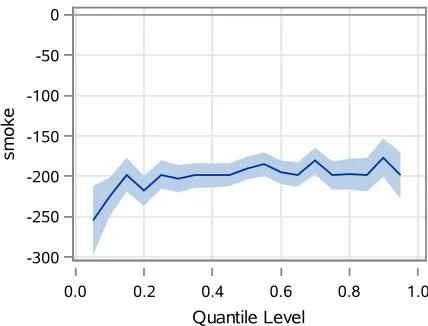
Figure 1.2 Estimated parameter smoking by quantile level
shown in Figure 1.2. Smoking during the pregnancy is associated with a decrease of
about 160−180 grams in birth weight. The effect of smoking is quite stable over the
entire distribution, as the least-squares estimates of the mother smoking effect are
1.3 Quantile Regression for Longitudinal Data
Koenker [2004] first considered the penalized interpretation of the classical random
effects estimator in order to estimate quantile functions with subject specific fixed
effects. For a conditional quantile regression model with a random intercept, a `1
penalty is employed to shrink the random effects towards a common value. Koenker
[2004] propose to estimate αi and βτk at multiple quantile levels τk, k = 1, . . . , q by
minimizing the following penalized objective function:
q X
k=1 n X
i=1 ni X
j=1
wkρτk(yij−αi−XijTβτk) +λ n X
i=1
|αi|,
wherewk is the weight on the quantile level τk and λ is the regularization parameter
that controls the variation of αi and helps shrink bi towards a common value. As in
most regularization problems, the choice of the penalty parameter λ is crucial. For
λ→0 we obtain the fixed effect estimator by solving minα,βPqk=1
Pn
i=1 Pni
j=1wkρτk(yij−
αi−XijTβτk); while for λ→ ∞ the ˆαi →0 for all i= 1, . . . , nand we obtain an
esti-mate of the model with only the fixed effects.
As mentioned in previous section, Geraci and Bottai [2007] and Yuan and Yin
[2010] extend the asymmetric Laplace distribution idea in Yu and Moyeed [2001] for
quantile regression with independent data to clustered data, where the conditional
distribution of the response is assumed to follow an asymmetric Laplace distribution
with the mean depending on the covariates and the skewness parameter depending on
the quantile level of interest. The conditional quantile regression model includes
sub-ject specific random intercepts to account for within−subject dependence in
longitu-dinal studies. But a model with random intercepts only cannot obviously account for
between−clusters heterogeneity associated with given explanatory variables. Geraci
and Bottai [2014] propose a class of models, called linear quantile mixed models
(LQMMs), which include both random intercepts and random slopes.
j = 1, . . . , ni, i= 1, . . . , N, whereyij is the jth measurement on the ith subject. For
a given τ ∈ (0,1) ,a conditional quantile mixed model for continuous response yij is
defined by
Qyij|bi(τ|xij,bi) =x T
ijβ+z
T
ijbi (1.8)
where zij denotes a q×1 subset of covariates xij, bi is a q×1 vector of random
effects. Qyij|bi(·) is the inverse of the cumulative distribution function of the response
conditional on a location-shift random effect bi. The expression 1.8 is equivalent to
yij =xTijβ+z T
ijbi +ij (1.9)
with Qij(τ|xij,bi) = 0. The error term ij are assumed to be independently
dis-tributed as ALD and the random effect bi are also independent and follow a
multi-variate distribution. Usuallybiandij are independent of each other. The conditional
density function can be written as
f(yij|β,bi, σ) =
τ(1−τ)
σ exp
−ρτ(
yij −µij
σ )
,
where µij = xTijβ +zTijbi is the linear predictor of the τth quantile. The random
structure above allows to account for between-individual heterogeneity associated
with given explanatory variables. A recent review of linear quantile regression
mod-els for longitudinal observations is provided by Marino and Farcomeni [2015]. The
majority of the econometrics literature that studies quantile regression models for
panel data with fixed effects propose inference procedures based on the assumption
that the number of periods goes to infinity when the sample size goes to infinity. This
assumption allows to estimate unobservable fixed effects. Canay [2011] introduces a
two-step estimator for panel data quantile regression models which gets rid of the
fixed effects under the assumption that these effects are location shifters. Lamarche
[2010] elaborates the asymptotic theory of penalized quantile regression estimators
tuning parameter. Galvao [2011] studies a quantile regression dynamic panel model
with fixed effects.
Jang and Wang [2015] approximate the central density by linearly interpolating
the conditional quantile functions of the response at multiple quantiles and estimate
the tail densities by adopting extreme value theory. Through joint-quantile
model-ing, their method can yield the joint posterior distribution of quantile coefficients at
multiple quantiles and meanwhile avoid the quantile crossing issue.
1.4 Bayesian Nonparametric Modeling for Quantile Regression
Recently Bayesian nonparametric methods have been studied and developed
exten-sively, Müller and Quintana [2004] provide an overview of the respective
methodolo-gies. By modeling the response distribution and the regression function
nonpara-metrically, Bayesian nonparametric modeling provides a flexible framework for the
general regression problem. Instead of defining priors as probability distributions for
parameters in parametric Bayesian analysis, nonparametric Bayesian’s prior beliefs
are expressed as random probability measures assigned directly to the set of
proba-bility distributions. Dirichlet process (DP), which can be understood as an infinite
dimensional probability distribution over probability distributions, was originally
for-malized by Ferguson [1973] and Antoniak [1974]. And Dirichlet process mixtures are
used to model the joint distribution of response and covariates, from which full
infer-ence is obtained for the desired conditional distribution for response given covariates.
Many papers have been devoted to developing the practicality of using DP priors
[Escobar and West, 1995, MacEachern and Müller, 1998, Neal, 2000].
Yu and Moyeed [2001] propose a Bayesian approach by noting that minimizing
equation (1.5) is equivalent to maximizing a likelihood function under the asymmetric
Laplace error distribution. However, it has limitations regarding modeling skewness
level. Nonparametric error distributions based on Dirichlet process mixture models
will be discussed later in this section.
Dirichlet Process Mixture Models (DPMM)
Consider a model for joint distribution of the response,y, and the vector of covariates,
x, which in general comprises both continuous and categorical covariates. We use a
nonparametric mixture model for the joint density z= (y,x),
f(z;G) = Z
k(z;θ)dG(θ)
with a parametric kernel density k(z;θ) and a random mixing distribution G that
is modeled non-parametrically by using an infinite dimensional Bayesian model.
Fol-lowing Ferguson [1973], a distribution G on Φ follows a Dirichlet process DP(αG0)
if, given an finite measurable partition, A1, ..., Ak of Φ, the joint distribution of
(G(A1), ..., G(Ak)) is Dirichlet (αG0(A1), ..., αG0(Ak)), whereG(Ai) andαG0(Ai)
de-note the probability of setAi underGandG0, respectively. The base distributionG0
has a parametric form on Φ and E(G(A)) = G0(A). G0 acts as a prior distribution
for component parameters in the DPMM discussed later in this section. The
concen-tration or precision parameter α >0 controls the variance of the DP. As α increases,
a sampleGis more likely to be close to baseG0. A draw from the Dirichlet process is
a probability distribution. The most commonly used DP definition is its constructive
definition by Sethuraman [1994], the stick-breaking construction, which
character-ized DP realizations as countable mixtures of point masses. A random distribution
G∼DP(α, G0), then the stick-breaking representation of Gis as the following
G=
∞ X
k=1
πkδθk,
where δθk is a point mass at θk. The locations of the point passes θk arise iid from
Beta(1, α) distribution
πk =βk k−1
Y
j=1
(1−βj)
This construction emphasizes that the samples from a DP are discrete with probability
one. The term stick-breaking comes from the interpretation of mixing proportionπk;
which is given by successively breaking a unit-length stick into infinitely many pieces.
Suppose in a hierarchical model, the data zi = (xi, yi : i = 1, . . . , n) are from a
parametric distributionf with latent mixing parametersθi, a DP prior can be placed
on the parameter distribution to ensure greater model flexibility and robustness.
The general Bayesian hierarchical model by linking DP to nonparametric Bayesian
modeling can then be written as:
zi|θi ind
∼ k(zi|θi), i= 1, . . . , n
θi iid
∼ G,
G ∼ DP(α, G0)
This is often called Dirichlet process mixture model (DPMM), that we use a DP prior
on the parameter and then complete the model by introducing a likelihood.
Accord-ing to the discreteness property of the DP and its stick-breakAccord-ing representation, this
model implieszi ∼P∞k=1πkk(zi|θk), whereθkare infinite samples fromG0. Under this
formulation, the DPMM is interpreted as a flexible mixture model in which the
num-ber of components is infinite. The assumption of exchangeability [De Finetti, 1935]
makes sure that the joint distribution is invariant to the order in which observations
are assigned to clusters. Given the heterogeneity in random effects, we are also
par-ticularly interested in classifying individuals in clusters, a nonparametric Dirichlet
Subgroup Identification through Dirichlet Process
There are two schemes in clustering: one produces a hierarchical sequence of
par-titions, and the other allocates observations into proposed clusters. The latter are
based on the concept that the observations come from a heterogeneous population
consisting of several clusters. Each cluster can be modeled by a distinct
paramet-ric distribution and a mixture of these clusters, a finite mixture model, is used to
model the heterogeneity of the overall population. More explicitly, given
observa-tions y = {y1, ..., yn}, assume that there are K clusters differentiated by θk, which
can be either a scaler or a vector. Let f(·|θk) be the density of cluster k; the finite
mixture model is of the form
f(x|θ) = K X
k=1
πkf(x|θk)
withπk≥0, fork= 1, ..., K, andPKk=1πk= 1. The probabilityπkalso represents the
prior probability that an observation comes from each clusterk. One of the challenges
of using finite mixture model in clustering analysis is in determining the number of
clusters K.
The number of clusters is automatically learnt from data through DP mixture
models. DP mixtures models became popular in recent years because of the
develop-ment of simple and efficient MCMC algorithms for posterior computation
[MacEach-ern, 1994, Escobar and West, 1998, MacEachern and Müller, 1998]. It is a
generaliza-tion of mixture models to infinite components in a Bayesian framework. The P´olya
Urn scheme from Blackwell and MacQueen [1973], which most popular algorithms
rely on, integrates out the infinite dimensional G to obtain the conditional prior of
ϕi given ϕ(i) = (ϕ1, . . . , ϕi−1, ϕi+1, . . . , ϕn)0:
ϕi|ϕ(i) ∼
α
α+n−1G0+ 1
α+n−1 X
j6=i
δϕj,
ϕi equal to an element of ϕ(i) that is chosen by sampling from a discrete uniform
distribution.
The tendency of the DP to cluster subjects into groups have identical coefficients
is quite apparent from this structure. In particular, the n subjects are allocated to
K ≤ n distinct values, θ = (θ1, . . . , θK)0, with the induced prior on k stochastically
increasing withα and n [Antoniak, 1974]. Hence, although the expression is infinite,
we obtain a finite number of K clusters on integrating out the random weights and
random atoms. For this reason, DP methods are commonly used to allow uncertainty
in the number of mixture components and for clustering.
Flexible Error Distribution
Another focus in Bayesian nonparametric modeling is to find flexible error
distribu-tion. It is natural to extend a parametric class of distributions to a nonparametric
model through mixing. Kottas and Krnjanić [2009] develope two families of
nonpara-metric prior distributions based on Dirichlet process mixture models. The first model
is a general scale mixture of ALD to allow more flexible tail behavior but does not
affect the skewness of the kernel of the mixture. The second is a flexible scale mixture
of uniform densities which can capture the shape (skewness, tail behavior) of general
unimodal error densities fp(·), which is a representation of non-increasing densities
on the positive real line.
Specifically, a density fp(·) on positive real line (R+) is non-increasing if and
only if there exists a distribution function G on R+ such that f(t) ≡ f(t, G) =
R
θ−110,θ(t)dG(θ). This result can be employed to provide a mixture representation
for any unimodal density on the real line with pth quantile (mode) equal to zero,
R R
supported on R+, and
kp(;σ1, σ2) =
p σ1
1(−σ1,0)() +
1−p
σ2
1[0,σ2)() (1.10)
with 0 < p < 1, and σr > 0, r = 1,2. Assuming independent DP priors for G1 and
G2, we obtain the model for the error density R R kp(;σ1, σ2)dG1(σ1)dG2(σ2), Gr ∼
DP(αrGr0), r = 1,2. In the context of quantile regression, this model is sufficiently
flexible to capture general forms of skewness and tail behavior [Kottas and Krnjanić,
2009].
Instead of posing a parametric likelihood, Reich et al. [2010] propose to model
the likelihood nonparametrically by an infinite mixture of quantile-restricted
two-component Gaussian mixtures and to accommodate error heteroscedasticity by
speci-fying its form parametrically. They followed location-shift model with random subject
effects bi,
yij =xTijβ+bi+xTijγeij,
wherexT
ijγ >0 for allxij. They defined the random error distribution as the infinite
mixture
h(e|µ,σ2) =
∞ X
l=1
plf(e|µl,σ2l, ql),
whereplis the mixing proportion withP∞l=1pl = 1, and the base densityf(e|µl,σ2l, ql)
is the two component normal mixture
f(e|µl,σl2, ql) = qlφ(µ1l, σ12l) + (1−ql)φ(µ2l, σ22l)
where φ(µ, σ2) is the normal density with mean µ and variance σ2. The parameters
are chosen to ensureR0
−∞f(e|µl,σl2, ql)de=τ, that is, to make theτ-th quantile of e
to be zero.
Learning about the Precision Parameters
The precision parameter, α, of the Dirichlet process is extremely important for the
Whenα is large, thenGis a distribution with many support points and the
nonpara-metric model is ‘closer’ toG0, the baseline model. These features are to be borne in
mind when considering priors for α. Escobar and West [1998] discuss various effects
of the parameter α and then issues arising in learning about α within the MCMC
analysis in their book. They developed a Gibbs sampler wherein draws from the
conditional posterior distribution of α are computed by drawing successive samples
from relatively familiar distributions. In Escobar and West [1995]’s approach, prior
uncertainty in α is specified using a Gamma(a, b) distribution with fixed
hyperpa-rameters or a mixture of gamma distributions. In many cases the values of a and b
are simply varied over a range that is thought to be reasonable, Escobar and West
[1995] mentioned the possibility of using a Gamma(a, b) reference prior by letting
a →0, b→ 0. There are at two advantages of choosing a gamma prior, 1)the
distri-bution is proper so there is no need to prove posterior propriety. This is especially
important in models with many parameters where propriety may be difficult or
im-possible to prove; 2)the gamma prior leads to full conditional distributions that are
easy to sample. Gamma prior can sometimes be unstable, so a grid search should be
used to find a proper value forα.
Some researchers adopt an empirical Bayes approach wherein the maximum
like-lihood estimate (MLE) of α is computed and inferences about all other model
pa-rameters are made conditional on the MLE [Liu, 1996]. MLE of α is computed by
alternating between inference and estimation steps until convergence [Dorazio et al.,
2008]. The shortcomings are, 1) it fails to account for errors in estimating α; 2) the
empirical Bayes approach is computationally demanding, usually requiring repeated
applications of the Gibbs sampler or other Markov chain Monte Carlo algorithm; 3)
Chapter 2
A Bayesian Nonparametric Quantile Regression
for Repeated Measures with a Flexible Error
Distribution
In longitudinal studies, several repeated measurements or contaminated replicates are
often taken on the same subject with errors. Bayesian approach for the analysis of
repeated measures offers a flexible way of combining data with prior information and
inference can be always provided without the need for approximations using modern
computation methods. However, quantile regression is not equipped with a
paramet-ric likelihood, and therefore, Bayesian quantile regression for repeated measures is
challenging. As mentioned in 1.2.3, there exist several likelihood estimation methods
in parametric and semiparametric frameworks in literature. Approaches extended
from Yu and Moyeed [2001] are based on the asymmetric Laplace distribution for
the errors. Note that in ALD, the same parameter determines both skewness and
quantile level, hence limiting its flexibility in modeling skewness and tail behavior. In
this chapter, we propose a Bayesian nonparametric quantile regression for repeated
measures with error using a flexible distribution, which can capture the shape (e.g.,
skewness, tail behavior) of any unimodal error density. DP mixture models are fit
by marginalizing the random mixing distribution over its DP prior and using the
resulting Pólya urn representation for the latent mixing parameters in sampling from
the posterior.
and prior specification. Section 2.2 discusses the computational details and posterior
inference. Simulation studies to assess the performance of the proposed method are
presented in Section 2.3. An application to a data set from orthodontic clinic is
illustrated in Section 2.4. Finally, conclusions and discussion are presented in Section
2.5. The technical details are given in Appendix A.
2.1 Model Setup
Suppose we observe the data in the form (yij, Xij, Zij), i= 1, . . . , n;j = 1, . . . , ni. yij
is the jth observation of the continuous response variable on the ith subject, Xij is
thep×1 covariate vector for fixed effects, and the first covariate is one corresponding
to the intercept. For a given subject, the covariates in Xi, for instance, gender, are
assumed to remain constant across the repeated measurements. Zij is the q ×1
covariate vector for random effects. A linear mixed model has the form
yij =Xijβ+Zijbi+ij, i= 1, . . . , n;j = 1, . . . , ni, (2.1)
where β= (β1, . . . , βp)T is the unknown regression coefficient vector associated with
p model covariates, bi = (bi,1, . . . , bi,q)T are i.i.d. random effects vectors associated
with q model covariates.
To allow more flexibility in Model 2.1 we assume that the true density of the
regres-sion errors belongs to a non-parametric scale mixture of uniform densities.
Specifi-cally, A density fp(·) on positive real line (R+) is non-increasing if and only if there
exists a distribution function G on R+ such that f(t)≡f(t, G) = R
θ−110,θ(t)dG(θ).
The result on the real line with pth quantile (mode) equal to zero,
Z Z
kp(;σ1, σ2)dG1(σ1)dG2(σ2).
HereG1 and G2 are general mixing distributions, supported on R+, and
kp(;σ1, σ2) =
p σ1
1(−σ1,0)() +
1−p
σ2
with 0< p < 1, and σr >0, r = 1,2. With latent mixing parameters σ1i and σ2i for
each response, the model can be represented by
yi, yij|β,bi, σ1i, σ2i ind
∼ kp(yij−Xijβ−Zijbi;σ1i, σ2i), i= 1, . . . , n, j = 1, . . . , ni
The likelihood becomes
n Y
i=1 ni Y
j=1
p σ1i
1(−σ1i,0)(yij −Xijβ−Zijbi) +
1−p
σ2i
1[0,σ2i)(yij −Xijβ−Zijbi) (2.3)
2.2 Prior Specification
Independent normal priors are given to fixed effect β. σ1i, σ2i are assigned
indepen-dent DP priors.
σri|Gr iid
∼ Gr, r= 1,2, i= 1, . . . , n
Gr|αr, dr ∼ DP(αrGr0), r= 1,2,
bi|Gb ∼ Gb, i= 1, . . . , n
Gb|αb, G0b ∼ DP(αbG0b)
Various noninformative prior distributions for σ have been suggested in Bayesian
literature and software, including an improper uniform density onσri [Gelman, 2006],
proper distributions such asp(σ2
ri)∼inverse-gamma. Many Bayesians have preferred
the inverse-gamma prior family, possibly because its conditional conjugacy suggested
clean mathematical properties. However, by writing the hierarchical model in the
above form, we see conditional conjugacy in the wider class of half-t distributions on
σri , which include the uniform and half-Cauchy densities on σri (as well as
inverse-gamma on σ2
ri as special cases. From this perspective, the inverse-gamma family
has nothing special to offer, and we prefer to work on the scale of the standard
deviation parameterσri, which is typically directly interpretable in the original model.
[2006], the choice of “noninformative” prior distribution can have a big effect on
inferences, especially for problems where the number of clusters (repeated measures)
is small or the cluster-level variance is close to zero. For a finite but sufficiently large
A, inferences are not sensitive to the choice of A. Random effects bi are assigned
independent DP priors. A normal base measure with zero mean is specified to G0b.
An assumed DP prior with zero mean may still imply a non-zero mean for random
effect distribution, to ensure that E(yi) = Xiβ, the additional constraintE(bi =0)
is needed. DP precision parameters play an important role and the optimal values of
αr, r= 1,2, b are decided by the grid search.
2.3 Posterior Computation
Bayesian approach provides a flexible framework for representing the intricate nature
of the word and our knowledge of it, and the Monte Carlo methods provide a
corre-sponding flexible mechanism for inference within this framework. MCMC integration
methods, especially the Metropolis-Hastings algorithm and the Gibbs sampler have
emerged as extremely popular tools for the analysis of complex statistical models in a
short period of computers’ development. Properly defined and implemented, MCMC
methods enable users to successively sample values from values from a convergent
Markov chain, and reduce complex high-dimensional problems to a sequence of much
lower-dimensional ones. Details of MCMC methods can be found in [Geyer, 2011].
Markov Chain Sampling Methods for Dirichlet Process Mixture Models
Many different Markov chain Monte Carlo sampling techniques have been developed
for making posterior inferences from DP mixture models; Neal (2000) is a good
ref-erence. The posterior inference methods for DP mixture models we use in this study
is a combination of MCMC methods from Escobar and West [1995] and Neal [2000].
priors [Blackwell and MacQueen, 1973]. The discreteness of the DP priors [Blackwell
and MacQueen, 1973, Sethuraman, 1994] induces a clustering. We useθ= (θ1, ..., θn)
as illustrations. The most direct approach to sampling for DP mixture models is to
repeatedly draw values for each θi from its conditional distribution given both the
data and theθj forj 6=i(written asθ−i). This conditional distribution is obtained by
combining the likelihood for θi that results from yi having distribution F(θi), which
will be written as F(yi, θi) and since the observations are exchangeable, the prior
conditional on θ−i, which is
θi|θ−i ∼
α
α+n−1G0 + 1
α+n−1 X
j6=i
δ(θj)
When combined with the likelihood, this yields the following conditional distribution
for use in Gibbs sampling
θi|θ−i, yi ∼riHi+ X
j6=i
qi,jδ(θj)
Here, Hi is the posterior distribution for θ based on the prior G0 and the single
observation yi with likelihood F(yi, θ). The values of the qi,j and of ri are defined by
qi,j = bF(yi, θj)
ri = bα Z
F(yi, θ)dG0(θ)
where b is such that P
j6=iqi,j+ri = 1.
There are two main approaches for Dirichlet Process mixtures, MCMC and
vari-ational inference [Escobar and West, 1995, MacEachern and Müller, 1998, Blei and
Jordan, 2005]. Use of Dirichlet process mixture models has become computationally
feasible as the development of Markov chain methods for sampling from the posterior
distribution of the component distribution or of the associations of mixture
compo-nents with observations. In the Chinese restaurant prior, we can easily swap customer
i to the last customer to arrive by taking advantage of exchangeability, which yields
on Gibbs sampling can be easily implemented for models based on conjugate prior
distribution. Lavine and West [1992] use the Gibbs sampling approach to calculate
normal mixture models. Such iterative resampling method is applied to the mixture
model by introducing the classification variables which identify data points with
spe-cific components. However, when non-conjugate priors are used, it is often difficult to
perform numerical integration in straightforward Gibbs sampling. Later, a Markov
chain method for sampling from the posterior distribution of a Dirichlet process
mix-ture model was presented, extended Gibbs sampling for the indicators specifying
which mixture component is associated with each observation by using a set of
aux-iliary parameters [MacEachern and Müller, 1998, Neal, 2000]. The method is simple
to implement and more efficient than previous ways of handling general Dirichlet
process mixture models with non-conjugate priors. Blei and Jordan [2005] presented
a variational inference algorithm, which is a class of deterministic algorithms that
convert inference problems into optimization problems.
Gibbs Samplig Algorithm with Auxiliary Parameter
MacEachern and Müller [1998] devised an approach to handle non-conjugate priors
that uses a mapping from a set of auxiliary parameter to parameters in use. Models
with non-conjugate priors can be handled by applying Gibbs sampling to a state
that has been extended by the addition of auxiliary parameters [Neal, 2000]. In
this approach, the auxiliary parameters are regarded as existing only temporarily;
this allows more flexibility in constructing algorithms. The permanent state of the
Markov chain will bex, but a variableywill be introduced temporarily and discarded
during Markov chain simulation. The implementation of our DP is performed using
a modified algorithm proposed in Neal [2000] (Algorithm 8), which is appropriate for
models with no closed form solutions and therefore applies Gibbs sampling with the
Let ci indicates the “latent class” associated with observation yi, with the
num-bering of the ci being of no significance. We can use this technique to update ci
for a Dirichlet process mixture model without having to integrate with respect G0.
The permanent state of the Markov chain consist of c = (c1, ..., cn) and φ = (φc :
c ∈ {c1, .., c2}). For each class, c, the parameters φc determine the distribution of
observations from that class; all such φc is denoted by φ When ci is updated, we
will introduce temporarily auxiliary parameters that represent potential values for θ
that are not associated with any other observations. We then update ci by Gibbs
sampling with respect to the distribution that includes these auxiliary parameters.
Figure 2.1 represents the conditional prior distribution for a new observation using
auxiliary parameters. In this setup, the number of auxiliary parametersm = 3. The
component for the new observation is chosen from among the four components
as-sociated with other observations plus three possible new components (m = 3), with
parameters,φ5, φ6, φ7, drawn independently fromG0. The probabilities used for this
choice are shown at the top. The probability of ci being equal to a c in {1, . . . , k−}
will ben−i,c/(n−1 +α), wheren−i,c is the number of timescoccurs among thecj for
j 6=i. The probability of ci having some other value will be α/(n−1 +α), which is
split equally amongm= 3 components introduced. The dashed arrows illustrate the
possibilities of choosing an existing component, or a new component that uses one of
the auxiliary parameters in the figure.
To perform a Gibbs sampling update forci in this representation of the posterior
distribution, ci must be either one of the components associated with other
obser-vations or one of the auxiliary components that were introduced, we can easily do
Gibbs sampling by evaluating the relative probabilities of these possibilities. Once a
new value forci has been chosen, we discard all φ values that are not now associated
with an observation.
Figure 2.1 Using auxiliary parameters to represent conditional prior distribution for a new observation.
{c1, . . . , cn}). The algorithms can be summarized by repeated sampling as follows:
• For i = 1, . . . , n :, let k− be the number of distinct cj for j 6= i, and let
h = k− +m. Label these cj with values in {1, . . . , k−}. If ci = cj for some
j 6=i, draw values independently fromG0 for those φc for whichk− < c≤h. If
ci 6=cj for all j =6 i, letci have the label k−+ 1, and draw values independetnly
fromG0 for thoseG0 for thoseφc for whichk−+ 1< c ≤h. Draw a new value
for ci from {1, . . . , h} using the following probabilities:
P(ci =c|c−i, yi, φ1, . . . , φh) =
b n−i,c
n−1+αF(yi, φc) for 1≤c≤k
−,
bnα/m−1+αF(yi, φc) for k−≤c≤h
(2.4)
where n−i,c is the number of cj for j 6= i that are equal to c, and b is the
appropriate normalizing constant. Change the state to contain only those φc
that are now associated with one or more observation.
• For all c∈ {c1, . . . , cn}: Draw a new value from φc|yi such that ci =c by using
the Metropolis-Hastings algorithm toφc that leaves this distribution invariant.
The posterior distributions forσri and bi can be handled by applying Gibbs
sam-pling with auxilliary parameters described in this section. The likelihood of i-th
assume both β and bi are “known”. By placing a Uniform distribution to base
dis-tribution Gr0, the conditional distribution for σri is
p(σri|yi, Gr0) ∝
αr
αr+n−1
Unif(dr)F(yi, σri) +
1
αr+n−1 X
g6=i
δ(σrg)F(yi, σri)
For each bi, suppose a Multivariate normal hyperprior for base distribution G0b
is Np(0, D), the conditional distribution
p(bi|yi) ∝ prior(bi|D)L(yi|bi)
∝ Np(0, D)p(yi|β,bi, σ1i, σ2i)
∝ 1
(2π)1/2 |D|1/2exp −
1
2(bi−0) T
D−1(bi−0)
! × ni Y j=1 p σ1i
1(−σ1i,0)(yij−Xijβ−Zijbi) +
1−p
σ2i
1[0,σ2i)(yij −Xijβ−Zijbi)
Bayesian Computing for Other Parameters
Updating fixed effects β requires Metropolis-Hastings algorithms as full
condition-als distributions are not recognizable. Suppose the prior is a multivariate normal
distribution Np(0,Σ0), the conditional distribution of β is
p(β|yi) ∝ Np(0,Σ0) n Y
i=1
p(yi|β,bi, σ1i, σ2i)
∝ 1
(2π)1/2 |Σ 0 |1/2
exp − 1
2(β−0) TΣ−1
0 (β−0)
! × n Y i=1 ni Y j=1 p σ1i
1(−σ1i,0)(yij −Xijβ−Zijbi) +
1−p
σ2i
1[0,σ2i)(yij −Xijβ−Zijbi)
For the (t)-th iteration, update β by using the following Metropolis-Hastings
algo-rithm. Draw β∗ from the proposal distribution Np(βt−1, T0), and take
βt=
β∗ with probability min(r,1),
βt−1 with probability1-min(r,1),
(2.5)
where
r= p(β
∗|