A COMPARATIVE STUDY OF RURAL AND URBAN STUDENTS WITH CERTAIN VARIABLES (THINKING STYLE AND LEARNING OUTCOMES)
Ratan Kumar Das Assistant Professor in History
I.A.S.E., Kunjaban, Agartala, West Tripura, Tripura
ABSTRACT
The review analyzes the student's classroom participation and learning results in connection to
their learning styles. The present review is descriptive in nature which uses to look at the
learning styles in rural and urban students in West Tripura District. The review was exhibited in
government schools and tuition based schools as far as rural and urban territories. The review
utilizes the Styles of Learning and Thinking (SOLAT) by Venkataraman (1994) for gathering the
information in schools. The specimen comprises of 200 students for the present review was
drawn from one School in urban area and another in rural area. The examination uncovered
that there is a huge contrast in learning styles of rural and urban students in West Tripura
District. So the review is a vital component to getting and keeping students effectively included in
learning lies in understanding learning style inclinations, which can emphatically or contrarily
impact astudent's execution.
Keywords: Learning outcomes, classroom interaction, thinking style, classroom participation
1. INTRODUCTION
Participation in classroom plays an
extremely noteworthy and indispensable part
in achievement of congruous improvement
of youngster in varying backgrounds as far
as their thinking and learning styles.
Classroom participation all in all alludes to
the degree or level of progress or capability
achieved in some particular range,
concerning educational and scholastic work.
A vital component to getting and keeping
students effectively included in learning lies
in understanding learning style
inclinations,which can emphatically or
adversely impact anstudent's execution. A
adaptable in their utilization of style and
they attempt with differing degrees to adjust
to the expressive requests as indicated by
circumstance. This is on account of mind
assumes an adaptable part in achieving
assortment of errands. It is along these lines
imperative for the guardians and the
educators to comprehend the way of the
student's brain and itscapacities in various
styles of learning and insight [1].
Schools were built up to oblige the differing
needs of the students. Under the school idea,
learning is made additionally intriguing and
important, as it includes students' psyche,
soul and body comprehensively.
Accordingly require developed to discover
whether Private schools are powerful in
propelling the students and to build level of
innovativeness through the self-managed,
self-got to and self-coordinated learning
procedures that will show critical contrasts
in classroom participation [2].
2. RURAL–URBAN DISPARITIES
There is no all-around acknowledged
definition for a rural region in light of the
fact that distinctive nations have diverse
view of what "rural" means. Kashaa (2012)
essentially portrays rural regions as denied,
lacking such a large number of government
formative intercessions, for example,
consumable water, power, great streets, and
school foundation to enhance the lives of the
general population. Rural societies can exist
in urban territories yet contrasts exist
between rural zones and urban focuses on
the grounds that huge rural towns that are
not a long way from urban focuses regularly
have more in a similar manner as the urban
region than they do with remote and
secluded residential areas. Destitution in
Sub-Saharan Africa is moved in rural ranges
where 75% of the poor dwell. Albeit rural
regions can give family-arranged settings,
bring down wrongdoing rates, natural air,
and an improved personal satisfaction,
numerous instructors decline rural postings
because of worries about the nature of
lodging, classroom offices, social insurance,
school assets, and open doors for expert
advancement [3].
3. REVIEW OF LITERATURE
Examine in science instruction is
coordinated towards distinguishing
examples and issues related with substance
obtaining as identified with differential
levels of scholarly working among learners:
distinction in classroom participation of
students having a place with various
learning style bunches. Comes about
demonstrated that there were critical
contrasts in the accomplishment in different
subjects and aggregate range of study in
light of certain learning styles.
Stahl, S. (1999) [5], found a noteworthy contrast amongst concrete and unique
learners. The accomplishment scores were
huge higher for students having a solid
learning style than for students having a
conceptual learning style.
The discoveries of Venkataraman, D. (1994) [6], demonstrated, that the students educated by direction that coordinated their
favored learning style, had huge picks up in
classroom participation.
Kumar, R. (1996) [7], examined the part that student learning style plays in execution
in early on school Chemistry. He found that
connections existed between learning styles
and execution. Detecting thinking/learners
made the most elevated evaluations, and
detecting feeling learners made the least
grades.
As indicated by Verma, B. P, &Kumari, B. (1989) [8], in adjusting students' learning
styles to teacher showing styles reasoned
that no noteworthy contrasts were noted as
far as the connection of showing style and
learning style on student accomplishment.
Verma, B. P. (1985) [9], analyzed the learning styles of youths from various
countries by age, sexual orientation,
classroom participation level and
nationality. The examination explored the
learning style qualities of 1,637 young
people from five nations Bermuda, Brunei,
Hungary, Sweden and New Zealand. It
investigated their similitude’s and contrasts
by age, sexual orientation, classroom
participation and nationality and it
additionally investigated their intuitive
relations among these four components and
teenagers learning style inclinations.
Discoveries uncovered that 15 out of the 22
learning style components fundamentally
separated among the skilled, high/normal
and low accomplishing students.
In the light of these investigates, it can be
reasoned that learning styles is an imperative
element for classroom participation. A
significant part of the wastage in classroom
participation could be captured if the
guidelines and learning styles are
4. STATEMENT OF PROBLEM
The issue of the review is: which
instructional mode would upgrade the
learning results of rural students with the
assistance of their more classroom
participation. Information is the
incorporated source taking perception of
their thinking and learning styles? As it
were, this review researches the examination
amongst rural and urban students as far as
their classroom participation collaboration
with the assistance of better learning and
thinking styles.
5. OBJECTIVES
1. To study and compare the learning
and thinking styles of rural and urban
students.
2. To study and compare the classroom
participation of rural and urban
students.
3. To compare learning and thinking
styles of rural boys and girls.
4. To compare learning and thinking
styles of urban boys and girls.
5. To compare classroom participation
of urban boys and girls.
6. To compare classroom participation
of urban boys and girls.
6. HYPOTHESES:
1. There will be no significant
difference in learning and thinking
styles of rural and urban students.
2. There will be no significant
difference in learning and thinking
styles of rural and urban boys and
girls.
3. There will be no significant
difference in classroom participation
of rural and urban students.
4. There will be no significant
difference in classroom participation
of rural and urban boys and girls.
5. There will be no significant difference in classroom participation
of rural students and urban students
in relation to learning and thinking
styles.
7. DESIGN OF THE STUDY
In the present review, descriptive study
strategy was utilized to look at learning
styles and thinking style of rural and urban
Population and Sample
The objective populace for this review was
class IV students examining in schools in
rural and urban areas. The examples were
drawn from one nearby schools in rural and
urban area in West Tripura District. The six
schools utilized were haphazardly chosen
through balloting. All schools utilized were
blended schools [10].
Instrumentation
The instrument used for the study wasthe
Styles of Learning and Thinking (SOLAT)
by Venkataraman (1994) [11].
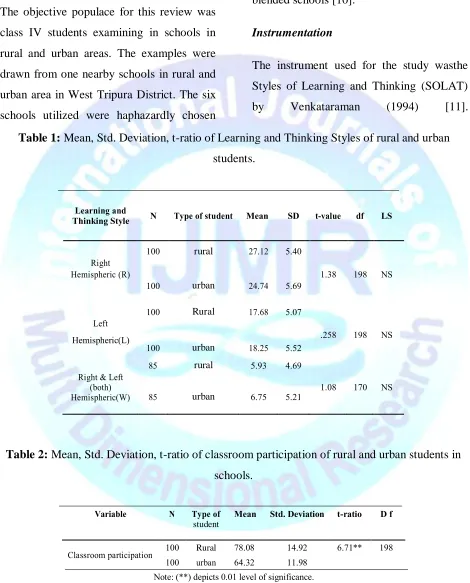
Table 1: Mean, Std. Deviation, t-ratio of Learning and Thinking Styles of rural and urban students.
Learning and N Type of student Mean SD t-value df LS
Thinking Style
Right
100 rural 27.12 5.40
Hemispheric (R) 1.38 198 NS
100 urban 24.74 5.69
Left
100 Rural 17.68 5.07
.258 198 NS
Hemispheric(L)
100 urban 18.25 5.52
Right & Left
85 rural 5.93 4.69
(both)
85 urban 6.75 5.21 1.08 170 NS
Hemispheric(W)
Table 2: Mean, Std. Deviation, t-ratio of classroom participation of rural and urban students in schools.
Variable N Type of Mean Std. Deviation t-ratio D f
student
Classroom participation 100 Rural 78.08 14.92 6.71** 198
100 urban 64.32 11.98
8. RESULTS AND DISCUSSIONS
Insignificant t-value was found between
students. Furthermore, Private schools
students with respect to their learning and
thinking styles. This plainly shows there is
no huge contrast in learning and thinking
styles of optional schools students in rural
and urban areas. It is clear that adolescents
learn and think similarly independent of sort
of rural and urban students [12].
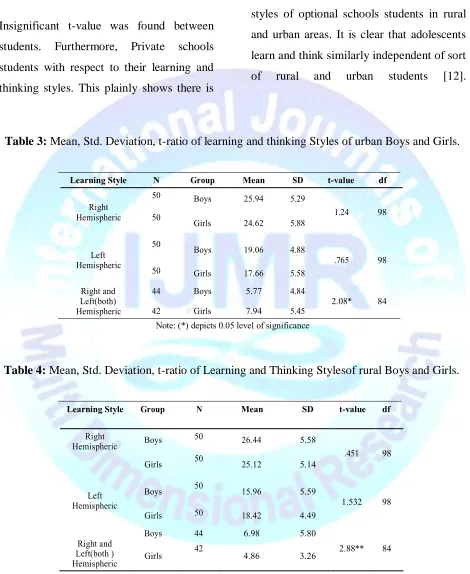
Table 3: Mean, Std. Deviation, t-ratio of learning and thinking Styles of urban Boys and Girls.
Learning Style N Group Mean SD t-value df
50 Boys 25.94 5.29
Right 1.24 98
Hemispheric 50
Girls 24.62 5.88
50
Boys 19.06 4.88
Left .765 98
Hemispheric 50
Girls 17.66 5.58
Right and 44 Boys 5.77 4.84
Left(both)
42 Girls 7.94 5.45 2.08* 84
Hemispheric
Note: (*) depicts 0.05 level of significance
Table 4: Mean, Std. Deviation, t-ratio of Learning and Thinking Stylesof rural Boys and Girls.
Learning Style Group N Mean SD t-value df
Right Boys 50 26.44 5.58
Hemispheric
.451 98
50
Girls 25.12 5.14
Boys 50 15.96 5.59
Left
1.532 98
Hemispheric
Girls 50 18.42 4.49
Boys 44 6.98 5.80
Right and 42 2.88** 84
Left(both ) Girls 4.86 3.26
Hemispheric
Note :(**) depicts 0.01 level of significance.
Variable Gender N Mean Std. Deviation t-ratio df LS
Academic Boys 50 75.28 14.89 1.77 98 NS
Achievement Girls 50 78.98 14.82
Note: LS-level of significance, df- degree of freedom
The learning and thinking styles of rural
males and females likewise contrast if there
should be an occurrence of both right and
left (W) hemispheric learning and thinking
styles, t-value (t=2.88).The reason might be
that lone couple of students incline toward
both right and left (W) learning and thinking
styles and by and large right and left
hemispheric learning and thinking styles is
favored.
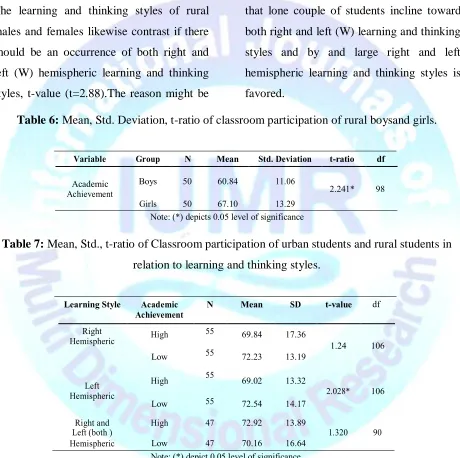
Table 6: Mean, Std. Deviation, t-ratio of classroom participation of rural boysand girls.
Variable Group N Mean Std. Deviation t-ratio df
Academic Boys 50 60.84 11.06 2.241* 98
Achievement
Girls 50 67.10 13.29
Note: (*) depicts 0.05 level of significance
Table 7: Mean, Std., t-ratio of Classroom participation of urban students and rural students in relation to learning and thinking styles.
Learning Style Academic N Mean SD t-value df
Achievement
Right High 55 69.84 17.36
Hemispheric 1.24 106
55
Low 72.23 13.19
High 55 69.02 13.32
Left 2.028* 106
Hemispheric
Low 55 72.54 14.17
Right and High 47 72.92 13.89
1.320 90
Left (both )
Hemispheric Low 47 70.16 16.64
Note: (*) depict 0.05 level of significance.
The classroom participation of urbanmales
and females school does not vary altogether,
(t=1.77).This implies meet accentuation is
laid on the instruction of both urban
malesand urban females which is an
empowering finding and considers changing
The classroom participation of optional
school students with high and low learning
and thinking pen hemispheric (L) learning
and thinking styles just as left side of the
equator works in successive, sensible,
verbal, diagnostic, typical concurrent
creation and rationale working and advanced
operations which is the way to classroom
participation.
9. EDUCATIONAL IMPLICATIONS OF THE STUDY
No examination can be said to be finished in
itself particularly in behavioral science. The
present review has satisfactorily managed
scholarly accomplishment and
learning-thinking style. The discoveries of the review
are probably going to inclined of
significance to instructive optional school
students, instructor teachers and approach
producers who are worried with the circle of
training. One of the ramifications of the
present conclusion for instructor teachers
and strategy producers is that their
educational module, syllabi, reading
material, and technique for educating and so
on all ought to be demonstrated in such a
mold, to the point that they can use their
energies in the correct heading. It is
subsequently most imperative for student
accomplishment to end up noticeably an
impeccable educator.
Accomplishment is the level of learning and
fulfillment in a specific region of the subject
regarding information, comprehension,
abilities and applications. The primary
concentration of educative process is to
enhance the execution or learning of the
students. The learning results of the students
are measured with the assistance of their
accomplishment or execution. Execution
appraisal is the way toward measuring the
terminal practices of the students toward the
finish of direction. It is the occupation of the
educator to gauge whether the students have
obtained the part ideas, as on
accomplishment, before continuing with the
guideline which organizes these ideas in
appropriate relationship for the learning of
the standards. The accomplishment is the
final result of the direction generally verbal
execution.
10. CONCLUSION
To finish up it is basic to recognize the
styles of learning and thinking of
adolescents keeping in mind the end goal to
encourage the way toward learning and
educating. Since the attention is on kid
the tyke's encounters, voices, musings and
participation in learning. The showing
procedures in the schools can be attempted
in consonance with the students' style of
learning and thinking. Facilitate it would
empower the instructor to sort out the
educating and learning techniques such that
they tone up and actuate the side of the
equator elements of the cerebrum in
students.
11. SUGGESTIONS FOR FURTHER RESEARCH WORK
1. The present review has been led on
optional school students; it can be
recreated on other review levels.
2. The specimen for the present review
was 200 students because of time
requirements.
3. It would be helpful if the review is
led on bigger example.
4. Two Govt. what's more, two Private
Schools were taken for information
gathering in the present review, in
future a vast example ought to be
considered for information
accumulation.
5. The review has been directed on
urban populace as it were. It is
productive to recreate think about on
rural populace too.
6. The present review has been led on
auxiliary school students of West
Tripura District just; it might be done
in different states too.
REFERENCES
1. Akuezuilo, E. O. (1989). An experimental study of teaching behaviours and students’ achievement in science: Journal of Science Teachers Association of Nigeria 26 (1).
2. Arisi, R. O. (2002). Effects of teaching methods on the learning process amongst social studies students with varying learning characteristics. (Unpublished Ph.D. Thesis. Delta State University, Abraka).
3. Ausubel, D. P. and Robinson, F. G. (1969). School learning: An introduction to educational psychology. New York, Holt, Rinehart and Winston
4. Spoon, J.C. and Schell, J.W. (1995). Aligning student learning and thinking styles with instructor teaching styles. Journal of Industrial Teacher Education, 35(2), 41- 56. 5. Stahl, S. (1999).Different strokes for
different folks? A critique of learning and thinking styles. American Educator, 23(2), 27-31. 6. Venkataraman, D. (1994). Styles of
7. Verma, B. P, & Kumar, R. (1996). Study involvement and learning styles of women students as related toresidential background, academic streams and type of institutions. Indian Educational Revi ew , 31 (2)99-111.
8. Verma, B. P, &Kumari, B. (1989). Learning style preferences of senior secondary students in relation to their sex. Journal of Education and Psychology, 46 (3 & 4) 85-89
9. Verma, B. P. (1985). Do different types of schools make differences in learning style preferences? Journal of Education and Psychology, 49 (3 & 4) 34-39
10.Verma, B.P. (1992). Relationship between rural-urban residential background and learning style preferences. Journal of education and Psychology, 49 (3 & 4) 67-73
11.Verma, B.P. and Sharma, J. P. (1987) Relationship between Learning Styles and Classroom participationofHigh School Girls. Journal of Educational Research and Extension, 24 (2), 90-98
12.Verma, B.P. and Sharma, J.P. (1987). A study of classroom participation in relation to learning styles of adolescents. Journal of the Institute of Educational Research, H.P. University, Shimla.
13.Xiang, J.C. (1994). The relationship of students having learning styles, computer attitudes and learning and